Architecture overview
This overview covers MCP scope, core concepts, and how clients and servers exchange context.
Because MCP SDKs abstract many concerns, most developers find the data layer protocol (primitives and discovery) the most useful part. For implementation details, use your language-specific SDK.
Adapted from the official Architecture overview. Verify against the live docs and specification.
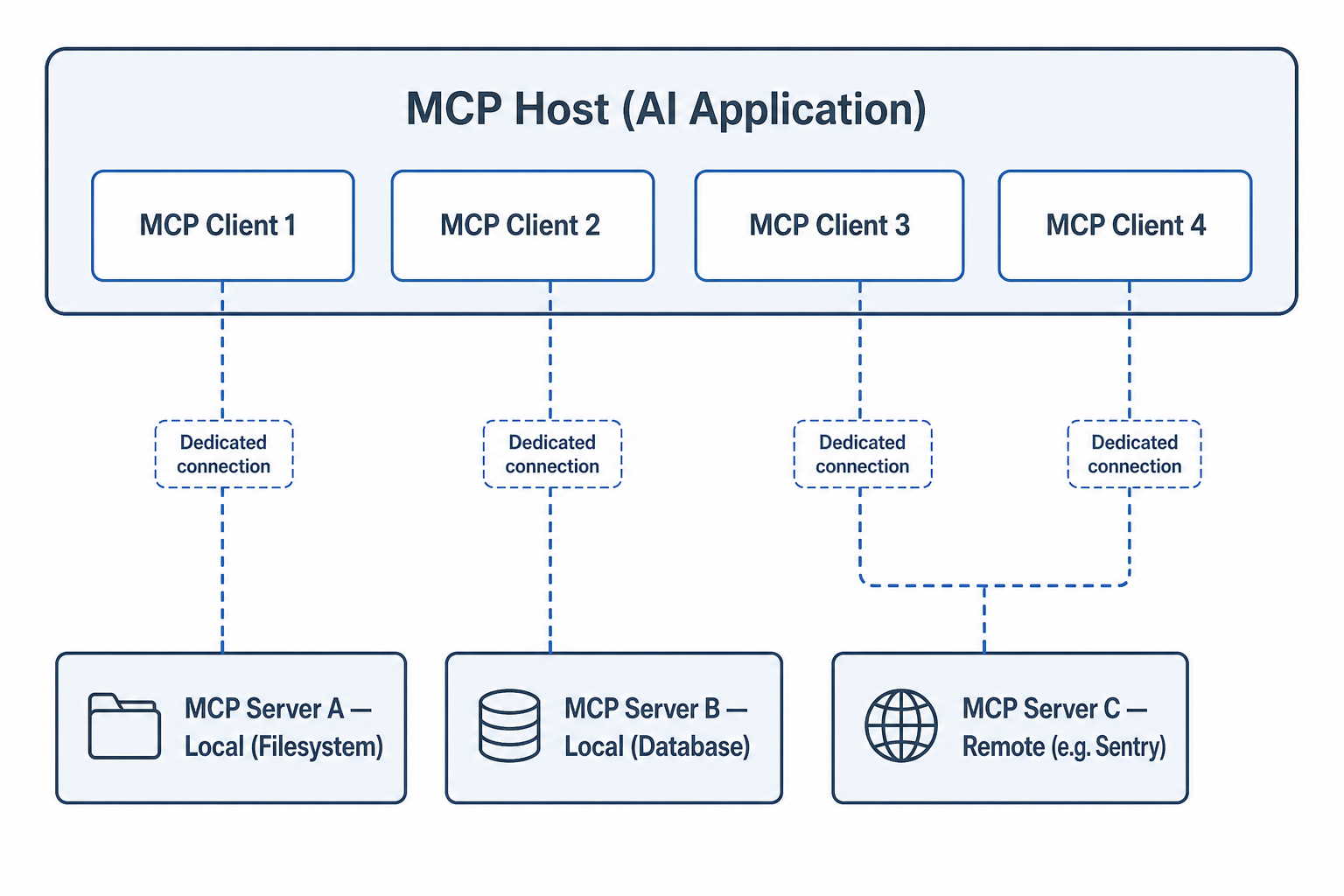
Host → clients → servers: one dedicated connection per client–server pair. Playbook diagram adapted from MCP architecture concepts.
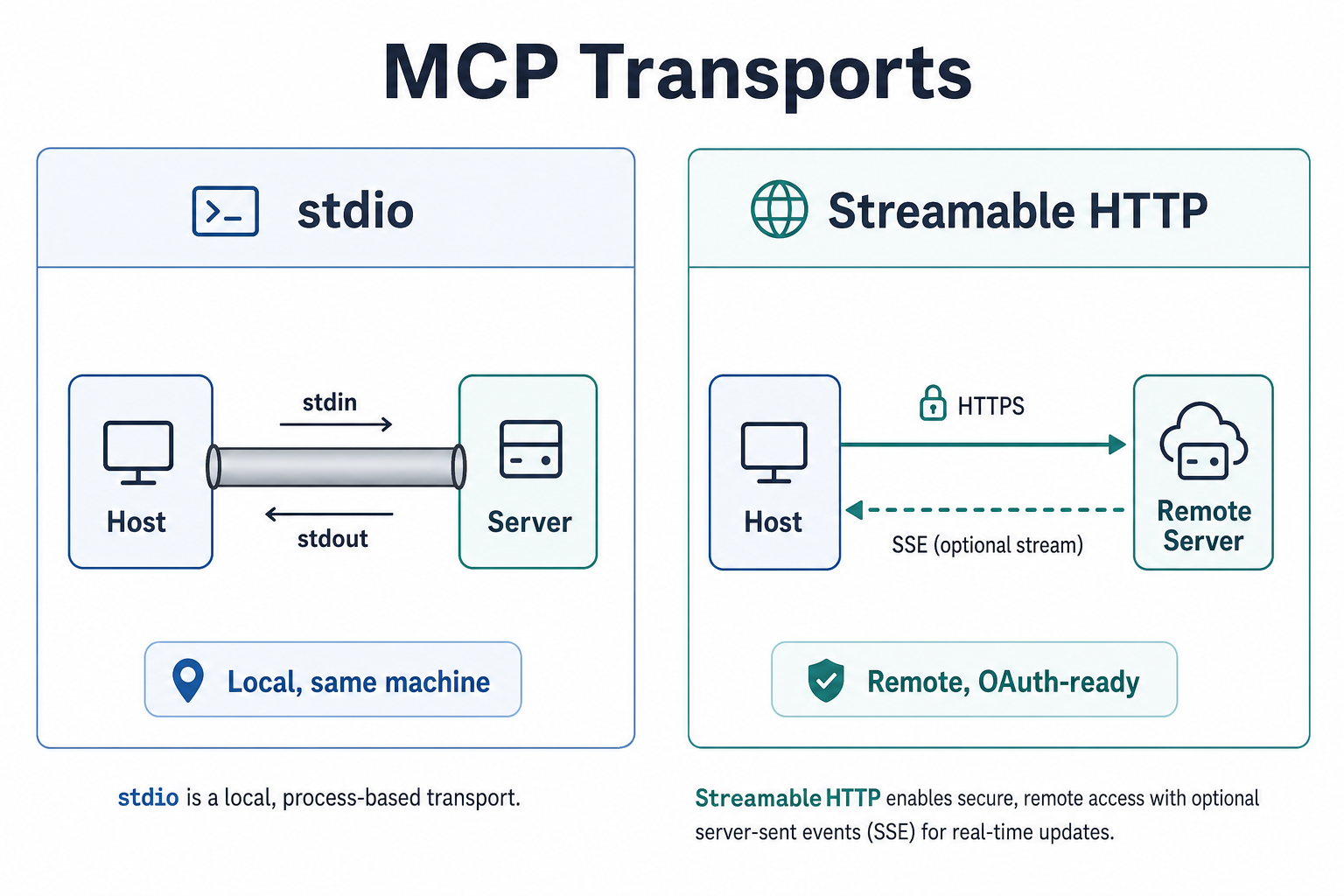
Two transport mechanisms: local stdio and remote Streamable HTTP. Playbook diagram.
Scope
The Model Context Protocol includes:
- MCP Specification — implementation requirements for clients and servers
- MCP SDKs — language implementations
- MCP development tools — including the MCP Inspector
- Reference server implementations
MCP focuses solely on the protocol for context exchange — it does not dictate how AI applications use LLMs or manage the provided context.
Participants
MCP follows a client–server architecture where an MCP host (for example Claude Code, Claude Desktop, Cursor or VS Code) establishes connections to one or more MCP servers by creating one MCP client per server.
| Role | Responsibility |
|---|---|
| MCP Host | AI application that coordinates one or many MCP clients |
| MCP Client | Maintains a connection to one MCP server and obtains context for the host |
| MCP Server | Program that provides context (tools, resources, prompts) to clients |
Example: Visual Studio Code acts as an MCP host. Connecting to the Sentry MCP server instantiates one MCP client; connecting to a local filesystem server instantiates another. A remote Streamable HTTP server may serve many clients; a local stdio server typically serves one.
Local servers (stdio) usually run on the same machine. Remote servers (Streamable HTTP) run on a platform — for example the official Sentry MCP server.
Layers
MCP has two layers:
| Layer | Role |
|---|---|
| Data layer | JSON-RPC protocol: capability and version discovery, tools, resources, prompts, notifications |
| Transport layer | Connection establishment, message framing, authorization |
Conceptually the data layer is inner; transport is outer.
Data layer
Built on JSON-RPC 2.0:
- Discovery —
server/discoverfor supported versions, capabilities and identity - Server features — tools, resources, prompts
- Client features — elicitation (sampling is deprecated as of
2026-07-28) - Utilities — notifications, progress for long-running work
Transport layer
| Transport | When to use |
|---|---|
| stdio | Local processes on the same machine — high performance, no network |
| Streamable HTTP | Remote servers — HTTP POST client→server, optional SSE for streaming; bearer tokens / OAuth recommended |
The same JSON-RPC message format applies across transports.
Statelessness and discovery
MCP is a stateless protocol. Every request carries protocol version and relevant capabilities in its _meta field so the server can process each request independently. Clients should identify themselves in _meta unless configured not to.
Servers advertise supported versions and capabilities through the mandatory server/discover request. Clients may call it before other requests; discovery responses are typically cacheable.
Example discover request
{
  "jsonrpc": "2.0",
  "id": 1,
  "method": "server/discover",
  "params": {
    "_meta": {
      "io.modelcontextprotocol/protocolVersion": "2026-07-28",
      "io.modelcontextprotocol/clientInfo": {
        "name": "example-client",
        "version": "1.0.0"
      },
      "io.modelcontextprotocol/clientCapabilities": {
        "elicitation": {}
      }
    }
  }
}
Primitives
Server primitives
| Primitive | Purpose | Typical methods |
|---|---|---|
| Tools | Executable actions (APIs, files, DB) | tools/list, tools/call |
| Resources | Contextual data (files, records) | resources/list, resources/read |
| Prompts | Reusable interaction templates | prompts/list, prompts/get |
Listings can be dynamic — clients discover then invoke.
Client primitives
| Primitive | Purpose | Notes |
|---|---|---|
| Elicitation | Server asks the user for structured input | Delivered via Multi Round-Trip Requests |
| Sampling | Server asks the host LLM for a completion | Deprecated in 2026-07-28 |
| Logging | Server → client log stream | Deprecated — prefer stderr / OpenTelemetry |
Optional extensions (for example Tasks) build on the core protocol.
Notifications
Servers can notify clients when capabilities change (for example tools list updates). Change notifications are opt-in: the client opens a long-lived subscriptions/listen stream naming notification types; the server delivers matching notifications on that stream.
Negative cases to design for
- Server does not support the requested protocol version →
UnsupportedProtocolVersionError; retry with a mutual version or fail clearly. - Remote server requires auth the host cannot obtain → fail closed; do not silently strip scopes.
- Tool list changes mid-session → subscribe or re-list before critical calls.
- Stdio child process crashes → host must restart and re-discover; surface errors to the user.
Discussion
Comments
Share feedback or questions about this page. No account required.
Loading comments…