The Personal MBA — Josh Kaufman’s Mental Models for Business
Business school sells credentials, networks, and a structured map of how organisations work. The Personal MBA sells something different: a portable lattice of mental models—reusable concepts you can apply to any offer, market, team, or system without waiting three years or spending six figures. Kaufman’s claim is blunt: if your goal is to understand how businesses create and capture value, you do not need an MBA. You need the models—and deliberate practice applying them.
Source note: This article is an original practitioner synthesis of themes from Josh Kaufman’s The Personal MBA (including the 10th anniversary mental-models framing). It is not a reprint of the book. Buy and support the original if you build, sell, advise, or operate businesses for a living.


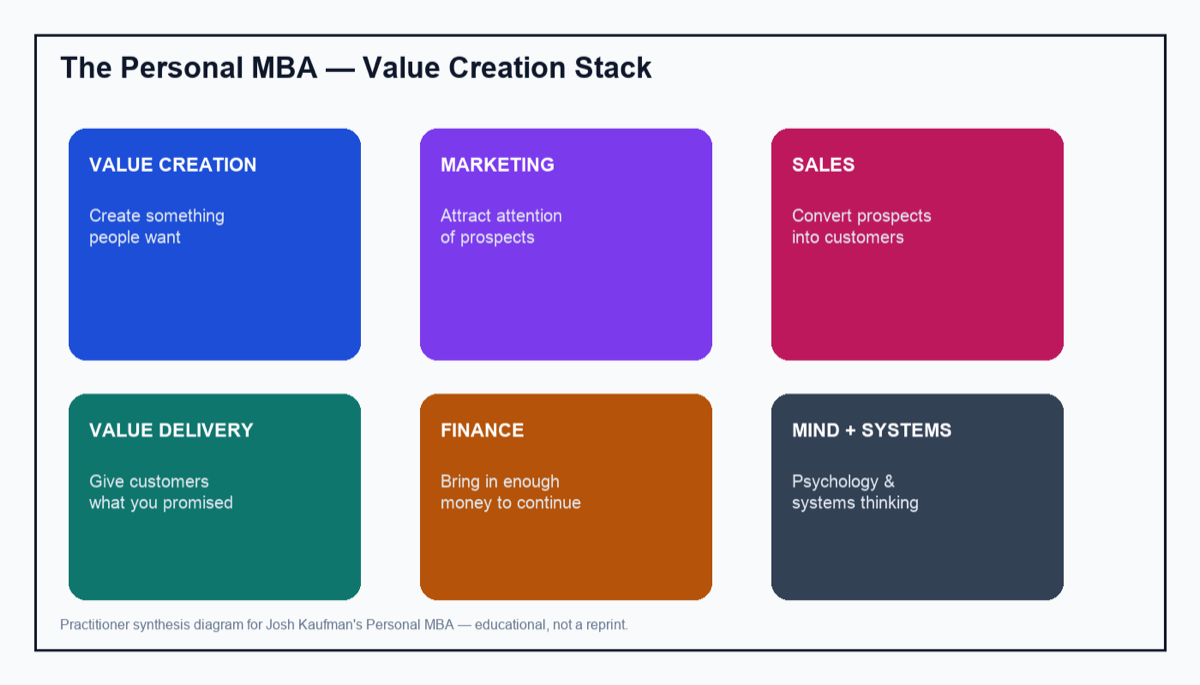
Figure: cover/title from Josh Kaufman’s The Personal MBA EPUB, plus a practitioner synthesis diagram of the value stack.
0. Why not B-school (and what Kaufman actually promises)
0.1 The Personal MBA thesis
Kaufman’s opening move is not anti-education; it is anti-confusion of credentials with capability. An MBA can be useful for signalling, peer networks, and career switching into certain firms. It is expensive, time-intensive, and often heavy on case theatre that does not transfer cleanly to a five-person startup or a mid-market operations turnaround.
What does transfer: a shared vocabulary of how value is created, priced, sold, delivered, and measured—and how humans actually decide. That vocabulary is what The Personal MBA tries to compress into mental models: short, named ideas you can recall under pressure.
0.2 What “mental models” mean here
A mental model is a compressed representation of how something works. Good models are:
| Property | Why it matters in practice |
|---|---|
| Named | Teams can point to the same idea in a meeting |
| Falsifiable in use | You can tell when the model does not fit |
| Composable | Models stack (e.g. scarcity + risk reversal + MVO) |
| Actionable | They imply a next experiment or decision |
Kaufman’s catalogue spans business mechanics and human systems. Skipping either half produces brittle advice: beautiful offers nobody buys, or brilliant persuasion attached to broken delivery.
0.3 The five parts of every business
Every business—regardless of industry—must do five things well enough to survive:
| Part | Job | Failure mode |
|---|---|---|
| 1. Value Creation | Discover and create something people want | Building what nobody needs |
| 2. Marketing | Attract attention and desire | Silence; wrong audience |
| 3. Sales | Turn prospects into paying customers | Leaks at the close; trust failure |
| 4. Value Delivery | Give customers what you promised | Churn, refunds, reputation damage |
| 5. Finance | Bring in enough money to keep going | Cash death despite “growth” |
Consulting diagnostic: score each part 1–5 with evidence. The lowest score is usually where the next engagement should focus—not where the client’s ego wants to play.
0.4 How to use this guide
- Skim the five-part map first.
- Deep-dive the chapter that matches your current bottleneck.
- For each model, ask: What would change in the next two weeks if this were true?
- Prefer small experiments (MVO, shadow tests, reactivation) over grand strategy decks.
1. Value Creation
Value Creation is the foundation: if nobody wants what you offer, marketing and sales only accelerate failure.
1.1 Economically valuable skills and relative value
Economically Valuable Skills are capabilities the market will pay for—often combinations of technical skill, domain knowledge, and persuasion. A lone skill rarely commands premium rates; a bundle does (e.g. AI engineering + industry process knowledge + stakeholder communication).
Relative Importance Testing asks prospects to trade off features, outcomes, and price rather than rate everything “important.” Forced trade-offs surface real priorities.
| Technique | Use when | Watch for |
|---|---|---|
| Importance ratings (1–10) | Early discovery | Everything scores 8–10 |
| Forced ranking | Prioritising roadmap | Social desirability bias |
| Conjoint / pairwise trade-offs | Pricing and packaging | Sample quality |
| “What would you cut first?” | Scope control | Polite clients who won’t cut |
Consulting use: Replace feature laundry lists with ranked outcomes tied to money, time, risk, or status.
1.2 The twelve forms of value
Kaufman catalogues twelve forms of value—distinct economic structures for how customers receive benefit:
| # | Form | Essence | Example pattern |
|---|---|---|---|
| 1 | Product | Tangible or digital good transferred | Hardware, SaaS licence as productised IP |
| 2 | Service | Help completing a task | Consulting engagement, managed ops |
| 3 | Shared Resource | Access to a common asset | Coworking, cloud capacity pools |
| 4 | Subscription | Ongoing access for recurring fee | Retainers, SaaS seats |
| 5 | Resale | Buy low, sell higher | Retail, marketplace flipping |
| 6 | Lease | Temporary exclusive use | Equipment rental, IP licence term |
| 7 | Agency | Sell on behalf of another | Recruiting, ad agencies |
| 8 | Audience Aggregation | Attract attention, sell access | Media, events, communities |
| 9 | Loan | Temporary capital for interest | Credit products |
| 10 | Option | Right to take action later | Retainer options, warrants |
| 11 | Insurance | Transfer risk for premium | Warranties, cyber cover |
| 12 | Capital | Equity investment for ownership | VC, angel, PE |
Practitioner move: Redesign a stuck offer by changing form, not only features. A struggling product workshop becomes a subscription knowledge community (Audience Aggregation + Subscription). A one-off service becomes a productised diagnostic (Product + Service hybrid).
1.3 The Iron Law of the Market
Iron Law of the Market: If you do not have enough people who want what you have to offer at a price that sustains the business, nothing else matters. Superior craft cannot compensate for no demand.
| Signal | Healthy market | Weak market |
|---|---|---|
| Urgency | Active search, deadlines, pain | “Nice to have someday” |
| Budget | Money already allocated or reallocatable | No owner of spend |
| Alternatives | Customers already paying someone | No category spend |
| Access | You can reach buyers | Gatekeepers forever |
When to use: Before building, fundraising, or proposing a large consulting build. Validate demand with conversations, waitlists, paid deposits, or shadow tests—not with slide enthusiasm.
1.4 Critical assumptions and shadow testing
Critical Assumptions are the beliefs that must be true for the offer to work (someone will pay X; we can deliver in Y days; regulators allow Z). List them explicitly; rank by risk × ignorance.
Shadow Testing measures interest before full build—landing pages, waitlists, concierge delivery, Wizard-of-Oz prototypes, LOIs.
| Assumption type | Cheap test |
|---|---|
| Willingness to pay | Deposit, pre-order, paid pilot |
| Reachability | Ad → landing → email capture CAC |
| Delivery feasibility | Concierge / manual first 10 customers |
| Legal / compliance | Expert review before scale |
1.5 Iteration, Feedback, and the Minimum Viable Offer (MVO)
Iteration is the cycle: create → measure → learn → improve. Feedback is the signal that closes the loop. Without feedback, iteration is theatre.
Minimum Viable Offer (MVO): the smallest offer that (1) delivers real value and (2) can be sold, so you learn from paying customers—not only from opinions.
| MVO design question | Good answer looks like |
|---|---|
| Who is the probable purchaser? | Named role + context |
| What end result do they buy? | Outcome in their language |
| What is the smallest promise we can keep? | Scoped deliverable |
| How do we reverse risk? | Guarantee, milestone billing, opt-out |
| What will we measure in 14 days? | One leading + one lagging metric |
Product/consulting tip: An MVO is not “half a product.” It is a complete transaction with limited scope.
1.6 Incremental Augmentation and Trade-offs
Incremental Augmentation improves an offer step by step based on feedback rather than reinventing from zero each time. Trade-offs are unavoidable: more features raise complexity and support cost; more customisation kills scale.
Use a simple quality bar:
| Dimension | Improve when… | Stop when… |
|---|---|---|
| Speed | Cycle time blocks sales | Quality collapses |
| Quality | Defects drive churn | Cost exceeds willingness to pay |
| Flexibility | Segments diverge | Ops cannot deliver |
| Price | Value capture lags value created | Volume dies |
1.7 Perceived value drivers
Perceived value rises with desirability of end result, perceived likelihood of achievement, and falls with time, effort, and risk perceived by the buyer. Marketing and sales largely manipulate these perceptions honestly or not; ethics plus sustainability favour honest alignment.
2. Marketing
Marketing’s job is to get the right attention from people likely to buy—and to make the offer remarkable enough to spread.
2.1 Attention, Receptivity, and Probable Purchasers
Attention is the scarce input. Receptivity is whether the audience is open to the message now. Probable Purchasers are the subset most likely to buy soon.
| Concept | Definition | Practitioner use |
|---|---|---|
| Attention | Mental spotlight | Compete for it deliberately |
| Receptivity | Timing + context fit | Point of market entry matters |
| Probable purchaser | High-likelihood buyer | Focus spend here first |
| End result | Outcome customer wants | Lead with that, not features |
| Qualification | Filtering unfit leads | Protect sales time |
When to use: Before scaling ads or content—define the probable purchaser in one sentence a junior marketer can target.
2.2 Hooks, CTAs, and Landing Pages
A Hook earns attention (curious promise, sharp problem statement, proof). A Call to Action (CTA) tells the prospect the next step. A Landing Page concentrates one offer and one primary CTA.
| Element | Weak | Strong |
|---|---|---|
| Hook | “We are innovative” | Specific painful end-result |
| CTA | “Learn more” | “Book diagnostic” / “Start trial” |
| Proof | Logos without context | Metric + named segment |
| Friction | Long form early | Progressive disclosure |
2.3 Remarkability, Controversy, and Permission
Remarkability (after Seth Godin via Kaufman): worth remarking on—unusual enough to discuss. Controversy can create attention but burns trust if manufactured. Permission marketing builds an asset: the right to continue the conversation (email list, community, CRM consent).
| Asset | Why it compounds |
|---|---|
| Permission list | Owned attention |
| Case library | Proof on demand |
| Category POV | Remarkability without gimmicks |
2.4 Awareness and Point of Market Entry
Prospects sit on an awareness ladder from unaware of the problem to ready to buy a specific offer. Messaging must match the rung. Point of Market Entry is when receptivity spikes (new job, audit failure, funding event, childbirth, move, regulatory deadline).
| Awareness rung | Message job |
|---|---|
| Unaware | Interrupt with problem framing |
| Problem-aware | Agitate cost of inaction |
| Solution-aware | Differentiate approach |
| Product-aware | Proof + risk reversal |
| Most aware | Clear offer + CTA |
Consulting use: Map stakeholder awareness before a pursuit narrative. Executives and users often sit on different rungs.
2.5 Demonstration, Narratives, and Prestige
Demonstration beats description. Narratives make abstract value concrete. Prestige and social proof raise perceived likelihood of success—use real proof, not invented scarcity theatre.
3. Sales
Sales converts attention into transactions—agreed exchanges of value.
3.1 Trust, Common Ground, and Education-Based Selling
Trust is the precondition for non-trivial deals. Common Ground (shared identity, values, language, goals) accelerates trust. Education-Based Selling teaches the buyer how to decide well—positioning you as guide rather than pusher.
| Stage | Seller behaviour | Buyer experience |
|---|---|---|
| Discover | Diagnose, listen | Felt understood |
| Educate | Frameworks, trade-offs | Clarity |
| Propose | Options with prices | Agency |
| Close | Next action + risk reverse | Safety |
| Expand | Deliver + reactivate | Continuity |
3.2 Barriers to Purchase and Risk Reversal
Common Barriers to Purchase: price uncertainty, switching costs, fear of looking stupid, complexity, lack of trust, timing, committee politics.
Risk Reversal shifts risk from buyer to seller: guarantees, milestone payments, pilots, warranties, SLAs with teeth, “pay after results” structures (use carefully).
| Barrier | Reversal pattern |
|---|---|
| “What if it fails?” | Money-back / milestone kill switch |
| “Too expensive” | ROI case + phased scope |
| “Too risky politically” | Internal champion pack + proof |
| “Too hard to switch” | Migration service included |
3.3 Pricing Uncertainty and Value-Based Selling
The Pricing Uncertainty Principle: buyers never know the “true” value of an offer in advance; sellers often underprice from fear. Value-Based Selling anchors price to economic outcomes, not cost-plus hours.
| Pricing mode | When it fits | Failure mode |
|---|---|---|
| Cost-plus | Commoditised delivery | Leaves value on table |
| Market-comparable | Crowded category | Race to bottom |
| Value-based | Clear ROI story | Needs credible quantification |
| Option / retainer | Uncertain demand | Scope creep |
3.4 Reactivation and Next Action
Reactivation sells again to past customers—often the highest-ROI channel. Next Action discipline: every sales conversation ends with a concrete, dated step owned by someone.
Consulting tip: Build a quarterly reactivation ritual before buying more top-of-funnel.
3.5 Negotiation as structured empathy
Sales negotiation is not warfare; it is discovery of Zone of Possible Agreement under constraints. Separate interests from positions; trade low-cost/high-value concessions; document Commander’s Intent of the deal (see Working with Others).
4. Value Delivery
Value Delivery is keeping the promise—reliably, repeatedly, and at improving cost.
4.1 Value Stream, Throughput, and Constraints
A Value Stream is the sequence of steps from request to delivered value. Throughput is the rate of completed valuable output. The Constraint (bottleneck) governs the whole system’s throughput—improving non-constraints can create inventory piles without helping customers.
| Question | Tool |
|---|---|
| Where does work wait? | Value-stream map |
| What limits finished output? | Constraint analysis |
| What quality escapes? | Defect/refund taxonomy |
| What surprises customers? | Expectation vs delivery audit |
4.2 Duplication, Multiplication, Scale, Accumulation
| Model | Meaning | Example |
|---|---|---|
| Duplication | Copy a working process | Playbooks, SOPs, templates |
| Multiplication | Reproduce via others | Franchise, partner channel |
| Scale | Handle more volume | Automation, platformisation |
| Accumulation | Small gains compound | Habit of weekly improvement |
| Amplification | Small input, large output | Force multipliers (tools, media) |
4.3 Force Multipliers and Systemization
Force Multipliers increase output per unit effort: software, checklists, capital equipment, brand, distribution. Systemization turns heroics into repeatable processes so quality does not depend on one star performer.
| Delivery maturity | Symptom | Next move |
|---|---|---|
| Heroic | Everything depends on one person | Document + pair |
| Craft | Variable quality | Checklists + QA gates |
| Systematised | Predictable SLA | Measure throughput |
| Scaled | Volume without collapse | Automate constraint |
4.4 Barriers to Competition
Durable delivery creates Barriers to Competition: proprietary data, switching costs, brand trust, exclusive distribution, regulatory licences, network effects. Do not confuse temporary cleverness with a barrier.
4.5 Expectation management
Overpromising in sales destroys delivery. Align Marketing/Sales promises with Delivery capacity using shared SLAs and scoped MVOs.
5. Finance
Finance ensures the business captures enough value to survive and improve.
5.1 Profit, Margin, and Value Capture
Profit = revenue − costs (simplifying). Profit Margin expresses profit relative to revenue. Value Capture is how much of the value you create you keep versus leaving to customers, employees, or competitors.
| Metric | Use | Misuse |
|---|---|---|
| Gross margin | Unit economics | Ignoring opex |
| Contribution margin | Channel decisions | Ignoring fixed costs forever |
| Net profit | Solvency story | Accrual vs cash blindness |
| Cash runway | Survival | Vanity growth |
5.2 Sufficiency vs maximisation
Sufficiency: enough profit to achieve your goals—not infinite growth for its own sake. Many operators burn out chasing maximisation when sufficiency would fund freedom.
Consulting question: What does “enough” look like in cash, time, and risk for this owner?
5.3 Pricing power and Cost Structure
Pricing power comes from differentiated value and switching costs. Cost structure (fixed vs variable) determines how scale affects profit. High fixed costs punish empty capacity; high variable costs limit operating leverage.
5.4 Cash Flow Cycle, Amortization, Opportunity Cost
| Model | Definition | Why it kills companies |
|---|---|---|
| Cash Flow Cycle | Time from spending cash to collecting cash | Growth can bankrupt you |
| Amortization | Spreading cost over useful life | Capex vs opex confusion |
| Opportunity Cost | Value of the next-best alternative | Wrong projects “succeed” |
| Time Value of Money | Cash now > same cash later | Bad payment terms |
| Compounding | Reinvested returns accelerate | Ignoring small leaks |
| Leverage | Borrowed resources amplify outcomes | Amplifies losses too |
5.5 Bootstrapping and Hierarchy of Funding
Bootstrapping funds growth from customers first. Kaufman’s practical hierarchy often runs: personal cash → credit → customers → angels → institutions—each layer adding cost and loss of control.
| Funding source | Upside | Cost |
|---|---|---|
| Customers | Proof + cash | Delivery load |
| Angels | Speed | Dilution, advice variance |
| VC | Scale capital | Growth mandate |
| Debt | No dilution | Covenants, repayment |
5.6 Valuation (practitioner view)
Valuation estimates what a business is worth—to a buyer, investor, or for internal decisions. Methods vary (multiples, DCF, replacement cost); all are stories constrained by cash flows and risk. For operators, improving cash predictability often beats debating multiple points.
6. The Human Mind
Businesses are run by brains that evolved for a different world.
6.1 Caveman Syndrome and Status
Caveman Syndrome: our hardware is ancient; our environment is modern. Chronic stress, status anxiety, and novelty-seeking are predictable. Status seeking shapes purchases, careers, and organisational politics—ignore it at your peril.
6.2 Loss Aversion and Cognitive Biases
People typically weigh losses more heavily than equivalent gains (Loss Aversion). Biases distort decisions:
| Bias | Pattern | Business implication |
|---|---|---|
| Confirmation | Seek affirming data | Bad strategy reviews |
| Availability | Vivid ≠ probable | Risk mispricing |
| Anchoring | First number sticks | Pricing & negotiation |
| Sunk cost | Past spend justifies more | Kill criteria needed |
| Planning fallacy | Underestimate time/cost | Buffer + gates |
| Social proof | Follow the herd | Category design / FOMO |
6.3 Motivation structure
A useful simplified loop: Stimulus → Desire/Urge → Action, moderated by Inhibition and context. Change behaviour by changing stimuli and environment—not only by exhortation.
6.4 Novelty, Pattern Matching, and Willpower limits
Brains crave Novelty but run on Pattern Matching. Willpower is limited; systems beat motivation. Design offers and workplaces accordingly: defaults, checklists, and friction where bad behaviour occurs.
6.5 Empathy as a commercial skill
Accurate models of others’ minds beat clever pitches. Interview for jobs-to-be-done language; mirror status and risk concerns in proposals.
7. Working with Yourself
Personal effectiveness is a business system with one employee: you.
7.1 Akrasia, Monoidealism, and Cognitive Switching
Akrasia: acting against your better judgement (procrastination, impulse). Monoidealism: one clear idea/goal dominating attention—useful for deep work. Cognitive Switching Penalty: context switching taxes performance hard.
| Practice | Model applied |
|---|---|
| Time blocks | Monoidealism |
| Single MIT (Most Important Task) | Priority under akrasia |
| Batch comms | Reduce switching |
| Environment design | Remove stimuli |
7.2 Four methods of completion
For every open loop: Do it, Defer it, Delegate it, or Delete it. Inbox zero is optional; decision zero on next actions is not.
7.3 Goals, Habits, Triggers, and Environment
Goals orient; Habits execute. Attach habits to Triggers (time, location, preceding action). Shape Environment so the default action is the desired one.
| Goal type | Better substitute |
|---|---|
| Vague aspiration | Measurable next action |
| Outcome-only | Process habit + review |
| Too many goals | One MIT per day |
7.4 Energy and Health as constraints
Sleep, nutrition, exercise, and relationships are not “soft”—they are throughput constraints on your personal system. Treat burnout as a systems failure, not a moral one.
7.5 Externalisation
Write things down. External memory beats heroic recall. Checklists for recurring quality-critical work (consulting proposals, releases, due diligence) prevent akrasia from deleting steps.
8. Working with Others
8.1 Power, Comparative Advantage, and Communication Overhead
Power is the ability to influence behaviour—formal authority is only one source. Comparative Advantage: specialise where your relative productivity is highest and trade. Communication Overhead grows nonlinearly with team size; more people is not always more throughput.
| Team size intuition | Risk |
|---|---|
| 1–3 | Speed, bus factor |
| 5–9 | Sweet spot for many projects |
| 15+ | Overhead dominates without structure |
8.2 The Golden Trifecta
Kaufman emphasises appreciation, courtesy, and respect as the cheapest high-ROI relationship behaviours. They are not fluff; they reduce friction costs.
8.3 Reasons Why and Commander’s Intent
Give Reasons Why (even brief ones—see Langer’s “because”). State Commander’s Intent: the purpose and end state, so people can improvise when the plan breaks.
| Directive style | Result |
|---|---|
| Step-only orders | Brittle execution |
| Intent + constraints | Adaptive execution |
| No why | Compliance theatre |
8.4 Bystander Apathy, Planning Fallacy, and Safety
Bystander Apathy: responsibility diffuses. Assign named owners. Plan with the Planning Fallacy in mind: cut scope, add buffers, use reference-class forecasting. Psychological safety enables bad news to surface before customers feel it.
8.5 Influence without dark patterns
Ethical persuasion uses clarity, proof, reciprocity, and commitment aligned with truth. Pair with Cialdini-aware defences when you are the target (Influence synthesis).
9. Understanding Systems
9.1 Gall’s Law
Gall’s Law: Complex systems that work evolved from simple systems that worked. Designing a complex system from scratch usually fails. Start simple; evolve.
When to use: Architecture reviews, operating-model redesigns, “big bang” ERP/AI programmes. Insist on a thin working slice first.
9.2 Stock, Flow, and Slack
| Concept | Meaning | Example |
|---|---|---|
| Stock | Accumulated quantity | Inventory, cash, backlog |
| Flow | Rate of change | Orders/day, burn rate |
| Slack | Buffer capacity | Spare servers, time contingency |
Zero slack feels efficient until variability hits—then the system breaks.
9.3 Feedback loops, Autocatalysis, Entropy
Reinforcing loops amplify; balancing loops stabilise. Autocatalysis: output of a process feeds its own growth (network effects, content flywheels). Entropy: systems decay without energy—maintenance is not optional.
9.4 Constraints and Inflows/Outflows
Identify the constraint before “optimising everything.” Trace inflows and outflows of the stock you care about (cash, leads, trust, defects).
9.5 Uncertainty and Black Swans
Systems face uncertainty and rare high-impact events. Build optionality, insurance, and kill switches—not only point forecasts.
10. Analyzing Systems
10.1 Deconstruction and Measurement
Deconstruction breaks a system into parts and relationships. Measurement makes states visible. Without measurement, improvement is storytelling.
10.2 KPIs, Proxies, and Segmentation
| Tool | Role | Risk |
|---|---|---|
| KPI | Tracks a goal-critical outcome | Gaming the metric |
| Proxy | Stands in when true measure is hard | Proxy drift |
| Segmentation | Separates different behaviours | Overfitting noise |
| Cohorts | Compare like with like | Wrong slice |
Goodhart’s Law reminder: when a measure becomes a target, it ceases to be a good measure—rotate and audit metrics.
10.3 Correlation vs Causation
Correlation suggests hypotheses; causation needs intervention, randomised tests, or strong causal design. Consulting decks that confuse the two create expensive magic rituals.
10.4 Norms, Variability, and Outliers
Know the baseline distribution before reacting to a single point. Outliers can be gold (extreme users) or data errors—investigate before celebrating.
10.5 Analytical checklist for engagements
- What stock are we trying to change?
- What flows move it?
- What is the constraint?
- What leading indicator moves first?
- What counter-metric prevents gaming?
- What experiment isolates causality?
11. Improving Systems
11.1 Intervention Bias and Optimization Ceiling
Intervention Bias: the urge to “do something” even when watching is wiser. Optimization Ceiling: beyond a point, further optimisation costs more than it returns.
| Situation | Prefer |
|---|---|
| Unclear diagnosis | Measure more, intervene less |
| Clear constraint | Focused intervention |
| Near ceiling | Redesign / reframing, not polish |
11.2 The Critical Few and Diminishing Returns
A few factors usually drive most results (Pareto-ish Critical Few). Diminishing Returns warn against polishing the already-good while the bottleneck starves.
11.3 Friction, Refactoring, and Second-order effects
Remove Friction from desired behaviours; add friction to undesired ones. Refactoring improves structure without changing external behaviour—necessary maintenance. Always scan for second-order effects (incentive distortions, shadow processes).
11.4 Experimental improvement loop
| Step | Action |
|---|---|
| 1 | State hypothesis in one sentence |
| 2 | Define success metric + guardrail |
| 3 | Run smallest reversible test |
| 4 | Read results against base rate |
| 5 | Standardise wins; discard flukes |
| 6 | Re-identify constraint |
11.5 Sustainable improvement culture
Improvement dies when it is a one-off project. Cadence matters: weekly throughput review, monthly assumption review, quarterly offer/pricing review.
11A. Expanded model cards (field reference)
Use these cards in workshops: one model per sticky; force a “so what / now what.”
Value Creation field cards
| Model | One-line definition | So what | Now what |
|---|---|---|---|
| Economically Valuable Skills | Skills markets pay for, especially in combination | Hire and train for bundles | Audit team skills vs paid outcomes |
| Market | Group of people with related needs | Products without markets fail | Define market before roadmap |
| Offer | Product/service + promise + price | Clarity beats cleverness | One-sentence offer test |
| Product Development | Process of creating the offer | Overbuilding is common | Cap scope to MVO |
| Quality | Fitness for purpose as judged by customer | Internal polish ≠ value | Measure defects customers feel |
| Unique Value Proposition | Why you vs alternatives | Weak UVP → price pressure | Write contrast table |
| Prototype | Rough version for learning | Perfect first versions waste time | Schedule throwaway builds |
Marketing field cards
| Model | One-line definition | So what | Now what | | --- | --- | --- | | Attention | Finite mental resource | You rent or earn it | Cut messages that don’t earn | | Receptivity | Openness to message now | Right message, wrong time fails | Target entry points | | Probable Purchaser | Most likely near-term buyer | Average targeting wastes cash | Narrow ICP | | End Result | Outcome buyer wants | Features don’t sell | Rewrite homepage in outcomes | | Qualification | Filtering non-buyers | Sales time is inventory | Add disqualifying questions | | Point of Market Entry | Moment need spikes | Timing beats budget | Build trigger lists | | Mindshare | Mental availability | Category leaders own cues | Consistency > campaigns | | Hook | Attention device | Without hook, silence | Test 5 hooks weekly | | Call to Action | Explicit next step | Vague CTAs leak | One primary CTA | | Landing Page | Focused conversion surface | Multi-purpose pages dilute | One page, one offer | | Controversy | Polarising attention | Can brand-damage | Use sparingly, truthfully | | Reputation | Accumulated trust signal | Slow to build, fast to burn | Protect delivery quality |
Sales field cards
| Model | One-line definition | So what | Now what | | --- | --- | --- | | Transaction | Agreed exchange | No transaction, no business | Count closes, not meetings | | Trust | Confidence in integrity/competence | Low trust → long cycles | Add proof + references | | Common Ground | Shared frame | Speeds rapport | Mirror language | | Barriers to Purchase | Frictions blocking yes | Hidden barriers kill deals | Objection taxonomy | | Risk Reversal | Seller takes downside | Removes fear | Design guarantee/pilot | | Reactivation | Re-engage past buyers | Cheaper than new logos | Quarterly win-back | | Negotiation | Bargaining under interdependence | Poor prep loses margin | BATNA + trades list | | Exclusivity | Scarce access | Raises perceived value | Use only if true |
Value Delivery field cards
| Model | One-line definition | So what | Now what | | --- | --- | --- | | Value Stream | Steps from request to value | Invisible waits kill lead time | Map once end-to-end | | Channel | Path to customer | Wrong channel = no scale | Test 2 channels max first | | Distribution | How offer reaches market | Product without pipe fails | Partner vs direct trade-off | | Expectation Effect | Perceived quality vs expect | Overpromise creates “defects” | Align sales scripts | | Predictability | Variance control | Customers buy calm | SLA + buffers | | Throughput | Rate of valuable completions | Local efficiency can lie | Optimise finished output | | Overwhelm | Excess WIP | Everything late | WIP limits | | Standardisation | Common methods | Enables scale | Template critical paths | | Quality Assurance | Catch defects early | Late QA is expensive | Shift left checks |
Finance field cards
| Model | One-line definition | So what | Now what | | --- | --- | --- | | Profit | Revenue beyond costs | Oxygen | Weekly cash + margin view | | Profit Margin | Profit / revenue | Comparability | Segment by offer | | Capturing Value | Keeping fair share of created value | Underpricing is chronic | Reprice annually | | Sufficiency | Enough for goals | Maximisation can trap you | Define “enough” | | Pricing Power | Ability to raise price | Strategic asset | Track win-rate vs discount | | Overhead | Ongoing fixed costs | Raises break-even | Challenge every 90 days | | Incremental Degradation | Slow quality/cost creep | Silent margin death | Monthly leak hunt | | Breakeven | Point where profit = 0 | Survival math | Know unit + monthly BE | | Purchasing Power | What money buys over time | Inflation matters | Contract index where needed | | Cash Flow Cycle | Spend → collect lag | Growth can bankrupt | Shorten receivables | | Opportunity Cost | Next best use of resources | Busy ≠ valuable | Kill low-ROI work | | Time Value of Money | Earlier cash preferred | Payment terms are pricing | Negotiate deposits | | Compounding | Returns on returns | Small edges matter | Reinvest systematically | | Leverage | Amplification via debt/tools/people | Cuts both ways | Cap downside | | Hierarchy of Funding | Prefer cheaper control-preserving capital | Dilution is expensive | Customer funding first | | Bootstrapping | Grow without outside equity | Forces discipline | Default until proven need | | Return on Investment | Gain vs cost of capital | Prioritise projects | Require ROI narrative | | Sunk Cost | Irrecoverable past spend | Emotional trap | Forward-looking kill rules |
Mind / Self / Others quick cards
| Model | Apply when |
|---|---|
| Caveman Syndrome | Stress, status games, irrational buys |
| Loss Aversion | Framing guarantees and change programmes |
| Confirmation Bias | Strategy offsites—assign a dissenter |
| Akrasia | Personal delivery failures |
| Monoidealism | Deep work / writing / modelling |
| Cognitive Switching Penalty | Meeting-heavy cultures |
| Most Important Task | Daily execution |
| Do/Defer/Delegate/Delete | Inbox and backlog triage |
| Golden Trifecta | Any stakeholder relationship |
| Commander’s Intent | Delegating under uncertainty |
| Bystander Apathy | Incidents and ownership gaps |
| Comparative Advantage | Team design and outsourcing |
| Communication Overhead | Hiring plans |
Systems quick cards
| Model | Apply when |
|---|---|
| Gall’s Law | Greenfield architecture / org redesign |
| Stock / Flow | Cash, backlog, inventory debates |
| Slack | “Efficiency” initiatives that remove buffers |
| Feedback Loop | KPI design |
| Constraint | Any throughput complaint |
| Entropy | Maintenance budgets under attack |
| Autocatalysis | Growth loops / virality claims |
| Proxy | Indirect metrics |
| Segmentation | Averaging hiding truth |
| Intervention Bias | Urge to “launch a programme” |
| Critical Few | Prioritisation fights |
| Diminishing Returns | Polish vs bottleneck |
| Friction | Onboarding and compliance design |
| Second-order effects | Incentive changes |
11B. Scenario drills (consulting & product)
Scenario A — Beautiful product, no revenue
| Step | Model | Action |
|---|---|---|
| 1 | Iron Law | Interview 20 probable purchasers; count willingness to pay |
| 2 | Shadow Testing | Landing + deposit before more build |
| 3 | MVO | Sell a concierge version in 14 days |
| 4 | Hook / CTA | Rebuild messaging around End Result |
| 5 | Risk Reversal | Pilot with kill clause |
Scenario B — Leads exist, closes don’t
| Step | Model | Action |
|---|---|---|
| 1 | Qualification | Tighten ICP; fire bad-fit leads |
| 2 | Barriers | Log every lost deal reason for 30 days |
| 3 | Trust | Add case studies matching segment |
| 4 | Education-Based Selling | Teach decision criteria |
| 5 | Next Action | No meeting without dated owner |
Scenario C — Wins, then delivery collapses
| Step | Model | Action |
|---|---|---|
| 1 | Expectation Effect | Diff sales promises vs delivery capacity |
| 2 | Value Stream | Find waits and rework loops |
| 3 | Constraint | Protect bottleneck resource |
| 4 | Systemization | Checklist the failure-prone steps |
| 5 | Throughput | Cap sales to delivery WIP limit |
Scenario D — “We’re busy but broke”
| Step | Model | Action |
|---|---|---|
| 1 | Cash Flow Cycle | Map days sales outstanding |
| 2 | Profit Margin | Kill negative-margin offers |
| 3 | Opportunity Cost | Stop low-value heroics |
| 4 | Pricing Power | Test +8–15% on renewals |
| 5 | Sufficiency | Reset goals to cash-positive plan |
Scenario E — Complex transformation programme
| Step | Model | Action |
|---|---|---|
| 1 | Gall’s Law | Ship thin vertical slice first |
| 2 | Commander’s Intent | One-page purpose for all vendors |
| 3 | Communication Overhead | RACI + fewer status forums |
| 4 | Proxy / KPI | Leading indicator of adoption |
| 5 | Intervention Bias | Pause new workstreams until constraint clears |
11C. Workshop agendas you can run tomorrow
90-minute Personal MBA diagnostic
| Minute | Activity | Output |
|---|---|---|
| 0–10 | Teach five parts | Shared vocabulary |
| 10–30 | Silent score 1–5 each part with evidence sticky | Heatmap |
| 30–45 | Cluster red flags | Theme list |
| 45–65 | Pick constraint; map stock/flow | One system sketch |
| 65–80 | Design MVO-scale intervention | Experiment card |
| 80–90 | Assign owners + Next Action | Dated plan |
Half-day offer redesign
| Block | Focus | Models |
|---|---|---|
| 1 | Customer End Result | Probable Purchaser, End Result |
| 2 | Form of value | Twelve forms matrix |
| 3 | Critical assumptions | Risk × ignorance ranking |
| 4 | Shadow test design | Landing, script, success metric |
| 5 | Pricing & risk reverse | Value capture, guarantee |
| 6 | Delivery sketch | Value stream, constraint |
Experiment card template:
| Field | Prompt |
|---|---|
| Hypothesis | If we ___, then ___ will move because ___ |
| Model(s) | Named Kaufman models |
| Metric | One primary |
| Guardrail | What must not get worse |
| Window | Start / end dates |
| Owner | Single name |
| Kill criteria | When we stop |
12. Practitioner synthesis: diagnosing with the Personal MBA
12.1 Five-part scorecard
| Part | Healthy signals | Red flags | First interventions |
|---|---|---|---|
| Value Creation | Paid demand, clear end result | Feature factory | MVO + critical assumptions |
| Marketing | Steady qualified attention | Vanity traffic | Probable purchaser + hook |
| Sales | Predictable close + next actions | Discount addiction | Risk reversal + value price |
| Delivery | Throughput + low defect | Heroics | Constraint + systemization |
| Finance | Cash + sufficiency | Growth into insolvency | Cycle time of cash |
12.2 Model stacks for common situations
| Situation | Model stack |
|---|---|
| New product idea | Iron Law → Critical Assumptions → Shadow Test → MVO |
| Soft pipeline | Probable Purchaser → Hook → Education Sale → CTA |
| Won’t close | Barriers → Risk Reversal → Trust/Common Ground |
| Churn rising | Expectation audit → Value Stream → Constraint |
| Scaling pain | Gall’s Law → Duplication → Force Multiplier |
| Team thrash | Overhead → Commander’s Intent → MIT focus |
| “Strategy” fog | Deconstruction → KPI/Proxy → Experiment |
12.3 Consulting engagement pattern
- Frame the five parts with the client (shared language).
- Instrument one constraint with a KPI and a guardrail.
- Ship one MVO-scale change in two weeks.
- Review with Feedback and Iteration—not a 60-page deck alone.
- Systemise what worked; delete what did not.
12.4 Product team pattern
- Write the End Result in customer language.
- List Critical Assumptions; star the riskiest.
- Shadow-test before roadmap theatre.
- Price with Value Capture conscious—avoid chronic underpricing.
- Instrument Activation → Retention before vanity acquisition.
13. Closing: mental models as operating system
Kaufman’s enduring gift is not a single framework but a portable OS for business judgement: five parts, human realities, and systems literacy. Credentials expire; models compound when practised.
Use them in daylight: name the model in the meeting, attach evidence, pick the smallest test. That is the Personal MBA in operation—less ceremony, more clarity, faster learning loops.
Discussion
Comments
Share feedback or questions about this page. No account required.
Loading comments…