The Goal: Goldratt’s Theory of Constraints for Operations and Knowledge Work
Local efficiency can bankrupt a plant—and a project. Eliyahu Goldratt and Jeff Cox’s The Goal teaches Theory of Constraints through a novel: the goal of a business is to make money now and in the future, and the system is governed by constraints. Optimise the bottleneck; stop celebrating busy non-bottlenecks.
Source note: This article is an original practitioner synthesis of themes from Eliyahu M. Goldratt and Jeff Cox’s The Goal: A Process of Ongoing Improvement. It is not a reprint. Support the original novel for narrative depth and the broader TOC body of work for advanced tools.

0. Why this book still matters
Operations management still worships local efficiency: keep every machine busy, maximise utilisation, cut unit cost everywhere. Goldratt’s novel—via plant manager Alex Rogo—shows why that religion destroys throughput. The book is forty years old; knowledge-work organisations repeat the same mistakes with Jira tickets instead of WIP on the shop floor.
Three commitments organise Theory of Constraints:
- The goal is throughput, not activity. Busy ≠ valuable.
- Systems have constraints. Improve the constraint; everything else is secondary.
- Policies linger after constraints move. Inertia kills the next improvement cycle.
For AI and consulting, the constraint is rarely “not enough developers.” It is partner review, client decision latency, security approval, eval capacity, or data access.
1. The goal — make money now and in the future
1.1 Not cost-cutting theatre
Not efficiency for its own sake. Not vanity metrics on dashboards.
The goal: make money now and in the future.
Operational translations:
| Increase | Decrease (carefully) |
|---|---|
| Throughput | Inventory |
| Operating Expense |
Cutting OE while destroying throughput is false progress. Increasing inventory to keep machines (or people) busy is often false progress.
1.2 Jonah’s question
Throughout the novel, Jonah asks: what is the goal? Every local decision should be tested against system throughput—not department KPIs.
Consulting translation: If utilisation is up but client outcomes and extensions are down, you optimised the wrong thing.
2. Three measures — T, I, OE
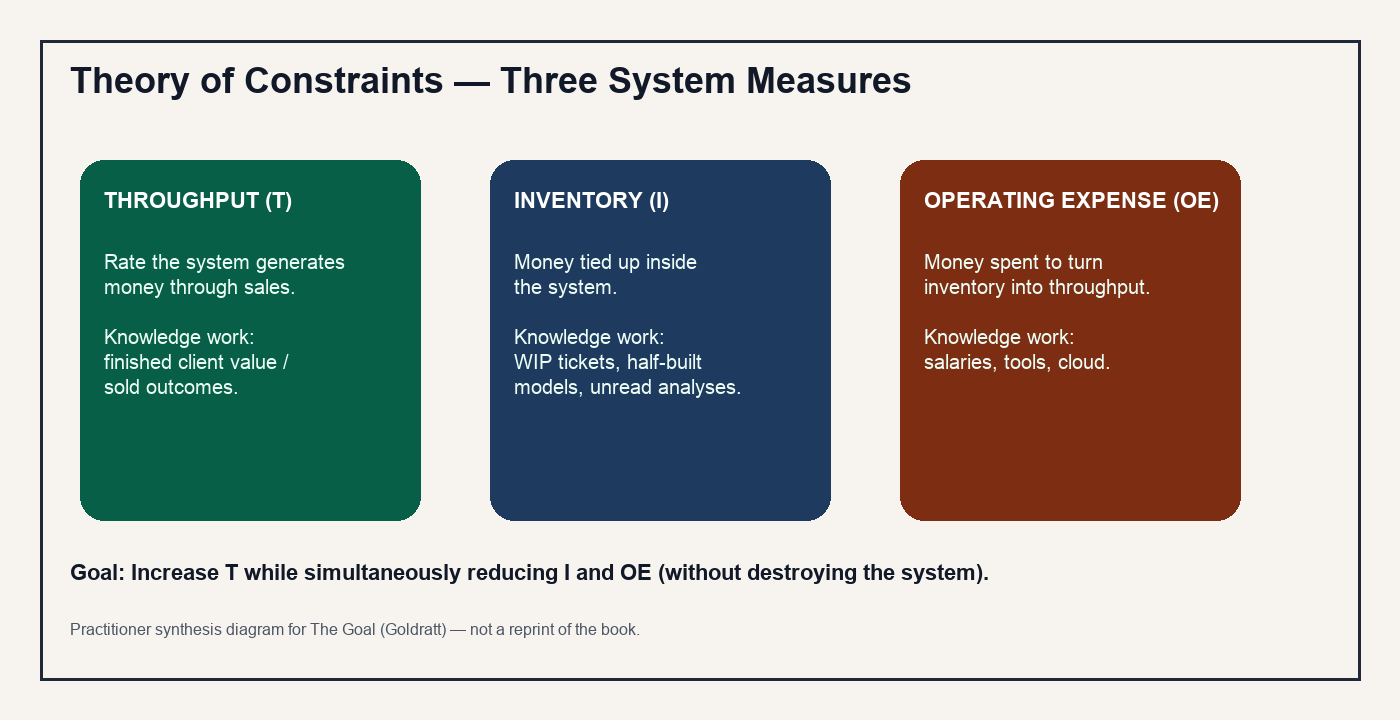
Figure: practitioner framework for Throughput, Inventory and Operating Expense (educational synthesis of Goldratt).
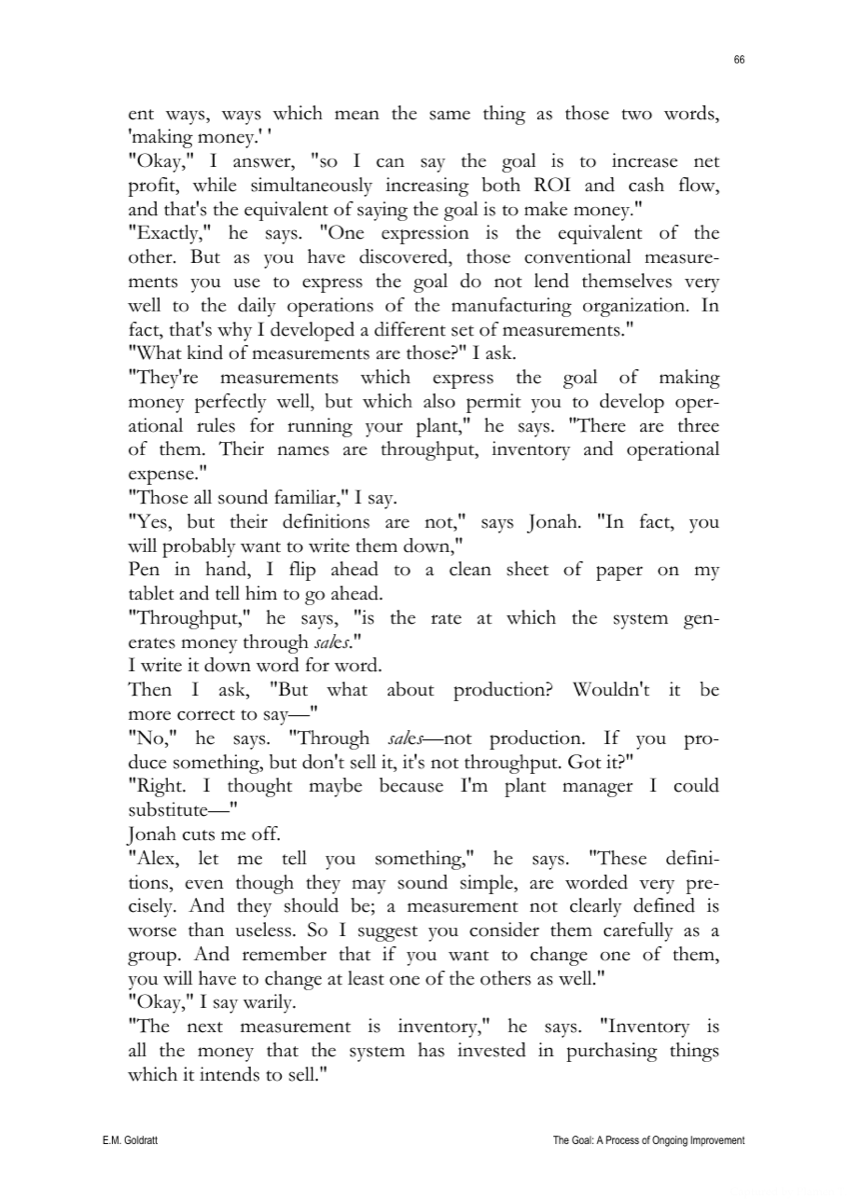
Figure: educational illustration from The Goal—Jonah introduces the three measures.
| Measure | Plain meaning | Knowledge-work analogue |
|---|---|---|
| Throughput (T) | Money generated by sales | Completed client value / shipped features that sell |
| Inventory (I) | Money stuck in the system | WIP tickets, half-built models, unread analyses |
| Operating Expense (OE) | Money to convert I → T | Salaries, tools, cloud spend |
2.1 Local optima trap
A team maximises its utilisation (looks productive) while increasing I and delaying T.
| Local KPI | System effect |
|---|---|
| Analysts at 100% utilisation | Queue before partner review explodes |
| Start every client request immediately | WIP ages; nothing finishes |
| Buy more GPUs | Inventory of half-trained models rises |
| Hire juniors without senior review capacity | Quality rework floods constraint |
2.2 Accounting vs throughput thinking
Traditional cost accounting can punish exactly what helps throughput (idle time at non-bottlenecks, small batches). Goldratt challenges managers to ask whether a decision increases T—not whether it lowers a allocated unit cost on a report.
3. Dependent events and statistical fluctuations
Work flows through dependent steps. Each step has variability. Without buffers and constraint management, variability accumulates as queues and late delivery.
Implication: balancing capacity across all resources to 100% utilisation is a fantasy that creates chaos.
| Phenomenon | Effect |
|---|---|
| Fast step followed by slow step | Queue before slow step |
| Variability at each step | Compounds downstream |
| “Balance the line” | WIP explosion |
The hike metaphor (Herbie) makes this visceral: the troop’s speed equals the slowest scout’s speed—not the average.
4. Bottlenecks (constraints) defined
A bottleneck is any resource whose capacity is less than or equal to demand placed on it. Time lost on a bottleneck is time lost for the entire system.
| On bottleneck | On non-bottleneck |
|---|---|
| Protect time fiercely | Idle time can be healthy |
| Quality before the constraint | Do not flood the constraint with defective work |
| Extra capacity here raises T | Extra capacity often only raises I |
| Never starve the constraint | Running “flat out” elsewhere wastes energy |
4.1 Finding the constraint
Look at queues, not opinions:
- Where does work wait longest?
- Which role is always at capacity?
- Which approval gate ages tickets?
Negative case: Declaring “engineering is the bottleneck” because headcount is low—while data never arrives from the client. The constraint may be client data access, not build capacity.
5. Five focusing steps (the TOC engine)
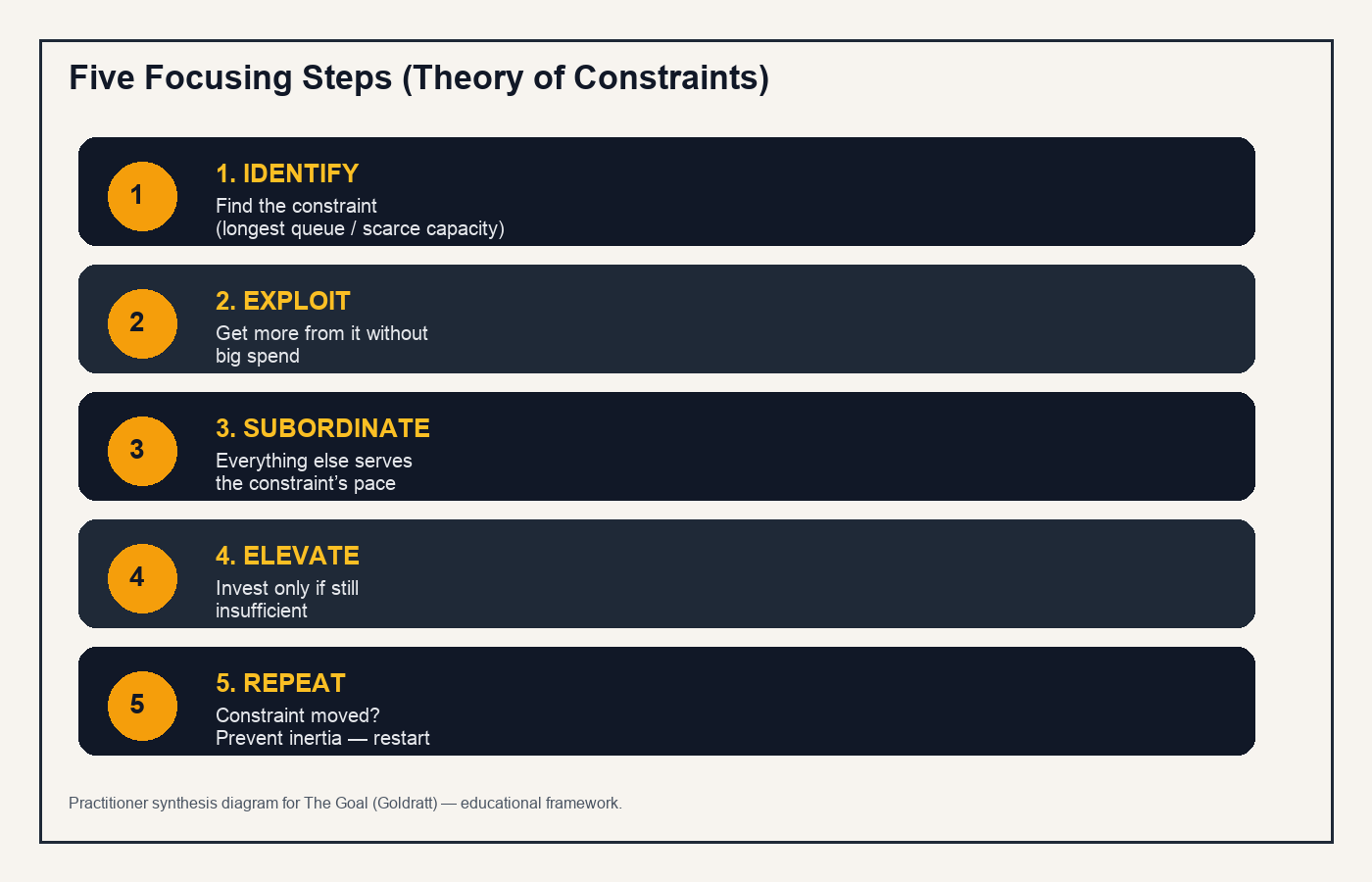
Figure: identify → exploit → subordinate → elevate → repeat (practitioner synthesis).
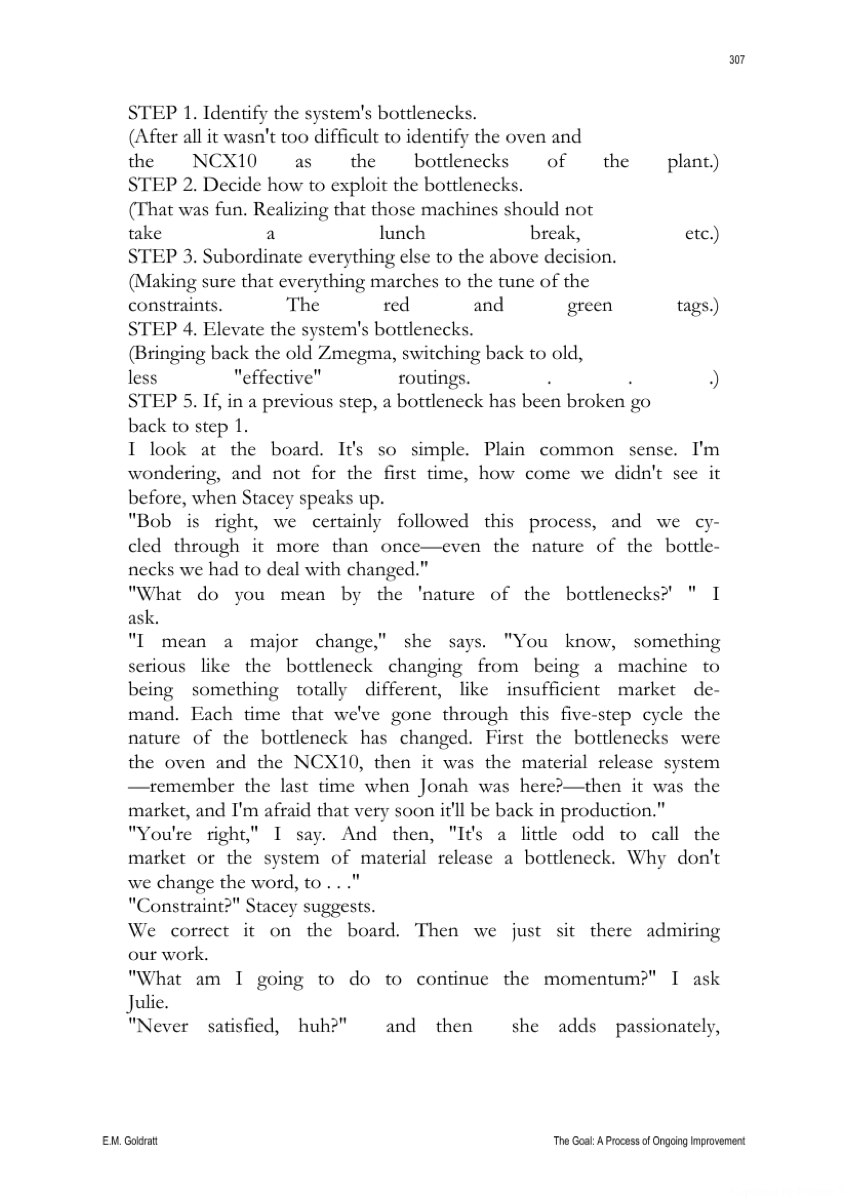
Figure: educational illustration from later chapters of The Goal on the process of ongoing improvement.
5.1 Step 1 — Identify
Where does work wait? Which scarce skill or machine limits output? Use queue data and WIP age—not hallway consensus.
5.2 Step 2 — Exploit
Get more out of the constraint without big spend:
- Improve quality into the constraint (no junk work arrives)
- Ensure constraint is never idle (no meetings during drum time)
- Prioritise highest-throughput work through the constraint
- Offload non-constraint work from the constraint’s calendar
5.3 Step 3 — Subordinate
All other processes must serve the constraint’s pace. Non-bottlenecks should not run “as fast as possible.”
| Subordinate action | Example |
|---|---|
| Release work at drum rate | Only N projects enter build per week |
| Pause low-value WIP | Kill zombie tickets blocking review |
| Align functional KPIs | Reward finished throughput, not starts |
Failure mode: Announcing the constraint in a town hall but leaving individual bonuses on local utilisation.
5.4 Step 4 — Elevate
If still insufficient after exploit + subordinate, invest: add capacity, automate, hire, change technology.
Rule: Do not elevate before exploit. Buying GPUs before fixing eval queue is elevation theatre.
5.5 Step 5 — Repeat (inertia warning)
When the constraint moves, policies that protected the old constraint become harmful. Re-diagnose monthly.
6. Drum-Buffer-Rope (DBR)
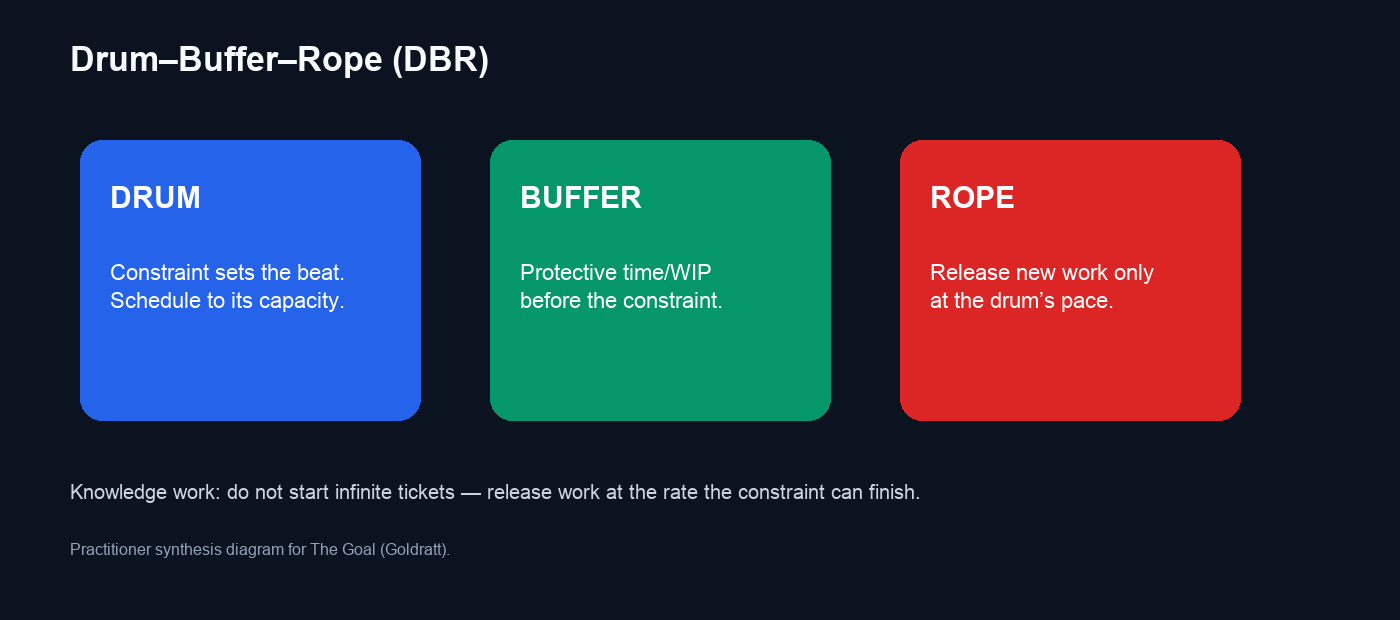
Figure: schedule to the constraint, protect it with a buffer, and rope new work releases to its pace.
| Element | Role |
|---|---|
| Drum | Constraint sets the beat (schedule) |
| Buffer | Time/protective inventory before the constraint |
| Rope | Release of new work tied to the drum so WIP does not explode |
Manufacturing intuition: Do not release material faster than the bottleneck can process.
Knowledge-work DBR: Do not start infinite tickets; release work at the rate the constraint (principal review, security sign-off, GPU eval) can finish.
6.1 Buffer management
Buffers are not waste—they absorb variability before the constraint starves. Monitor buffer consumption:
| Buffer state | Action |
|---|---|
| Healthy | Continue drum pace |
| Consuming fast | Expedite upstream quality; protect constraint |
| Empty | Constraint will starve—stop new releases |
7. Herbie and the hike — intuition pump
In the novel, a slow scout (“Herbie”) paces the troop: putting him at the front and redistributing load increases the group’s speed. System speed equals constraint speed—after you help the constraint.
| Hike lesson | Operations lesson |
|---|---|
| Help Herbie | Exploit constraint |
| Don’t push from the back | Subordinate non-bottlenecks |
| Pack weight off Herbie | Quality in before constraint |
8. Novel arc — key plot lessons (synthesis)
Goldratt spreads theory across ~40 chapters. Practitioners extract these recurring beats:
| Story beat | TOC lesson |
|---|---|
| Late orders despite busy plant | Local efficiency ≠ throughput |
| Batch size debates | Smaller batches often help flow |
| Quality at bottleneck | Defects at constraint are catastrophic |
| Marriage subplot | Systems thinking applies beyond factory |
| Promotion pressure | Short-term cuts can destroy T |
You do not need the novel’s every romance scene for operations work—but the emotional resistance to idle machines is the same resistance to “waiting” knowledge workers.
9. Applying TOC to consulting delivery
9.1 Typical constraints
| Domain | Common constraint |
|---|---|
| Consulting | Partner review hours; client decision latency |
| Software | Integration/test environment; senior design review |
| GenAI delivery | Evaluation / red-team capacity; data access approvals |
| Sales+delivery | Scarce SME for pursuits |
9.2 Exploit examples
- Pre-check deliverable quality before partner review
- Standardise templates so review is faster
- Batch client decisions in steering (reduce setup waste)
- Kill low-throughput WIP that blocks the constraint
9.3 Subordinate examples
- Stop starting new workstreams without partner capacity
- Delay non-critical internal projects consuming SMEs
- Align sales promises to drum capacity
9.4 Metrics to watch
| Instead of | Prefer |
|---|---|
| 100% utilisation | Throughput of finished value |
| Tasks started | Cycle time / WIP age |
| Local team velocity only | System queue before constraint |
| Billable hours | Cash collected / extensions |
10. Applying TOC to AI pipelines
10.1 Common AI constraints
| Stage | Often constrained by |
|---|---|
| Data | Access, labelling, governance approval |
| Training | GPU quota—not always the real constraint |
| Evaluation | Red-team / domain expert review |
| Production | Change advisory board, security sign-off |
| Adoption | Client change management bandwidth |
10.2 Exploit without buying more GPUs
- Pre-validate datasets before ML engineer time
- Shared eval harness (constraint does not redesign tests per model)
- Automated smoke tests before human eval
- Tiered review: quick screen → deep review
10.3 Rope rule example
“No new model enters human eval until prior eval queue ≤ 5 items.”
11. Negative cases (expanded)
| Failure | Symptom | Fix |
|---|---|---|
| Bottleneck without evidence | Random “fix engineering” | Queue measurement |
| Elevate before exploit | Tooling spend; same delays | Exploit checklist first |
| Subordinate not enforced | WIP flood returns | Rope policy with teeth |
| Cost accounting myopia | Cut constraint protection | T-first decisions |
| Constraint moved invisibly | Old policies harm new flow | Monthly re-identify |
| Fake constraint | Optimise easy step | Follow the queue |
Health checklist
- Constraint named with queue evidence
- Exploit actions listed before budget requests
- WIP release policy (rope) written
- Buffer monitored (not infinite)
- Monthly re-identify constraint
12. Consulting engagement translation
| Client symptom | TOC diagnosis | Intervention |
|---|---|---|
| “Everyone is busy, nothing ships” | High I, low T | Identify constraint; rope |
| “Quality issues at go-live” | Defects hitting constraint late | Quality before constraint |
| “We need more headcount” | Maybe—or wrong exploit | Exploit before elevate |
| “Agile velocity up, revenue flat” | Local optima | System throughput metric |
Pair with Disciplined Entrepreneurship: scaling (Step 24) before unit economics work is elevating a broken drum.
13. Capstone — one-week TOC sprint
- Map the value stream for one offer.
- Measure wait times at each step for five items.
- Name the constraint with data.
- List three exploit actions; execute this week.
- Write one rope rule; enforce it.
- Report T / I / OE proxies to the team.
- Schedule constraint re-identification in 30 days.
14. Novel chapter themes — practitioner map
Goldratt spreads theory across ~40 chapters. Use this map when reading or coaching teams:
| Chapter band | Plot / theme | TOC lesson |
|---|---|---|
| Early plant crisis | Late orders, angry customers | Local efficiency fails |
| Jonah conversations | “What is the goal?” | T, I, OE framing |
| Boy Scout hike | Herbie slows troop | Constraint sets system pace |
| Bottleneck discovery | Where work piles up | Identify via queues |
| Quality debates | Defects before NCX | Quality into constraint |
| Batch size fights | Small vs large lots | Flow vs false economy |
| DBR implementation | Drum, buffer, rope | Release work to drum |
| Management inertia | Old policies after fix | Step 5 — re-identify |
| Personal subplot | Marriage under stress | Systems thinking is personal |
You do not need every narrative beat for operations work—the resistance to idle capacity is the cultural battle in knowledge work too.
15. Throughput accounting vs cost accounting (plain language)
| Cost accounting habit | Throughput thinking |
|---|---|
| Cut idle time everywhere | Idle non-bottleneck can be optimal |
| Reward utilisation | Reward finished throughput |
| Allocate overhead to units | Ask effect on T, I, OE |
| Buy cheaper machine on non-bottleneck | Invest at constraint first |
Consulting fee model example: Discounting to keep juniors at 100% utilisation while partner review queues grow increases I and delays T—even if margin per hour looks stable.
16. Multi-project portfolio TOC
When several client projects share one constraint (e.g. one architecture review board):
| Policy | Rationale |
|---|---|
| Single prioritised queue | Avoid hidden multitasking at constraint |
| WIP limit per stage | Rope across portfolio |
| Kill or pause lowest-T projects | Exploit constraint time |
| Buffer before steering gates | Absorb client schedule variability |
Pair with High Output Management for managerial leverage at the constraint.
17. AI factory extended example
| Stage | Queue signal | Exploit (no new budget) |
|---|---|---|
| Data ingest | Tickets waiting on legal | Pre-approved template contracts |
| Feature eng | Idle waiting for labels | Active learning sampling |
| Training | GPU queue long | Schedule off-peak; smaller experiments |
| Eval | Red-team backlog | Automated regression first |
| Deploy | CAB monthly | Pre-approved patterns library |
Rope example: “Maximum three models in human eval at once.”
18. Exploit tactics catalogue (by constraint type)
| Constraint type | Exploit tactics (before elevate) |
|---|---|
| Partner review | Pre-review checklist; delegate L1 review |
| Client decision | Batch decisions; exec sponsor cadence |
| Security sign-off | Pre-approved patterns; shift-left scans |
| Data access | Template DPA; synthetic data for dev |
| GPU quota | Smaller experiments; off-peak scheduling |
| Expert eval | Automated regression; tiered human review |
19. Subordinate policies — sample library
| Policy | What it prevents |
|---|---|
| WIP limit per person | Context switching |
| No-start rule without capacity | Rope violation |
| Kill tickets >30 days idle | Inventory bloat |
| Single prioritisation queue | Constraint starvation |
| Freeze non-critical internal work | SME drain |
Enforce subordinate before buying capacity (elevate).
20. TOC in agile / kanban language
| Agile concept | TOC translation |
|---|---|
| WIP limits | Rope + buffer |
| Cycle time | System flow to throughput |
| Velocity | Dangerous if local—watch constraint queue |
| Stand-up blockers | Often queue before constraint |
| Sprint commitment | Must match drum capacity |
Negative case: Team velocity up 40%; releases still late—constraint moved to CAB and nobody re-identified.
21. Executive steering narrative (consulting)
When client leadership celebrates utilisation:
- Show queue chart before constraint (Situation).
- Show delayed throughput £ impact (Complication).
- Recommend exploit + subordinate before headcount (Answer).
Use Minto SCQA + one SWD queue chart.
22. Monthly TOC operating rhythm
| Week | Activity |
|---|---|
| 1 | Measure WIP age by stage |
| 2 | Re-identify constraint |
| 3 | Implement one exploit action |
| 4 | Review buffer consumption; adjust rope |
23. Goldratt follow-on reading (TOC body of work)
| Work | Extends The Goal by… |
|---|---|
| It's Not Luck | Thinking processes; conflict resolution |
| Critical Chain | Project management at constraint |
| Necessary but Not Sufficient | ERP / software as constraint illusion |
| The Choice | TOC as life philosophy |
For consulting PMOs, Critical Chain pairs directly with multi-project Section 16.
24. Constraint elevation decision tree
Constraint identified & exploited?
  No → return to Step 2 Exploit
  Yes → subordinate enforced 2+ weeks?
    No → enforce rope/WIP limits first
    Yes → throughput still insufficient?
      No → monitor; prevent inertia (Step 5)
      Yes → elevate (hire, automate, buy)
Do not skip branches—especially subordinate before elevate.
Discussion
Comments
Share feedback or questions about this page. No account required.
Loading comments…