SPIN Selling: Neil Rackham’s Research-Backed Method for Major Sales
In small sales, clever closes and feature pitches can work. In major sales—large value, multiple stakeholders, long cycles—Rackham’s Huthwaite research showed that traditional closing pressure often reduces success. SPIN Selling replaces folklore with behaviours correlated with winning: diagnose problems, expand implications, and let buyers articulate payoffs. The book is not a script; it is an evidence-backed operating system for complex B2B and consulting pursuits.
Source note: This article is an original practitioner synthesis of themes from Neil Rackham’s SPIN Selling. It is not a reprint. Figures are educational illustrations from the work; support the original research-backed book for full studies, appendices and practice drills.
0. Why this book still matters
Sales training is crowded with 1920s-era folklore: open questions beat closed questions, objections must be “handled,” and the close is the climax. Rackham’s contribution is uncomfortable for trainers who sell those courses: what works in small sales often fails—or backfires—in major sales.
The Huthwaite research programme analysed thousands of calls across industries. Top performers in major sales were not distinguished by more closes, better objection handling, or more open questions. They were distinguished by how they investigated needs—especially Implication and Need-payoff questions—and by when they demonstrated capability.
Three commitments organise the whole work:
- Major sales have different psychology. Multi-call cycles mean the decisive conversations happen when you are not in the room.
- Needs must be developed, not assumed. Implied pain is not enough; explicit needs drive action.
- Capability demonstration is timing-sensitive. Benefits after explicit needs; Features and Advantages before that create objections.
If your pursuit process cannot show explicit needs on paper before a demo, you are not running SPIN—you are running a product tour.
1. Chapter 1 — Sales behaviour and sales success
1.1 The research shock
Rackham opens with a meeting that went badly: a sales VP expected confirmation that closing, objection handling and open probing separate stars from laggards. The data said otherwise. Successful major-account calls had fewer closes, fewer objections, and no difference in open vs closed question ratios.
The implication is strategic: if you train major-account teams on small-sale techniques, you may be training failure.
1.2 The classic sales-call model (and where it breaks)
Traditional models describe four stages:
| Stage | Small-sale assumption | Major-sale reality |
|---|---|---|
| Opening | Personal rapport + benefit statement | Over-eager openings can reduce credibility |
| Investigating | Open questions uncover needs | Question type matters more than open/closed |
| Demonstrating capability | Features and Advantages persuade | Benefits tied to explicit needs persuade |
| Obtaining commitment | Strong closes win | Pressure closes create regret and stall |
Rackham does not dismiss these stages. He shows that behaviours within each stage must change as deal size and complexity rise.
1.3 Defining the major sale
Major sales share traits practitioners recognise immediately:
| Characteristic | Why it changes selling |
|---|---|
| Long cycle | Decisions happen between calls, not only in your presence |
| High value | Personal and organisational risk rise; buyers need justification |
| Multiple stakeholders | Champions must resell internally; economic buyers may never attend your demo |
| Complex solution fit | Needs are latent, political and cross-functional |
Consulting translation: A £50k SaaS renewal is not a major sale in Rackham’s sense. A £2m multi-year AI transformation with steering committees, security review and procurement is.
1.4 Questions and success
The research pivot: success correlates with Investigating quality, not closing theatrics. Questions are not neutral—they either develop urgency or waste airtime.
Diagnostic: In your last lost pursuit, did you have documented explicit needs from the economic buyer—or only implied pain from a friendly user?
2. Chapter 2 — Obtaining commitment: closing the sale
2.1 What closing means in major sales
Closing is not a verbal trick at the end. In major sales, commitment means advances: agreement on the next step that moves the decision forward with the right people.
| Commitment type | Example advance |
|---|---|
| Access | Intro to economic buyer or security lead |
| Information | Shared data for a business case |
| Action | Pilot design workshop with DMU present |
| Decision | Signed SOW, PO or steering approval |
2.2 Why traditional closes fail at scale
Photo-store and field studies showed:
- More closing attempts correlate with lower success in large sales
- Closing pressure increases post-sale dissatisfaction when buyers feel rushed
- Sophisticated buyers recognise closing techniques and resist
Negative case: A consulting partner uses assumptive closes in a steering meeting. The champion says yes to end the meeting; procurement reverses the decision two weeks later because explicit needs were never developed.
2.3 Closing and client sophistication
As buyers become more professional (procurement, formal evaluation), closing tricks lose power. Success shifts to building internal conviction through Implication and Need-payoff—so the buyer team closes itself when you are absent.
2.4 Effective commitment behaviours
| Behaviour | Practice |
|---|---|
| Check concerns continuously | “What would make this a bad idea?” early |
| Summarise benefits tied to explicit needs | Not feature recap |
| Propose realistic next step | One clear advance, not “sign today” |
| Match commitment request to call stage | First meeting ≠ contract signature |
AI pursuit example: After discovery, advance = “joint eval criteria workshop with ops + risk + finance”—not “send proposal Friday.”
3. Chapter 3 — Customer needs in the major sale
3.1 How needs develop
Needs do not arrive fully formed. They evolve through conversation:
In small sales, implied needs may suffice (“I’m thirsty” → buy a drink). In major sales, implied needs are necessary but insufficient.
3.2 Implied vs explicit needs
| Need type | Definition | Example |
|---|---|---|
| Implied | Problem, difficulty, dissatisfaction | “Our agents re-key data constantly.” |
| Explicit | Clear want or desire for a solution | “We need to cut re-key time by 40% this year.” |
Buying signals strengthen as needs become explicit. Your job is development—not feature dumping on implied pain.
3.3 Buying signals in the major sale
| Signal strength | Typical form |
|---|---|
| Weak | General interest, polite questions |
| Moderate | Implied need statements, problem detail |
| Strong | Explicit need, value quantification, internal selling language |
| Strongest | Specific implementation questions, stakeholder mobilisation |
Trap: Mistaking enthusiasm for an explicit need. “This is cool” is not “We must fix this in Q3.”
4. The SPIN question sequence
4.1 Situation questions
Gather facts about context. Necessary—but overuse bores buyers and signals unpreparedness.
| Do | Don't |
|---|---|
| Research stack, org, metrics before the call | Ask 20 questions Google could answer |
| Ask Situation questions that unlock Problem paths | Interrogate for its own sake |
| Time-box early context | Let Situation dominate the meeting |
Consulting rule: Send a one-page “what we already know” before discovery; use live time for Problem and Implication.
4.2 Problem questions
Explore difficulties and dissatisfactions. They uncover implied needs.
Examples for AI/consulting pursuits:
- “Where does handoff fail today?”
- “Which steps create the most rework?”
- “What breaks when volume spikes 40%?”
- “Where do auditors push back?”
Problem questions alone can feel negative. They set up Implication.
4.3 Implication questions
Explore consequences of problems—cost, risk, political exposure, missed goals. They make implied needs feel larger and more urgent.
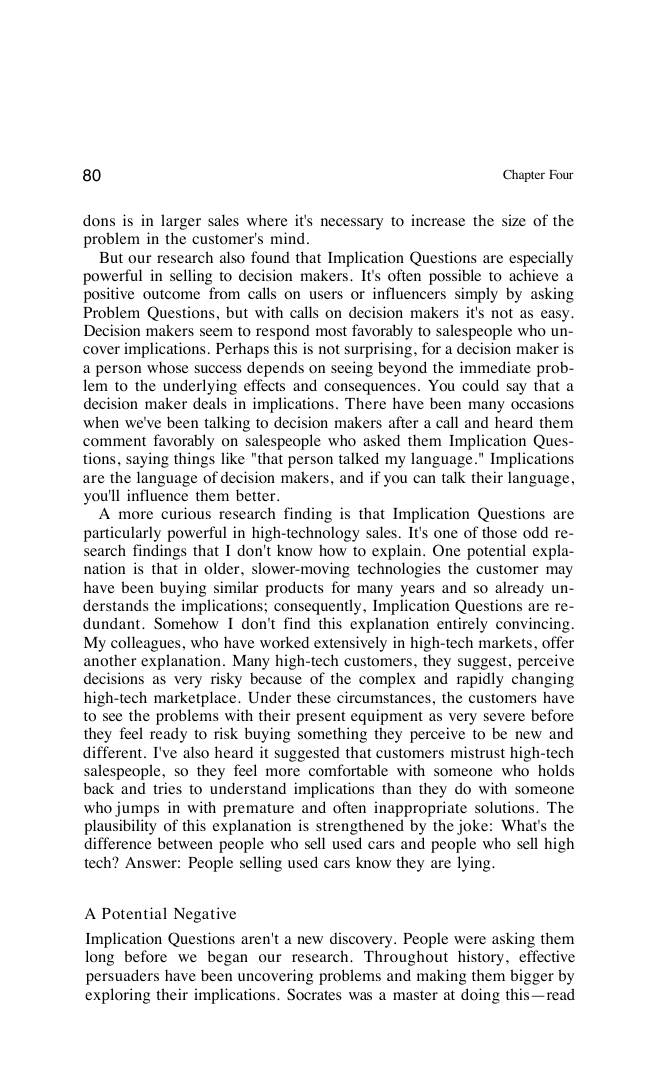
Figure: Implication questions link problems to wider business consequences.
| Problem (implied) | Implication chain |
|---|---|
| Manual re-key | → errors → rework → SLA breaches → regulatory exposure |
| Slow model deployment | → missed campaign window → revenue loss → exec credibility hit |
| No eval harness | → hallucination incidents → brand risk → project freeze |
Tone matters: Implication is not accusation. It is joint exploration of “what happens if this persists?”
4.4 Need-payoff questions
Ask about the value or usefulness of solving the problem—so the buyer states benefits.
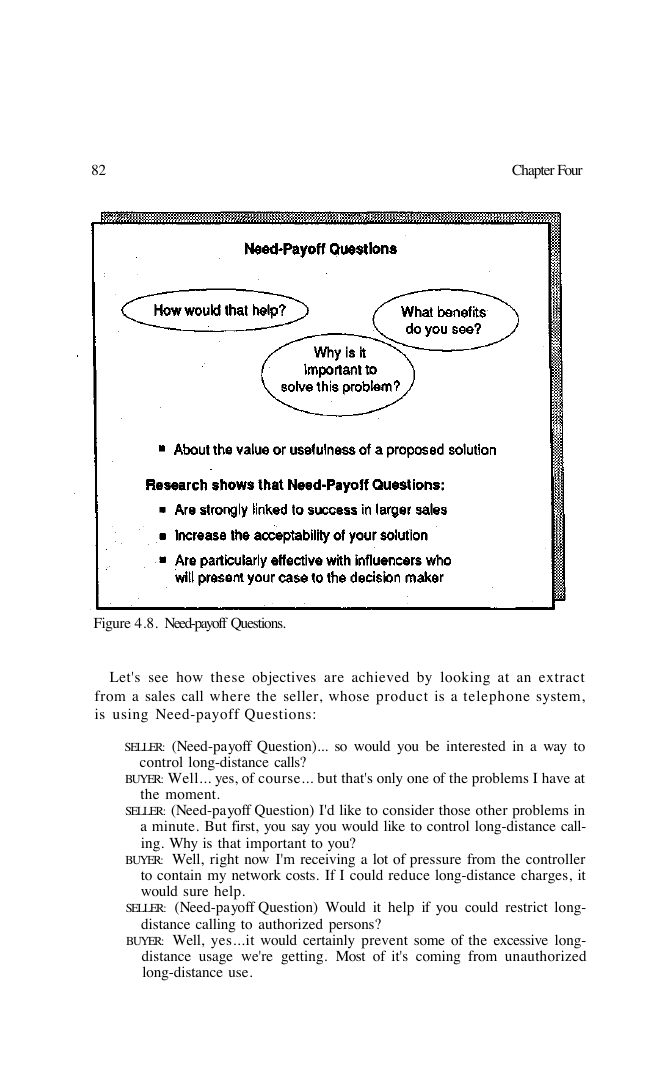
Figure: Need-payoff questions build acceptability—especially with influencers who must resell internally.
| Need-payoff prompt | Why it works |
|---|---|
| “How would solving that help?” | Buyer voices benefit |
| “Why is it important to fix now?” | Buyer owns urgency |
| “What would change if you cut that time in half?” | Quantification emerges |
| “Who else would benefit internally?” | Coalition building |
Need-payoff is especially powerful with influencers who must sell upward without you in the room.
4.5 Implication vs Need-payoff
| Implication | Need-payoff | |
|---|---|---|
| Focus | Pain of not solving | Value of solving |
| Emotional tone | Serious, consequential | Positive, forward-looking |
| Risk if overused | Interrogation | Premature optimism if problem not real |
| Sequence | Usually before Need-payoff | After problem is credible |
4.6 SPIN summary table
| Question type | Purpose | Risk if overused |
|---|---|---|
| Situation | Context | Irritation / laziness signal |
| Problem | Implied needs | Negativity without path forward |
| Implication | Urgency and scale | Feels interrogative if tone is wrong |
| Need-payoff | Buyer-owned benefits | Too early before problem is real |
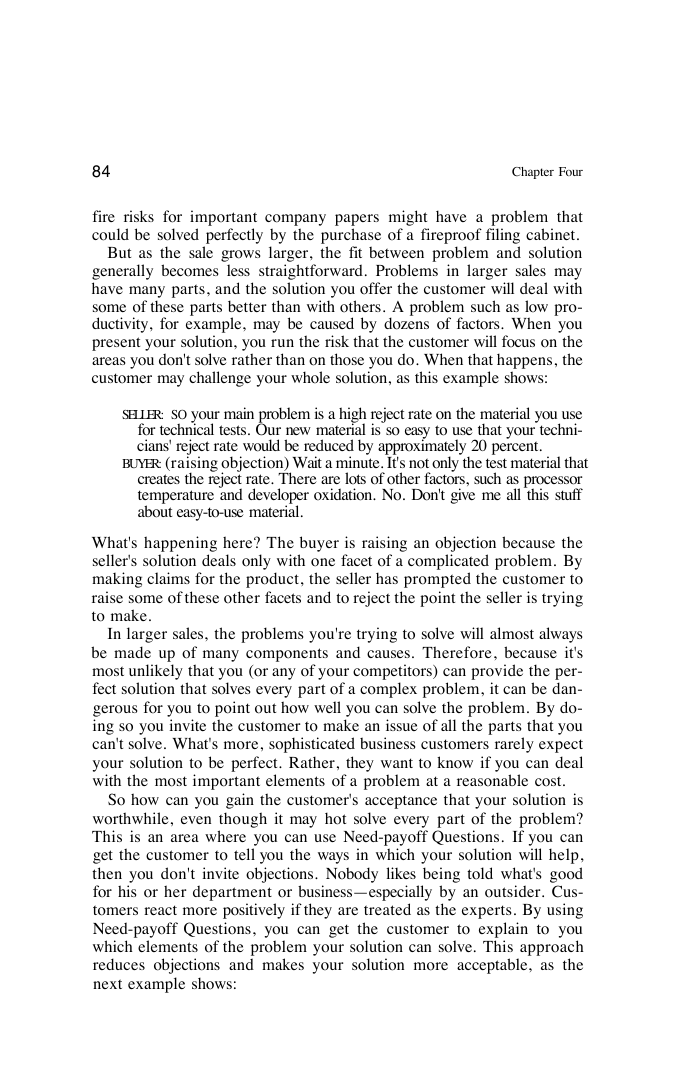
5. Demonstrating capability — Features, Advantages, Benefits
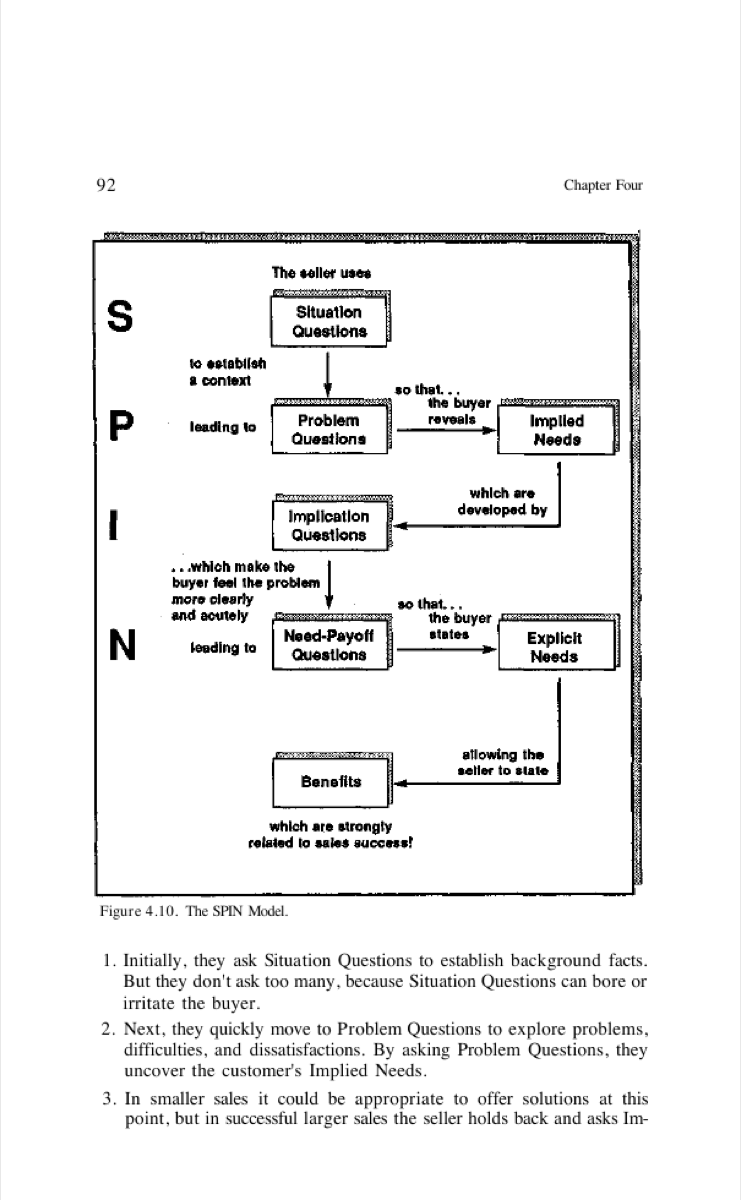
Figure: educational illustration from SPIN Selling on demonstrating capability effectively.
5.1 Rackham’s definitions
| Term | Meaning | Major-sale impact |
|---|---|---|
| Feature | Fact about the product | Weak alone |
| Advantage | How a feature helps / could be used | Can create objections if premature |
| Benefit | Shows how capability meets an explicit need | Strongly linked to success |
Rule: Pitch Benefits after SPIN has created explicit needs. Early Advantage showers create price and objection thrash.
5.2 Why Advantages backfire
When you demonstrate Advantages before explicit needs exist, buyers raise new concerns you triggered:
- “That would require integration we cannot fund.”
- “Security will never approve that.”
- “We tried something similar and it failed.”
These are not random objections—they are seller-created.
5.3 Benefit statements that work
Template: Because you said [explicit need], [capability] means [outcome they stated].
| Weak (Advantage) | Strong (Benefit) |
|---|---|
| “We have RAG with citations.” | “Because you need audit-ready answers for Tier-1, citation-locked retrieval cuts review time without raising hallucination risk.” |
| “Our team has 200 consultants.” | “Because you must hit Q3 with only two internal FTEs, our accelerator gets you to pilot in six weeks—not eighteen.” |
5.4 Demo design under SPIN
| Demo section | Tie to |
|---|---|
| Opening | Recap explicit needs (their words) |
| Each scene | One explicit need → one Benefit |
| Appendix | Features for technical validators |
| Close | Advance + Need-payoff confirmation |
6. Preventing objections
6.1 Objection prevention vs handling
Rackham’s data: top performers get fewer objections, not better rebuttals.
Common seller-caused objections:
- Pitching Features/Advantages before needs are explicit
- Creating unnecessary concerns with irrelevant capability
- Not involving the real economic buyer early
6.2 Objection prevention checklist
- Explicit needs documented before capability demo
- DMU map includes blockers invited early
- No “surprise” pricing or scope in late stage
- Benefits use buyer vocabulary, not vendor jargon
Pair with Never Split the Difference: labels and tactical empathy when objections surface—but SPIN says prevent first.
7. Opening the call
7.1 Openings in major sales
Classic training: personal rapport + immediate benefit statement. Rackham: in major sales, over-familiar or premature benefit openings can reduce trust with senior buyers.
Effective opening frame:
| Element | Content |
|---|---|
| Purpose | Why we are meeting |
| Permission | To ask questions |
| Time-box | Respect for their calendar |
| Focus | Their issues—not your slide museum |
7.2 Preliminaries vs Investigating
Preliminaries should be short. The differentiator is Investigating. If your “discovery call” is 80% you talking, you skipped the book.
8. Turning theory into practice — learning SPIN
8.1 Rackham’s learning rules
- Practise one behaviour at a time (e.g. Implication only for two weeks)
- Use safe calls for deliberate practice
- Quantity of practice beats theory consumption
- Review recordings against SPIN counts—not gut feel
8.2 Call review scorecard
- Situation questions (count; aim low after research)
- Problem questions
- Implication questions (quality > quantity)
- Need-payoff questions
- Explicit needs captured in notes
- Benefits linked to those needs
- Advance agreed
8.3 Team coaching cadence
| Week | Focus | Metric |
|---|---|---|
| 1 | Reduce Situation; add Problem | Problem count per call |
| 2 | Implication chains | Implication per implied need |
| 3 | Need-payoff | Buyer-stated benefits recorded |
| 4 | Benefit-only demos | Objection rate |
9. Appendix themes — evaluating the model
Rackham addresses sceptics directly: correlation is not always causation; field adoption at Motorola Canada and other programmes strengthened confidence. For practitioners, the practical test is behavioural: run SPIN discipline on a pursuit cohort for one quarter and compare advance rates, objection counts and win/loss quality—not slide count.
10. Consulting and AI pursuit translation
10.1 Pursuit moment map
| Pursuit moment | SPIN use |
|---|---|
| Discovery workshop | Problem + Implication across ops, risk, finance |
| Champion coaching | Need-payoff so champion can sell internally |
| Demo | Only Benefits tied to documented explicit needs |
| Commercial | Implications of delay / status quo priced |
| Security review | Situation homework first; do not Situation-interrogate live |
| Procurement | Explicit needs → Benefit summary in their template language |
10.2 Integration with adjacent methods
| Method | SPIN pairing |
|---|---|
| Disciplined Entrepreneurship | Quantified value (Step 8) feeds Implication |
| Obviously Awesome | Positioning sets Problem hypotheses |
| Never Split the Difference | Labels when Implication surfaces emotion |
| Minto Pyramid Principle | Proposal = explicit needs as governing answer |
10.3 Negative cases (expanded)
| Failure mode | Symptom | Fix |
|---|---|---|
| Endless Situation | “Tell me about your stack” for 30 minutes | Pre-read + Problem-first |
| Demo after one Problem | No urgency, no economic buyer | Implication chain to exec sponsor |
| Need-payoff before Problem | Hollow optimism | Sequence discipline |
| SPIN as script | Robotic interrogation | Conversational tone + summaries |
| Champion-only selling | Win in workshop, lose in board | Need-payoff with economic buyer |
| Feature arms race | Compete on Advantages | Return to explicit needs |
10.4 AI-specific SPIN prompts
| Stakeholder | Problem | Implication | Need-payoff |
|---|---|---|---|
| COO | Where does manual work break at scale? | What happens to margin at +40% volume? | How would 30% handle-time reduction change your plan? |
| CRO | Where do reps lose deals in the funnel? | Cost of inconsistent messaging? | What would uniform playbooks unlock? |
| CISO | Where is shadow AI today? | Exposure if an incident hits media? | What would governed self-serve change for the board? |
11. Capstone: one opportunity SPIN sheet
Use this template for every major pursuit:
- Pre-call Situation — What must we know before the call? (research, not live questions)
- Top 5 Problem hypotheses — From positioning and industry pattern
- Implication chains — Problem → cost / risk / politics (three hops minimum)
- Need-payoff prompts — For champion and economic buyer separately
- Explicit needs gate — What must we hear before pitching?
- Benefit statements — Mapped 1:1 to explicit needs (their words)
- Advance — Realistic next step for this meeting only
- Post-call — Explicit needs updated? Objections seller-caused?
12. Practitioner checklist before proposal
- At least two explicit needs from economic buyer or written delegate
- Implication documented in business case currency (£, risk, time)
- Demo script contains zero orphan Features
- Champion has Need-payoff quotes they can reuse internally
- Advance path to signature mapped with dates
13. Major-account call stages — behaviour map
| Stage | Top performer behaviours | Underperformer behaviours |
|---|---|---|
| Preliminaries | Short; permission to ask | Long rapport; early pitch |
| Investigating | SPIN sequence; few Situation | Feature questions; stack interrogation |
| Capability | Benefits after explicit needs | Advantage dump; demo-first |
| Commitment | Advance; concern check | Hard close; pressure |
14. Implication chain library (consulting)
Build reusable chains by industry:
| Industry | Problem seed | Implication hops |
|---|---|---|
| Banking CS | Manual policy lookup | → handle time → SLA → reg risk |
| Insurance claims | Adjuster rework | → cycle time → combined ratio → fraud exposure |
| Retail ops | Forecast error | → stockout → margin → customer churn |
| Public sector | FOIA backlog | → statutory breach → reputational → legal cost |
Each hop should be testable with the buyer (“Is that fair?”).
15. Need-payoff question bank
| Role | Need-payoff starters |
|---|---|
| Champion | “How would solving X help your team hit OKRs?” |
| Economic buyer | “What would fixing this mean for the P&L line you own?” |
| Technical buyer | “How would reliable eval change your sign-off process?” |
| Procurement | “What would a clear ROI model enable on your side?” |
Record answers verbatim for proposal governing thought (Minto).
16. Benefits vs advantages — extended examples
| Explicit need (buyer words) | Advantage (weak) | Benefit (strong) |
|---|---|---|
| “Cut Tier-1 handle time 25%” | “We have fast inference” | “Because you need 25% handle-time reduction, our cached policy answers hit sub-3s p95” |
| “Audit-ready AI decisions” | “We use RAG” | “Because audit requires lineage, every answer links to source paragraph + model version” |
| “Deploy in 90 days” | “We have consultants” | “Because Q3 is immovable, our accelerator delivers MVBP in 11 weeks per prior insurer pilot” |
17. Objection prevention playbook
| Objection type | Usually caused by | Prevention |
|---|---|---|
| Price | Early advantage before value | Implication + quantified value |
| Security | Surprise architecture slide | Early CISO thread + Situation homework |
| “We can build” | Feature war | JTBD + time-to-value Implication |
| Priority | No economic buyer Need-payoff | Exec Need-payoff session |
| Integration | Unscoped complexity | Problem mapping before demo |
18. Multi-threading SPIN across DMU
| Meeting | Primary SPIN focus | Output |
|---|---|---|
| User workshop | Problem + Implication | Implied → explicit needs |
| Champion 1:1 | Need-payoff | Internal sell quotes |
| Economic buyer | Implication (P&L) + Need-payoff | Budget explicit need |
| Technical | Situation (homework) + Problem | Non-functional requirements |
| Procurement | Situation + Problem (process) | Commercial explicit needs |
19. Rackham research — practitioner implications
| Finding | Action |
|---|---|
| Closing ↓ success in major sales | Train advances not closes |
| Objections ↓ with top performers | Investigate better |
| Open/closed ratio neutral | Stop open-question fetish |
| Benefits correlate with wins | Gate demos on explicit needs |
| Situation overuse irritates | Pre-call research |
20. 90-day SPIN adoption programme
| Month | Focus | KPI |
|---|---|---|
| 1 | Problem + Implication quality | Chains documented per pursuit |
| 2 | Need-payoff + explicit needs | EB quotes on file |
| 3 | Benefit-only demos + advances | Objection rate; win rate |
Discussion
Comments
Share feedback or questions about this page. No account required.
Loading comments…