The Sales Acceleration Formula: Mark Roberge’s Data-Driven Playbook from $0 to $100M
Most sales advice is folklore: hire “hunters,” run motivational Monday, blame marketing for lead quality. Mark Roberge—MIT-trained engineer turned HubSpot’s first head of sales—built a formulaic, inspectable system that helped take HubSpot from early startup to roughly $100M: hire with a scorecard, train to a methodology, coach from metrics, generate demand inbound, align sales and marketing with SLAs, and run experiments like an engineering org. The Sales Acceleration Formula is the field manual for that machine.
Source note: This article is an original practitioner synthesis of themes from Mark Roberge’s The Sales Acceleration Formula (Wiley / HubSpot). It is not a reprint. Figures are educational illustrations from the work; buy the original for full HubSpot cases, scorecards and experiment narratives.
0. Why this book still matters
Organic growth strategies fail when sales cannot outsell competitors. Roberge’s contribution is not a clever close—it is an operating system: data to hire, curriculum to train, coaching to improve, inbound to scale demand, SLAs to align functions, experiments to evolve.
Buyer power shifted online; aggressive pitch culture underperforms. Statistics (and HubSpot’s experience) favoured intelligent, helpful sellers over high-pressure ones. The formulas operationalise that reality.
Part I — The Sales Hiring Formula
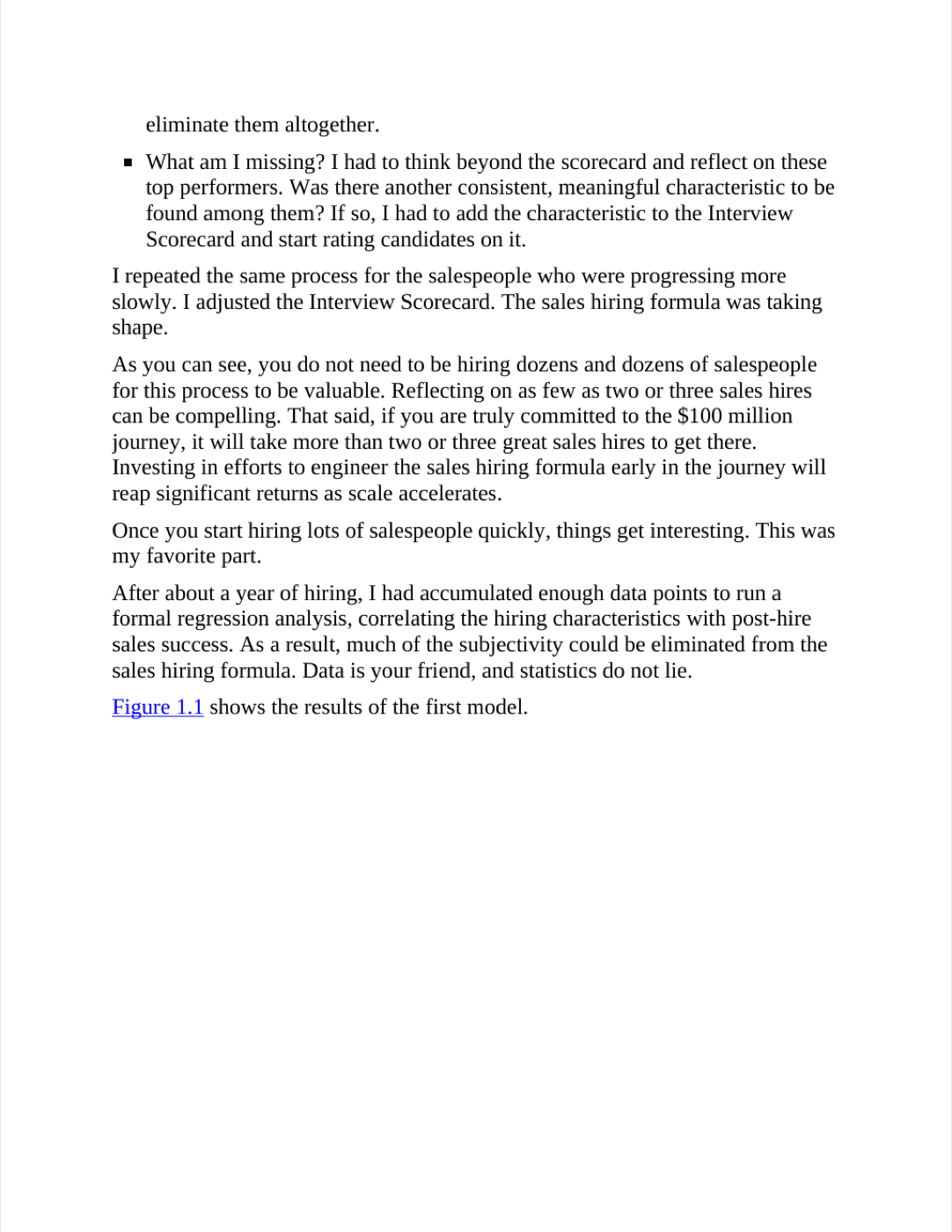
Figure: educational framing of the Sales Hiring Formula.
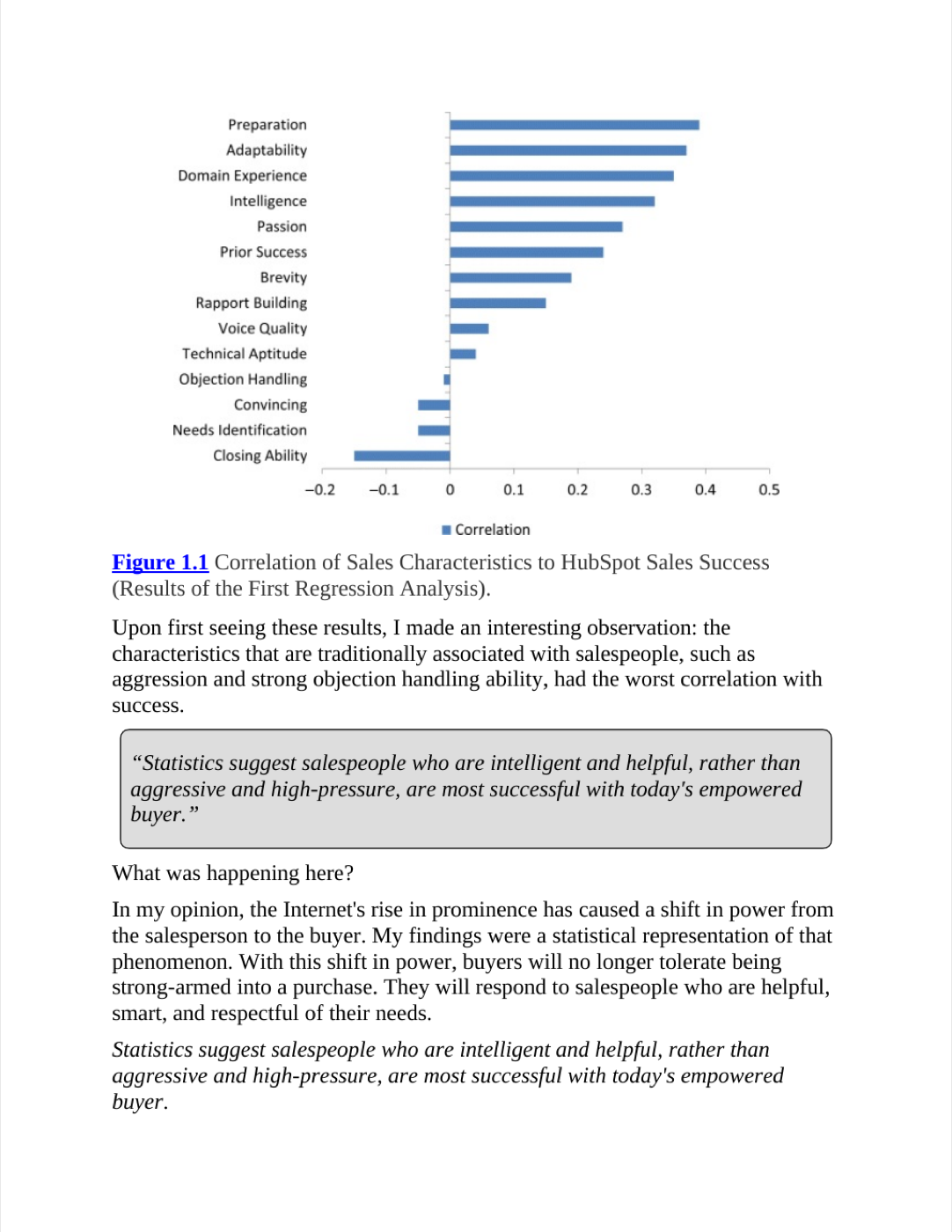
Figure: continued educational page on engineering the hire.
1.1 Engineer the hire; do not mythologise it
The ideal sales hiring formula differs by company. The process to engineer it is the same.
- Define the sales context (buyer, motion, ACV, cycle).
- Interview with a structured Interview Scorecard.
- Correlate scorecard traits with later performance.
- Reweight the scorecard; iterate slowly with data.
1.2 HubSpot’s five traits (context-bound, widely useful)
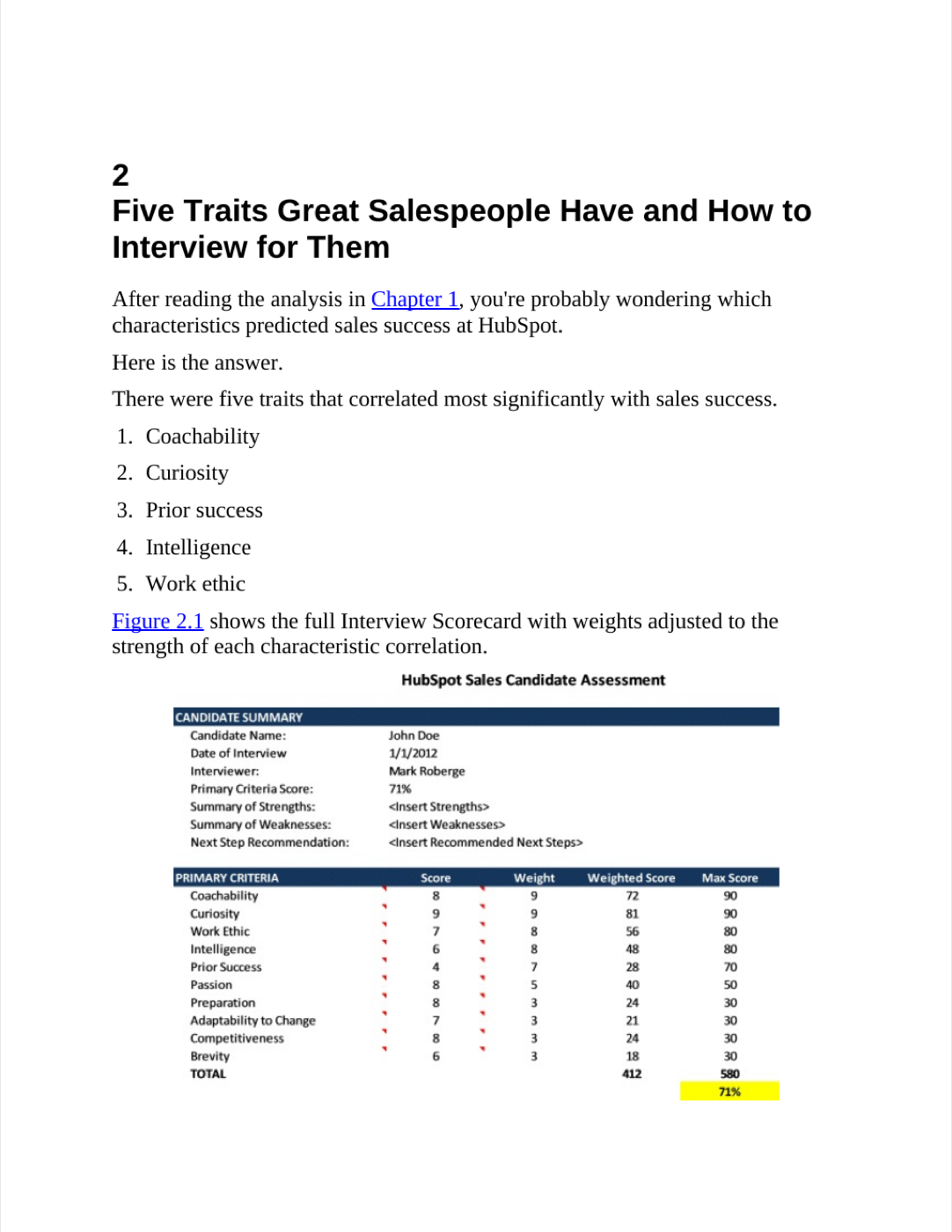
Figure: HubSpot-style sales candidate assessment / scorecard concept.
| Trait | Definition | Why it mattered |
|---|---|---|
| Coachability | Absorb and apply coaching | Strongest hiring signal in Roberge’s analysis |
| Curiosity | Question and listen without interrogation | Matches empowered buyers |
| Prior success | Evidence of excellence in prior domains | Pattern of high performance |
| Intelligence | Learn complex product/buyer context fast | Inbound + consultative motion |
| Work ethic | Sustained outbound/inbound discipline | Predictable activity → pipeline |
Do not copy HubSpot’s weights blindly. Copy the engineering loop.
1.3 Interviewing for coachability (three steps)
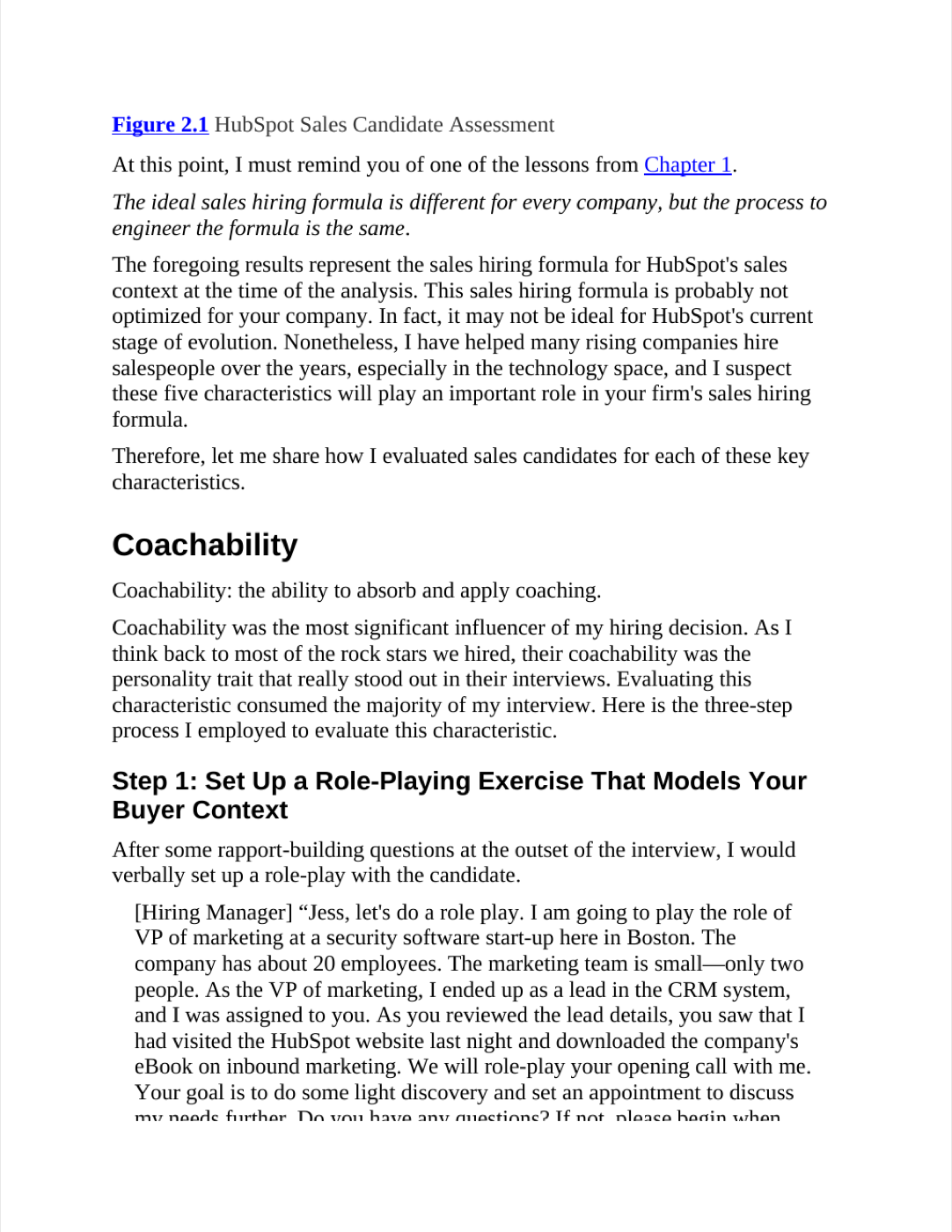
Figure: educational page on evaluating coachability via role-play.
- Role-play a realistic buyer context (inbound lead, light discovery, book next step).
- Self-diagnose — ask how they did; look for analytical reflection, not “I crushed it.”
- Coach → re-run — give one praise + one improvement; watch absorb-and-apply. Seek effortful improvement, not perfection. Rare perfect second passes are hire-at-all-costs signals.
1.4 Interviewing for curiosity
- Lobby test: do they ask thoughtful questions immediately?
- Role-play test: do they diagnose with open, non-interrogative questions?
- Party test (Roberge’s advice to students): can you question a stranger without talking about yourself—and leave them feeling interested, not grilled?
Negative case: Hiring a charismatic presenter who fails coachability. They peak in month one demo theatre and plateau forever.
Part II — The Sales Training Formula
2.1 Three elements of methodology
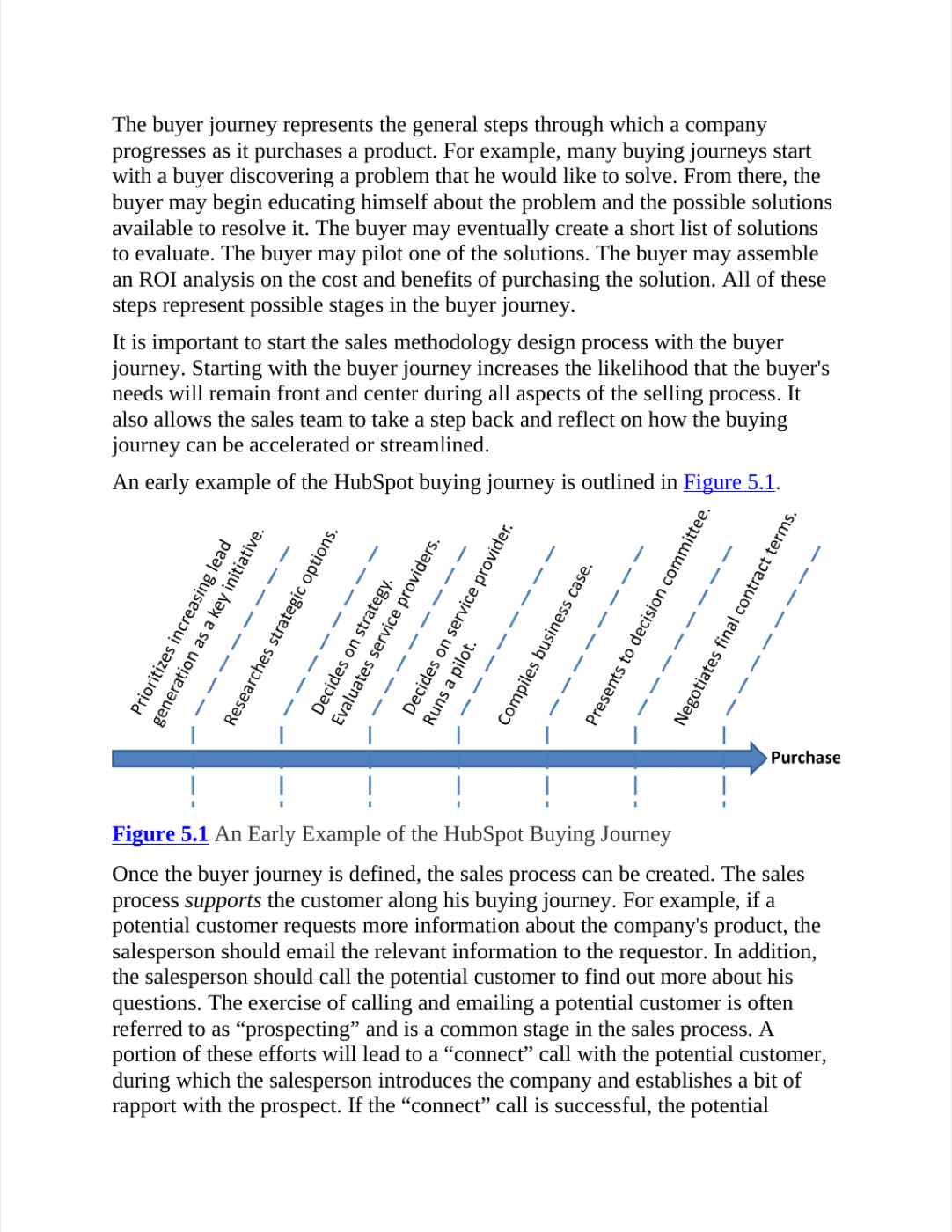
Figure: buyer journey framing for training design.
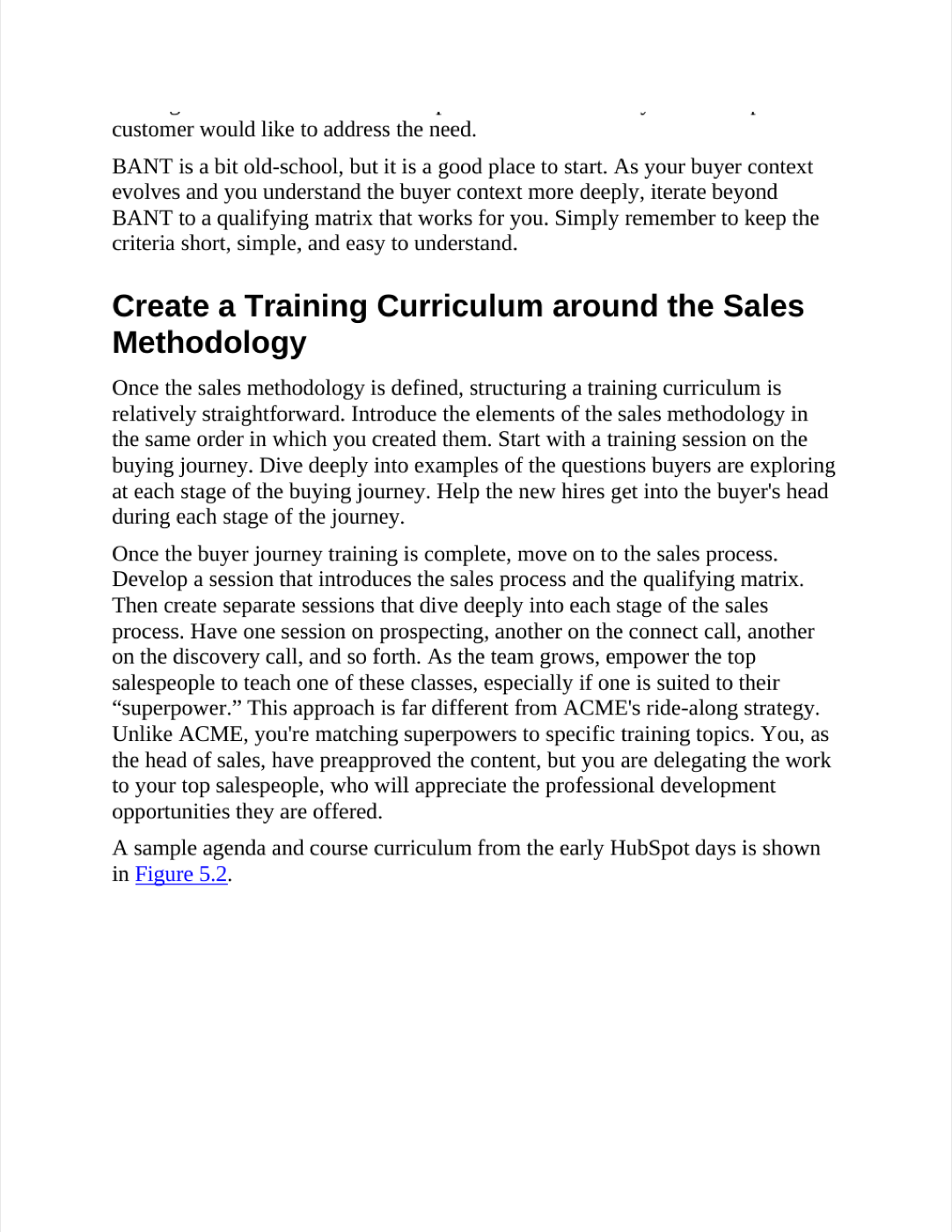
Figure: sales process element of the training formula.
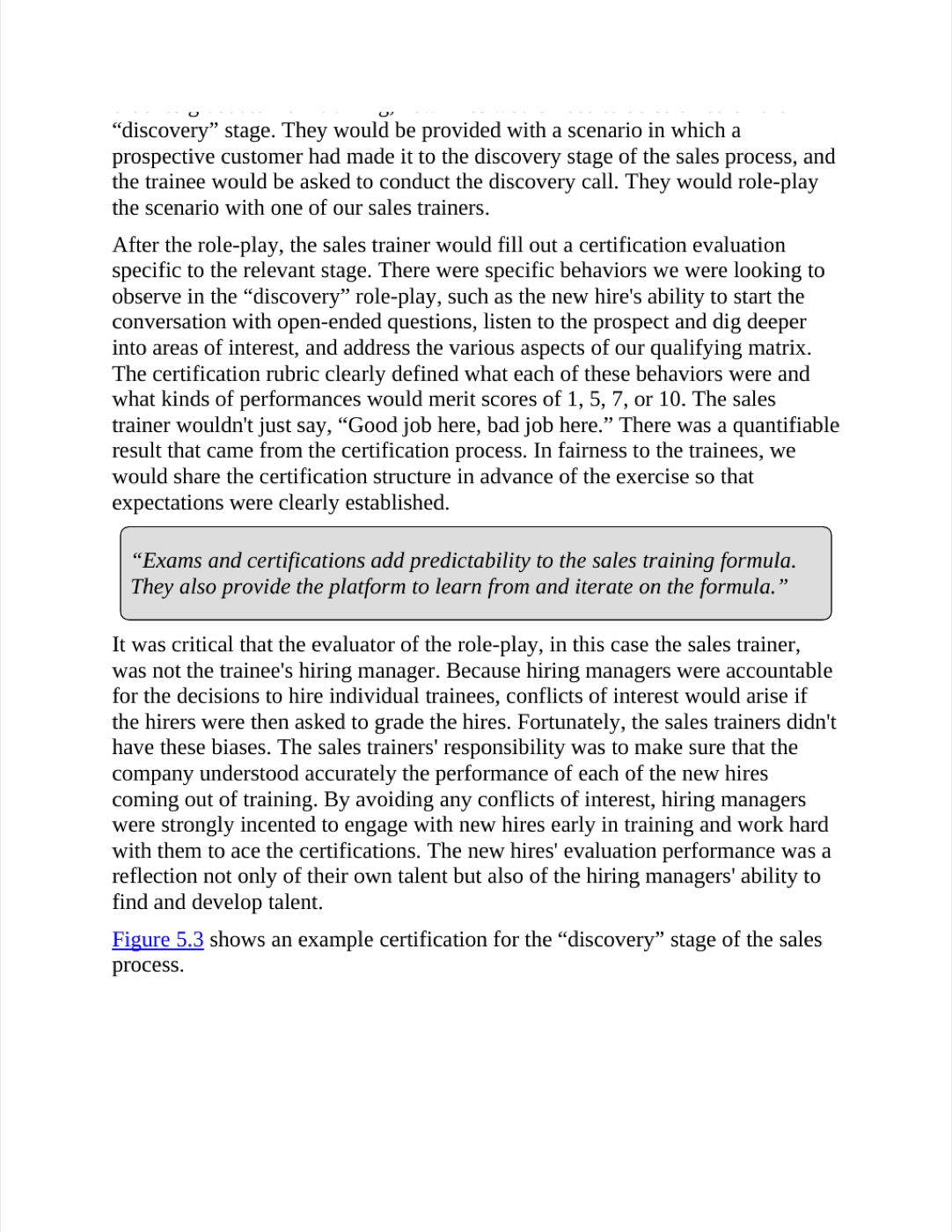
Figure: qualifying matrix element of the training formula.
| Element | Question it answers |
|---|---|
| Buyer journey | How buyers educate, research and select |
| Sales process | Stages and advances your team runs |
| Qualifying matrix | Who is worth scarce seller time |
Build a curriculum around these three; iterate as the market teaches you. Predictability comes from repeating a taught process—not from heroics.
2.2 Helpful sellers buyers trust
- Have sellers experience the day-to-day job of the customer (empathy as skill, not poster).
- Enable personal brand building on social so inbound trust starts before the first call.
Consulting translation: put new associates through a day-in-the-life of a claims adjuster or contact-centre lead before they sell “AI transformation.”
Part III — The Sales Management Formula
3.1 Metrics-driven sales coaching
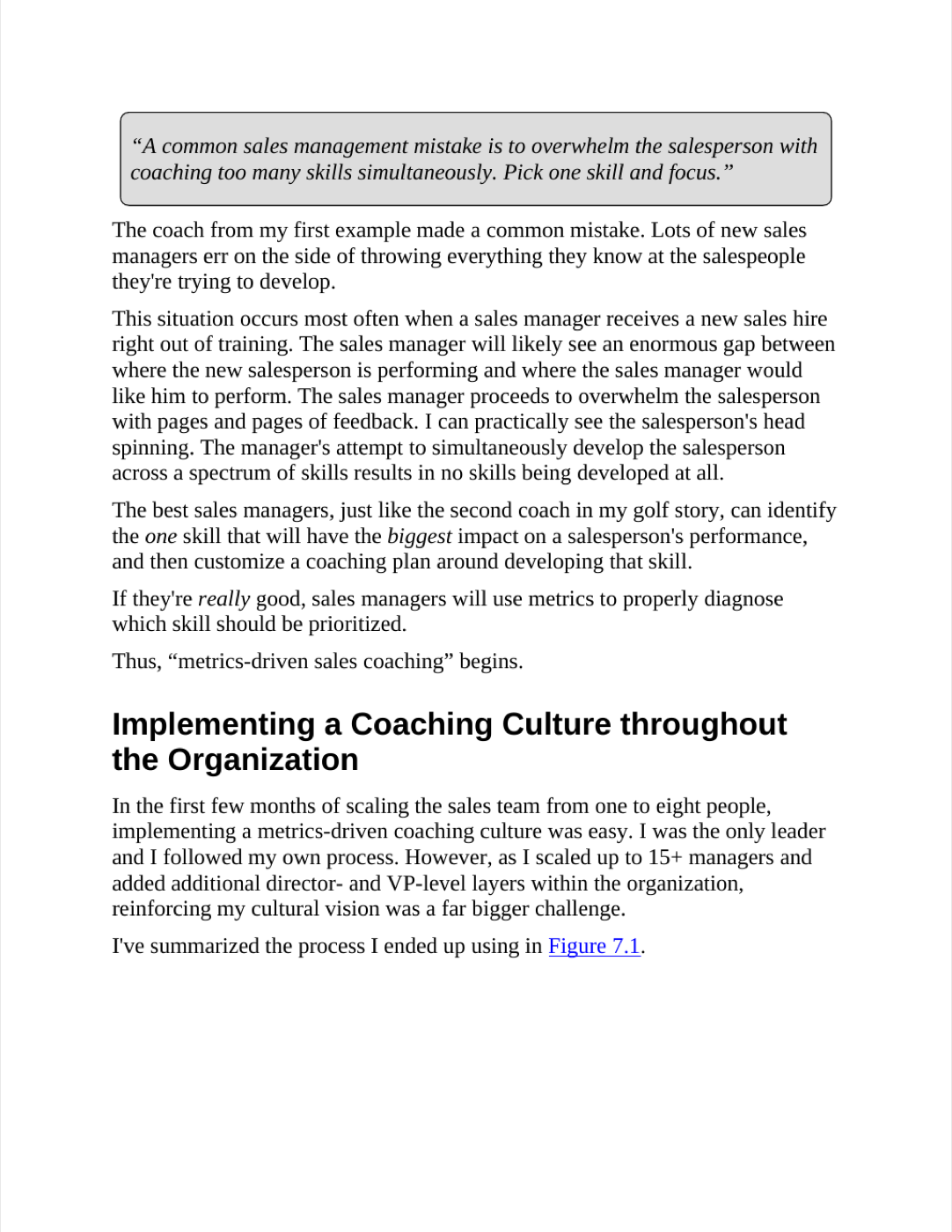
Figure: educational page on metrics-driven coaching culture.
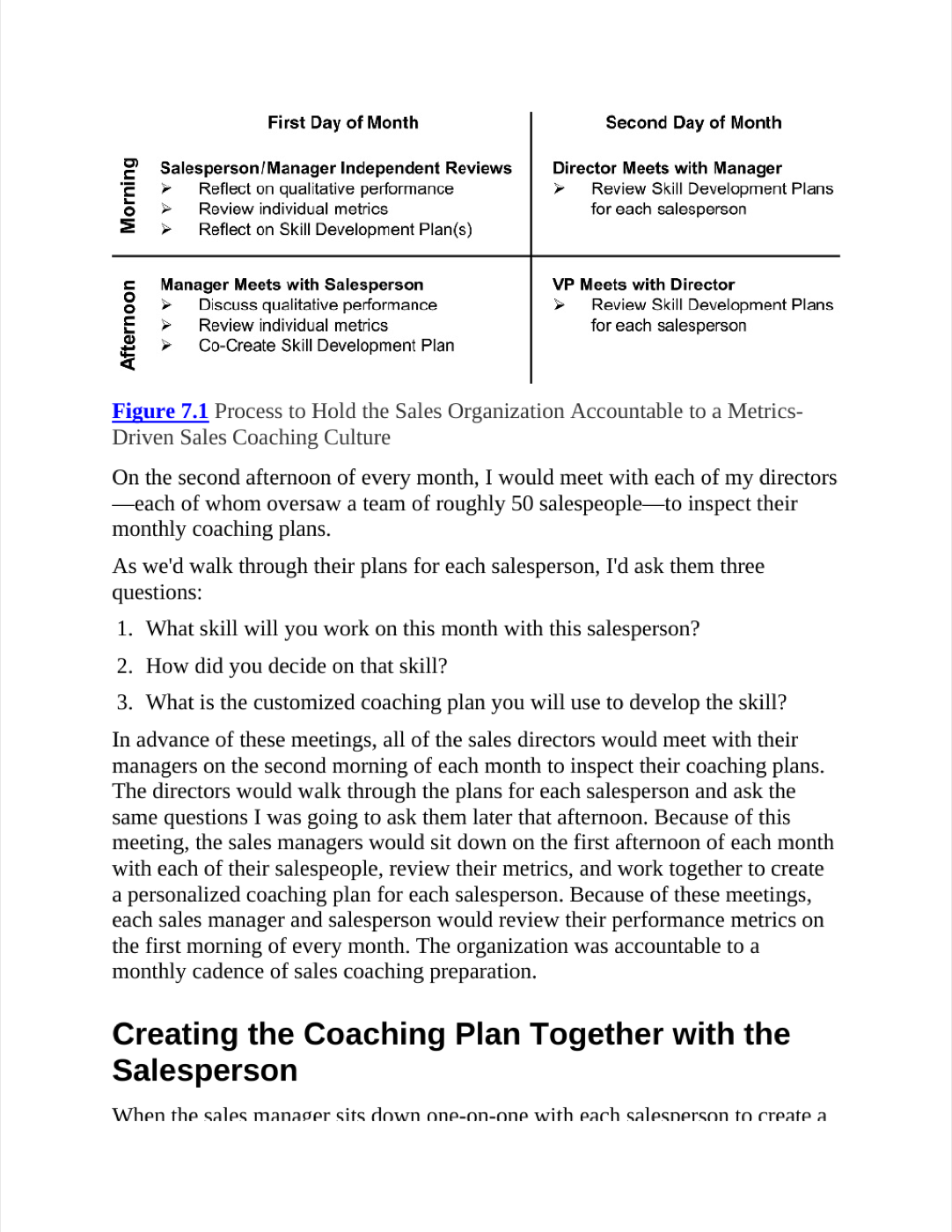
Figure: creating a coaching plan with the salesperson.
Roberge preferred “sales coaches” over classic managers. Coaching time is the scarce managerial lever—see also Grove’s leverage ideas in High Output Management.
| Coaching practice | Underperformer pattern |
|---|---|
| Diagnose skill from metrics | Generic “try harder” speeches |
| Co-create a coaching plan | Top-down mandates without buy-in |
| Peel the onion on root cause | Treating symptoms (e.g. low demos) only |
| Measure coaching success | No before/after skill metric |
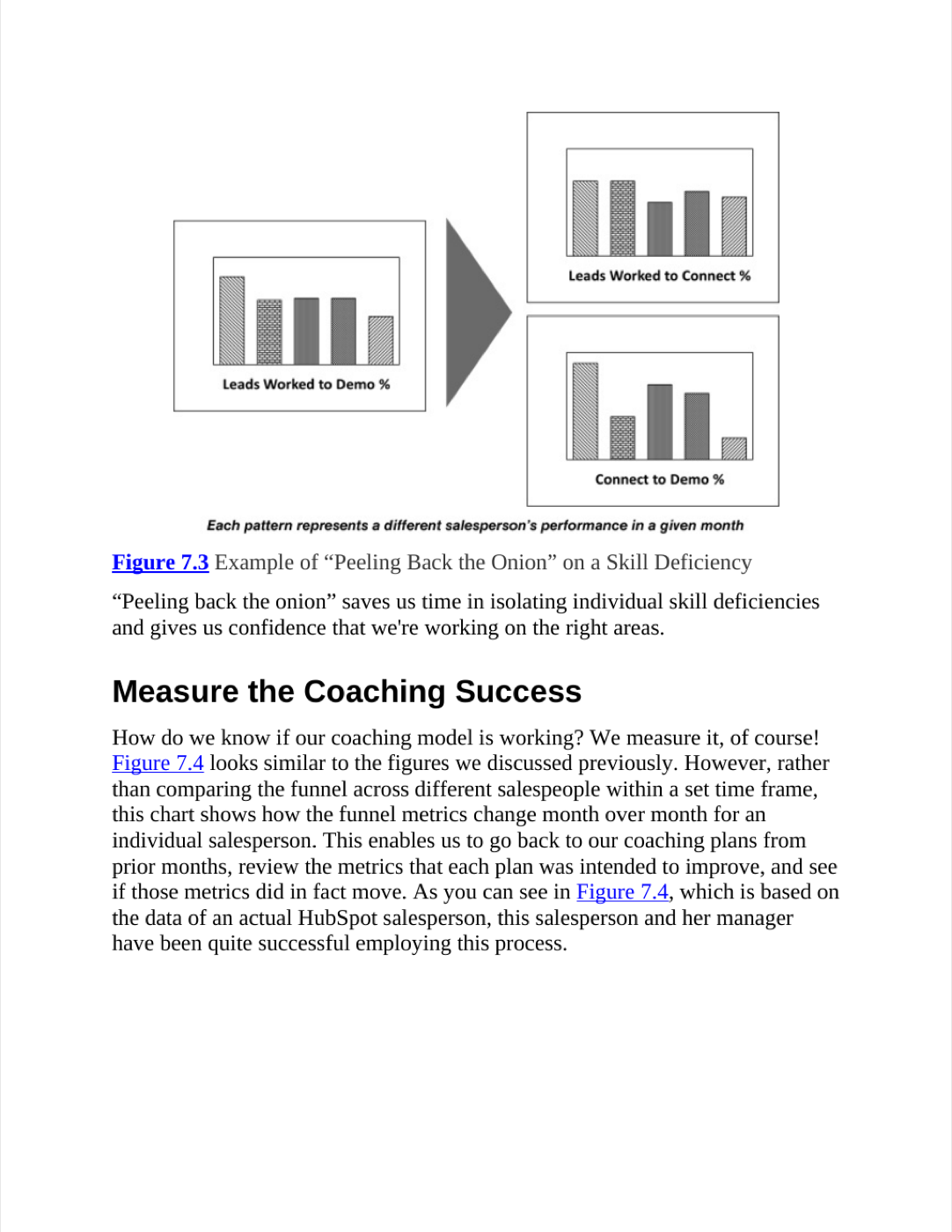
Figure: “peel back the onion” diagnostic coaching metaphor.
Example diagnostic chain: Low close rate → weak discovery → shallow goal understanding → train GPCT/SPIN depth → re-measure.
3.2 Compensation, contests, promotions
- Evaluate commission plans against clear criteria; involve the team in design.
- Use promotion tiers to remove subjectivity from compensation changes.
- Contests motivate when fair, short and aligned with long-term behaviour (not sandbagging).
3.3 Promote-from-within leaders
Prerequisites for leadership consideration; classroom ≠ real world. New managers commonly fail by overselling as “super rep” instead of coaching capacity into the team.
Part IV — The Demand Generation Formula
4.1 Flip the formula — get buyers to find you
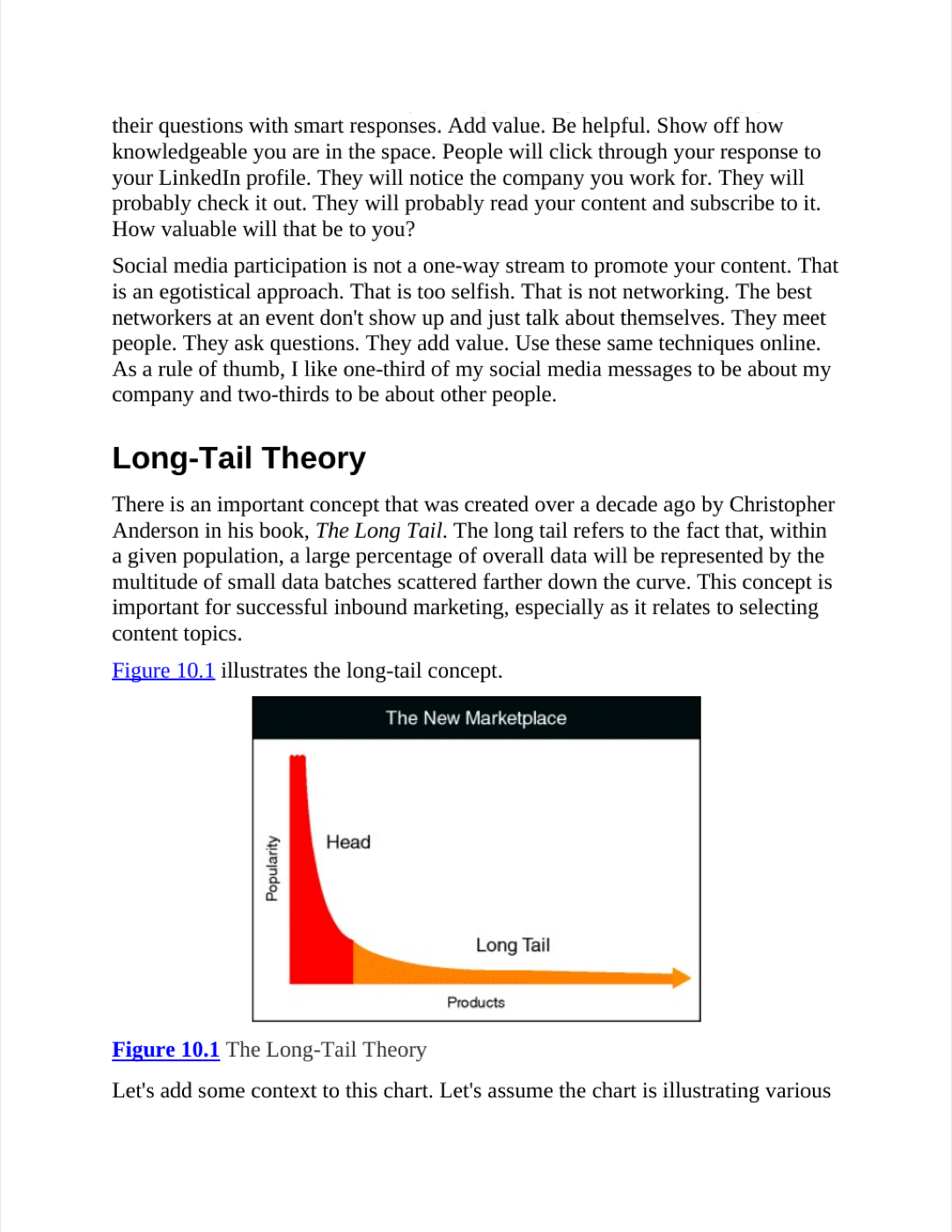
Figure: educational page on inbound / content-led demand generation.
Inbound is not “free leads.” It is a production system: content process, social participation, long-tail theory, patience for compounding search/authority.
Complement with Hormozi’s Core Four for a fuller channel map: $100M Leads.
4.2 Converting inbound interest into revenue
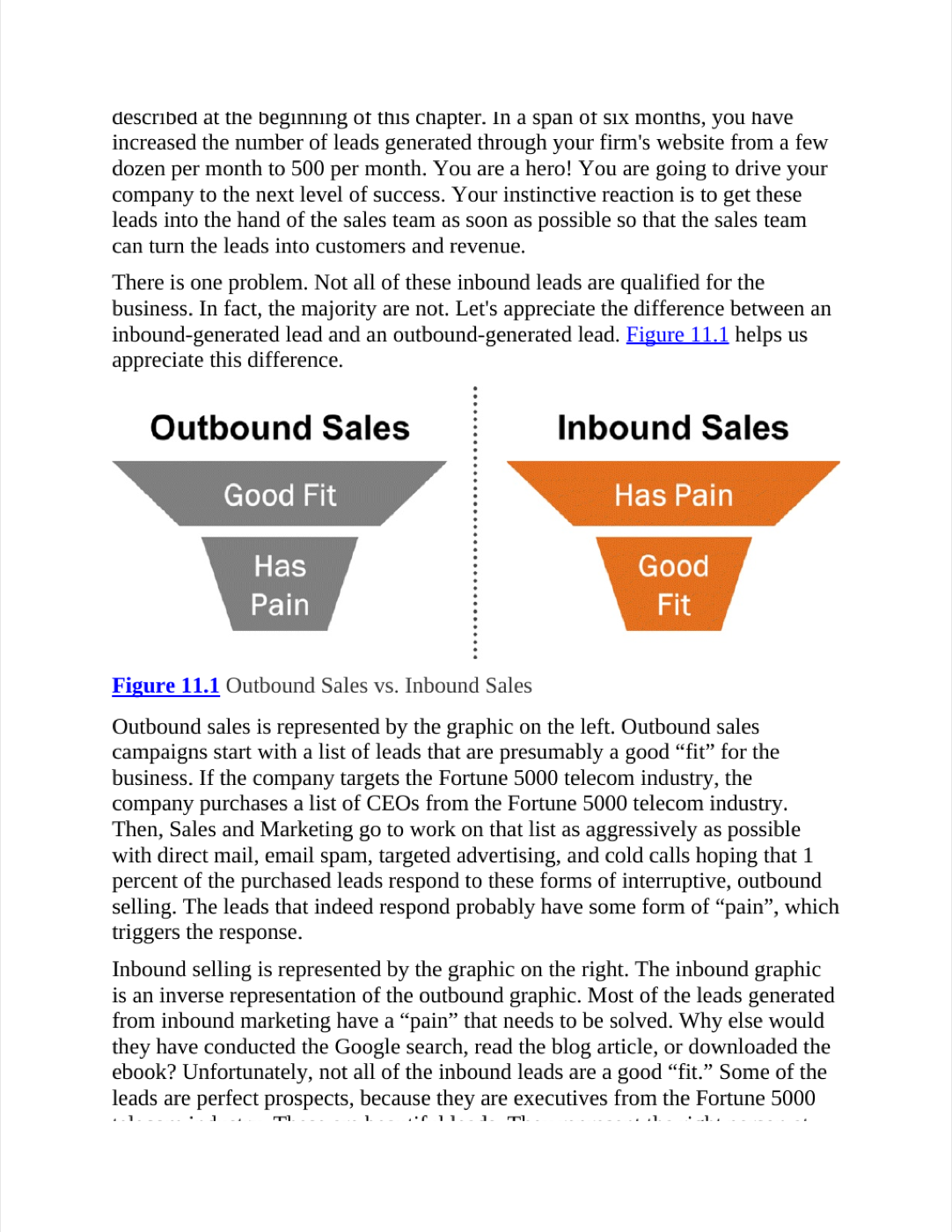
Figure: marketing and sales roles in converting inbound interest.
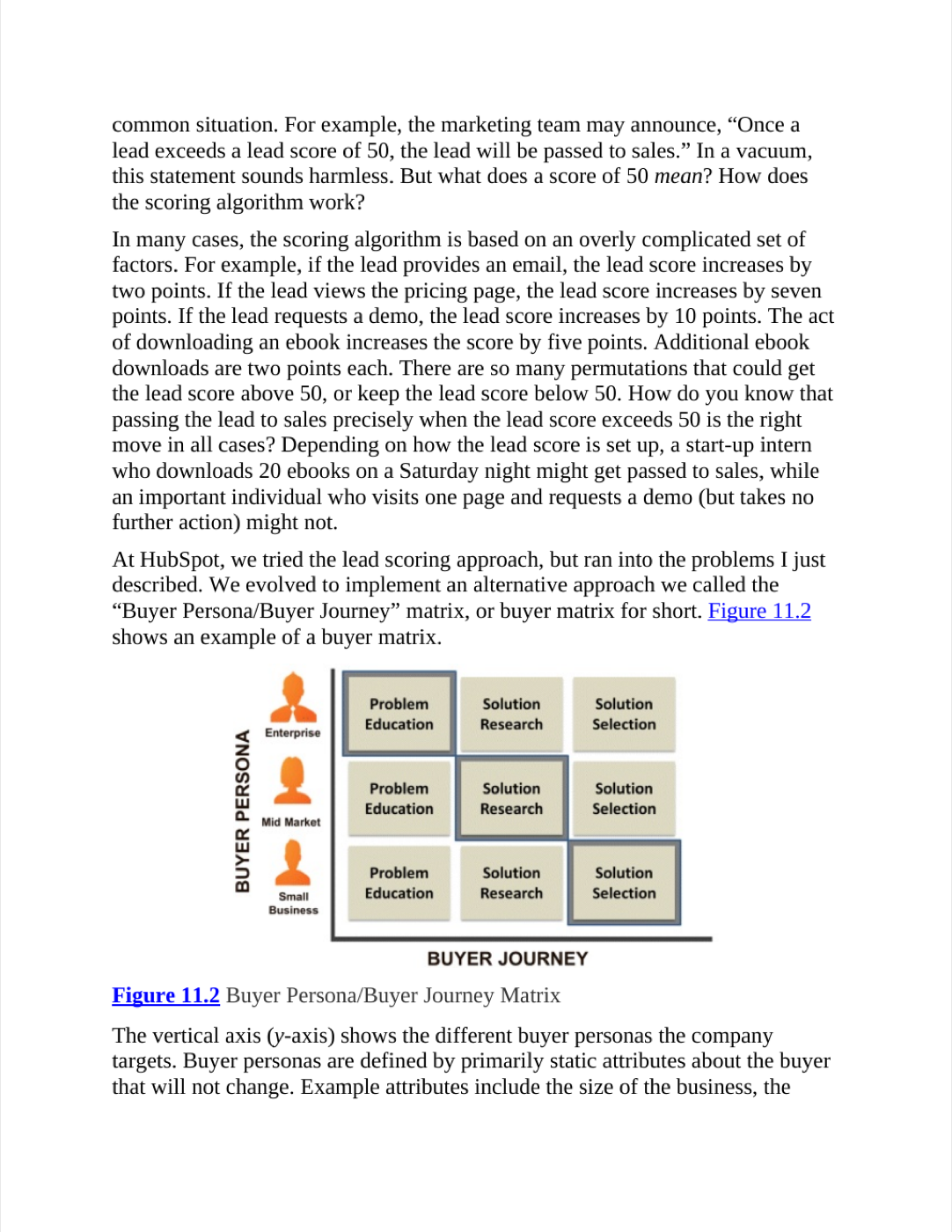
Figure: educational page on lead engagement / response discipline.
| Function | Conversion job |
|---|---|
| Marketing | Nurture, educate, score, route by buyer stage |
| Sales | Fast, helpful engagement; diagnose; advance |
Speed-to-lead and helpful first touches matter more than clever cadences on cold spam.
4.3 SMarketing SLA — implied lead dollar value
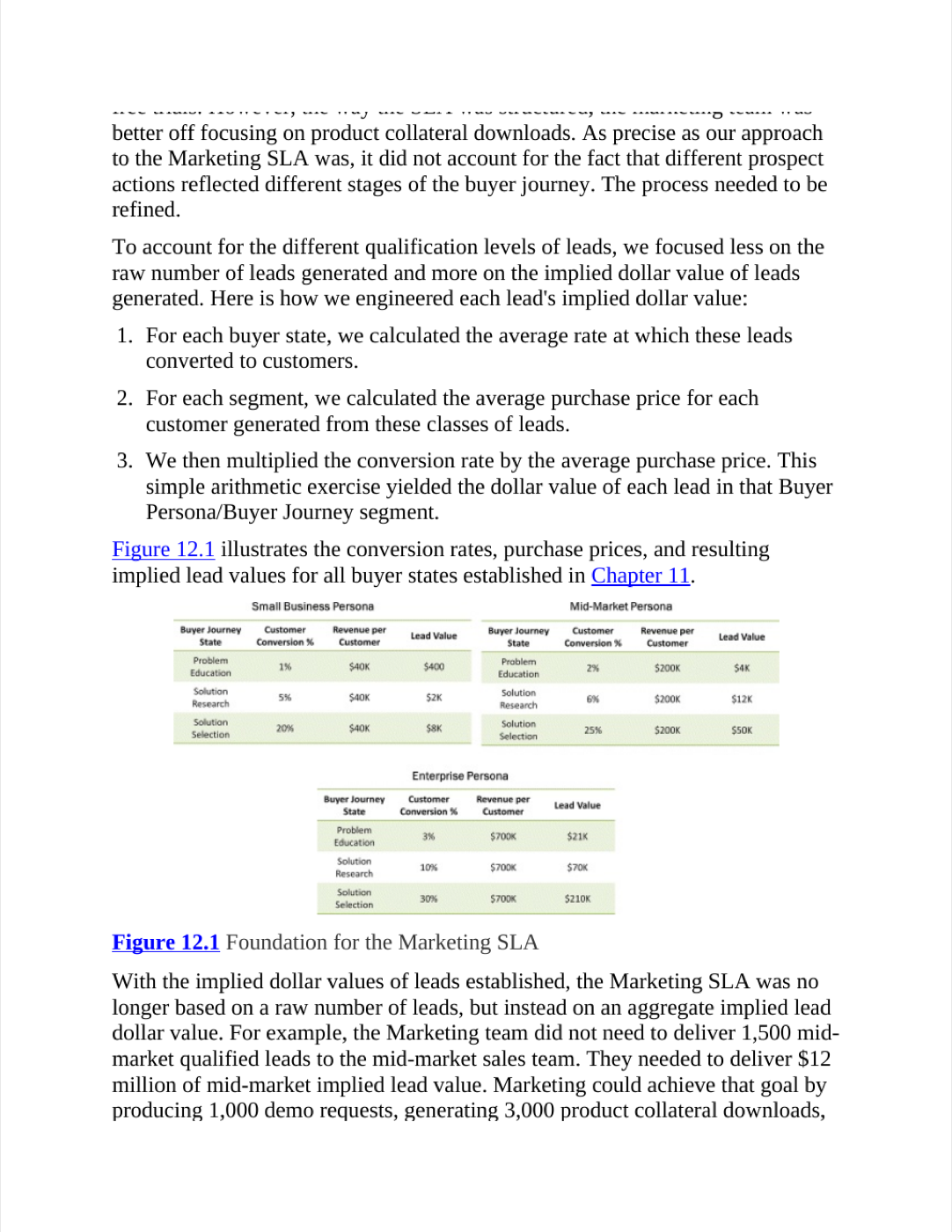
Figure: Foundation for the Marketing SLA—lead value by persona × buyer journey stage.
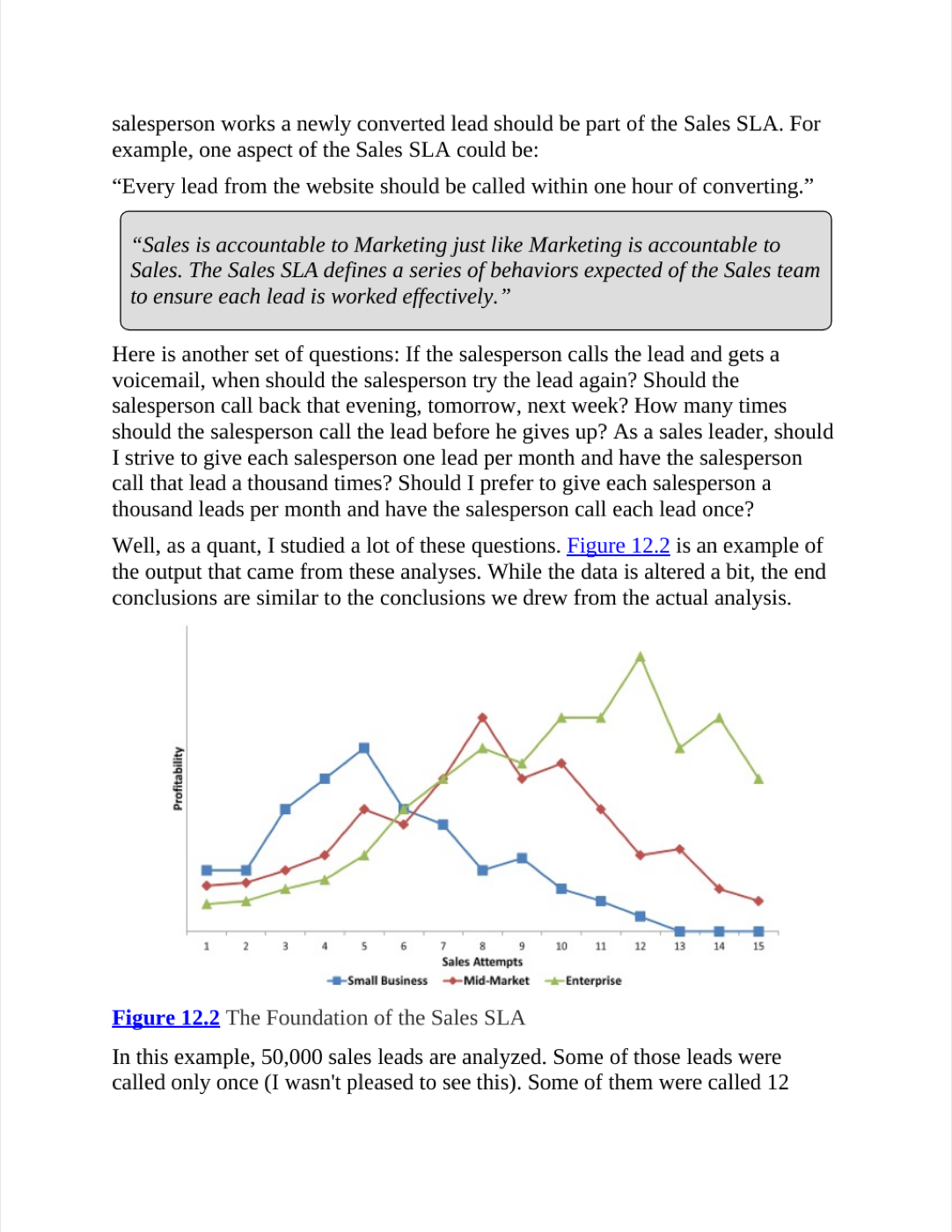
Figure: educational SMarketing SLA alignment page.
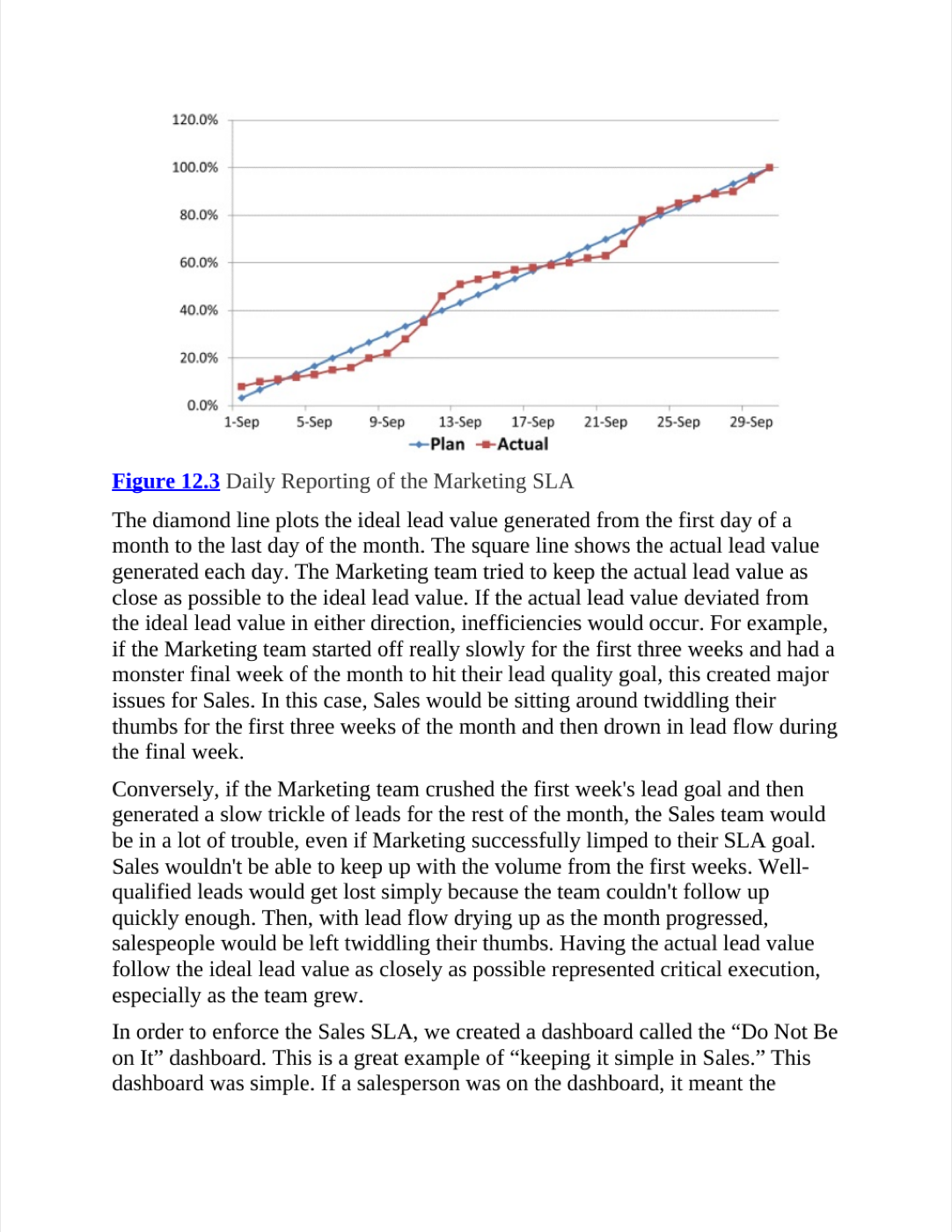
Figure: Sales SLA side of the alignment contract.
Marketing SLA insight: stop committing to “1,500 mid-market leads.” Commit to aggregate implied lead dollar value.
Method:
- Conversion rate by persona × buyer-journey state → customer
- Average revenue per customer in that segment
- Lead value = conversion rate × average revenue
Illustrative pattern from the book’s tables (educational numbers):
| Persona | Journey state | Example lead value logic |
|---|---|---|
| SMB | Problem education | Low conversion × lower ACV → smaller $ |
| Mid-market | Solution research | Medium conversion × medium ACV |
| Enterprise | Solution selection | High conversion × high ACV → large $ |
Marketing can mix many cheap early-stage leads or fewer late-stage leads to hit the same dollar SLA. Sales SLA commits to speed, acceptance criteria and feedback loops on quality.
Part V — Technology and experimentation
5.1 Technology to sell better, faster
Use tech to accelerate sourcing, prospecting, engagement and reporting—not to automate bad process. Crudely: automate inspection and speed; keep human curiosity in discovery.
5.2 Experiment execution formula
- Clear goal and success metric (thesis)
- Lowest-cost, shortest path to learn
- Passionate, skilled experiment leader
- Team of top performers (seek true negatives)
- Routine executive check-ins; fund or kill
Negative case: Assigning a weak rep to a new motion, watching it fail, and concluding the motion is dead—when you only learned that weak reps fail.
5.3 GPCT — a methodology experiment that stuck
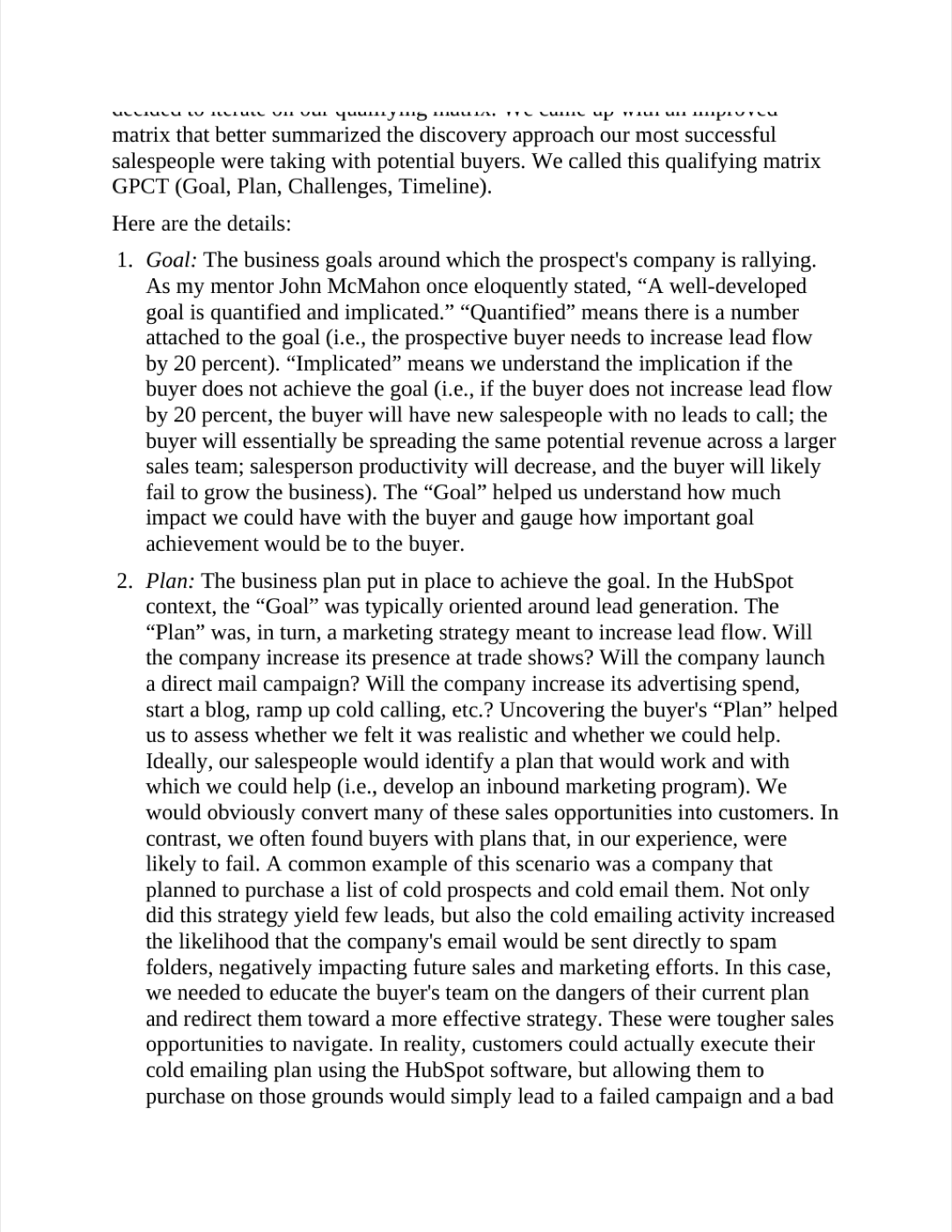
Figure: educational introduction of GPCT qualifying.
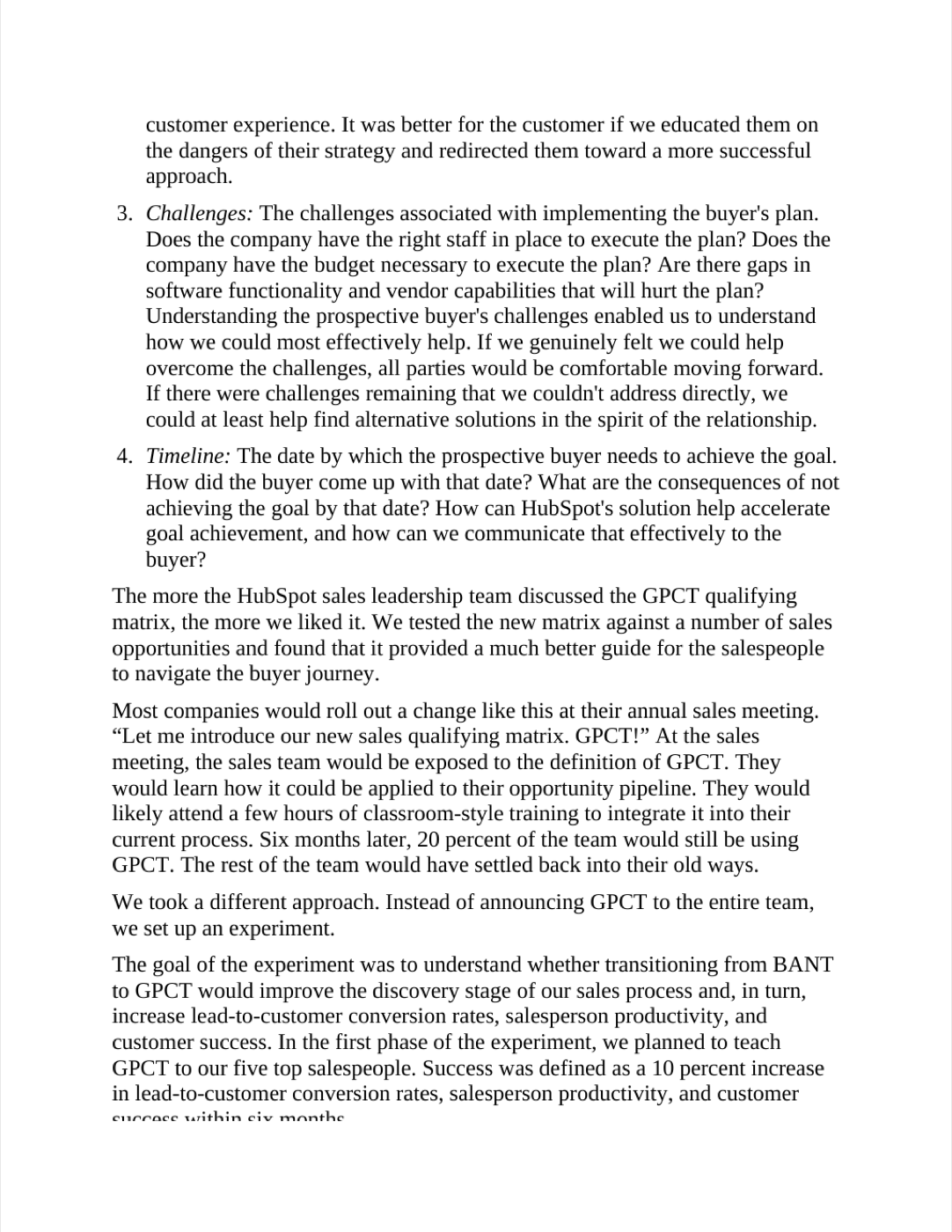
Figure: educational detail on GPCT adoption.
GPCT = Goals, Plans, Challenges, Timeline.
HubSpot did not announce GPCT to the whole team on day one. They:
- Pilot with top performers + best coach
- Define success (e.g. ~10% improvement in a discovery metric)
- Film reviews and evening practice
- Let organic demand pull adoption before company-wide rollout
Pair GPCT with SPIN Selling: SPIN develops explicit needs; GPCT structures qualification depth around goals/plans/challenges/time.
6. Consulting / AI organisation translation
| Roberge formula | Consulting application |
|---|---|
| Hiring scorecard | Score partners/managers on coachability + curiosity, not only pedigree |
| Training triad | Buyer journey of CIO/CFO/CISO; pursuit process; bid qualification matrix |
| Metrics coaching | Win-rate by stage, discovery quality scores, cycle time |
| Inbound | Publish eval/architecture artefacts that attract engaged leads |
| SMarketing SLA | Agree “qualified pursuit value” not raw RFP count |
| Experiments | Pilot a new industry offer with two top sellers before firm-wide launch |
Offer quality still gates everything—use $100M Offers. Channel volume uses $100M Leads.
7. Failure modes
| Failure | Symptom | Fix |
|---|---|---|
| Hero hiring | Inconsistent ramp | Scorecard + trait correlation |
| Training as onboarding dump | Reps freestyle by week 3 | Curriculum tied to methodology triad |
| Pipeline theatre | Forecast lies | Metrics-driven skill coaching |
| Lead-count SLA | Sales-marketing war | Implied dollar value SLA |
| Big-bang process change | Quiet non-adoption | Top-performer experiment first |
| Tool sprawl | Busywork CRM | Tech follows process |
8. 90-day adoption programme
| Month | Focus | KPI |
|---|---|---|
| 1 | Scorecard + coachability interview | Ramp quality of new hires |
| 2 | Coaching plans from metrics | Skill metric movement |
| 3 | SMarketing dollar SLA + one experiment | SLA hit rate; experiment learnings |
9. Practitioner checklist
- Interview Scorecard exists and is used every hire
- Coachability tested via role-play + re-run
- Buyer journey / process / qualifier documented
- Managers have weekly coaching time on calendar
- Marketing measured on implied lead $ not vanity volume
- Sales SLA on speed-to-lead and feedback
- At least one live experiment with top performers
- Qualifying matrix taught (GPCT or equivalent)
10. Building your first Interview Scorecard
| Step | Action |
|---|---|
| 1 | List 5–8 traits hypothesised to matter in your motion |
| 2 | Weight them (force-rank; avoid equal weights) |
| 3 | Define behavioural evidence for each (questions, exercises) |
| 4 | Score every candidate the same way for 90 days |
| 5 | Correlate scores with ramp attainment / quota |
| 6 | Reweight; drop traits that do not predict |
Consulting variant traits to consider: written communication, comfort with ambiguity, stakeholder mapping, ethical independence, coachability, curiosity about industry operations.
11. Metrics dictionary for coaching
| Metric | Skill hypothesis if weak |
|---|---|
| Connect / conversation rate | Targeting, opener, personalisation |
| Meeting set rate | Discovery depth, CTA clarity |
| Stage advance rate | Qualifying honesty, multi-threading |
| Win rate | Value articulation, champion enablement |
| Cycle time | Stakeholder map, mutual action plan |
| Discount rate | Offer strength / negotiation skill |
Peel the onion: never coach “win rate” in the abstract—find the upstream broken skill.
12. SMarketing dollar SLA — worked mini-example
Assume mid-market average revenue £200k.
| Journey state | Conv. to customer | Implied lead value |
|---|---|---|
| Problem education | 2% | £4k |
| Solution research | 6% | £12k |
| Solution selection | 25% | £50k |
Marketing monthly SLA example: £600k implied lead value. Combinations that all hit the SLA:
- 150 solution-research leads, or
- 50 problem-education + 40 solution-research + 4 solution-selection, or
- other mixes summing to ≥ £600k
Sales SLA companions: accept/reject within X hours; reason codes; weekly quality forum.
13. GPCT question bank (consulting)
| Letter | Example questions |
|---|---|
| Goals | What does good look like for claims cycle time by year-end? |
| Plans | What initiatives are already funded to get there? |
| Challenges | Where have prior automation attempts stalled? |
| Timeline | What makes this urgent in this quarter vs next fiscal? |
Use with SPIN: GPCT structures the map; SPIN develops emotional and economic urgency inside Challenges.
14. Experiment backlog ideas for AI / consulting firms
| Experiment | Success metric | True-negative design |
|---|---|---|
| Industry-specific landing + magnet | Engaged leads / week | Two top sellers work inbound only |
| Partner co-webinar channel | Meetings from partner | Top performers staff booth/follow-up |
| Fixed-scope accelerator SKU | Win rate vs bespoke | Same sellers, split opportunities |
| GPCT / SPIN call scoring | Discovery score ↑ 10% | Film review with best coach |
15. Technology principles (without tool worship)
| Accelerate… | With… | Avoid… |
|---|---|---|
| Lead sourcing | Enrichment + intent | Buying junk lists at scale |
| Prospecting | Sequencing after personalisation | Fully automated spam |
| Engagement | Instant routing + snippets | Script prisons |
| Reporting | Auto dashboards for coaching metrics | Vanity activity boards |
Process first; software second. Grove’s production thinking still applies: High Output Management.
16. Cross-stack map
| Job | Book |
|---|---|
| Offer force-multiplier | $100M Offers |
| Channel force-multiplier | $100M Leads |
| Call-level discovery | SPIN Selling |
| Positioning for inbound topics | Obviously Awesome |
Discussion
Comments
Share feedback or questions about this page. No account required.
Loading comments…