Obviously Awesome: April Dunford’s Positioning Method for Products That Sell Themselves
If customers cannot place your product in a mental category, they will invent the wrong one—or ignore you. April Dunford’s Obviously Awesome treats positioning as a deliberate process: start from real alternatives, isolate unique strengths, translate them into value, pick the market context that makes that value obvious, then align messaging and sales.
Source note: This article is an original practitioner synthesis of themes from April Dunford’s Obviously Awesome. It is not a reprint. Figures are educational illustrations of the positioning flow; support the original book for workshops, examples and nuance.
0. Why this book still matters
Positioning workshops often devolve into tagline theatre: brainstorm adjectives, vote on “platform vs solution,” refresh the homepage hero, wonder why win rates do not move. Dunford—veteran of multiple B2B repositioning exercises—shows that positioning is context setting, not copywriting.
When positioning is wrong, every downstream function pays tax: longer sales cycles, confused product roadmaps, mis-hired sales profiles, and SEO that attracts the wrong buyers.
Three commitments organise the work:
- Positioning is a business strategy choice—not a marketing paragraph.
- Customers compare you to alternatives—including spreadsheets and status quo.
- Category teaches buyers how to evaluate you—choose it deliberately.
1. Part I — What is positioning?
Figure: educational illustration from Part I of Obviously Awesome (Dunford).
1.1 Positioning as context
Positioning answers: What am I? For whom? Why pick me vs alternatives?
| Positioning is | Positioning is not |
|---|---|
| Context that makes value obvious | A tagline brainstorm |
| A cross-functional agreement | A marketing-only exercise |
| Grounded in real alternatives | Fantasy competitive maps |
| Input to messaging and sales | A paragraph buried in a deck |
Test: Can a smart stranger understand who it is for, why it wins, and against what—in under a minute?
1.2 The five (plus one) components
| Component | Question |
|---|---|
| Competitive alternatives | What would they use if you vanished? |
| Unique attributes | What do you have that alternatives lack? |
| Value (and proof) | What outcomes do attributes enable? |
| Target market characteristics | Who cares a lot? |
| Market category | What frame makes value obvious? |
| Relevant trends (optional) | What macro shift adds urgency? |
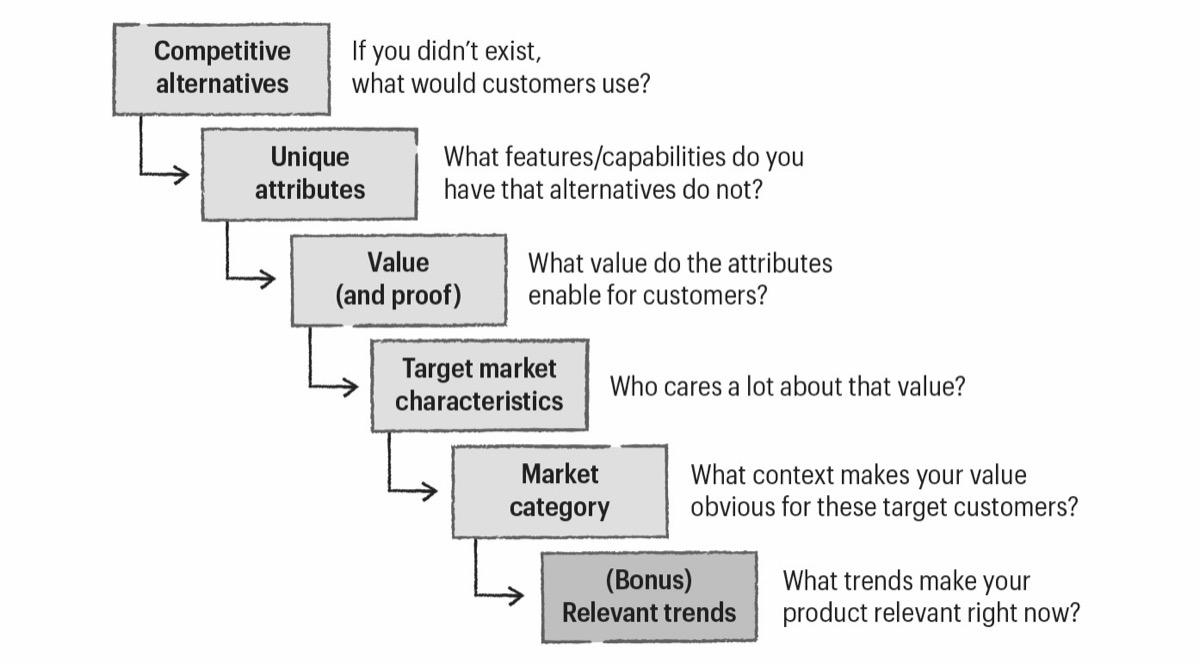
Figure: the staircase flows alternatives → attributes → value → best-fit customer → category → trends.
1.3 Positioning baggage
Teams carry positioning baggage: old taglines, founder stories, analyst labels, legacy categories. Dunford insists you must let go of baggage that conflicts with customer reality—or you will decorate a broken frame.
2. Part II — The 10-step positioning process
Dunford’s full process includes team and vocabulary steps practitioners often skip at their peril.
Step 1 — Understand the customers who love your product
Start with happy customers, not aspirational personas. Who already gets it? Interview them before debating category.
| Ask | Why |
|---|---|
| Why did you buy? | Real value, not assumed |
| What did you compare us to? | True alternatives |
| What almost stopped you? | Objections to address |
Step 2 — Form a positioning team
Cross-functional: product, marketing, sales, founder/GM. Positioning fails when marketing writes it alone and sales ignores it.
Step 3 — Align positioning vocabulary and let go of baggage
Agree terms: alternative vs competitor, attribute vs feature, category vs vertical. Kill sacred cows that contradict customer interviews.
Step 4 — List your true competitive alternatives
Ask: If we didn’t exist, what would customers do?
Include:
- Status quo / manual process
- Spreadsheets and docs
- Agencies and consultants
- Hire-a-person
- “Do nothing”
- Internal build
Not just logo competitors on a battle card.
Step 5 — Isolate your unique attributes or features
What do you have that alternatives lack—or cannot match economically?
| Attribute type | Example |
|---|---|
| Technical | Citation-locked RAG on private corpora |
| Delivery | Pursuit-to-value methodology with eval gates |
| Data | Proprietary benchmark for regulated CS |
| GTM | Outcome-based pricing tied to handle time |
Step 6 — Map attributes to value “themes”
Group attributes under 2–4 value themes buyers care about—not feature lists.
| Attribute | Value theme |
|---|---|
| Eval harness + human override | Risk reduction |
| 30% handle-time reduction in pilots | Operational efficiency |
| Audit log + policy citations | Regulatory compliance |
Step 7 — Determine who cares a lot
Best-fit customer characteristics—traits of accounts where value is 10×, not 10%.
| Vague ICP | Best-fit characteristics |
|---|---|
| “Enterprises” | Regulated mid-market, >50 agents, audited SOPs, Tier-1 volume pain |
| “AI teams” | CISO-mandated governance, no shadow LLM policy yet |
If everyone is a fit, no one is.
Step 8 — Find a market frame of reference
Choose the category that puts your strengths at the centre.
| Category choice | Effect |
|---|---|
| Known category | Faster comprehension; harder differentiation |
| Subsegment (big fish, small pond) | Dominance in niche |
| New category | High education cost; high reward if you win |
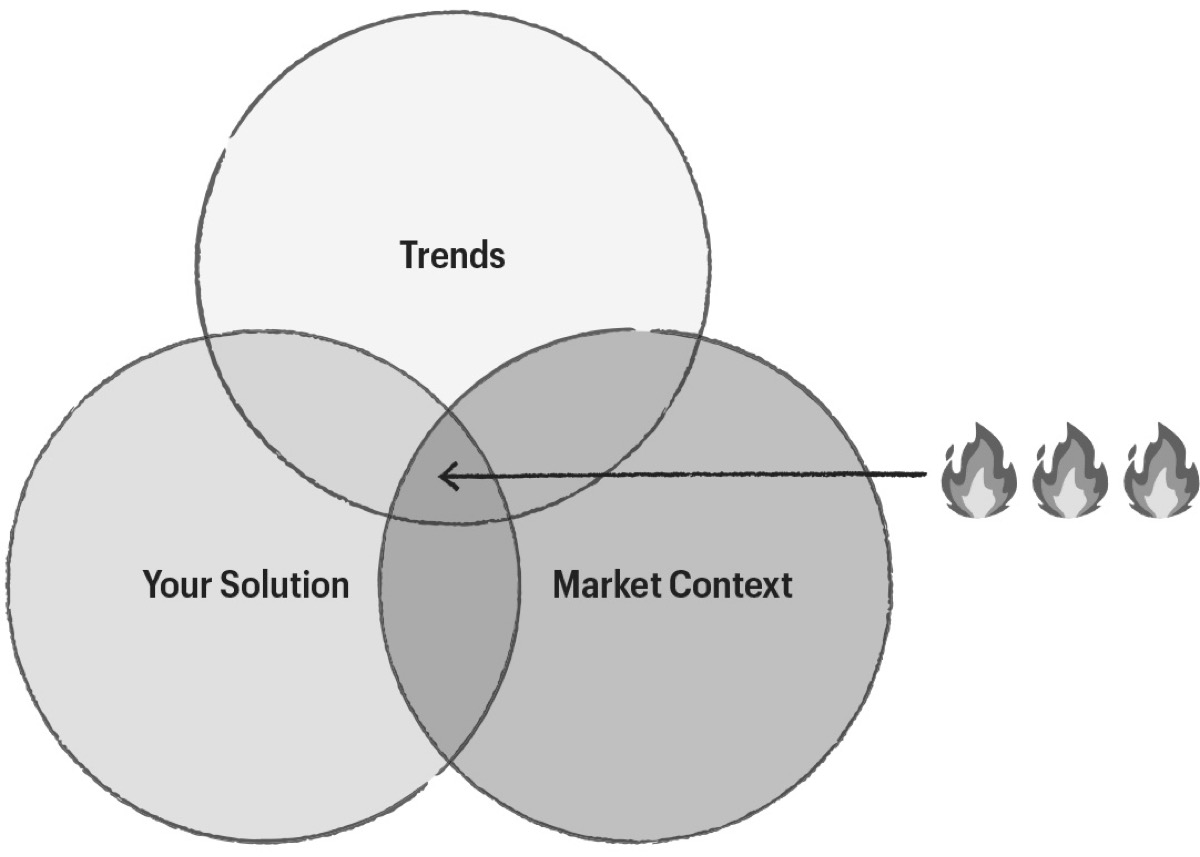
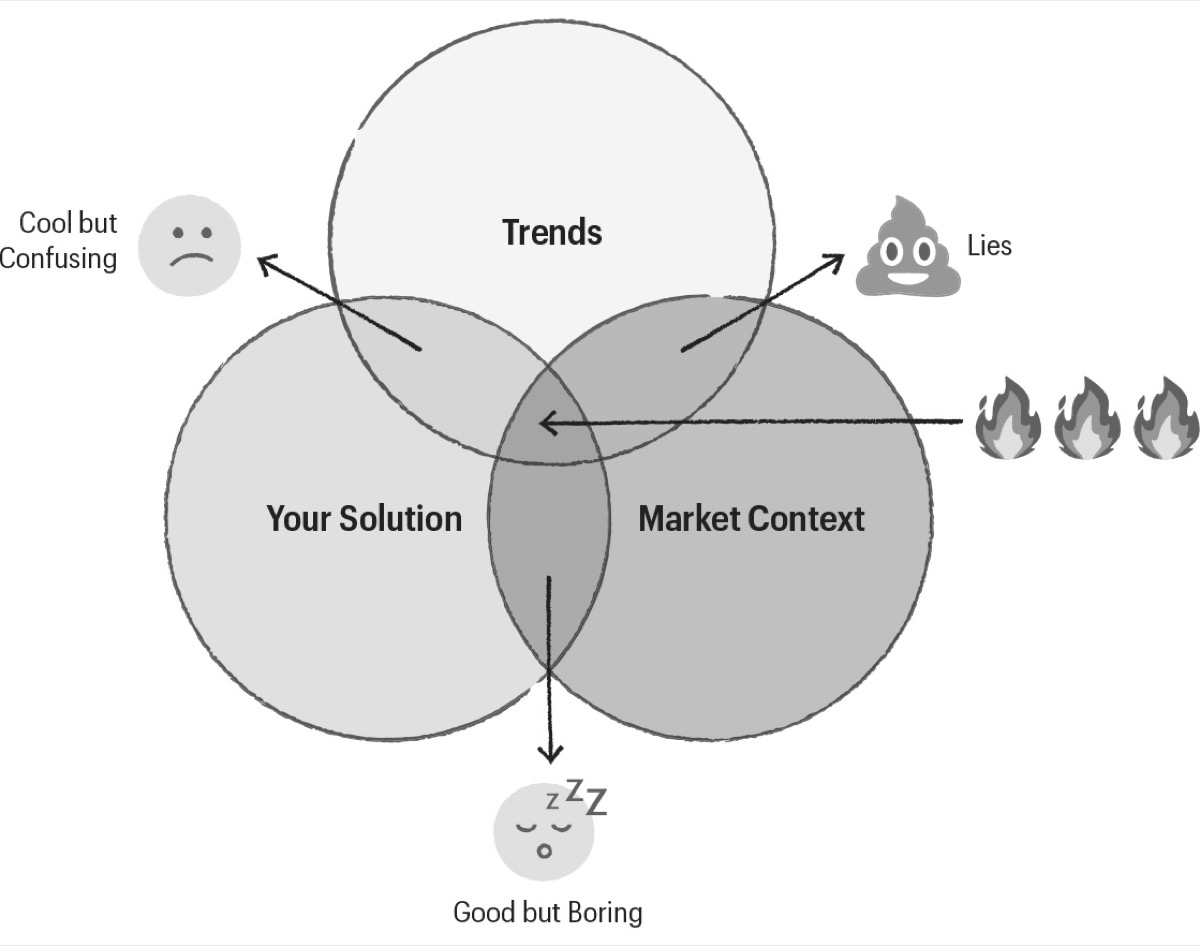
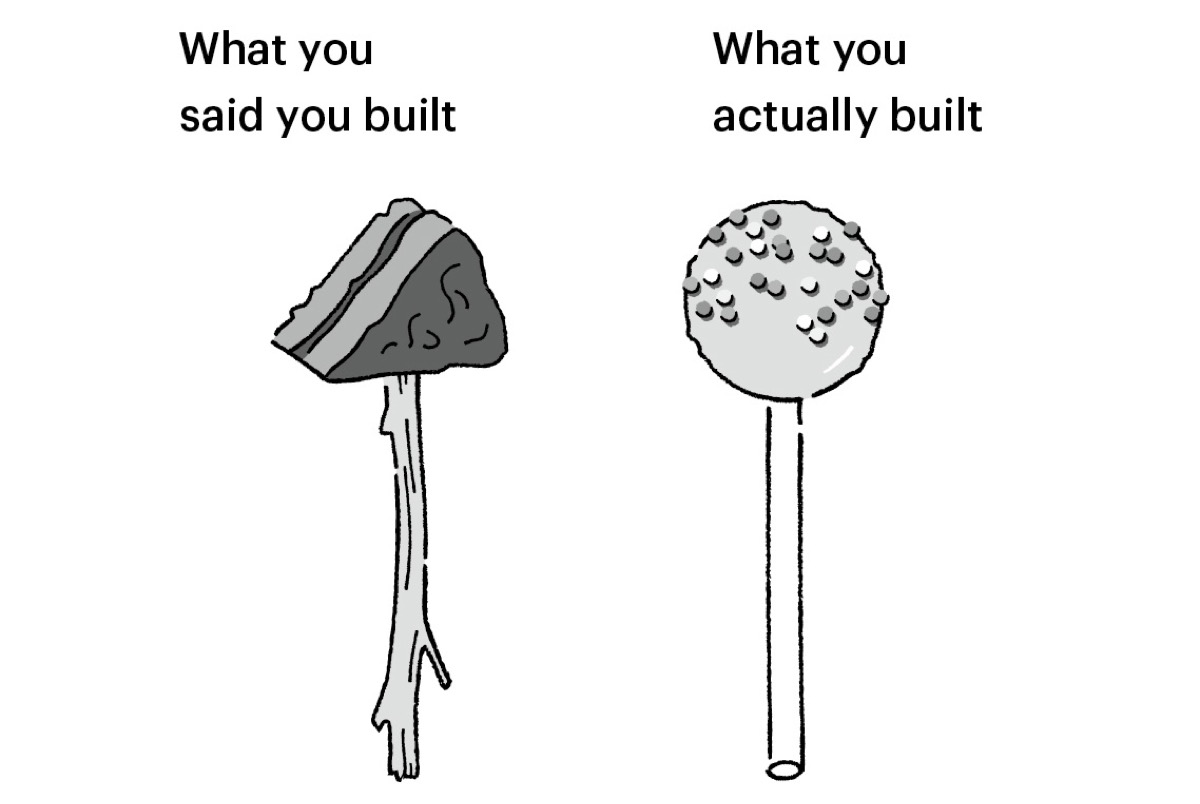
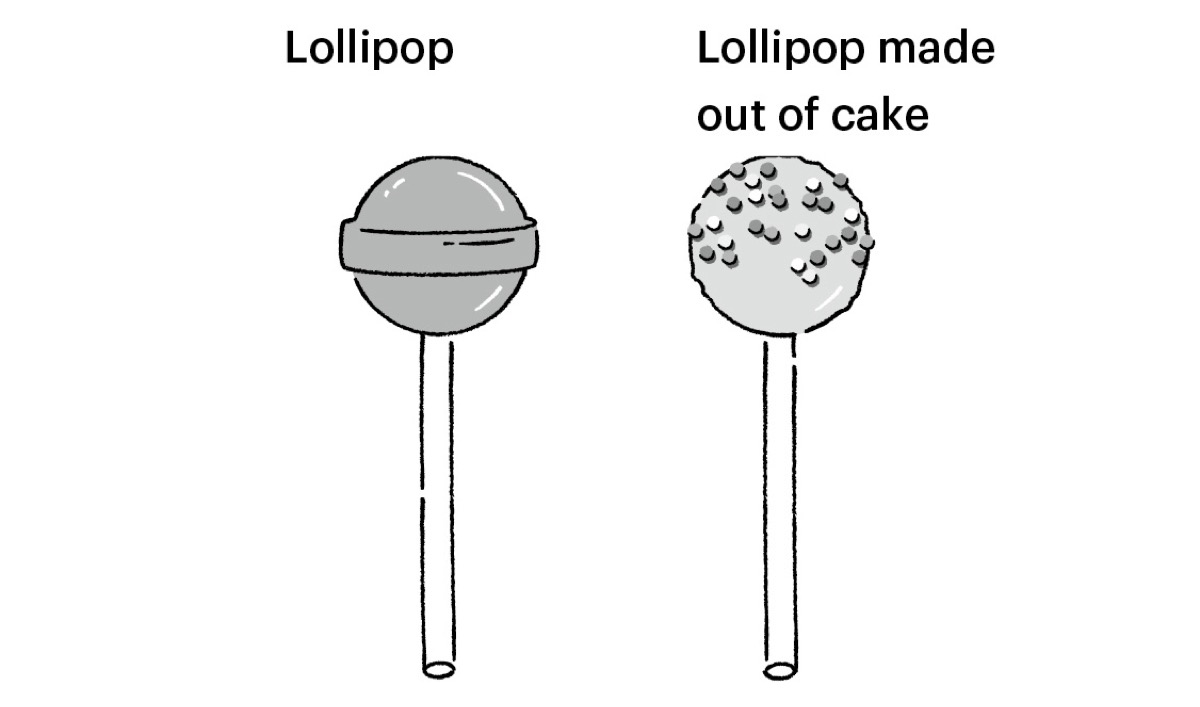
Figures: Dunford’s visual metaphors for how context changes what customers perceive (educational illustrations from the EPUB).
Step 9 — Layer on a trend (carefully)
Trends add urgency when credible:
- Regulatory shift (EU AI Act, model risk management)
- Cost pressure in customer service
- Talent shortage in niche skills
Trend-washing: Claiming “AI-first” without unique capability → commodity.
Step 10 — Capture positioning so it can be shared
One-page canvas: alternatives, attributes, value themes, best-fit, category, trends. Version it. Sales and product sign it.
3. Styles of positioning (choose deliberately)
| Style | Description | When |
|---|---|---|
| Head-to-head | Win in existing category vs leader | Clear superiority on buyer criteria |
| Big fish, small pond | Own a subsegment | Leader ignores niche |
| Create new category | Teach market a new frame | Strong budget + patience |
| Custom hybrid | Borrow known category + sharp wedge | Common in B2B AI |
Rule: Category choice affects sales motion, pricing power, SEO, analyst narrative, and hiring—not just homepage copy.
4. Part III — Putting positioning into play
4.1 After positioning: what happens next
| Function | Action |
|---|---|
| Product | Roadmap prioritises attributes that deliver claimed value |
| Marketing | Messaging hierarchy from canvas |
| Sales | Narrative + battle cards per alternative |
| Success | Onboarding matches best-fit profile |
| Pricing | Aligns to value themes |
4.2 Sales narrative structure
- Category context (teach how to think about the problem)
- Why alternatives fail for this buyer
- Unique value themes + proof
- Best-fit confirmation (“this is for teams like yours because…”)
- Next step
Pair with SPIN Selling: Problem hypotheses come from positioning; Need-payoff validates value themes.
4.3 Website and collateral
| Element | Source |
|---|---|
| Hero | Category + best-fit + primary value theme |
| Proof | Step 6 evidence |
| Comparison pages | Step 4 alternatives |
| Case studies | Step 1 lovers |
5. Common traps (expanded)
| Trap | Symptom | Fix |
|---|---|---|
| Starting with category | Months debating “platform” | Start Step 4 |
| Feature dumping | Buyers lost | Value themes (Step 6) |
| Everyone is ICP | Spray and pray | Step 7 exclusion |
| Aspirational category | Education burn | Big fish or hybrid |
| Copying competitor language | Sameness | Attribute → value chain |
| Positioning by committee fiction | No customer quotes | Step 1 interviews |
| Quarterly repositioning | Sales amnesia | Version canvas; change rarely |
6. AI product example (worked)
| Element | Weak | Stronger |
|---|---|---|
| Alternative | “Other LLMs” | Manual review + rules engines + generic chatbots |
| Unique attribute | “We use GPT” | Citation-locked answers on private policies with eval harness |
| Value theme | “Productivity” | Risk-safe efficiency in regulated Tier-1 |
| Best fit | “Enterprises” | Regulated mid-market, >50 agents, audited SOPs |
| Category | “AI platform” | Agent assist for regulated customer operations |
| Trend | “AI is hot” | Supervisor scrutiny on model risk in banking |
7. Consulting proposition example
Position against staff augmentation, strategy deck shops, and pure tech vendors.
| Element | Example |
|---|---|
| Alternatives | Big four staff aug, offshore build shop, internal COE |
| Unique attributes | Pursuit-to-value method, eval systems, industry accelerators |
| Value themes | Time-to-production, governance-ready, measurable ROI |
| Best fit | Regulated enterprise with board AI mandate and thin delivery bench |
| Category | AI solution engineering (pursuit-to-value) |
8. Half-day workshop agenda
- Interview synthesis review (45 min)
- Competitive alternatives list—include status quo (45 min)
- Unique attributes inventory (30 min)
- Attribute → value theme mapping (45 min)
- Best-fit customer filter—who is out (30 min)
- Category options scored (45 min)
- Optional trend layer (15 min)
- Draft messaging + sales openers (30 min)
- Roadmap implications assigned (15 min)
9. Consulting and AI pursuit translation
| Pursuit artefact | Positioning input |
|---|---|
| No-bid / pursue | Best-fit match |
| Discovery guide | Alternatives + problem themes |
| Proposal hero | Category + value theme |
| Demo script | Attributes → benefits per theme |
| Pricing | Value theme anchors |
Negative cases
- Repositioning every quarter → sales cannot tell a consistent story
- “We’re different” without attribute proof → disbelief in procurement
- Category too broad → 18-month education cycle you cannot fund
- Ignoring status quo alternative → lose to “do nothing”
Health check
- Alternatives list includes status quo and internal build
- Every claimed value traces to an attribute
- Best-fit customer excludes someone specific
- Category makes value obvious without a 20-minute lecture
- Sales and product signed the same canvas version
10. Competitive alternative interview guide
Use in win/loss and customer development calls:
| Question | Captures |
|---|---|
| What did you use before us? | True alternative |
| What would you do if we shut down tomorrow? | Status quo + build |
| Why did you almost not buy? | Objections + frame gaps |
| How do you explain us to your boss? | Category in customer words |
| What result would make this a no-brainer? | Value proof threshold |
Document verbatim phrases for messaging—do not marketing-sanitize.
11. Category scoring matrix
Score each candidate category 1–5:
| Criterion | Weight | Category A | Category B |
|---|---|---|---|
| Makes unique value obvious | High | ||
| Buyer knows how to evaluate | High | ||
| You can win references quickly | Medium | ||
| Education cost affordable | Medium | ||
| Analyst/SEO alignment | Low | ||
| Competitive intensity | Medium |
Pick the frame you can win, not the frame that sounds largest.
12. Repositioning triggers
When to rerun the 10-step process:
| Signal | Action |
|---|---|
| Win rate drops in core segment | Revisit best-fit (Step 7) |
| Sales cycles lengthen | Category may be wrong (Step 8) |
| Product roadmap drift | Attributes no longer unique (Step 5) |
| New alternative emerges (e.g. native AI in platform) | Refresh Step 4 |
| Merger or new product line | Full canvas |
Avoid reactive repositioning after every lost deal—look for patterns.
13. Capstone — positioning canvas
Fill before any rebrand or major pursuit:
- Top 3 alternatives (customer words)
- Top 5 unique attributes
- 2–4 value themes + proof each
- Best-fit characteristics (include anti-fit)
- Category choice + style (head-to-head / niche / new)
- Trend (if any)—one sentence, factual
- One-sentence positioning statement
- Sales opener (30 seconds)
14. Step-by-step deep dive — all 10 steps
Step 1 — Customers who love you (expanded)
| Activity | Output | Time box |
|---|---|---|
| Interview 5–10 delighted customers | Verbatim quotes | 2 weeks |
| Extract “before state” struggles | Problem language | |
| Map what they compared you to | Alternatives list seed |
Negative case: Interviewing only churned users first—you learn exit reasons, not positioning strength.
Step 2 — Positioning team (expanded)
| Role | Responsibility |
|---|---|
| Product | Attributes truth |
| Marketing | Category + messaging |
| Sales | Alternatives + objections |
| Founder/GM | Final category call |
Step 3 — Vocabulary + baggage (expanded)
| Baggage type | Example | Release criterion |
|---|---|---|
| Legacy tagline | “We’re a platform” | Fails customer interview test |
| Founder vision | “Change the world” | No buyer comprehension |
| Analyst label | Gartner quadrant obsession | Misaligned with wins |
Step 4 — Competitive alternatives (expanded)
| Alternative class | Include? |
|---|---|
| Direct vendor | Yes |
| Internal build | Yes |
| Manual process | Yes |
| Spreadsheet + intern | Yes |
| Do nothing | Yes |
Step 5 — Unique attributes (expanded)
Attributes must be provable and differentiating vs Step 4 list—not table stakes.
Step 6 — Value themes (expanded)
| Theme | Proof types |
|---|---|
| Efficiency | Time/cost study |
| Risk reduction | Audit, eval metrics |
| Revenue | Pipeline, conversion lift |
Step 7 — Who cares a lot (expanded)
Define anti-fit: accounts where you will lose or deliver poorly—sales must disqualify.
Step 8 — Market frame (expanded)
See Section 3 styles; score with Section 11 matrix.
Step 9 — Trends (expanded)
Good trend: regulatory deadline. Bad trend: “AI” with no capability link.
Step 10 — Capture + share (expanded)
Version the canvas; quarterly review; no silent drift in sales decks.
15. Messaging hierarchy from canvas
| Level | Content | Example |
|---|---|---|
| L1 Category | Frame | Agent assist for regulated CS |
| L2 Primary value | Theme #1 | Risk-safe efficiency |
| L3 Proof | Metric | 30% handle-time reduction |
| L4 Attributes | Mechanism | Citation-locked RAG + eval |
| L5 Differentiator vs alt X | Battle | vs generic chatbot: audit trail |
16. Consulting proposition worked example
| Step | Consulting AI practice |
|---|---|
| Alternatives | Staff aug, offshore build, strategy-only decks |
| Attributes | Pursuit-to-value, eval harness, industry accelerators |
| Value themes | Time-to-production, governance-ready, measurable ROI |
| Best fit | Regulated enterprise, board AI mandate, thin bench |
| Category | AI solution engineering (pursuit-to-value) |
| Trend | Model risk supervision tightening |
17. AI product anti-patterns by step
| Step | Anti-pattern | Symptom |
|---|---|---|
| 4 | “We compete with OpenAI” | Buyer confusion |
| 5 | “We use transformers” | Not unique |
| 7 | “All enterprises” | Long cycles, losses |
| 8 | “AI platform” category | 18-month education |
| 9 | “Digital transformation wave” | Trend-washing |
18. Quarterly positioning review agenda
- Win/loss themes (30 min)
- Alternatives refresh (20 min)
- Attribute drift vs roadmap (20 min)
- Category still winning? (20 min)
- Messaging updates assigned (10 min)
Discussion
Comments
Share feedback or questions about this page. No account required.
Loading comments…