Never Split the Difference: Chris Voss’s Negotiation Field Manual for Business
Classical deal-making often worships rational split-the-difference compromise. Chris Voss’s Never Split the Difference argues that high-stakes negotiation is emotional first—and that the side that makes the counterpart feel understood gains information, leverage and durable agreements. Hostage-negotiation tools become a business field manual: mirrors, labels, calibrated questions, accusation audits, Ackerman bargaining, and relentless Black Swan hunting.
Source note: This article is an original practitioner synthesis of themes from Chris Voss and Tahl Raz’s Never Split the Difference. It is not a reprint. Figures are educational illustrations; buy the original for full stories, scripts and the negotiation one-sheet appendix.
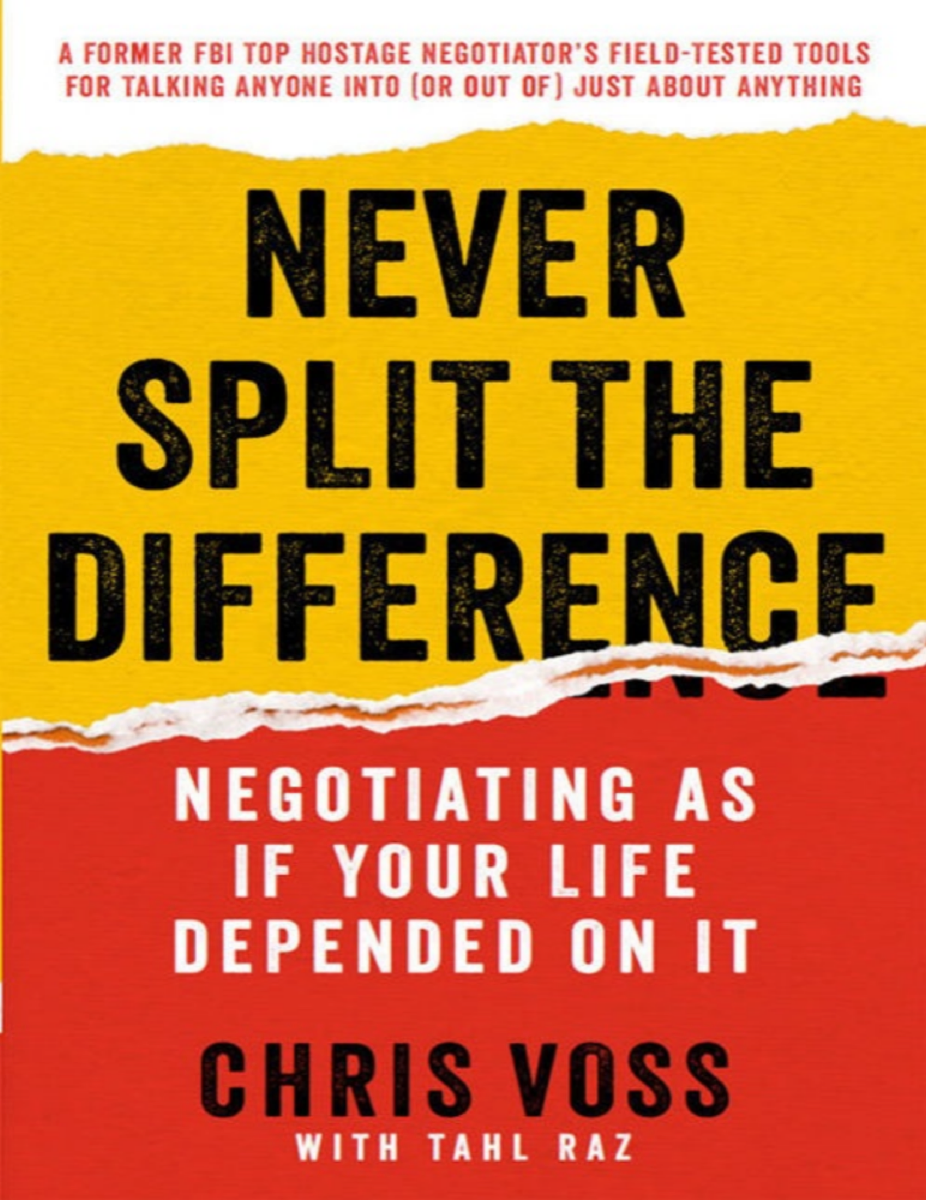
0. Why this book still matters
Business schools still teach negotiation as if humans were spreadsheets: interests, BATNAs, ZOPAs, rational concessions. Voss’s FBI career—kidnappings, bank robberies, hostage standoffs—demonstrates that emotion and cognition are not separable at the table. People make bad deals when they feel unheard; they make revealing mistakes when they feel safe.
The book’s Harvard classroom story matters: when law professors role-played kidnappers, Voss’s emotional tools beat their analytic frameworks. For consultants and operators, the lesson is not “be manipulative.” It is: information is leverage, and empathy is how you get information under stress.
Three commitments organise the work:
- Listen first, bargain second. Most failures come from talking past the real constraint.
- “No” is a gateway, not a wall. Safe no beats fake yes.
- Implementation is the real close. A signed SOW that dies in week two is not a win.
Pair Voss with Getting to Yes for structure and Negotiation Genius for analytic value creation—Voss supplies the emotional operating system.
1. Chapter 1 — The new rules
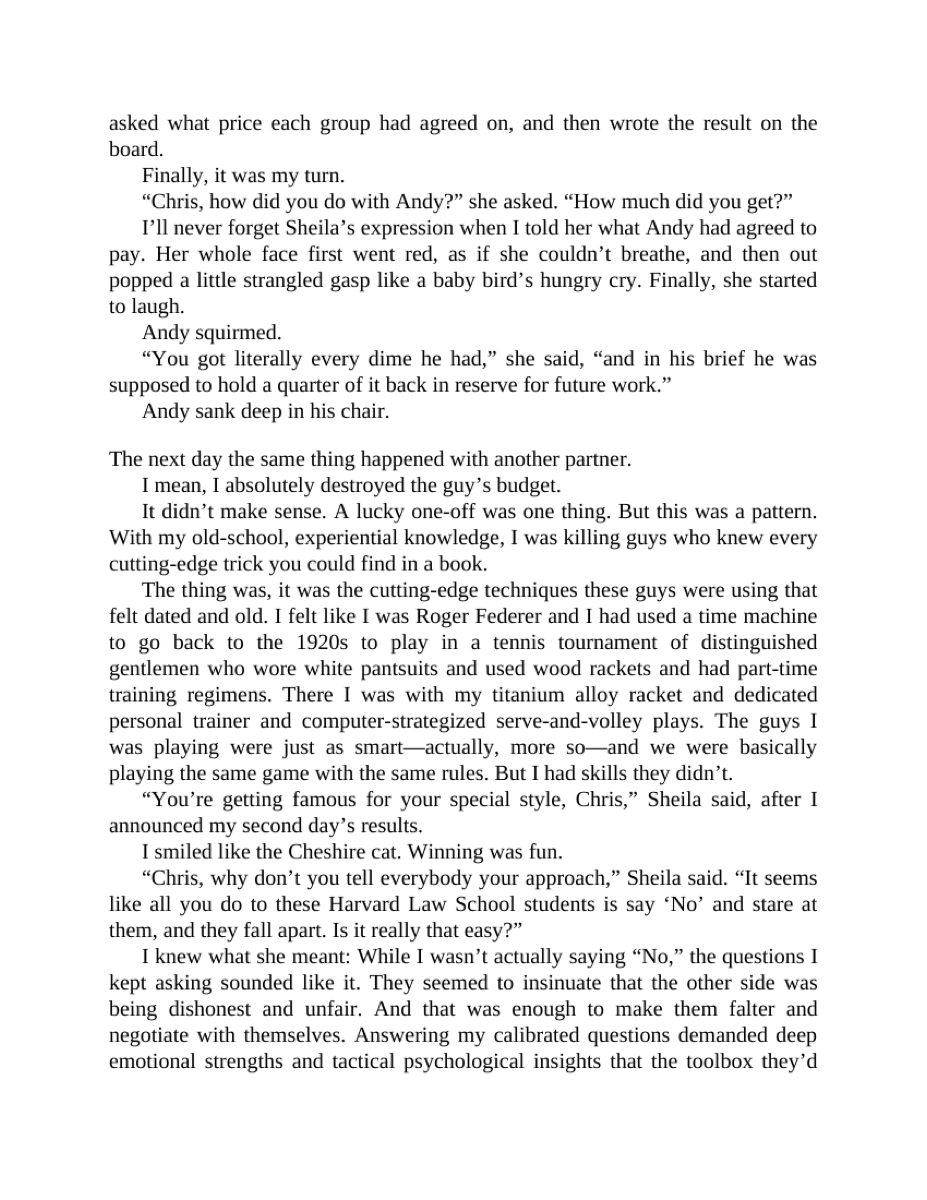
Figure: the book opens by challenging classroom “rational actor” negotiation with lived high-stakes practice.
1.1 Old rules vs Voss-oriented rules
| Old rule | Voss-oriented rule |
|---|---|
| Separate people from the problem | Emotions are the problem space—use them |
| Aim for win-win split | Avoid lazy splits; uncover hidden constraints |
| Logic persuades | Empathy unlocks information that logic needs |
| Yes is success | Premature yes is often fake compliance |
| Never go silent | Strategic silence and mirrors elicit truth |
| Be assertive early | Late assertiveness after understanding |
1.2 The voice framework
Voss describes three negotiator voices:
| Voice | Use | Risk |
|---|---|---|
| Late-night FM DJ | Calm, downward inflection; authority without threat | Sounds cold if overused |
| Positive / playful | Default business tone; encourages collaboration | Wrong in genuine crisis |
| Assertive | Sparingly; direct without aggression | Triggers defensiveness if early |
Consulting tip: Open steering calls in DJ voice; move to playful when exploring options; assertive only when summarising non-negotiables after “That’s right.”
1.3 Negotiation is discovery
Every commercial conversation is partly intelligence gathering. Your fee, scope and timeline are downstream of what you learn about fears, hidden decision makers and real success metrics.
2. Chapter 2 — Be a mirror
2.1 Mirroring mechanics
Repeat the last one-to-three critical words (or key phrase) with an upward / inquisitive tone. Mirrors buy time and pull elaboration without interrogation energy.
| They say | You mirror |
|---|---|
| “The budget is basically frozen.” | “Frozen?” |
| “We need something transformative.” | “Transformative?” |
| “Legal is nervous about liability.” | “Nervous about liability?” |
Mirrors work because humans naturally explain when echoed—especially under silence.
2.2 Strategic silence
After a mirror or label, wait. Four seconds feels long; that is when truth often arrives.
2.3 Rapport without agreement
Mirroring builds rapport without conceding substance. You are not saying they are right—you are proving you heard them.
Negative case: Mirror sarcasm (“Frozen?!” with eye roll) destroys safety. Tone is the technique.
3. Chapter 3 — Don’t feel their pain, label it
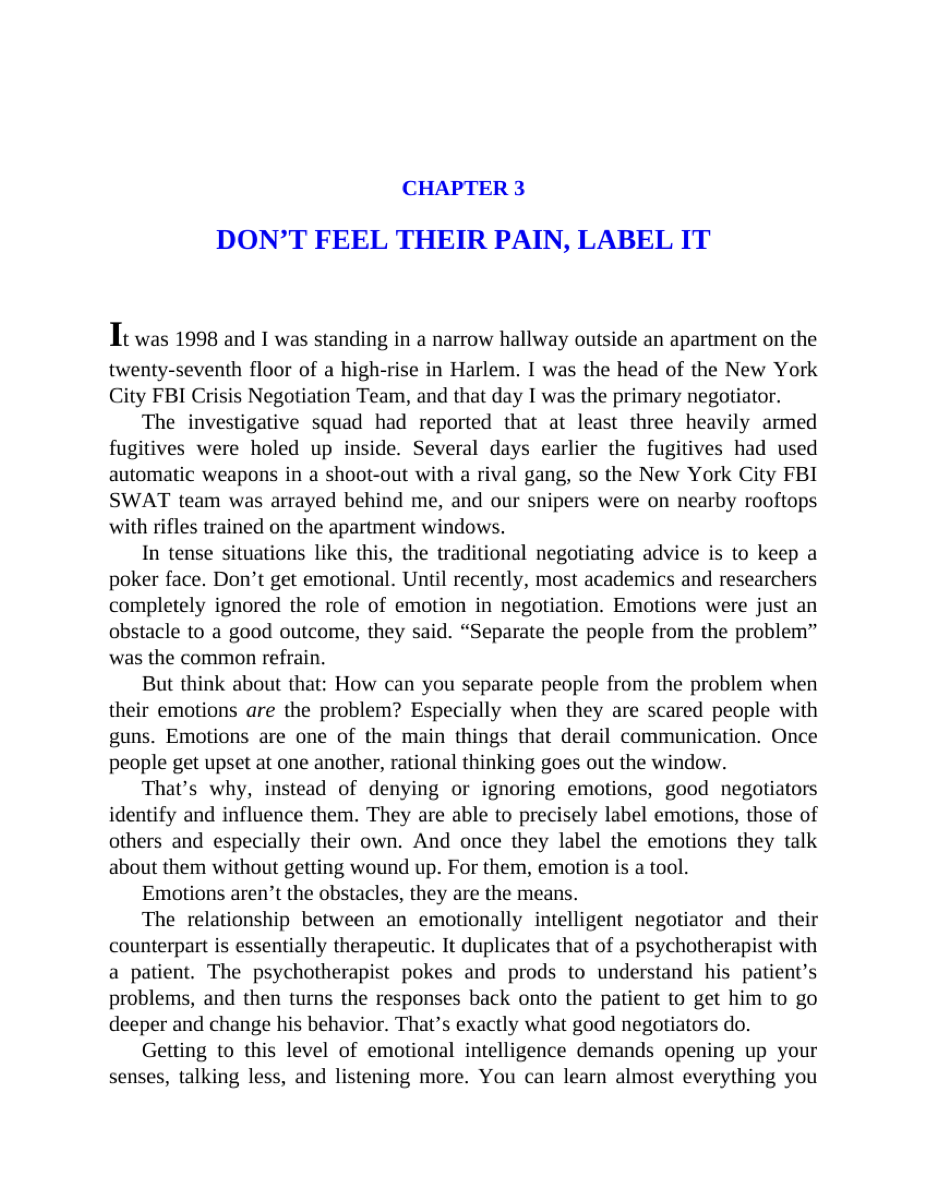
Figure: educational page from Never Split the Difference on tactical empathy and labeling.
3.1 Tactical empathy defined
Empathy here is not agreement. It is disciplined recognition of the counterpart’s feelings and worldview so you can influence with accuracy.
3.2 Labeling formula
Name the emotion or dynamic:
- “It seems like…”
- “It sounds like…”
- “It looks like…”
| Situation | Label |
|---|---|
| Aggressive procurement | “It sounds like you are under pressure to show a win on rate card this quarter.” |
| Silent sponsor | “It seems like something changed since our last conversation.” |
| Scope creep request | “It looks like the team is worried about missing the launch if we don’t expand scope.” |
Labels defuse negativity and invite correction—which is information.
3.3 Practice loop
Listen → Mirror → Label → Silence → Summarise.
Repeat until you can articulate their world better than they can.
4. Chapter 4 — Beware “yes,” master “no”
4.1 Three types of yes
| Type | Meaning | Danger |
|---|---|---|
| Counterfeit | Yes to end conversation | You think you have a deal |
| Confirmation | Yes as affirmation | Low commitment |
| Commitment | Yes with implementation intent | What you actually need |
4.2 Designing for no
A quick yes can be a lie to exit pressure. A safe no starts honest negotiation.
| Instead of | Try |
|---|---|
| “Do you agree this is the right approach?” | “Is now a bad time to rethink the pilot scope?” |
| “Can we move forward?” | “Have you given up on hitting Q3?” |
| “Will you sign this week?” | “Is it ridiculous to assume we could close by Friday?” |
“No” gives the counterpart protection and control.
4.3 Email and async negotiation
Late-night emails invite counterfeit yes. Prefer calibrated questions that allow no without ending the relationship—and schedule live calls for hard commits.
5. Chapter 5 — Trigger “That’s right”
5.1 “That’s right” vs “You’re right”
Summarise the counterpart’s world so completely they say “That’s right”—stronger than “You’re right” (which often means “please stop talking”).
That’s right signals alliance with their narrative. Only then propose your frame.
5.2 Summary structure
- Paraphrase facts they care about
- Name stakes and constraints
- Acknowledge emotions (labeled)
- Pause for “That’s right”
5.3 Consulting pursuit application
Before presenting a £1.2m AI programme, summarise the sponsor’s world: legacy cost pressure, board AI mandate, risk committee fear, talent gap. Wait for “That’s right.” Then—and only then—present the recommendation pyramid (Minto).
6. Chapter 6 — Bend their reality
6.1 Fairness
People fight for fairness even when economics suggest they should not. Define fair with:
- Comparable deals (comps)
- Transparent process
- Standards they helped shape
“Fair” is emotional; meet it explicitly.
6.2 Deadlines
Deadlines are often flexible or tactical. Probe gently:
- “What happens if we miss that date?”
- “Who set the deadline, and why?”
6.3 Loss aversion and framing
Frame concessions as preventing a loss they care about—not only gaining upside.
6.4 Odd numbers and precision
Precise, non-round offers feel considered. Round numbers can signal you are guessing.
| Weak anchor | Stronger anchor |
|---|---|
| “£500k” | “£487,500 based on three-sprint scope” |
| “20% discount” | “18.7% aligned to removed eval workstream” |
7. Chapter 7 — Calibrated questions and the illusion of control
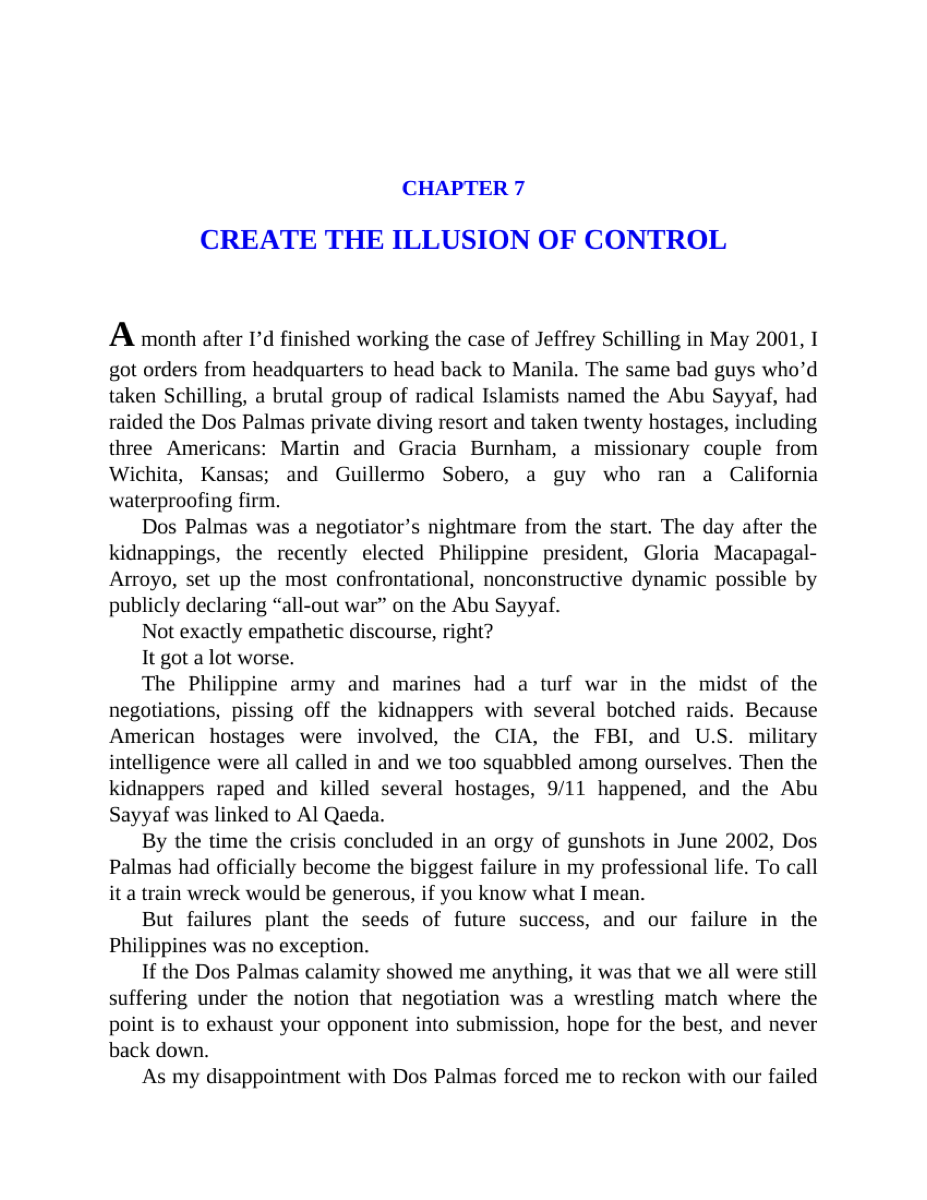
Figure: educational page on calibrated How/What questions from Never Split the Difference.
Calibrated questions start with What or How (rarely Why—Why feels accusatory).
| Goal | Example |
|---|---|
| Reveal constraints | “What about this process is most important to you?” |
| Shift problem-solving to them | “How am I supposed to do that?” |
| Implementation reality | “What happens if we miss this date?” |
| Decision map | “How does this decision get made on your side?” |
| Scope trade | “What should we de-scope to hit that date?” |
| Risk share | “How would you want liability handled if the model drifts?” |
They create the illusion of control: the counterpart feels agency while you steer the frame.
7.1 “How am I supposed to do that?”
Classic Voss move when pressed on price or terms. Forces them to solve your constraint—or reveal hidden flexibility.
7.2 Avoiding calibrated-question abuse
| Abuse | Fix |
|---|---|
| Sarcastic tone | Genuine curiosity |
| Weaponised how/what in email wars | Pick up the phone |
| Endless questions without summary | Drive toward “That’s right” |
8. Chapter 8 — Guarantee execution
Hearing yes is not enough. Calibrate for implementation:
- “How will we know we are on track?”
- “Who on your team will own step one by Friday?”
- “What could cause this to stall after signature?”
Watch for verbal/nonverbal mismatch; ask clarifying labels.
Document agreements in their words when possible—reduces reinterpretation in procurement.
8.1 The 7-38-55 rule (use carefully)
Communication research suggests words, tone and body language contribute unevenly to perceived meaning. In video calls, tone and presence still matter—do not rely on slides alone for hard negotiations.
8.2 Liars and inconsistency
Voss teaches spotting inconsistency—not as courtroom accusation, but as prompt for labels and calibrated questions: “It seems like there are two different priorities here.”
9. Chapter 9 — Bargain hard (Ackerman model)
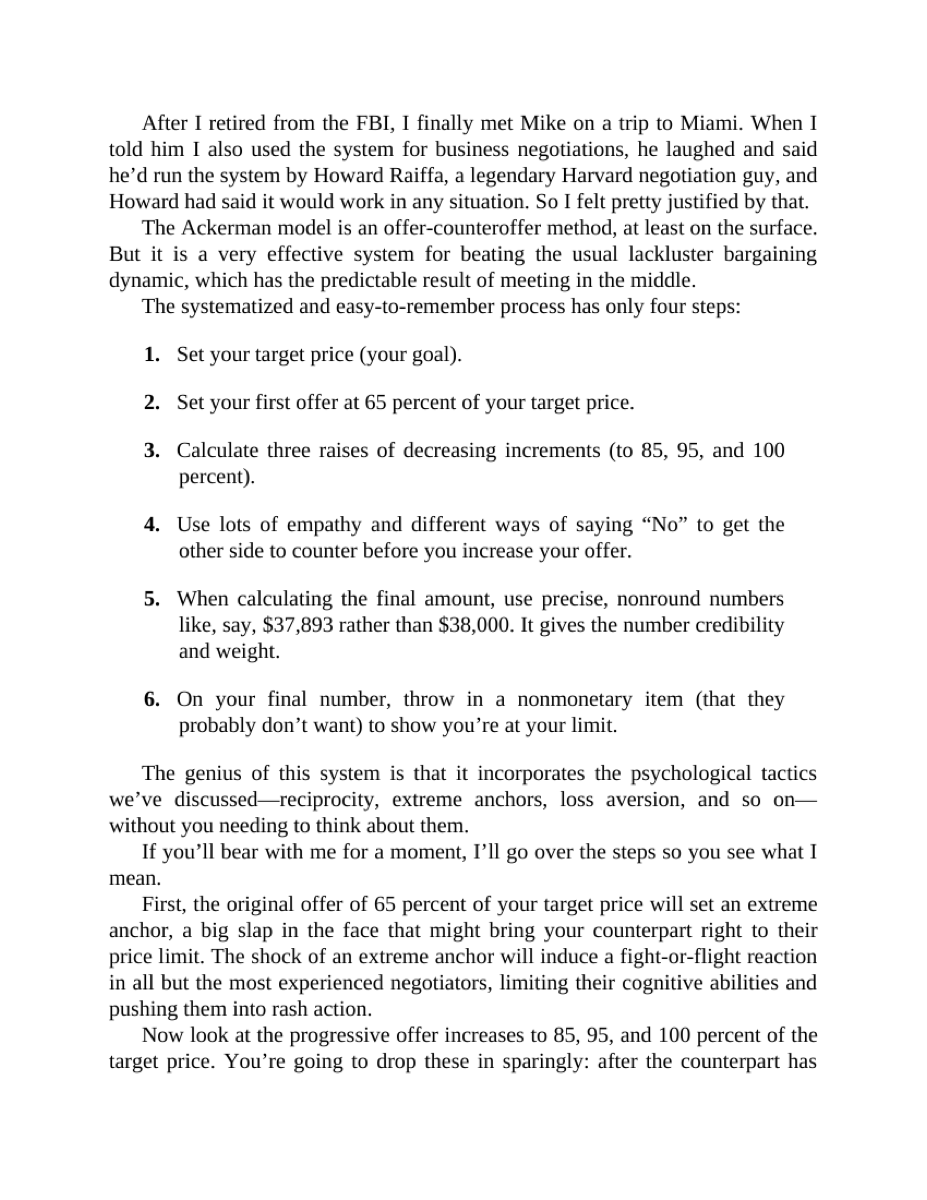
Figure: educational page on hard bargaining discipline from Never Split the Difference.
A structured bargaining system (adapted for business):
- Set target price / term.
- Plan incremental moves toward the target (e.g. when buying, open at ~65% of target and move 85% → 95% → 100%; when selling, invert carefully—never accept first offer).
- Use empathy and calibrated questions between moves.
- Final non-round number + non-monetary item to signal limit.
Rules:
- Never accept the first offer.
- Never split the difference by reflex.
- Use empathy between numeric moves.
9.1 Non-monetary trades
Often more valuable than price:
| Trade | Example |
|---|---|
| Scope | Remove optional workstream |
| Timing | Phased start |
| Risk | Shared success fee |
| Access | Executive reference rights |
| Exclusivity | Limited industry window |
9.2 Ackerman + walkaway
Ackerman without a real walkaway is theatre. Define minimum acceptable outcome before the call (Negotiation Genius BATNA work).
10. Chapter 10 — Find the Black Swan
Black Swans are pieces of information that change everything—hidden budgets, political landmines, personal motivations, alternative vendors already chosen, an internal build team racing you.
Hunt them by:
- More listening than pitching
- Wide calibrated questions
- Building enough safety for disclosure
- Noticing what does not fit the official story
| Possible Black Swan | How it surfaces |
|---|---|
| Incumbent vendor already selected | “How” questions about decision process |
| Sponsor leaving in 60 days | Labels about career pressure |
| Secret pilot with competitor | Mirrors on “transformative” language |
| Board veto on cloud | Accusation audit on security fears |
11. Negotiation one-sheet (business version)
| Section | Fill before the call |
|---|---|
| Goal / walkaway | Best case, target, minimum |
| Their likely emotions | Fears, status threats, time pressure |
| Accusation audit | Top 5 negatives to voice first |
| Labels prepared | 3–5 ready phrases |
| Calibrated questions | 5–8 how/what questions |
| Black Swan hypotheses | What might be hidden? |
| Non-cash trades | Scope, timing, references, risk share |
| Implementation owners | Names post-deal |
12. Consulting and AI pursuit applications
12.1 Moment map
| Moment | Voss move |
|---|---|
| Price pushback | “How am I supposed to deliver that risk profile at that fee?” + accusation audit |
| Scope creep | Label pressure; calibrate “What should we de-scope to hit that date?” |
| Silent prospect | Mirror last phrase; silence; “It seems like something changed.” |
| Procurement game | Separate fairness process from hostage discounting |
| Internal steering group | Get “That’s right” on the problem before pitching the solution |
| AI risk committee | Label fear; calibrate “How would you want human override designed?” |
12.2 Integration with SPIN
| Phase | SPIN | Voss |
|---|---|---|
| Discovery | Problem, Implication, Need-payoff | Labels, mirrors |
| Commercial | Explicit needs recap | Ackerman, fairness |
| Close | Advance | Implementation how/what |
| Post-signature | — | Execution guarantees |
See SPIN Selling for discovery question design.
12.3 Negative cases (expanded)
| Failure | Symptom | Fix |
|---|---|---|
| Empathy without boundaries | Doormat pricing | Walkaway clarity |
| Calibrated sarcasm | Relationship damage | Tone discipline |
| Robot labels | Manipulation vibe | Specificity from listening |
| Splitting difference “to be nice” | Wrong economics | Ackerman + trades |
| Yes-chasing | Fake compliance | Design for no |
| Ignoring implementation | Signed but stalled | Chapter 8 discipline |
13. Capstone drill (30 minutes)
- Write an accusation audit for your next hard conversation.
- Prepare five calibrated questions.
- Role-play: only mirrors/labels for the first five minutes.
- Demand a “That’s right” summary before any proposal.
- End with implementation how/what questions.
- List three Black Swan hypotheses and one question each to test them.
14. Comparison with classical negotiation canon
| Lens | Getting to Yes | Negotiation Genius | Never Split the Difference |
|---|---|---|---|
| Core move | Interests, options, criteria | Claim/create value analytically | Tactical empathy, calibrated questions |
| Best for | Structured deals | Complex multi-issue trades | High emotion, opaque constraints |
| Risk | Ignores emotion | Analysis paralysis | Empathy without BATNA |
| Combined use | Frame and criteria | Economics and creativity | Information and safety |
Use all three in a pursuit: Genius for prep, Yes for structure, Voss for the room.
15. Chapter-by-chapter field guide
| Ch. | Title | Business translation |
|---|---|---|
| 1 | New rules | Emotion-first; slow down |
| 2 | Mirror | Last words + silence |
| 3 | Label it | “It seems like…” defuse |
| 4 | Master “no” | Safe no beats fake yes |
| 5 | “That’s right” | Summarise before pitch |
| 6 | Bend reality | Fairness + loss framing |
| 7 | Calibrated questions | How/what steering |
| 8 | Guarantee execution | Implementation map |
| 9 | Bargain hard | Ackerman + empathy between |
| 10 | Black Swans | Hunt unknown unknowns |
16. Accusation audit — templates by scenario
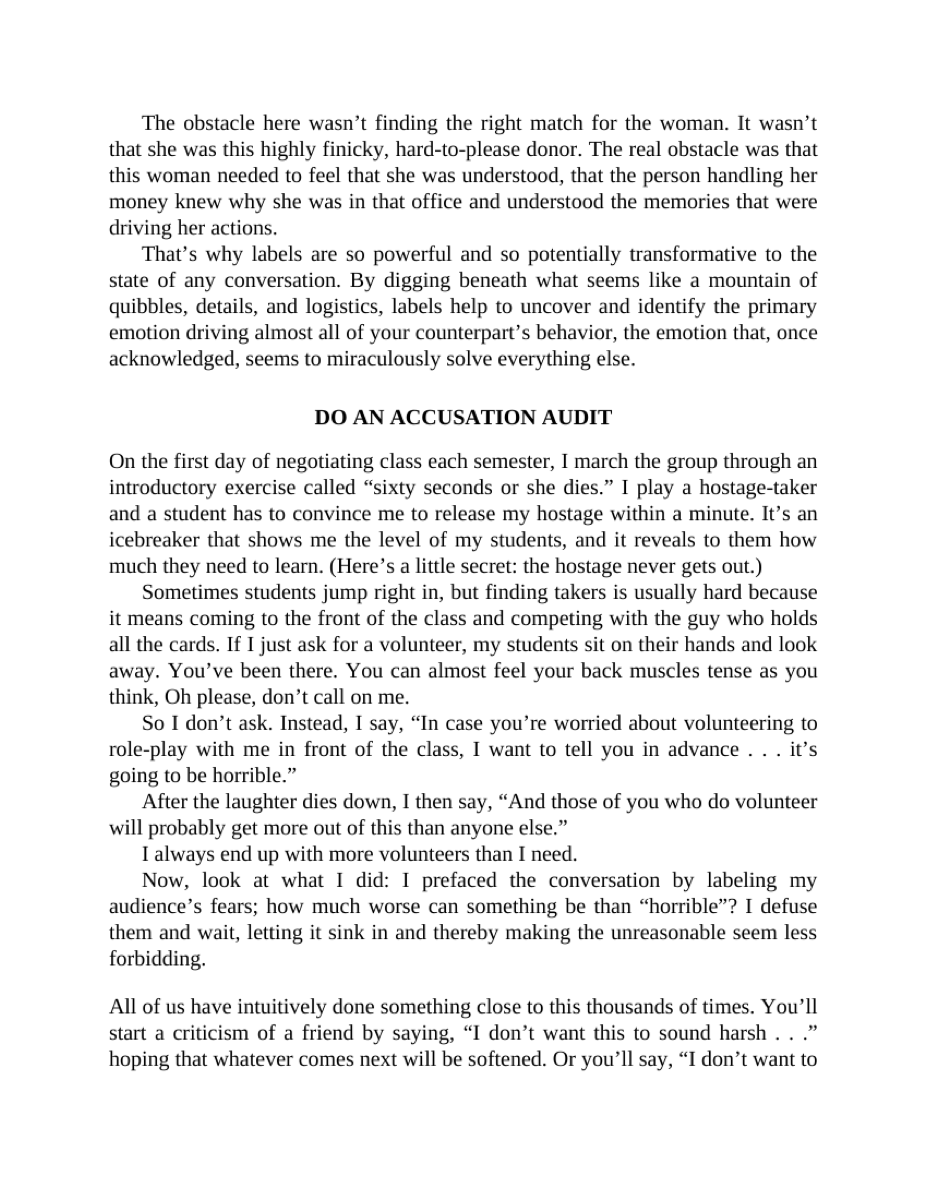
Figure: educational page introducing the accusation audit from Never Split the Difference.
| Scenario | Open with |
|---|---|
| Price shock | “You’re going to think we’re expensive for this market…” |
| Scope cut | “It may look like we’re trying to over-engineer…” |
| Timeline push | “You might feel we’re being slow or risk-averse…” |
| AI hype fatigue | “You may think this is another GenAI slide deck…” |
| Incumbent loyalty | “You probably assume switching cost outweighs benefit…” |
Say audits before the counterpart attacks—removes defensive energy.
17. Calibrated question bank (consulting)
| Situation | Question |
|---|---|
| Budget freeze | “How am I supposed to absorb scope at that fee?” |
| Scope creep | “What should we deprioritise to protect the date?” |
| Silent steering committee | “What about this is hardest for your team?” |
| Procurement discount demand | “How does your fairness benchmark apply to outcome-based work?” |
| Internal build bias | “How will internal teams hit the Q3 date with current bench?” |
| Risk committee stall | “What would need to be true for you to feel comfortable proceeding?” |
18. Ackerman worked example (selling services)
Target fee £500k; walkaway £380k:
| Round | Offer | Pair with |
|---|---|---|
| 1 | £325k | Label budget pressure |
| 2 | £365k | Calibrated scope question |
| 3 | £395k | Non-cash: phased billing |
| 4 | £487k | Precise; small free training day |
Never move without new information (Black Swan surfaced).
19. Black Swan hunt — consulting checklist
- Hidden incumbent already selected?
- Sponsor leaving or promoted?
- Parallel internal build team?
- Board event before decision date?
- Personal KPI conflict on champion?
- Undisclosed budget already committed?
One confirmed Black Swan often changes scope, price, or walkaway—not just tactics.
20. Internal sponsorship negotiations
| Stakeholder | Voss sequence |
|---|---|
| CFO | Accusation audit on cost → fairness on ROI method |
| CISO | Label risk fear → calibrated “how” on controls |
| Business sponsor | “That’s right” on pain → Need-payoff via SPIN |
| PMO | Implementation how/what → owners by Friday |
Pair SPIN for sponsor discovery; Minto for written ask.
21. Email and async — do / don’t
| Do | Don't |
|---|---|
| Short mirror of their last line | Novel-length persuasion |
| One calibrated question | Demanding yes |
| Propose live call for numbers | Ackerman by email thread |
| Label tone you detect | Sarcastic labels |
22. 30/60/90 negotiation skill plan
| Period | Drill |
|---|---|
| 30 days | Daily labels in low-stakes chats |
| 60 days | One-sheet on every commercial call |
| 90 days | Full sequence: audit → mirror → that’s right → Ackerman → implementation |
23. Difficult Conversations crossover
When negotiation becomes identity-threatening, pair Voss labels with Difficult Conversations: separate impact from intent; use labels for feelings; return to calibrated how/what for joint problem-solving.
24. Pursuit timeline — where Voss applies
| Pursuit phase | Primary Voss tools |
|---|---|
| Qualification | Mirrors; safe no on bad fit |
| Discovery | Labels; Black Swan hunt |
| Proposal defense | Accusation audit; “That’s right” |
| Commercial | Ackerman; fairness framing |
| Contracting | Implementation how/what |
| Post-signature | Execution guarantees |
Discussion
Comments
Share feedback or questions about this page. No account required.
Loading comments…