Negotiation Genius: Claiming Value, Creating Value and Beating Bias — A Complete Practitioner Guide
Most negotiation books teach what to say. Malhotra and Bazerman teach how the mind fails—and how to build a repeatable system that claims value, creates value, survives bias, and knows when to walk away. Negotiation Genius sits between Fisher and Ury’s principled method and Voss’s tactical empathy: analytic rigour plus behavioural science for deals that are complex, emotional, asymmetric, or outright ugly.
Source note: This article is an original practitioner synthesis of themes from Deepak Malhotra and Max H. Bazerman’s Negotiation Genius. It is not a reprint. Support the original for full cases (Roosevelt photograph, UN dues, NHL lockout, Cuban Missile Crisis, Guidant/J&J, and others) and the end-of-book glossary.
0. Why this book still matters
Negotiation advice is everywhere: “be tough,” “be collaborative,” “never make the first offer,” “always make the first offer.” Malhotra and Bazerman cut through the contradictions with a closed vocabulary grounded in decision research: reservation values, ZOPA, logrolling, bounded awareness, bounded ethicality, competitive arousal.
Three commitments organise the whole work:
- Claiming and creating are both mandatory. Soft value creation without claiming leaves money on the table; hard claiming without creation shrinks or kills deals.
- Bias is predictable. Mind and heart errors are not random—they are systematic. Genius prepares counters before the table, not after the damage.
- Not every situation deserves a negotiation. Weak BATNAs, reputational traps, and social judgment failures (the manure professor) are first-class strategic inputs.
If your prep sheet cannot name aspiration, reservation, BATNA, issue weights, bias risks, and walk-away triggers in one page, you are improvising—not negotiating.
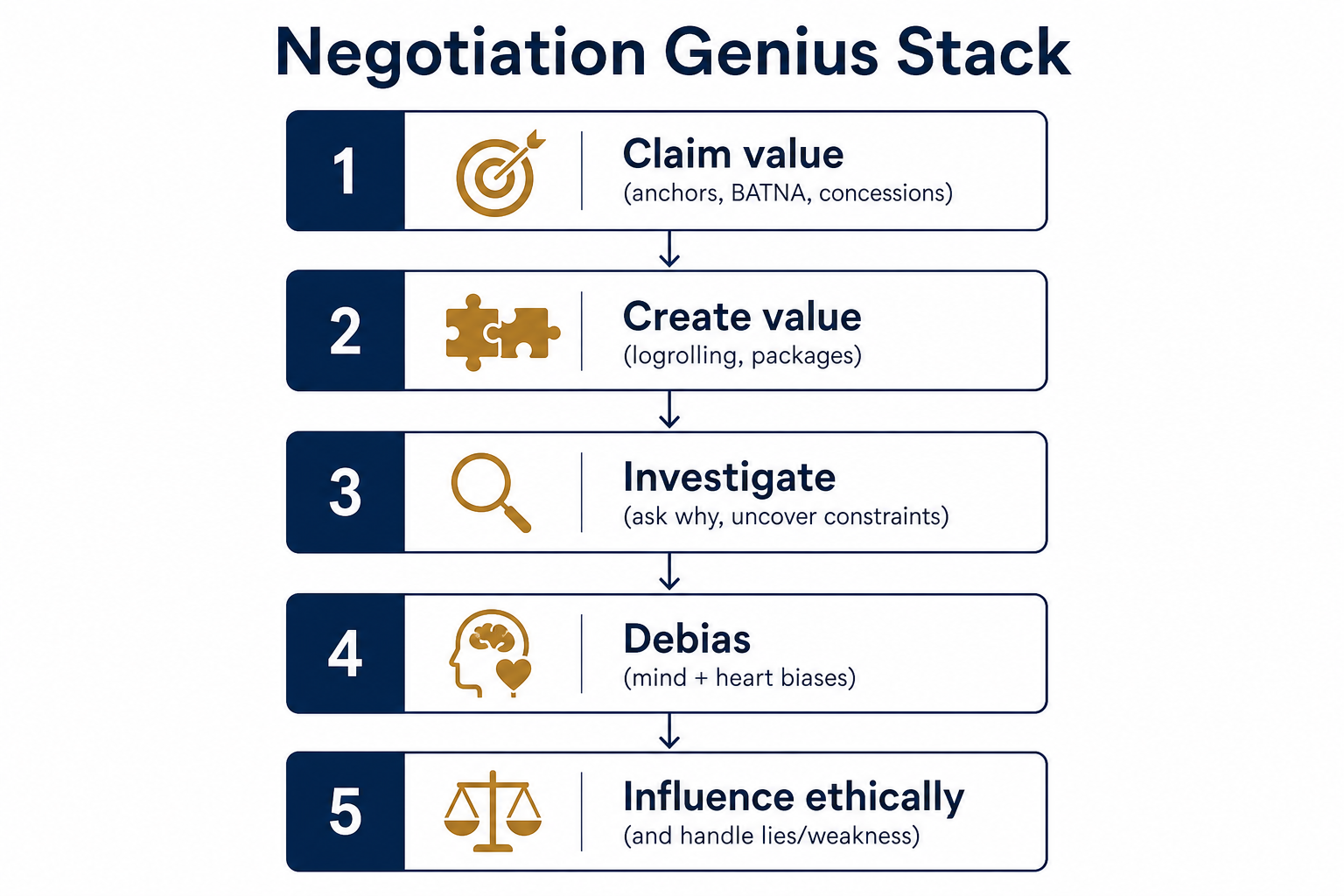
Figure: claim → create → investigate → debias → influence—then handle hard cases.
| Part | Chapters (book) | Practitioner job |
|---|---|---|
| I — Core dealcraft | 1 Claiming · 2 Creating · 3 Investigative | Structure the economics and the information hunt |
| II — Rationality under bias | 4 Mind · 5 Heart · 6 Negotiating rationally | Error correction and expertise-building |
| III — Hard cases | 7 Influence · 8 Blind spots · 9 Lies · 10 Ethics · 11 Weakness · 12 Ugly · 13 When not · 14 Path to genius | Influence, diligence, deception, ethics, power, escalation, judgment |
1. Introduction — Becoming a negotiation genius
1.1 What “genius” means here
A negotiation genius is not someone who wins every haggle. Genius shows up in preparation architecture, reframing hopeless situations, and consistent outcomes across deal types—not charisma alone.
| Ordinary negotiator | Negotiation genius |
|---|---|
| Prepares late or not at all | Uses a repeatable prep framework every time |
| Treats “no” as rejection | Treats “no” as data about constraints |
| Splits differences on price | Packages issues and hunts differences |
| Trusts experience and gut | Builds expertise via conceptual debriefs |
| Negotiates whenever challenged | Knows when talks destroy leverage or reputation |
1.2 How this book complements your stack
| Book | Layer | Genius adds |
|---|---|---|
| Getting to Yes | Principled method (interests, options, criteria, BATNA) | Quantitative claiming/creating tools; bias science |
| Never Split the Difference | Tactical empathy, labels, calibrated questions | When empathy must yield to ZOPA math and deception defence |
| Difficult Conversations | Identity, feelings, contribution in hard talks | Commercial structure for the same emotions at the deal table |
| SPIN Selling | Discovery in major sales | Investigative negotiation behind the SPIN questions |
1.3 The five-step prep skeleton (extended across the book)
Malhotra and Bazerman open with a five-step framework that grows as negotiations get complex:
- Assess your BATNA — identify alternatives, estimate value, select best.
- Calculate reservation value — walk-away linked to BATNA (issue-level or package-level).
- Assess their BATNA — hypothesise; update with investigation.
- Set aspiration (target) — ambitious but justifiable.
- Evaluate the ZOPA — overlap between reservation values; size predicts claiming opportunity.
Later chapters add issue lists, weights, contingency ideas, influence plans, bias flags, and deception defences.
1.4 What genius looks like in practice (book introduction themes)
The introduction’s running claim: you often recognise a negotiation genius after the fact—when someone turns around a hopeless situation, negotiates successful deals consistently, or refuses to negotiate when that is the smart move. Genius is visible in how they think, how they prepare, and how they execute—not in a single clever line.
| Genius signal | Observable behaviour |
|---|---|
| Reframe | Roosevelt manager turned liability into publicity opportunity |
| Investigate | Chris asked “why” once; team had sweetened price for days |
| Multi-issue | Holbrooke split size vs timing across 189 parties |
| De-bias | System 2 prep when stakes are high—not “trust the gut” |
| Escalation control | Kennedy chose blockade over air strike; bought negotiation time |
| Judgment | Manure professor should have apologised—not haggled |
1.5 Failure mode: no prep at all
The book’s most repeated finding from training tens of thousands of executives: the costliest mistakes happen before talks begin. People assume negotiation is “all art,” skip preparation, and treat the real action as starting at the table. Genius inverts this: the table is where preparation pays off.
2. Chapter 1 — Claiming value in negotiation
Figure: value claiming is not greed—it is disciplined capture of jointly created surplus.
2.1 Case anchor: Roosevelt’s photograph (1912)
During Roosevelt’s 1912 campaign, three million brochures with his photograph had already been printed when managers discovered they lacked the photographer’s permission. Copyright law could have cost $1 per copy—roughly $3 million (over $60 million in today’s terms). Reprinting would be ruinously slow and expensive.
The campaign manager’s telegram reframed the negotiation entirely:
“Planning to distribute three million copies of campaign speech with photographs. Excellent publicity opportunity for photographers. How much are you willing to pay to use your photographs? Respond immediately.”
The photographer replied within hours: he would pay $250 for the privilege.
Lessons (without copying the tactic blindly):
| Lesson | Mechanism |
|---|---|
| Reframe the reference point | Shift from “what we owe you” to “what you gain from us” |
| Anchor aggressively but credibly | First number shapes expectations |
| Hide catastrophic weakness when possible | Photographer did not know brochures were already printed |
| Separate information from influence | Facts about volume were deployed as influence, not confession |
2.2 Core claiming vocabulary
| Term | Definition | Practitioner use |
|---|---|---|
| Value | Whatever parties find useful (money, time, risk reduction, face) | Define metrics before opening |
| Claiming | Capturing share of jointly available value | After or while creating |
| Aspiration (target) | Best realistic outcome you aim for | Drives opening and package design |
| Reservation value (RV) | Walk-away minimum | Derived from BATNA |
| BATNA | Best alternative if talks fail | Must be real, not wishful |
| ZOPA | Set of outcomes both sides prefer to BATNA | Large ZOPA ≠ automatic fair split |
2.3 Hamilton Real Estate pattern (one-issue claiming lab)
The Hamilton case (seller vs buyer on land price) teaches that RV is not your BATNA number alone—seller’s BATNA might be Quincy at $38M but negotiable upward 10–15%; RV sits in that band. First-offer timing depends on information advantage; haggling should shrink concessions with reciprocity; claiming hard need not mean personal hostility.
Five-step prep applied (seller view):
| Step | Hamilton application |
|---|---|
| 1. BATNA | Finalise with Quincy at ~$38M (+10–15% negotiable) if Estate One fails |
| 2. Reservation value | Low end ~$41.8M; high end ~$43.7M depending on risk preference |
| 3. Their BATNA | Estate One may have other sites; luxury condo use raises willingness to pay |
| 4. Aspiration | Push toward luxury-condo premium (~20% above apartment use case) |
| 5. ZOPA | Exists if buyer’s RV exceeds seller’s; size unknown until investigation |
2.4 Should you make the first offer?
| Make first offer when | Let them open when |
|---|---|
| You have strong anchor justification | They know much more about value |
| You want to set expectations | Your anchor might be wildly off |
| Silence would signal weakness | Their opening educates you cheaply |
| Package complexity favours your frame | You need their priorities first |
If you anchor first: make it assertive but defensible. If they anchor first: re-anchor with analysis—do not negotiate inside their frame without challenge.
2.5 Anchoring: power and peril
Anchoring research (e.g. Northcraft & Neale on real-estate experts) shows even professionals are pulled by arbitrary starting numbers.
| Do | Don’t |
|---|---|
| Prepare a reasoned anchor with comps, cost build-ups, or criteria | Open with a fantasy number that destroys credibility |
| Re-anchor with analysis when they anchor first | Accept their frame silently |
| Use package anchors (total deal economics) | Negotiate issue-by-issue when packaging helps you |
2.6 Concession patterns
| Pattern | Description | Risk |
|---|---|---|
| Diminishing concessions | Each move smaller than the last | Signals approaching limit |
| Contingent concessions | “We can do X if you do Y” | Clarifies quid pro quo |
| Reciprocal norm | Match their moves | Prevents unilateral giveaways |
| Unilateral “goodwill” | Concede to show spirit | Trains them to wait you out |
Negative case: Revealing reservation value (“I can go to $X”) before you must—invites them to offer $X minus epsilon.
2.7 Haggling, satisfaction and relationship
Haggling is iterative give-and-take after initial offers. Genius haggling:
- Concessions get smaller over time.
- Every concession extracts something in return (contingent concessions).
- Avoid negotiating against yourself—never lower your offer because they waited in silence.
- Manage satisfaction: people judge outcomes against aspirations and anchors, not absolute value—a deal they “won” feels better and sticks.
2.8 Package deals vs single-issue haggling
When multiple issues exist, package reservation value beats issue-by-issue settlement. Use a scoring system:
| Issue | Weight (your side) | Best | RV | Their hypothesised weight |
|---|---|---|---|---|
| Price | 40 | … | … | … |
| Payment terms | 15 | … | … | … |
| Scope / IP | 25 | … | … | … |
| References / exclusivity | 20 | … | … | … |
Settling “easy” issues first can lock you into a bad package—sequence issues strategically, not emotionally.
2.9 Failure modes — claiming
| Failure | Symptom | Fix |
|---|---|---|
| No BATNA | Accept any deal | Build alternatives before call |
| RV leak | “I can go to $X” | Share interests; protect walk-away |
| Fantasy anchor | Laughter or instant accept | Re-ground in criteria |
| Unilateral concessions | “Goodwill” discounts | Contingent reciprocity only |
| Issue-by-issue trap | Win price, lose IP | Package score everything |
2.10 Practitioner checklist — claiming
- BATNA documented with evidence it is executable.
- Package RV computed—not price alone.
- Three opening packages drafted with justification.
- Concession ladder with reciprocity triggers.
- Weak BATNA not advertised; their BATNA hypothesised.
3. Chapter 2 — Creating value in negotiation
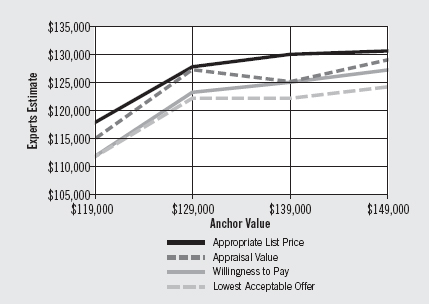
Figure: expand joint gains before fighting over division.
3.1 Case anchor: Holbrooke and UN dues (2000)
Ambassador Richard Holbrooke faced a multi-party nightmare: the U.S. owed $1B+ in UN arrears but demanded reforms—including cutting the U.S. assessment from 25% to 22%—before paying. Consensus of 189 member states was required; Helms-Biden funding expired 1 January 2001.
Initial talks looked zero-sum: if the U.S. pays less, someone pays more. Japan and Europe refused. Holbrooke restarted with investigation: visiting every delegation to learn why increases were impossible—not just that they refused.
Critical discovery: many countries’ 2001 budgets were already fixed; they could not absorb higher assessments immediately even if philosophically willing. Holbrooke split the problem into two issues—assessment size and assessment timing:
- U.S. reduction to 22% immediately (meets congressional deadline).
- Other nations increase contributions starting 2002 (meets their budget cycles).
Each side got what it cared about most on the issue it weighted highest. A one-year funding gap was covered by Ted Turner’s $30M+ donation—another negotiated layer.
| Surface frame | Genius frame |
|---|---|
| One issue: who pays what share | Two issues: size and timing |
| Fixed pie of assessments | Different priorities across time horizons |
| Convince 189 parties | Understand 189 constraint sets |
3.2 Moms.com pattern — multi-issue syndication
The Moms.com simulation (licensing fee vs runs-per-episode) shows logrolling: buyer values extra runs; seller loses residual value on overexposure—trade where marginal value differs. Industry standards (six runs) are anchors, not laws of physics.
| Issue | Seller preference | Buyer preference | Logroll opportunity |
|---|---|---|---|
| Licensing fee | High (~$7M target) | Lower | Trade fee vs runs |
| Runs per episode | 4 (protect residual) | 8 (max ad revenue) | Meet at 6–7 with fee adjustment |
| Future show (Juniors) | Bundle for relationship | Optional | Package sweetener |
Issue sequencing: Negotiating easiest issues first can anchor badly on minor points. Genius often packages or negotiates linked issues so no single issue settles in isolation.
3.3 Sources of value creation (differences)
| Difference type | Example trade |
|---|---|
| Priorities | You want price; they want payment timing |
| Forecasts / beliefs | You think adoption will be slow; they think fast → contingency |
| Risk tolerance | You fear model drift; they accept → warranty / SLA tier |
| Time preference | You need cash now; they prefer spread → front-loaded fee |
| Tax / accounting | Structure payments for mutual efficiency |
| Capabilities | You provide references; they provide case-study rights |
3.4 Logrolling mechanics
Logrolling = give them more on issues they value relatively more; receive more on issues you value relatively more.
Steps:
- List all issues (including “add issues” candidates: training, pilot scope, data rights, exclusivity carve-outs).
- Estimate relative importance weights for both sides (hypothesise theirs; update via investigation).
- Never trade issues of equal importance without compensation elsewhere.
- Present packages, not sequential concessions.
3.5 Contingency contracts
When beliefs differ and both sides are confident, bet on the future:
| Structure | When to use |
|---|---|
| Bonus / malus on KPI | AI model accuracy, uptime, adoption milestones |
| Price adjustment clause | Forecast disagreement on usage volume |
| Re-opener triggers | Regulatory change, cost-of-living beyond threshold |
| Escrow / holdback | Distrust on delivery quality |
Contingencies must be measurable, incentive-compatible, and cheap to verify—or they become litigation fuel.
3.6 Post-settlement settlements (PSS)
After signing, parties often relax—and discover Pareto improvements both prefer:
- “We locked price; can we adjust scope slightly to reduce your delivery risk?”
- “Now that counsel signed, can we simplify the reporting appendix?”
PSS requires trust not to reopen core terms as a bargaining tactic. Use when relationship capital exists.
3.7 Failure modes — creating
| Failure | Symptom | Fix |
|---|---|---|
| Fixed-pie assumption | Price-only haggle | Add issues; hunt differences |
| Compromise without analysis | Split every issue 50/50 | Logroll by weights |
| Premature close | Sign before PSS hunt | Schedule post-sign improvement pass |
| Bad contingency | Unmeasurable KPI | Define verification upfront |
3.8 Practitioner checklist — creating
- Minimum five issues on table (add if needed).
- Their weights hypothesised before call one.
- Two contingency structures for biggest belief gap.
- PSS review scheduled at 30 days post-close.
4. Chapter 3 — Investigative negotiation
Figure: ask why; surface constraints; treat deadlocks as information problems.
4.1 Case anchor: Chris and the exclusivity deadlock
A Fortune 500 team negotiated a $18/pound × 1M pounds/year ingredient deal. Exclusivity stalled: the buyer needed exclusivity to invest in manufacturing; the small European supplier refused—even when offered minimums and higher price.
The team assumed motives: holding out for money or keeping optionality with competitors. They escalated offers. Still deadlocked.
Negotiation genius Chris asked one word: “Why?”
The supplier’s constraint was unrelated to money: exclusivity would violate a promise to his cousin, who bought 250 pounds/year for a local product. Solution: exclusivity except a few hundred pounds for the cousin. Deal closed; no substantive concession required.
| Failed approach | Investigative approach |
|---|---|
| Argue positions (exclusivity yes/no) | Map interests (competitive protection vs family promise) |
| Sweeten price | Remove the actual blocker |
| Assume industry-standard motives | Ask why with genuine curiosity |
4.2 Principles of investigative negotiation
- Ask why—not only what. Positions hide interests; interests hide constraints.
- Seek constraints, not just preferences. Budget cycles, legal limits, political promises, plant utilisation, internal KPIs.
- Treat “no” as data. Which constraint fired? Timing, authority, risk, face?
- Share information strategically to elicit information—not naive full transparency.
- Separate information from influence. Their deadline may be real or tactical—probe.
- When stuck on one issue, zoom out to the package. “What would make a yes possible overall?”
4.3 Consulting / AI pursuit translation
| Stated blocker | Investigative questions |
|---|---|
| “Your rate is too high” | “Which budget line owns this? What comparators are you using? What outcome justifies the spend?” |
| “We can’t do exclusivity on data” | “Is the concern regulatory, competitive, or operational? Who else must agree?” |
| “Security won’t approve cloud AI” | “Which control failed—data residency, model training, logging? What would a pilot need to prove?” |
| “Procurement needs three bids” | “Is this policy or preference? Can incumbent advantage be documented as DVP?” |
Plant utilisation pattern (generalised): A supplier refuses terms that look irrational on volume alone—investigation reveals they need a second small customer for factory economics, not a desire to arm your competitor. A volume commitment, take-or-pay, or carve-out may unlock exclusivity.
4.4 Negative cases — investigation failures
| Failure | Cost |
|---|---|
| Assuming price is the only issue | Overpay without solving blockers |
| Asking threatening direct questions (“What’s your bottom line?”) | Invites lies; destroys trust |
| Stopping at first “no” | Misses multi-issue reformulations |
| Ignoring agents’ constraints | Deal dies in legal/procurement after “yes” |
4.5 Investigative question bank
| Instead of (threatening) | Ask (investigative) |
|---|---|
| “What’s your bottom line?” | “What would need to be true for this package to work on your side?” |
| “Why won’t you budge on price?” | “Which constraints—budget, policy, politics—limit movement on fee?” |
| “Is that your final offer?” | “Help me understand what drove that structure.” |
| “We need exclusivity.” | “What would exclusivity prevent you from doing that matters to you?” |
4.6 Failure modes — investigation
| Failure | Cost |
|---|---|
| Chris team pattern | Days of price escalation; wrong blocker |
| Holbrooke skip | Would have missed budget-cycle constraint |
| Assumed plant utilisation | Missed carve-out that unlocks exclusivity |
4.7 Practitioner checklist — investigative
- Three constraint hypotheses before each call.
- Ask why before counter-offering.
- Log each no as constraint data.
- Never improve offer until information changes.
5. Chapter 4 — When rationality fails: biases of the mind
5.1 Case anchor: NHL lockout (2004–05)
On 15 September 2004, the NHL locked out players. Five months later, the league cancelled the entire season—the first major U.S. sport to lose a full season to labour dispute.
Under Commissioner Gary Bettman, the NHL expanded aggressively in the 1990s—but player salaries reached ~75% of revenues by 2003. Nineteen of thirty franchises lost money in 2003–04; league claimed $225M in losses. Both sides framed the fight in zero-sum wage terms under public pressure.
| Mind bias | NHL manifestation |
|---|---|
| Fixed-pie | Salary share as the only movable issue |
| Anchoring | Opening positions on historical splits |
| Framing (gain vs loss) | Owners framed as “saving the league”; players as “protecting gains” |
| Reference group neglect | Insufficient weight on fan/revenue destruction |
| Overconfidence | Each side believed the other would blink |
Practitioner caution: Public negotiations amplify mind biases—constituencies punish compromise even when ZOPA exists.
5.2 Cognitive bias field guide
| Bias | Negotiation damage | Countermeasure |
|---|---|---|
| Anchoring | First number warps judgment | Prepare your anchor; re-anchor with criteria |
| Fixed-pie assumption | Miss logrolls and added issues | Explicitly hunt differences; add issues |
| Framing (gain/loss) | Risk-seeking when losses loom | Reframe; use outsider lens |
| Vividness / availability | Overweight dramatic anecdotes | Demand base rates, comps, distributions |
| Egocentric fairness | “Fair” = favourable to me | External standards; role reversal |
| Winner’s curse | Win auction by overpaying | Adjust for information asymmetry |
| Reactive devaluation | Reject good ideas from adversary | Evaluate substance blind to source |
5.3 De-biasing moves (mind)
- Write the ZOPA and weights before opening—System 2 before System 1.
- Red-team your anchor: “What would an outsider say?”
- Pre-mortem: “If this deal fails, which bias killed us?”
- Criteria first: Tie numbers to benchmarks (Getting to Yes objective standards).
5.4 Failure modes — mind biases
| Context | Typical bias stack | Counter |
|---|---|---|
| RFP / auction | Anchoring + winner’s curse | Pre-bid cap; outsider review |
| Public labour dispute | Fixed-pie + reference group neglect | Expand issues; private channel |
| Internal budget fight | Egocentric fairness | External benchmark |
| AI vendor bake-off | Vivid demo + availability | Require eval on your data |
5.5 Practitioner checklist — mind biases
- Name top two mind biases for this deal type.
- Assign bias buddy in the room.
- Run winner’s curse math before auctions.
- Pre-mortem before signing.
6. Chapter 5 — When rationality fails: biases of the heart
6.1 Case anchor: the $909 co-op window bars
Manhattan co-op residents installed $909 window bars for childproofing. The board argued the unit owners should pay; owners argued building-wide safety. The dispute escalated to court.
- Co-op board won—residents owed $909.
- Combined legal fees approached $20,000—then $50,000 on appeal.
- Final tally: six years, >$100,000 spent fighting over $909.
Fairness rage and escalation of commitment dominated: each side punished perceived unfairness at enormous cost. Egocentric fairness made “winning” symbolic beyond economics.
6.2 Motivational / emotional bias field guide
| Bias | Pattern | Countermeasure |
|---|---|---|
| Competitive arousal | Winning the contest beats winning the deal | Pre-commit walk-away; separate “win” metrics |
| Escalation of commitment | Sunk costs drive continued fight | Decide on forward value only; use third party |
| Empathy gaps | Underestimate others’ emotion/face needs | Pre-mortem on their shame, status, fear |
| Fairness rage | Punish unfairness despite net loss | Process fairness; acknowledge; reframe |
| Overconfidence | Under-prepare; skip investigation | Checklists; outsider lens |
| Illusion of superiority | “We’re better negotiators” | Track outcomes; debrief honestly |
| Nonrational optimism | “We’ll definitely win in court” | Base rates for litigation |
6.3 Heart vs mind interaction
Heart biases often trigger mind biases: anger narrows framing to fixed-pie; arousal accelerates System 1 concessions.
| Signal you’re in heart bias | Emergency move |
|---|---|
| Desire to “teach them a lesson” | Pause 24h; consult non-involved adviser |
| Pride in not budging | Ask “What interest does stubbornness serve?” |
| Fear of looking weak | Separate face from substance (Getting to Yes) |
| Adrenaline in competitive bid | Cap bid in writing beforehand |
6.4 Want-self vs should-self
Negotiators often face internal conflict between what they want to do ( retaliate, concede to end pain, win visibly) and what they should do (prepare, logroll, walk). Heart biases amplify the want-self. Pre-commit rules before arousal: walk-away numbers, mandatory pause, third-party review.
6.5 Failure modes — heart biases
| Signal | Likely bias | Emergency protocol |
|---|---|---|
| “We’ll show them” | Competitive arousal | 24h pause; no email replies |
| “We’ve spent too much to stop” | Escalation | Forward-value-only decision memo |
| “That’s not fair!” at $909 scale | Fairness rage | Mediation before counsel |
| “They’ll fold” | Overconfidence | Red-team their BATNA |
6.6 Practitioner checklist — heart biases
- Rate emotional temperature 1–5; postpone if ≥4 without plan.
- Offer process fairness when substance stuck.
- Mediation gate for disputes below cost threshold X.
- Log sunk costs—forbidden as forward argument.
7. Chapter 6 — Negotiating rationally in an irrational world
7.1 Experience vs expertise
Malhotra and Bazerman follow Neale & Northcraft: experience is repetition; expertise is a strategic conceptualisation of effective negotiation.
| Experience alone | Expertise |
|---|---|
| “I’ve done 100 deals” | “Here’s my framework; here’s where deal 100 fits” |
| Overgeneralises from wins | Extracts principles via analogical reasoning |
| Vulnerable to same biases | Uses checklists and debiasing systems |
| Domain-specific luck | Transfers learning across contexts |
You can be brilliant at sales contracts and terrible at partnership dissolutions if you lack transferable structure.
7.2 System 2 in a System 1 world
System 1 (fast, intuitive) suits low stakes; System 2 (deliberate) is mandatory for complex deals. Habits: monthly System 2 list of high-stakes talks; refuse artificial time pressure; partition sessions with reflection breaks; separate information from influence on urgency claims.
7.3 Analogical reasoning
Learning improves when you compare two episodes and extract structural lessons—not surface details.
| Weak debrief | Strong debrief |
|---|---|
| “That supplier was difficult” | “When exclusivity blocks, ask family/legal/carve-out constraints before price” |
| “We should have walked” | “When BATNA weak and public, don’t haggle—apologise and ask amends” |
Technique: After each deal, write one principle that would help in a different industry.
7.4 Checklists and debriefs
Pre-negotiation checklist (minimum):
- BATNA / RV / aspiration (both sides hypothesised)
- Issues + weights
- Opening packages
- Bias risks (mind + heart)
- Influence and ethics red lines
- Walk-away triggers
Post-negotiation debrief:
- What created value? What did we leave on table?
- Which bias appeared? Did we counter it?
- What did we learn about their constraints?
- Analogical principle for the library.
7.5 Outsider lens
Adopt the perspective of an uninvolved adviser: less egocentrism, better generalisation. Pair with a colleague who does not carry your sunk costs.
7.6 Analogical reasoning technique (from the book)
After two similar negotiations (or case studies):
- List surface similarities (industry, size, issue).
- List structural similarities (weak BATNA both sides, exclusivity blocker, agent conflict).
- Extract principle: “When structure X, tactic Y before tactic Z.”
- Apply principle to the next deal—not the surface facts.
Loewenstein, Thompson and Gentner’s research: comparing two exercises yields far better transfer than debriefing one episode alone.
7.7 Failure modes — expertise
| Trap | Symptom |
|---|---|
| Experience illusion | “I’ve done 100 of these” + repeated bias |
| Domain overconfidence | Great at sales, terrible at partnerships |
| No debrief | Same mistake quarterly |
| Intuition under time pressure | System 1 concessions |
7.8 Practitioner checklist — rationality systems
- Deal library of 10 annotated cases.
- Quarterly: compare two failures for structure.
- No deal >$X without written prep.
- Track contingency outcomes—calibrate beliefs.
8. Chapter 7 — Strategies of influence (ethical)
Figure: listening discovers; ethical influence helps good packages get to yes.
Investigation first; influence when merit alone stalls. Malhotra and Bazerman draw on Cialdini-style research—use ethically (true scarcity, real social proof, honest loss framing).
8.1 Influence strategy catalogue
| Strategy | Mechanism | Ethical guardrail |
|---|---|---|
| Loss framing | Losses weigh heavier than gains | Same facts; don’t fabricate losses |
| Disaggregate gains / aggregate losses | Two $10 wins feel better than one $20; two $10 losses feel worse | Transparency in totals |
| Social proof | Uncertainty → look to peers | Cite real references only |
| Scarcity / deadline | Urgency increases compliance | Deadlines must be credible |
| Foot-in-the-door (FITD) | Small yes → larger yes | Small ask must be legitimate |
| Door-in-the-face (DITF) | Large ask rejected → smaller seems reasonable | Not manipulative cruelty |
| Yesable draft | Concrete proposal easy to accept | Draft is genuinely workable |
8.2 Loss aversion in commercial pitches
Energy audit study: “You lose X cents per day without insulation” outperformed “You save X”—identical economics. In consulting: frame delayed AI governance as exposure to audit and model-drift costs, not only risk reduction. Use loss frames sparingly early in relationships.
8.3 Defence against their influence
| Their tactic | Your defence |
|---|---|
| Fake deadline | “Is this firm? What happens if we need one more week?” |
| Bogus competitor offer | Verify; ask for term sheet; walk if false |
| DITF extreme first ask | Reset to criteria; ignore anchor |
| Social proof bluff | “Which similar firms? May we speak with them?” |
8.4 Additional influence strategies (book catalogue)
| Strategy | Application | Defence |
|---|---|---|
| Authority / credentials | Cite expert benchmarks | Verify source independently |
| Commitment / consistency | FITD: small pilot → enterprise | Evaluate each step on merits |
| Liking | Rapport before ask | Separate liking from terms |
| Contrast effect | Absurd first offer makes second seem reasonable | Evaluate packages in isolation |
8.5 Failure modes — influence
Over-reliance on loss frames sours relationships. Influence changes compliance likelihood, not merit—never use tactics to sell a bad deal.
8.6 Practitioner checklist — influence
- Draft yesable package before call.
- One loss frame + one gain frame prepared.
- Log tactics used on you in RFPs.
- Never claim scarcity you cannot prove.
9. Chapter 8 — Blind spots in negotiation (bounded awareness)
9.1 Case anchor: Guidant, J&J, and Boston Scientific
December 2004: J&J agrees to buy Guidant for $25.4B. May 2005: New York Times reveals Guidant failed for three years to disclose defibrillator flaws affecting thousands of patients. FDA investigation, recalls, lawsuits follow.
J&J seeks to renegotiate; Guidant sues to enforce. Boston Scientific—a competitor strategically disadvantaged if J&J acquires Guidant—enters bidding. Escalation ends with Boston Scientific buying Guidant for $27B—far above J&J’s later bids.
Aftermath: Boston Scientific’s stock fell below $17; Forbes later called the deal among the worst acquisitions ever. J&J’s stock also fell on bid announcements. Bounded awareness: focus on price and synergy blinded parties to competitive dynamics, regulatory tail risk, and information available but unfocused.
| Blind spot | Who missed what |
|---|---|
| Inattentional blindness | Product-liability signals during diligence |
| Reference group neglect | Boston Scientific’s strategic BATNA worsening if J&J wins |
| Competitive arousal | Bidding war detached from integration value |
| Insider lens | Deal team momentum vs outsider risk view |
9.2 Bounded awareness toolkit
Bounded awareness = systematic failure to notice readily available, relevant information outside current focus.
| Prevention | Practice |
|---|---|
| Diligence checklist beyond financials | Legal, regulatory, reputational, competitive response |
| Outsider review | Uninvolved exec red-teams the deal thesis |
| Consider who is NOT at the table | Competitors, regulators, media, future customers |
| Pre-mortem on hidden information | “What would make us fools in six months?” |
9.3 Who is not at the table (Guidant lesson extended)
Boston Scientific was virtually unmentioned in early reporting—but had the most to lose if J&J acquired Guidant. Their entry transformed a bilateral deal into a competitive auction detached from integration value. Genius asks: Who gains if we sign? Who loses? Who might enter?
9.4 Failure modes — blind spots
| Blind spot | Consulting analogue |
|---|---|
| Inattentional blindness | Missed subprocessor in AI vendor diligence |
| Insider lens | Pursuit team momentum ignores delivery red flags |
| Competitive neglect | Incumbent SI triggers client RFP when you near close |
9.5 Practitioner checklist — blind spots
- Competitor BATNA column on every M&A/partnership prep.
- One person hunts disconfirming evidence only.
- Guidant gate after price agreement—catastrophic fact check.
- AI diligence: data lineage, model change logs, subprocessors.
10. Chapter 9 — Confronting lies and deception
Most executives admit they have lied in negotiation; all report being lied to. Genius assumes deception is possible—not that everyone is evil.
10.1 Three phases: prevent, detect, respond
| Phase | Tactics |
|---|---|
| Prevent | Look prepared; signal verifiability; contingency clauses; incentive-compatible contracts |
| Detect | Inconsistencies; too-precise claims; reluctance to put terms in writing; indirect question paths |
| Respond | Correct record; renegotiate; escalate; walk—don’t “trap” for sport |
10.2 Prevention details
Appear prepared (details, notes, industry fluency); signal future verification; ask indirect questions about process and suppliers instead of “What’s your bottom line?”; use contingency penalties for misrepresentation.
10.3 Common deception patterns
| Pattern | Example | Response |
|---|---|---|
| Fake competitor offer | “Vendor B quoted 20% less” | Request evidence; call bluff professionally |
| False scarcity | “Offer expires Friday” | Probe firmness |
| Material omission | Undisclosed defect / dependency | Due diligence + reps & warranties |
| Puffery | “Best in class” | Distinguish from falsifiable claims |
10.4 Detection and response (expanded)
Detection signals: inconsistency across meetings; excessive precision on unverifiable claims; discomfort when asked for written confirmation; answers that dodge indirect questions.
Response ladder:
- Clarify on the record—no accusation.
- Contingency—tie payment to verification.
- Renegotiate if material misrepresentation surfaces.
- Walk—preserve reputation; document.
Do not run sting operations for sport—focus on outcome protection.
10.5 Failure modes — deception
| Failure | Result |
|---|---|
| Unverified competitor price | Unilateral discount |
| Trusting reservation value stated | Anchor manipulation |
| No reps & warranties | Material omission undiscovered |
10.6 Practitioner checklist — deception
- Classify claims: verifiable / unverifiable / puff.
- Audit rights and benchmark clauses in contract.
- Never discount without changed information.
11. Chapter 10 — Recognizing and resolving ethical dilemmas
11.1 Bounded ethicality
Not all “unethical” behaviour is conscious lying. Bounded ethicality (Banaji, Chugh, Bazerman): ordinary psychological processes lead people to harm others while believing they act ethically.
Examples from the book’s opening prompts:
- “I wouldn’t sell this if it weren’t best for you.”
- “We treat all employees equally.”
- “We’re expanding the pie for everyone.”
These may be sincere self-deception driven by conflict of interest—not cartoon villainy.
11.2 Conflict of interest traps
| Role | Bias |
|---|---|
| Hourly lawyer | Believes long process serves client |
| Contingency lawyer | Believes quick settlement serves client |
| Seller | Genuinely believes own product is best |
| Real-estate agent | Pushes faster close / higher price for commission |
Shocking finding: Disclosure of conflict can worsen behaviour—advisers feel licensed to exaggerate; clients feel more trust after disclosure.
| Wrong fix | Better fix |
|---|---|
| Assume disclosure solves ethics | Use disinterested advisers; outside benchmarks |
| Attack counterpart as liar | Reframe: “Help me verify” |
| Trust your moral compass alone | Structural checks (checklists, second opinions) |
11.3 Stereotypes and implicit bias
Landscaping vendor case: analysis favoured a newer supplier; gut chose the legacy firm—implicit bias tax. Use criteria and blind evaluation where possible.
11.4 Ethical negotiation reputation
Short-term claiming via deception destroys long-term deal flow. Ethical genius:
- Distinguish illegal lies, material omissions, puffery.
- Build reputation for preparation, honesty on verifiable facts, and process fairness.
- Walk when the game requires lying.
11.5 Stereotype tax and evaluation discipline
Steve Barrett landscaping case: analytic comparison favoured the newer, innovative firm; gut chose the legacy vendor—implicit bias. Genius uses written criteria, blind scoring where feasible, and debate before gut on vendor selection.
11.6 Failure modes — ethics
| Situation | Wrong move | Better move |
|---|---|---|
| Seller sincerely oversells | Call them liar | Request verification; criteria |
| Agent pushes overbid | Blind trust | Outside benchmark |
| Disclosure signed | Assume objectivity | Independent second opinion |
11.7 Practitioner checklist — ethics
- List your conflicts before advising.
- Ask who pays whom for what outcome on agent deals.
- Define red lines in writing.
12. Chapter 11 — Negotiating from a position of weakness
Weakness = your BATNA is bad relative to theirs—not necessarily absolute.
12.1 Strategies while still weak
| # | Strategy | Idea |
|---|---|---|
| 1 | Don’t reveal weakness | Roosevelt manager hid printed brochures |
| 2 | Leverage their weakness | They may need you despite your bad BATNA |
| 3 | Distinct value proposition (DVP) | Non-price assets they cannot get elsewhere |
| 4 | Never negotiate against yourself | No unilateral price drops without new asks |
| 5 | Negotiate process | Information rights, criteria, pilot structure, timing |
When both BATNAs are weak, ZOPA is large—who claims more depends on who understands fundamentals and makes the other’s opportunity cost salient.
12.2 Change the ZOPA / change the game
| Move | Example |
|---|---|
| Improve your BATNA | Parallel vendor talks; internal build option |
| Weaken their BATNA | Exclusive pilot; reference dependency |
| Add parties | Coalition with allies; regulator clarity |
| Add issues | Training, IP, success fees, co-marketing |
| Change timing | Align to their budget cycle (Holbrooke timing split) |
12.3 Commodity auction trap
Customers force single-issue price auctions. Genius response:
- Articulate DVP they actually value (quality, risk, speed, brand, compliance record).
- Refuse to play pure auction—or play with package scoring.
- Introduce contingencies that competitors cannot match.
12.4 Weakness stories from the book (patterns)
| Story type | Weakness | Genius move |
|---|---|---|
| Only buyer for shares | Seller needs liquidity | Focus on buyer’s gain from control; anchor high |
| Customer price-only | Commodity auction | DVP + package scoring |
| Frivolous lawsuit threat | Rich opponent | Change forum; improve BATNA; process rights |
| Small country diplomacy | Power asymmetry | Coalitions; multi-issue; timing |
12.5 Never negotiate against yourself
Unilateral price drops—without a new ask or new information—train counterparts to wait. If you must move, demand contingent reciprocity: “We can reduce fee if scope phase 2 moves to Q3 and case study rights granted.”
12.6 Failure modes — weakness
| Failure | Symptom |
|---|---|
| Desperation leak | “We really need this deal” |
| Price-only defence | Ignoring DVP |
| Accept first offer | Weak BATNA panic |
12.7 Practitioner checklist — weakness
- Their BATNA written with same rigour as yours.
- Three ZOPA-expanders before price concession.
- Non-desperate timeline language scripted.
13. Chapter 12 — When negotiations get ugly
13.1 Case anchor: Cuban Missile Crisis (1962)
Thirteen days brought the U.S. and USSR closer to nuclear war than before or since. Kennedy rejected air-strike advice in favour of a naval blockade—buying time for back-channel negotiation. Critical insight: understand Khrushchev’s needs (face, security, removal of Jupiter missiles in Turkey)—not only U.S. dominance displays.
Years later, intelligence revealed Cuba had operational nuclear warheads authorised for use if attacked—Kennedy’s restraint avoided catastrophe miscalculation.
| Ugly force | Crisis lesson |
|---|---|
| Escalation ladder | Each step narrows options—design off-ramps early |
| Misread capabilities | Assume worst plausible, verify |
| Ego / audience costs | Public threats lock positions |
| Time pressure | Slow down when stakes are existential |
13.2 Ugly talk toolkit
| Element | Response |
|---|---|
| Anger | Label; pause; separate people from problem (Getting to Yes, Voss) |
| Threats | Take seriously; don’t mirror; document; improve BATNA |
| Distrust | Small commitments; contingent structure; third parties |
| Irrationality | Don’t argue sanity—change process or walk |
| Ego | Face-saving packages; private vs public channels |
13.3 Escalation control
- Define sixth step before taking fifth—what happens after your next escalation?
- Use graduated reciprocation in tension reduction (GRIT)-style unilateral small moves when safe.
- Prefer process resets (“Let’s agree on agenda”) over substantive concessions under heat.
13.4 Cuban Missile Crisis — negotiation mechanics (synthesis)
Kennedy’s team used multiple channels, face-saving for Khrushchev (secret Turkey missile withdrawal), and time (blockade vs strike) to avoid nuclear miscalculation. Intelligence later showed Cuba had operational warheads—restraint was not weakness but accurate escalation control.
Pair ugly-talk tactics with Difficult Conversations for identity and feelings; with Voss for labels and calibrated questions under stress.
13.5 Failure modes — ugly talks
| Failure | Result |
|---|---|
| Mirror threats | Escalation spiral |
| Argue rationality | Ego lock |
| Concede under heat | Bad deal + lost respect |
13.6 Practitioner checklist — ugly talks
- No substantive concessions in session one if temperature ≥4/5.
- Face-saving story prepared for their internal audience.
- Sixth step defined before fifth escalation.
14. Chapter 13 — When not to negotiate
14.1 Case anchor: the manure professor (April 2005)
A Harvard economics professor habitually took manure from a farm without permission. One night, caught by the farmhand (owner’s nephew), he tried to negotiate—offering $20, then $40 for manure worth at most $20.
The farmhand called police. Charges: trespass, larceny, malicious destruction. Media frenzy followed. The professor’s errors:
| Error | Why fatal |
|---|---|
| Misread BATNA asymmetry | His weak BATNA (criminal + reputational ruin) vs their strong BATNA (lawful enforcement) |
| Negotiated when apology was required | Offers looked like bribes, inflaming moral outrage |
| Ignored social judgment | Some transgressions demand amends, not haggling |
| Lowball under high stakes | Insult compounded harm |
14.2 When negotiation hurts you
| Condition | Action |
|---|---|
| Your BATNA is catastrophic and public | Apologise; ask what amends are required—don’t haggle |
| Counterparty lacks authority or good faith | Don’t treat talks as real |
| Talks destroy leverage (exclusive lock-in while stalling) | Delay or walk |
| Deal legitimises bad actor with no upside | Refuse |
| Symbolic “split the difference” on ethics | Refuse |
| Negotiation appears to reward prior bad behaviour | Change process or exit |
14.3 Consulting / pursuit applications
- Don’t renegotiate scope downward unilaterally to “save” a doomed pursuit—fix the thesis or walk.
- Don’t enter fake bake-offs when incumbent has already decided—improve BATNA (different entry point) or decline.
- Don’t negotiate with bad-faith IP grabs—legal response may beat table talk.
14.4 Social judgment vs economic negotiation
The manure professor conflated economic haggling (appropriate for manure worth $20) with moral transgression (theft, trespass). When the other party seeks justice and reputation repair, not economic surplus, negotiation signals disrespect. Ask what amends are required—do not bid incrementally.
14.5 Failure modes — when not to negotiate
| Situation | Risk of talking |
|---|---|
| Criminal / ethical breach caught | Offers read as bribes |
| Bad-faith counterpart | Legitimises abuse |
| Better BATNA outside table | Talks destroy leverage |
14.6 Practitioner checklist — when not
- Score BATNA asymmetry + reputational exposure.
- Newspaper headline test before sitting down.
- If amends required: open-ended “What would make this right?”
15. Chapter 14 — The path to genius
15.1 You are not an expert on day one
Malhotra sat in an MBA class where the professor called students “negotiation experts” on the last day—premature. Genius is lifelong deliberate practice with feedback.
15.2 Mastery loop
Prepare (claim + create + investigate + bias + ethics)
    → Execute (System 2 where stakes demand)
        → Debrief (analogical principle)
            → Update checklists & deal library
                → Repeat
15.3 Glossary — core terms (book-aligned)
| Term | Meaning |
|---|---|
| Anchor | First number that focuses attention and expectations |
| BATNA | Best Alternative To a Negotiated Agreement |
| ZOPA | Outcomes both prefer to their BATNAs |
| Reservation value | Walk-away; indifferent vs BATNA |
| Package reservation value | Walk-away across weighted issues |
| Logrolling | Trades across unequally valued issues |
| Contingency contract | Terms resolving after future uncertainty |
| Post-settlement settlement | Pareto improvements after signing |
| Investigative negotiation | Hunt hidden interests, priorities, constraints |
| Bounded awareness | Missing available information outside focus |
| Bounded ethicality | Unconscious ethical drift, not cartoon villainy |
| Analogical reasoning | Structural lessons from comparing episodes |
| Distinct value proposition (DVP) | Assets you deliver better than alternatives |
| Fixed-pie bias | Their gain = your loss assumption |
| Competitive arousal | “Win at any cost” rivalry state |
| Nonrational escalation | Persisting in failing course to justify sunk costs |
| Loss aversion | Losses loom larger than equivalent gains |
| Reactive devaluation | Devaluing adversary’s offers automatically |
| Co-opetition | Cooperate on some fronts, compete on others |
| Behavioral decision research | Systematic study of rationality deviations |
| Winner’s curse | Winning auction by overpaying vs true value |
| Incentive compatible | Clauses aligning behaviour with agreement spirit |
| Negotiauction | Auction narrowing field → bilateral negotiation |
| Parasitic value creation | Gains extracted from parties not at table |
| Pareto-efficient agreement | No improvement without hurting someone |
| Stereotype tax | Cost of decisions based on stereotypes vs individual data |
16. Consulting and AI pursuit playbook
16.1 Pursuit-phase negotiation map
| Phase | Genius focus | SPIN / GTY / Voss complement |
|---|---|---|
| Qualification | Willingness to investigate constraints; avoid fake pursuits | SPIN Implication / Need-payoff |
| Discovery | Investigative “why”; map stakeholders & BATNAs | SPIN Situation / Problem |
| Proposal | Package anchor; DVP; contingency on outcomes | GTY objective criteria |
| Commercial | Logroll scope, IP, liability, payment, references | Claim + create tables |
| Close | PSS on delivery friction; no unilateral discounts | Voss calibrated questions for blockers |
16.2 Multi-issue consulting package (template)
| Issue | Typical buyer weight | Typical seller weight | Logroll ideas |
|---|---|---|---|
| Fixed fee vs T&M | Budget certainty | Risk coverage | Hybrid + cap |
| IP / model weights | Ownership | Reuse rights | Licensed background IP |
| Data use / retention | Privacy | Training restriction | Tiered data handling |
| SLAs / acceptance | Uptime | Scope creep protection | Contingent fee on KPI |
| Subcontracting / staffing | Named experts | Flexibility | Key-person clause |
| Case study / reference | Marketing | Confidentiality | Delayed public reference |
| Exit / termination | Flexibility | sunk cost recovery | Wind-down fee schedule |
16.3 AI-specific and agent dynamics
| Topic | Create | Claim |
|---|---|---|
| Model performance | Contingency on eval benchmarks | Holdback until acceptance tests |
| Hallucination risk | Human-in-loop tiers | Liability cap with carve-outs |
| Vendor lock-in | Export formats, API standards | Multi-year discount without exclusivity |
| Regulatory change | Re-opener clause | Price tied to compliance cost index |
Agents (procurement, legal, SI) often suffer bounded ethicality—sincerely believing process rules serve fairness while killing value. Investigate why the process exists; negotiate process (pilot, phased MSAs, criteria) before substance concessions.
16.4 Anti-patterns — consulting commercials
| Anti-pattern | Genius correction |
|---|---|
| “Win-win” without issue map | Logroll table with weights |
| Discount to save doomed pursuit | Fix thesis or walk |
| Ignore procurement agent incentives | Process negotiation first |
| Single-issue rate card | Package scope, IP, SLA, references |
| Skip post-sign PSS | Schedule 30-day friction review |
17. Negative cases compendium (field guide)
| Case | Bias / failure | Lesson |
|---|---|---|
| Roosevelt (reverse) | If photographer knew brochures printed, anchor flips | Information asymmetry drives claiming |
| NHL lockout | Fixed-pie + public arousal | Expand issues; manage audience |
| $909 co-op | Fairness rage + escalation | Process fairness early; mediation gates |
| Guidant / J&J / Boston Scientific | Bounded awareness + competitive arousal | Competitor BATNA + diligence depth |
| Manure professor | Negotiated when amends required | Know when not to negotiate |
| Cuban Missile Crisis (counterfactual) | Escalation without off-ramps | Slow down; verify capabilities |
| Fake competitor offer (book stories) | Deception + weak verification | Never unilateral discount |
| Chris exclusivity (inverse) | Would have overpaid without “why” | Investigation before sweetening |
18. Worked mini-cases (synthetic, for practice)
18.1 AI governance pursuit — procurement price-only
- Setup: Client procurement opens with “Your day rate is 30% above incumbent SI.”
- Fixed-pie trap: Team prepares discount ladder.
- Genius move: Investigate—discover security mandate new model audit requirement; add issue: audit artefact delivery + regulator-ready documentation (your DVP). Package: fee holds; scope includes audit pack; contingency on regulatory approval timeline.
- Principle: When price-only, add issues where you logroll.
18.2 Exclusivity on training data
- Setup: Client demands exclusive use of fine-tuned model; vendor refuses.
- Assumption: Vendor wants higher price.
- Investigation: Vendor’s constraint—open-source licence on base model prevents exclusivity.
- Solution: Exclusivity on client data + fine-tune weights; shared base model carve-out; contingency if base model licence changes.
18.3 Partnership dissolution under arousal
- Setup: Co-founders splitting; lawyers engaged; both sides “winning.”
- Heart bias: Escalation + fairness rage ($909 pattern at scale).
- Genius move: Third-party mediator; forward-value-only memo; separate people (Difficult Conversations) from economics (this book’s package RV).
18.4 Vendor bake-off with fake competitor
- Setup: Client claims “Vendor B at −20%.”
- Deception defence: Request term sheet; note you benchmark quarterly; signal verification.
- Response: No unilateral discount; offer pilot with acceptance criteria—changes information, not just price.
19. Capstone — Negotiation Genius prep sheet
| # | Block | Item |
|---|---|---|
| 1–5 | Economics | BATNAs · aspiration/RV (package-scored) · ZOPA · issue weights · their weights/unknowns |
| 6–10 | Strategy | Anchor + justification · three packages · contingencies · concession ladder · DVP |
| 11–14 | Behaviour | Mind bias + counter · heart bias + counter · influence plan · deception defences |
| 15–18 | Power | Weakness plan · ugly-talk plan · walk-away triggers · “do not negotiate” flags |
| 19–20 | After | 48h debrief (analogical principle) · PSS calendar if closed |
20. Integration and closing checklist
| Need | Pair with |
|---|---|
| Principled method | Getting to Yes |
| Pressure and empathy | Never Split the Difference |
| Identity and feelings | Difficult Conversations |
| Major-sale discovery | SPIN Selling |
| Full MBA stack | Business Administration reading map |
Sequence: SPIN → Getting to Yes → Negotiation Genius → Voss → Difficult Conversations.
Closing checklist: (1) prep beats personality; (2) package by default; (3) ask why again; (4) debias yourself first; (5) investigate → create → claim; (6) reputation for verifiable honesty; (7) when weak, change the game; when ugly, slow down; when wrong, don’t negotiate.
Malhotra and Bazerman’s gift is rigorous language for the hardest commercial question: not “how do I win this haggle?” but “how do I prepare for negotiations that matter—and recognise those that must not happen?”
Discussion
Comments
Share feedback or questions about this page. No account required.
Loading comments…