The Minto Pyramid Principle: Logic for Writing, Thinking and Problem Solving
Unclear writing is usually unclear thinking. Barbara Minto’s The Minto Pyramid Principle gives the standard structure used across consulting: lead with the answer, group ideas MECE, order them logically, and pull the reader down a question-and-answer pyramid. Master it once; every memo, proposal and board pack gets sharper.
Source note: This article is an original practitioner synthesis of themes from Barbara Minto’s The Minto Pyramid Principle: Logic in Writing, Thinking, & Problem Solving. It is not a reprint. Figures are educational illustrations; support the original book for full drills, prose examples and presentation technique.
0. Why this book still matters
Business communication defaults to chronology: we did discovery, then analysis, then options, then—maybe—a recommendation. Executives do not read that way. They read to decide. Minto, ex-McKinsey, codified how consulting firms force clarity: answer first, then prove.
The Pyramid Principle is not stylistic preference. It mirrors cognitive limits. If you violate MECE or vertical logic, readers feel confusion even when they cannot name why.
Three commitments organise the work:
- Structure before prose. Fix the pyramid; words get easier.
- One governing thought per document section. If you have three recommendations, you have three pyramids—or a weak top.
- Introductions sell the question. SCQA earns the right to your answer.
1. Part I — Basic pyramid concepts
1.1 Why a pyramid?
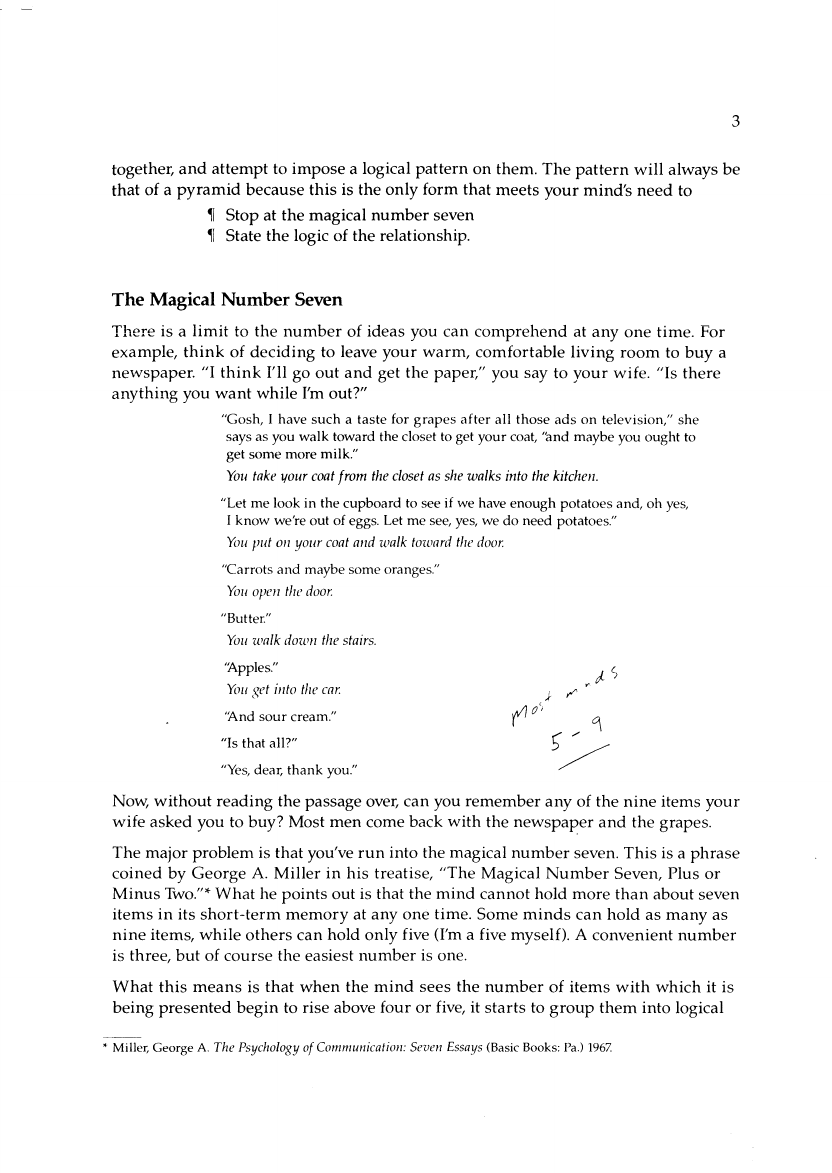
Figure: working memory limits force grouping; unstructured lists overwhelm.
Miller’s research (and successors) suggests people track roughly 7 ± 2 chunks. Beyond that, comprehension collapses unless ideas are grouped and summarised.
| Without pyramid | With pyramid |
|---|---|
| Reader hunts for the point | Point first |
| Ideas feel random | Groups have logical glue |
| Rewrites forever | Structure reveals gaps early |
| Slides = data dump | Slides = argument |
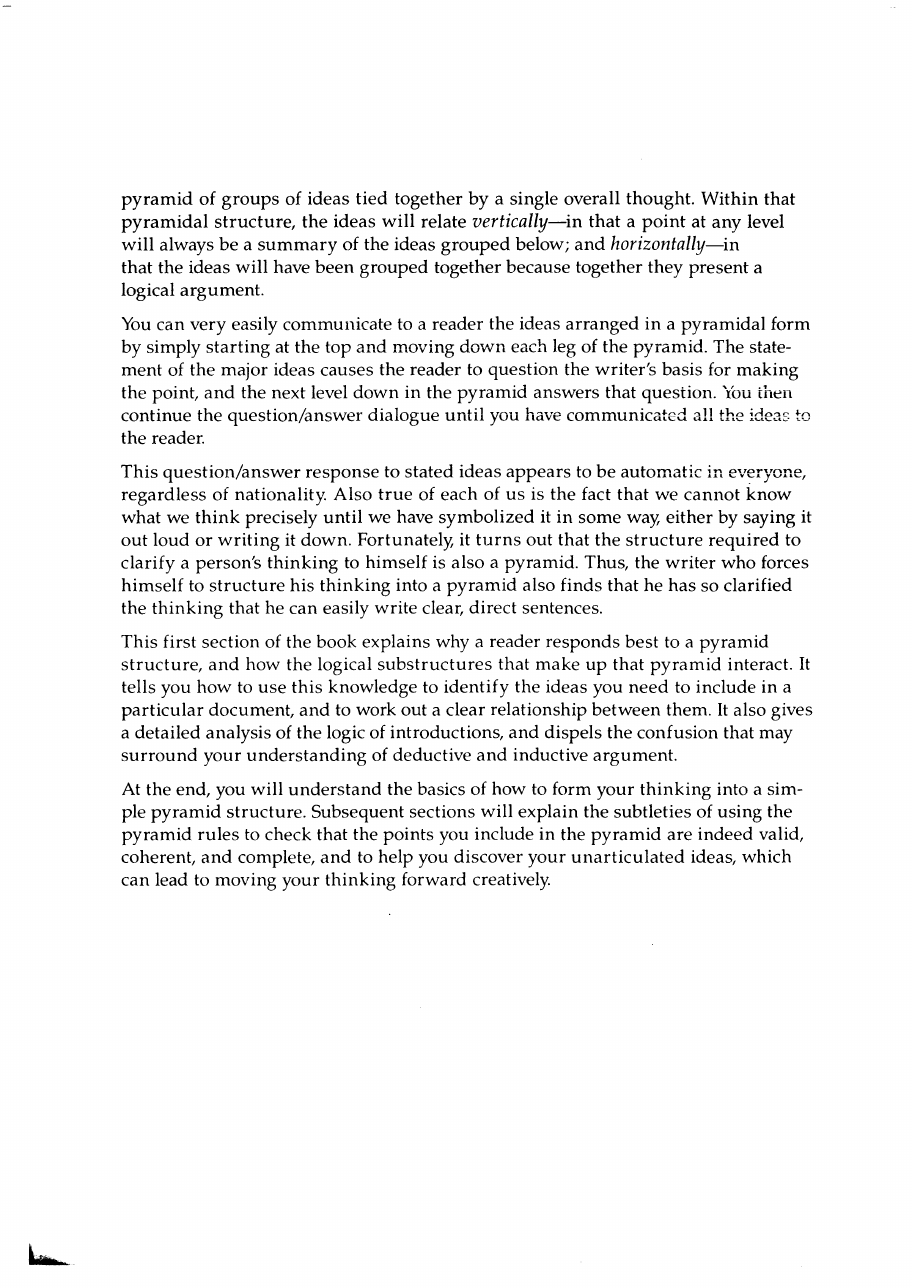
Figure: vertical summary relationships and horizontal logical grouping create a question/answer dialogue.
1.2 Vertical relationship — question and answer
- State the governing idea (answer).
- The reader asks why / how / what evidence?
- The next level answers.
- Repeat until the question is exhausted.
Rules:
- Never raise a question you leave unanswered.
- Never place an idea that does not answer a question the level above raises.
Test: Cover everything below a heading. Does the heading still feel true and complete? If not, the summary is wrong or the grouping is wrong.
1.3 Horizontal relationship — logic at one level
Ideas at the same level must relate in one of two ways:
| Mode | Pattern | Use when |
|---|---|---|
| Deductive | Major premise → minor → conclusion | Formal proof; tight chains |
| Inductive | Similar points → inferred conclusion | Most business recommendations |
Inductive groups need a clear categorising principle:
- Time order (first, second, third phase)
- Structural parts (org, process, technology)
- Ranking by importance
- Cause categories (people, process, technology)
1.4 MECE
| Mutually exclusive | Collectively exhaustive |
|---|---|
| No overlapping categories | No missing category that matters |
MECE failures:
| Failure | Example | Fix |
|---|---|---|
| Overlap | “Cost” and “Efficiency” both cover headcount | Sharpen definitions |
| Gap | Risk list with no regulatory category | Add missing bucket |
| Fake MECE | “People, process, technology, other” | “Other” is a junk drawer |
2. Part I — How to build a pyramid structure
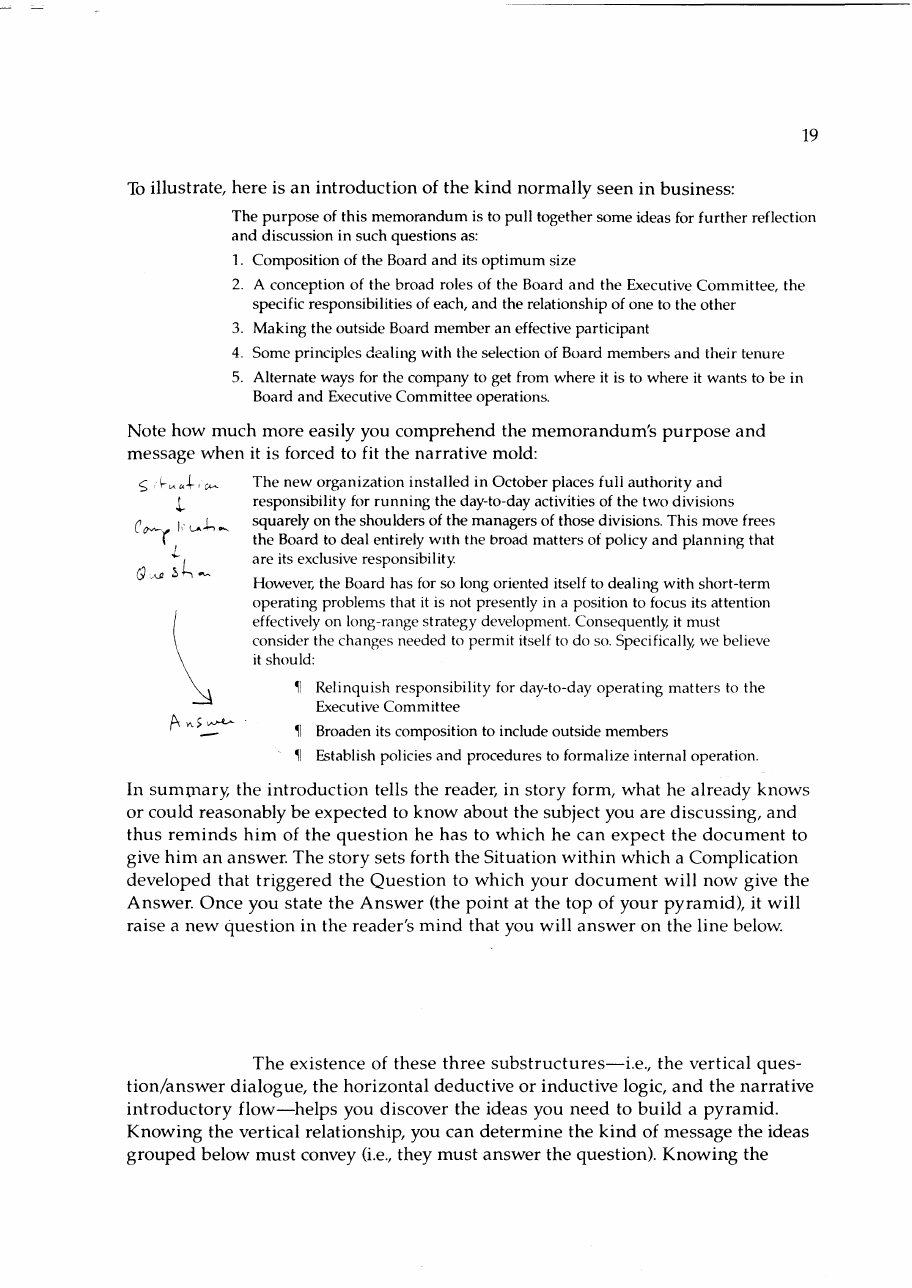
Figure: build top-down when the answer is known; bottom-up when discovering the point.
2.1 Top-down construction
When you know the recommendation:
- What is the subject?
- What is the question in the reader’s mind?
- What is your answer (governing thought)?
- What new questions does the answer raise?
- Fill MECE groups beneath until questions stop.
Consulting memo example:
- Answer: Pilot agent-assist on Tier-1 with eval gates before scale.
- Q1: Why this over alternatives? → MECE: risk, ROI, speed.
- Q2 under risk: What controls? → Human-in-loop, eval harness, audit log.
2.2 Bottom-up construction
When you are still thinking:
- List all points you might make.
- Group related points.
- Infer the summary idea for each group.
- Draw the governing thought.
- Check vertical Q&A and MECE.
Bottom-up is slower but essential in messy diagnostics.
2.3 The story form check
Minto warns against “story form” narratives that hide the answer. Story is for introductions (SCQA), not for burying the recommendation.
3. Part I — Fine points of introductions (SCQA)
Before the pyramid body, set the story:
| Element | Function | Example |
|---|---|---|
| Situation | Stable context reader accepts | “Claims ops uses a 120-person manual review team.” |
| Complication | Change that creates tension | “Volumes rose 40%; quality SLAs are failing.” |
| Question | Implicit or explicit | “What should we do?” |
| Answer | Governing recommendation | “Pilot agent-assist on Tier-1 with eval gates.” |
3.1 SCQA variants
| Variant | When to use |
|---|---|
| S-C-Q-A (standard) | Reader knows context |
| C-S-Q-A | Complication is the hook |
| Q-S-C-A | Reader already asked the question |
Length rule: Introduction ≤ what the reader needs—not a company history.
3.2 Common SCQA mistakes
| Mistake | Symptom |
|---|---|
| Situation too long | Reader skims before Complication |
| Weak Complication | No tension; Answer feels optional |
| Wrong Question | You answer a question they do not have |
| Answer in introduction only | Body repeats without proof |
4. Part II — Logic in thinking
4.1 Deductive reasoning
Classic syllogism structure:
- Major premise (rule)
- Minor premise (case)
- Conclusion
Use when: Chain must be airtight (policy, legal, formal proof).
Risk: Hidden invalid premises. One false major premise collapses the chain.
4.2 Inductive reasoning
Group observations → infer conclusion.
Use when: Recommendations from evidence (most consulting).
Requirement: Groups must be MECE and the summary must truly follow from the set.
4.3 Ordering within groups
| Order type | Example |
|---|---|
| Time | Phase 1 → 2 → 3 |
| Structure | Front office / middle / back |
| Importance | Critical / important / nice |
| Comparison | Option A vs B vs C |
Pick one ordering rule per group—do not mix.
5. Part III — Logic in problem solving
Minto extends pyramid logic into problem definition—a precursor to SCQA and the governing answer.
5.1 Problem definition sequence
- What is the problem (undesirable effect)?
- Where does it sit in the structure/process?
- Why does it exist (causes)?
- What actions address causes?
5.2 Diagnostic tree discipline
| Step | Question |
|---|---|
| Situation map | Where in the value chain? |
| Symptom vs problem | Is this effect or root? |
| Cause buckets | MECE causes |
| Actions | One action per cause where possible |
Pair with The Goal: constraint identification is a problem-definition special case.
5.3 Starting points for problem solving
| Starting point | When |
|---|---|
| Known solution | Top-down pyramid |
| Known problem | SCQA then pyramid |
| Unknown problem | Bottom-up grouping |
6. Part IV — Logic in presentation
6.1 Reflecting the pyramid on page and screen
| Medium | Practice |
|---|---|
| Prose memo | Answer in first paragraph; headings = key line supports |
| Slides | One idea per slide; title = point (not topic); extras in appendix |
| Subject + first lines = answer; bullets = MECE supports |
6.2 Point titles vs topic titles
| Topic title (weak) | Point title (strong) |
|---|---|
| Background | Manual review drives 62% of handle time |
| Market | GenAI adoption in insurance lags peers by 18 months |
| Risks | Model drift without eval gates exposes regulatory breach |
| Next steps | Approve 6-week pilot with joint eval criteria |
6.3 Chart integration
Charts sit below the point they prove. The slide title states the insight; the chart is evidence.
See Storytelling with Data Before & After for visual craft under the pyramid.
6.4 Appendix discipline
Main deck = pyramid. Appendix = supporting detail for sceptics who ask “show me the data.”
7. Consulting and AI pursuit templates
7.1 Recommendation memo skeleton
- SCQA (½ page max)
- Answer (boxed governing thought)
- Three MECE reasons (inductive)
- Risks and mitigations (MECE by cause)
- Ask / next steps (one clear request)
7.2 Pursuit narrative
| Weak | Strong (pyramid) |
|---|---|
| Chronology of our discovery | Answer: proceed / no-bid / reframe |
| Feature catalogue | MECE value drivers tied to sponsor question |
| Mixed risk laundry list | Risks grouped by cause with actions |
| 40-slide “story” | 8-slide pyramid + appendix |
7.3 Integration with SPIN and Voss
| Phase | Method |
|---|---|
| Discovery | SPIN explicit needs |
| Alignment | Voss “That’s right” summary |
| Written proposal | Minto pyramid + SCQA |
8. Negative cases (expanded)
| Failure | Symptom | Fix |
|---|---|---|
| Mystery storytelling | Answer on slide 28 | Answer in introduction |
| Topic titles | “Analysis” slides | Point titles |
| Non-MECE workstreams | Double-counted benefits | Recategorise |
| Deductive with bad premise | Logical but wrong | Test premises |
| SCQA lecture | Five pages of Situation | Cut to Complication fast |
| Multiple governing thoughts | “We recommend A and also B and reorganise” | Split documents |
| Pyramid without evidence | Assertions | Bottom-up support |
9. Editing checklist
- Can I state the answer in one sentence?
- Does each heading answer a question raised above?
- Are siblings MECE with a clear ordering rule?
- Does SCQA match the reader’s real question?
- Can I delete 30% of words without losing logic?
- Do slides use point titles?
- Does every chart support one point title?
10. Capstone drill
Take your last client email or deck:
- Write the governing answer on a sticky note.
- List supporting points; force three MECE groups.
- Rewrite the opening as SCQA ≤ 120 words.
- Replace topic titles with point titles.
- Ask a colleague: “What am I recommending?” in 10 seconds.
- If they hesitate, fix vertical logic—not prose.
11. Practitioner reference — pyramid levels
| Level | Content | Reader question |
|---|---|---|
| 0 | SCQA introduction | Why should I care? |
| 1 | Governing thought | What do you recommend? |
| 2 | Key line supports (MECE) | Why / how? |
| 3 | Evidence, analysis, sub-arguments | Prove it |
| Appendix | Detail, data, methodology | For sceptics |
12. Part IV — Presentation logic (expanded)
12.1 Slide storyboard vs document memo
| Element | Memo | Slide deck |
|---|---|---|
| SCQA | First ½ page | Slides 1–2 |
| Governing thought | Paragraph 1 | Slide 3 title |
| Key lines | H2 sections | Slides 4–6 titles |
| Evidence | Body text | Charts below titles |
| Ask | Final section | Final slide |
12.2 Transition phrases (vertical logic)
Each section opening should echo the question above:
- “You may ask why we recommend X…”
- “Three reasons support this…”
- “First, on risk…”
13. SCQA variants by document type
| Doc type | Complication emphasis |
|---|---|
| Board note | Financial/regulatory stakes |
| Pursuit proposal | Competitive window |
| Steering update | Milestone slip or quality |
| No-bid memo | Fit or economics misfit |
| Internal memo | Resource or priority conflict |
14. MECE drilling exercises
| Broken group | Fix |
|---|---|
| People / process / technology / culture | Culture overlaps people—split or define |
| Short / medium / long term | Add “ongoing” or merge |
| Revenue / cost / risk | Ensure risk not double-counted in cost |
| Option A / B / do nothing | Do nothing is valid fourth if material |
15. Deductive chain example (AI governance)
- Major premise: Regulated AI requires auditable model decisions.
- Minor premise: Current chat deployment lacks lineage and eval gates.
- Conclusion: Pilot must not expand to Tier-2 without controls.
Test minor premise with evidence before presenting conclusion.
16. Consulting memo template (full skeleton)
TITLE: [Governing thought — recommendation]

SCQA (≤120 words)

RECOMMENDATION
[Boxed answer]

REASON 1 — [MECE theme]
  - Evidence
REASON 2 — [MECE theme]
  - Evidence
REASON 3 — [MECE theme]
  - Evidence

RISKS & MITIGATIONS (MECE by cause)

NEXT STEPS
- Owner / date / decision requested
17. AI pursuit deck — pyramid mapping
| Slide | Pyramid level | SPIN/Voss input |
|---|---|---|
| 1–2 | SCQA | Client explicit needs |
| 3 | Governing answer | Recommendation |
| 4–6 | Key lines | Value drivers MECE |
| 7 | Risks | Premortem |
| 8 | Ask | Advance + commercial |
Pair discovery from SPIN; alignment from Voss “That’s right.”
18. Negative cases — editorial sins
| Sin | Reader experience |
|---|---|
| “Kitchen sink” appendix in main body | Exhaustion |
| Identical slides with new titles | Distrust |
| Recommendations without owner | No action |
| 15 recommendations | No governing thought |
| Copy-paste client org chart as Situation | Insult |
Discussion
Comments
Share feedback or questions about this page. No account required.
Loading comments…