LLM Caching Ultimate Guide: KV Cache, PagedAttention, Prefix Caching, and Semantic Caching
LLM inference is expensive because the model repeatedly recomputes attention state over the same tokens. Caching attacks that redundancy at every layer of the stack: inside one decode loop (KV cache), across concurrent requests on a serving GPU (PagedAttention / prefix caching), across API calls for stable prompt prefixes (prompt caching), and finally at the application layer when the answer itself can be reused (exact / semantic response caching).
This guide synthesizes the mechanics from Sebastian Raschka’s KV-cache and architecture work, Sankalp’s PagedAttention deep dive, provider prompt-caching docs, AWS caching patterns, and application-layer guides from Machine Learning Mastery, IBM, Latitude, ngrok, and related sources into one engineering playbook.
0. The caching stack at a glance
| Layer | What is stored | Scope | Who enables it | Typical win |
|---|---|---|---|---|
| 1. KV cache | Per-layer key/value tensors | One generation request (decode) | Inference runtime (always) | Decode speed; avoids O(n²) recompute |
| 2a. PagedAttention blocks | KV tensors in fixed GPU blocks | Cross-request on same engine | vLLM / similar engines | Memory efficiency + block reuse |
| 2b. Prefix / prompt caching | KV for identical leading tokens | Across API requests / users | Provider or self-hosted engine | Up to ~90% input-token discount; lower TTFT |
| 3. Exact response cache | Full prompt → response | Application | You (Redis, DynamoDB, …) | Sub-ms replies; zero model cost |
| 4. Semantic response cache | Embedding → nearest prior Q&A | Application | You (vector DB) | Hit paraphrases; still skips LLM |
These layers are complementary, not alternatives (Machine Learning Mastery). KV caching always runs. Prefix caching is usually the first production lever. Semantic caching pays off when query volume and similarity are high enough to justify embedding + vector search overhead (AWS Database Blog, Latitude).
Part I — Foundations: why inference needs a cache
1. Prefill vs decode
Modern serving splits inference into two phases (Sankalp, NVIDIA NIM metrics):
- Prefill — process the full prompt; compute Q/K/V for every input token; emit the first output token. Highly parallel; compute / FLOPs bound. Dominates time to first token (TTFT) on long prompts.
- Decode — generate one token at a time. Each step needs the new token’s query against all prior keys/values. Memory bound: the engine must load a large KV cache from GPU memory for little arithmetic.
Agents and coding copilots often have a huge prefill:decode ratio (large context, short answers). That is exactly when prefix/prompt caching pays off: you skip most of the prefill bill when the shared prefix is already cached.

Figure: Shareable vs non-shareable prompt segments across document Q&A, multi-turn chat, and few-shot patterns. Source: How prompt caching works (via SGLang-style diagrams).
2. What attention actually needs each step
For each token, attention forms three projections (ngrok, Raschka):
- Q (query) — “what am I looking for?”
- K (key) — “what do I offer for matching?”
- V (value) — “what content should be mixed in?”
Scores ≈ Q · Kᵀ, masked for causality, softmax → weights, then weights · V.
Critical caching insight: during autoregressive decode you only need the current token’s Q. Older queries are discarded. Older K and V must remain, because the new token still attends over the whole prefix (Raschka FAQ).
Temperature / top_p / top_k affect only the final sampling step after attention, so changing them does not invalidate a KV/prompt cache (ngrok).
Part II — Layer 1: the KV cache
3. The redundancy problem
Without a cache, generating “Time flies fast” reprocesses “Time flies” on every step:

Figure: Token-by-token generation. Source: Understanding and Coding the KV Cache (Sebastian Raschka).
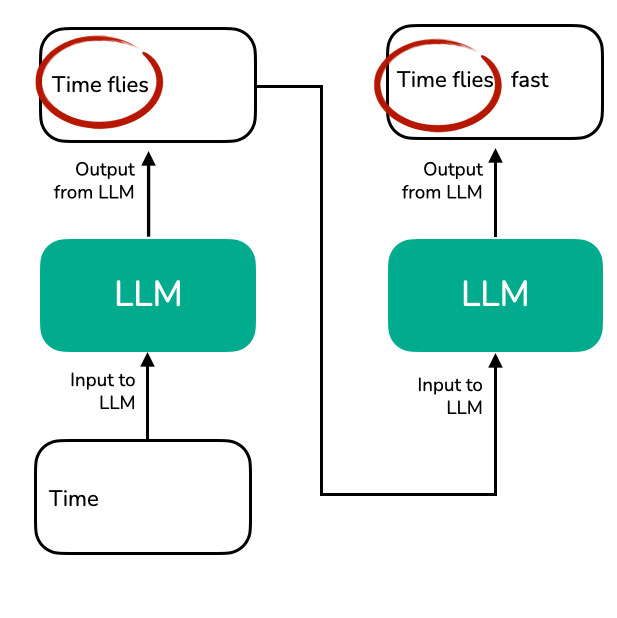
Figure: Redundant recomputation of the same prefix. Source: Raschka.
When a new token arrives, prior keys/values have not changed—recomputing them is pure waste:
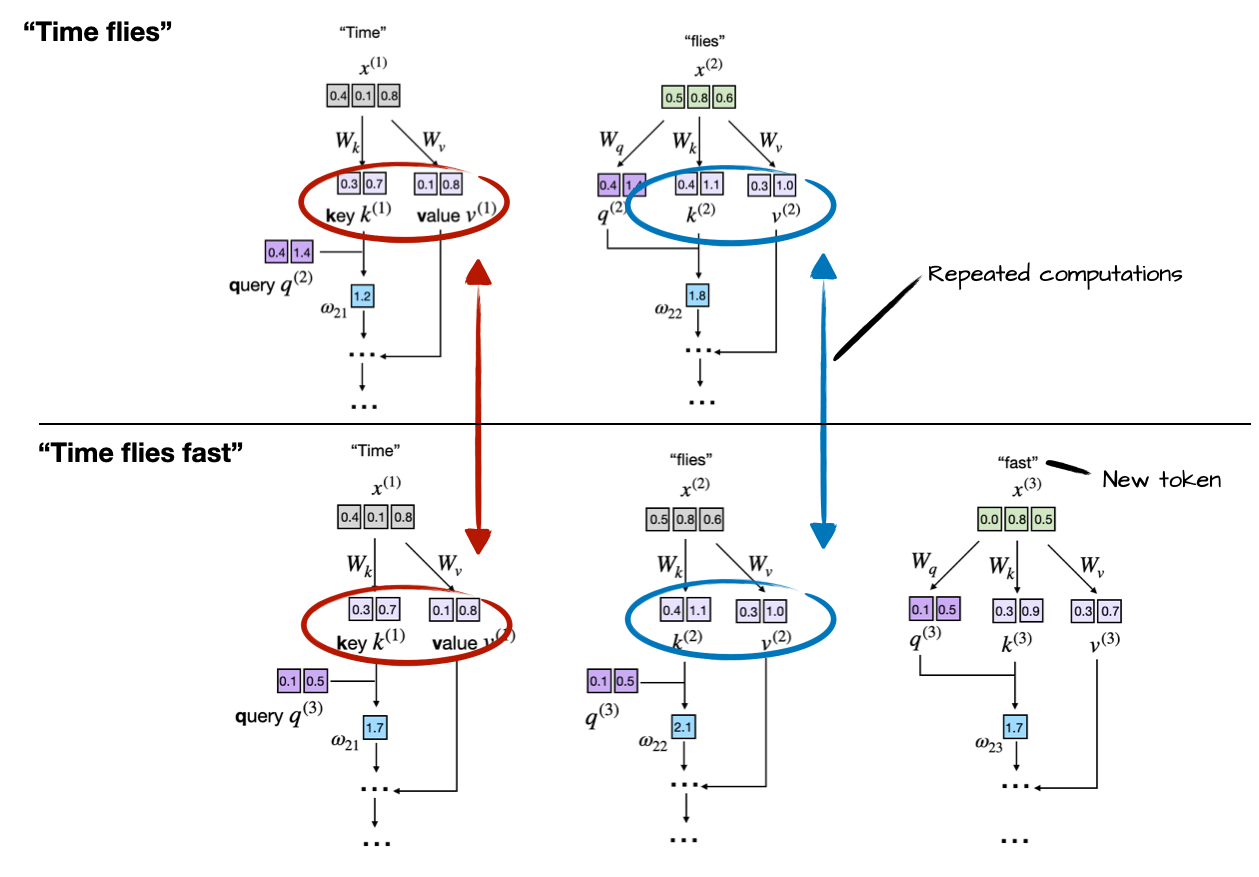
Figure: Same K/V for “Time” and “flies” after adding “fast”. Source: Raschka.
4. How the KV cache works
- Prefill the prompt; store K and V for every layer.
- For each new token, compute K/V only for that token.
- Append to the cache.
- Attend with the new Q over cached K/V.
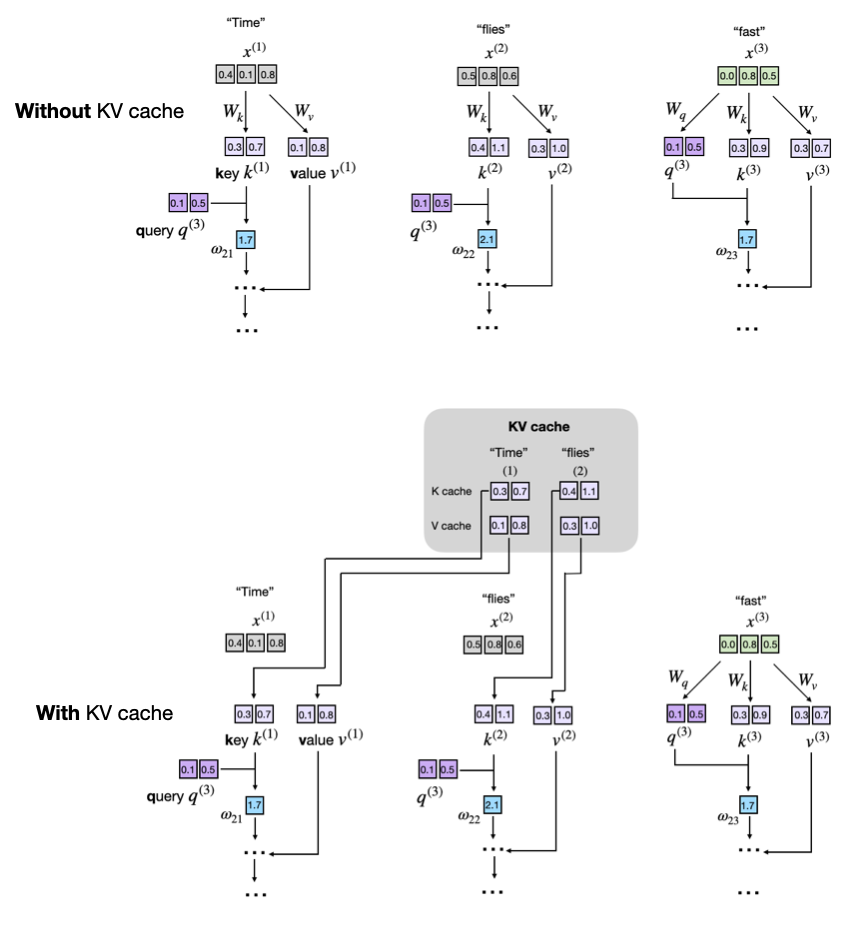
Figure: Side-by-side generation with and without KV cache. Source: Raschka / FAQ.
Complexity intuition (Raschka):
- Without cache: cumulative attention work grows roughly O(n²) over a sequence of length n.
- With cache: each token’s K/V computed once → roughly O(n) incremental work, at the cost of O(n) memory growth for the cache.
Educational GPT (~124M) generating 200 tokens: ~5× speedup on Apple M4 CPU in Raschka’s readable torch.cat implementation.
5. Minimal implementation pattern
Conceptually (PyTorch-style, from Raschka’s tutorial):
# Inside MultiHeadAttention
self.register_buffer("cache_k", None)
self.register_buffer("cache_v", None)

def forward(self, x, use_cache=False):
    keys_new = self.W_key(x)
    values_new = self.W_value(x)
    queries = self.W_query(x)

    if use_cache:
        if self.cache_k is None:
            self.cache_k, self.cache_v = keys_new, values_new
        else:
            self.cache_k = torch.cat([self.cache_k, keys_new], dim=1)
            self.cache_v = torch.cat([self.cache_v, values_new], dim=1)
        keys, values = self.cache_k, self.cache_v
    else:
        keys, values = keys_new, values_new
    # ... attention with queries, keys, values
Operational rules:
- Reset caches between independent generations (stale K/V → nonsense).
- Track position indices so new tokens align after the cached prefix (
current_pos). - In generation with cache: prefill full prompt once, then feed only the new token each step.
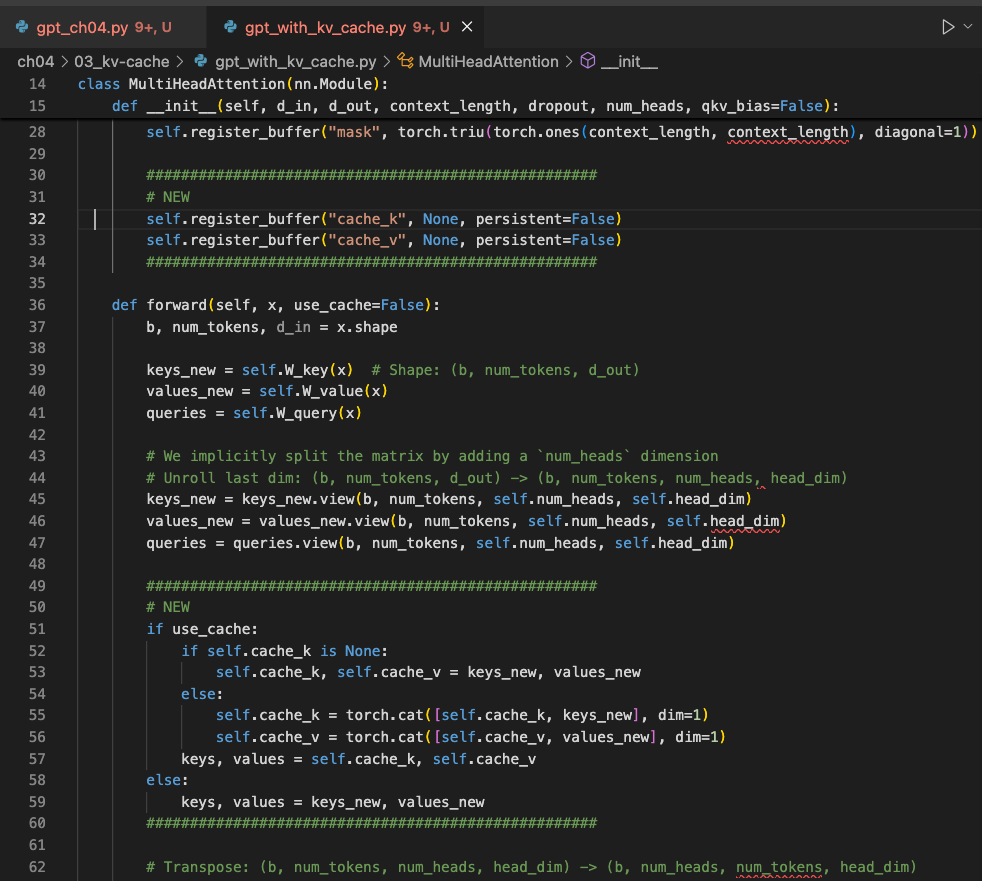
Figure: Cache buffers in attention code. Source: Raschka.
6. Production hardening of Layer 1
| Issue | Mitigation |
|---|---|
Repeated torch.cat allocations | Pre-allocate max-seq tensors; write into slices |
| Unbounded memory growth | Sliding window / truncation; architecture tricks (next section) |
| Wrong positions | Maintain current_pos or derive offset from cache_k.shape |
| Training | Do not use decode-style KV cache; training is parallel over positions |
Memory formula (float16 example for a 7B-class layout, from Sankalp):
kv_bytes ≈ 2 × layers × kv_heads × head_dim × seq_len × bytes_per_elem
Roughly ~0.5 MB/token → ~512 MB at 1K context per request before concurrency. At 100 concurrent long contexts, KV alone can dominate GPU RAM.
Part III — Shrinking the KV cache (architecture)
Modern open-weight models treat KV-cache size as a first-class design constraint for long-context agents and reasoning (Recent Developments in LLM Architectures, Big LLM Architecture Comparison).
7. Attention variants that reduce cache footprint
| Technique | Idea | Effect on KV |
|---|---|---|
| MQA / GQA | Share K/V heads across many Q heads | Fewer K/V tensors stored |
| MLA (DeepSeek) | Compress K/V to a latent before caching; up-project at use | Smaller cache; extra matmul |
| Sliding window | Local attention over last W tokens | Cache / compute bounded by W |
| Hybrid full + window | Few global layers, many window layers | Long-range + cheap local |
| Cross-layer KV sharing (Gemma 4 E*) | Later layers reuse earlier layers’ K/V | ~½ the layer-KV footprint |
| CCA (ZAYA1) | Attend in compressed latent space | Cuts cache and attention FLOPs |
| Sparse / compressed attention (DeepSeek-family) | Structured sparsity / compressed caches | Long context at lower cost |
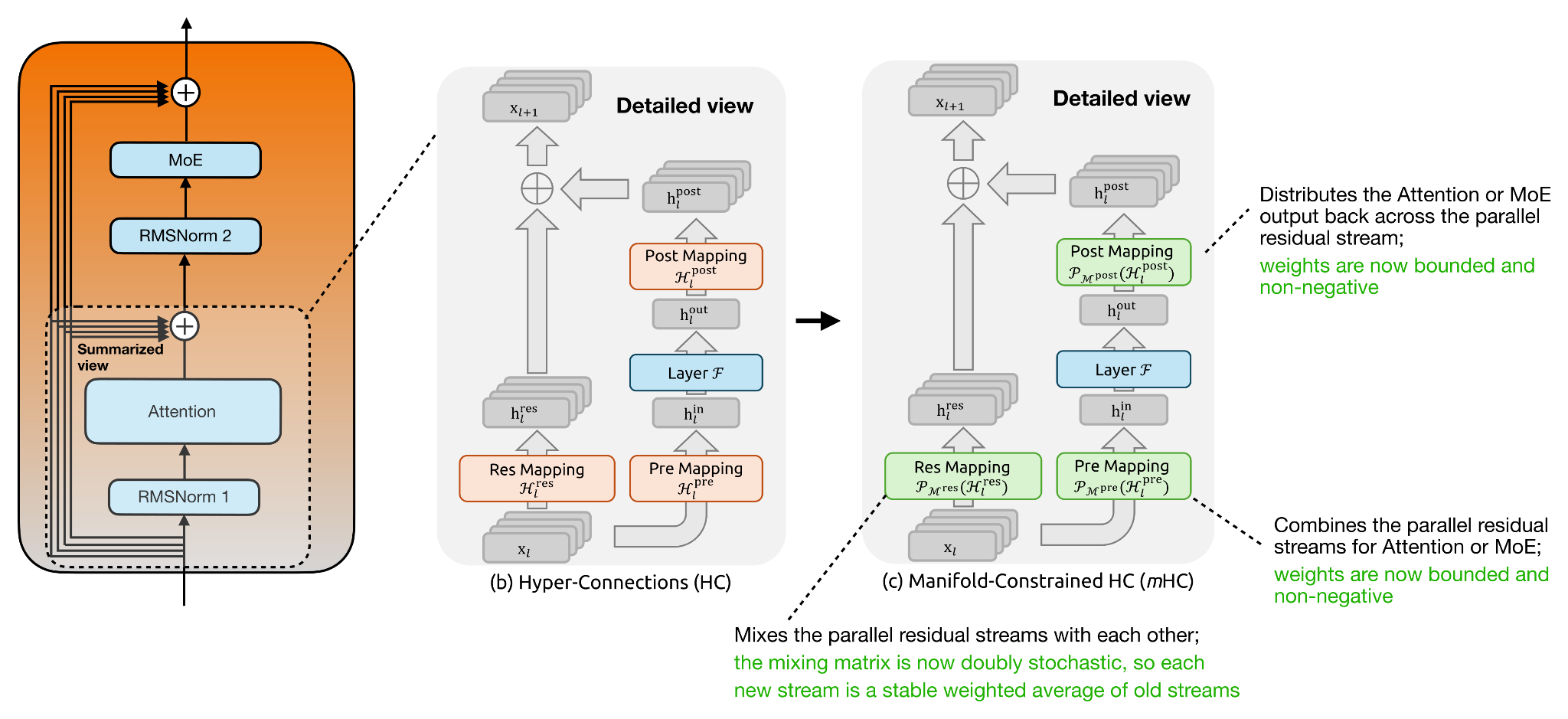
Figure: GQA reduces KV heads vs full MHA. Source: Raschka architecture articles.
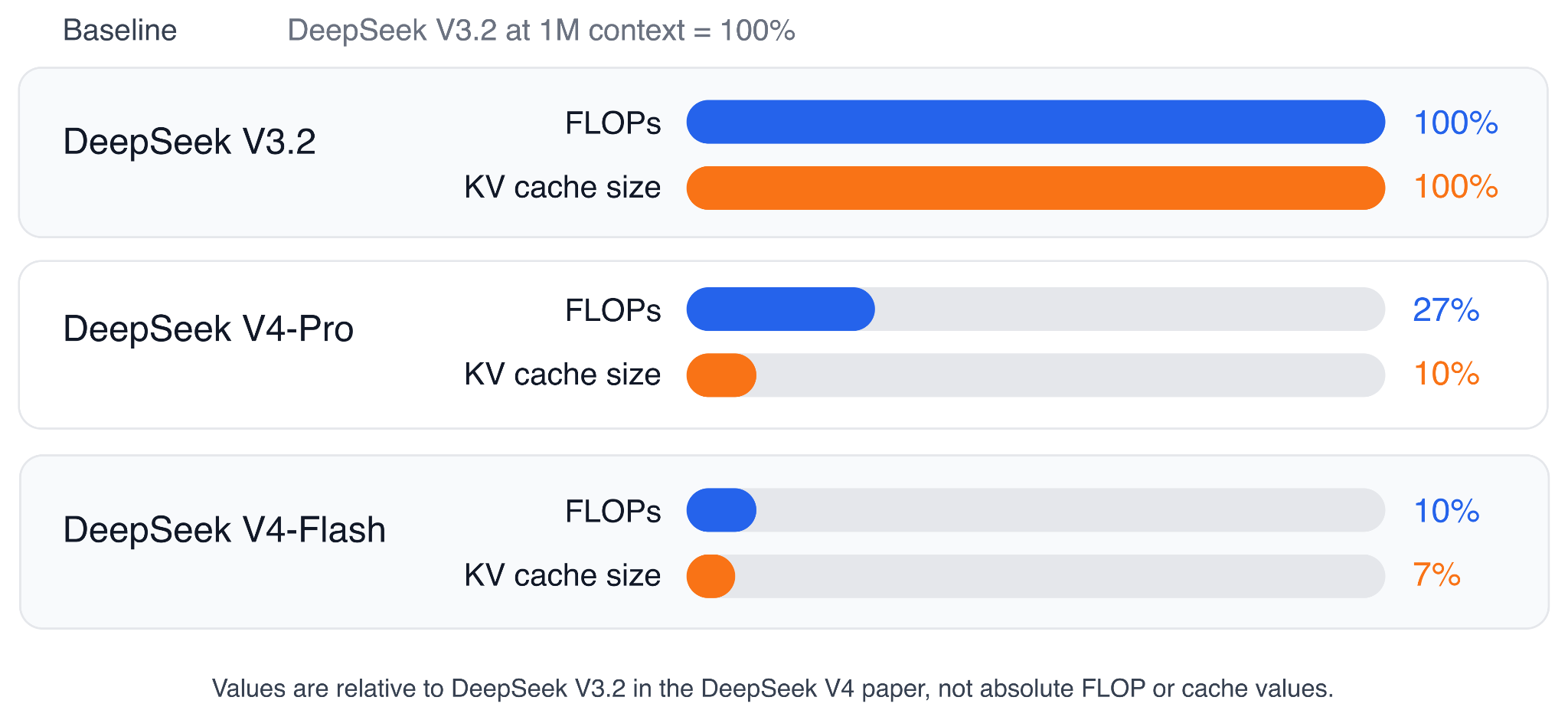
Figure: Multi-Head Latent Attention compresses what is cached. Source: Raschka / DeepSeek discussion.
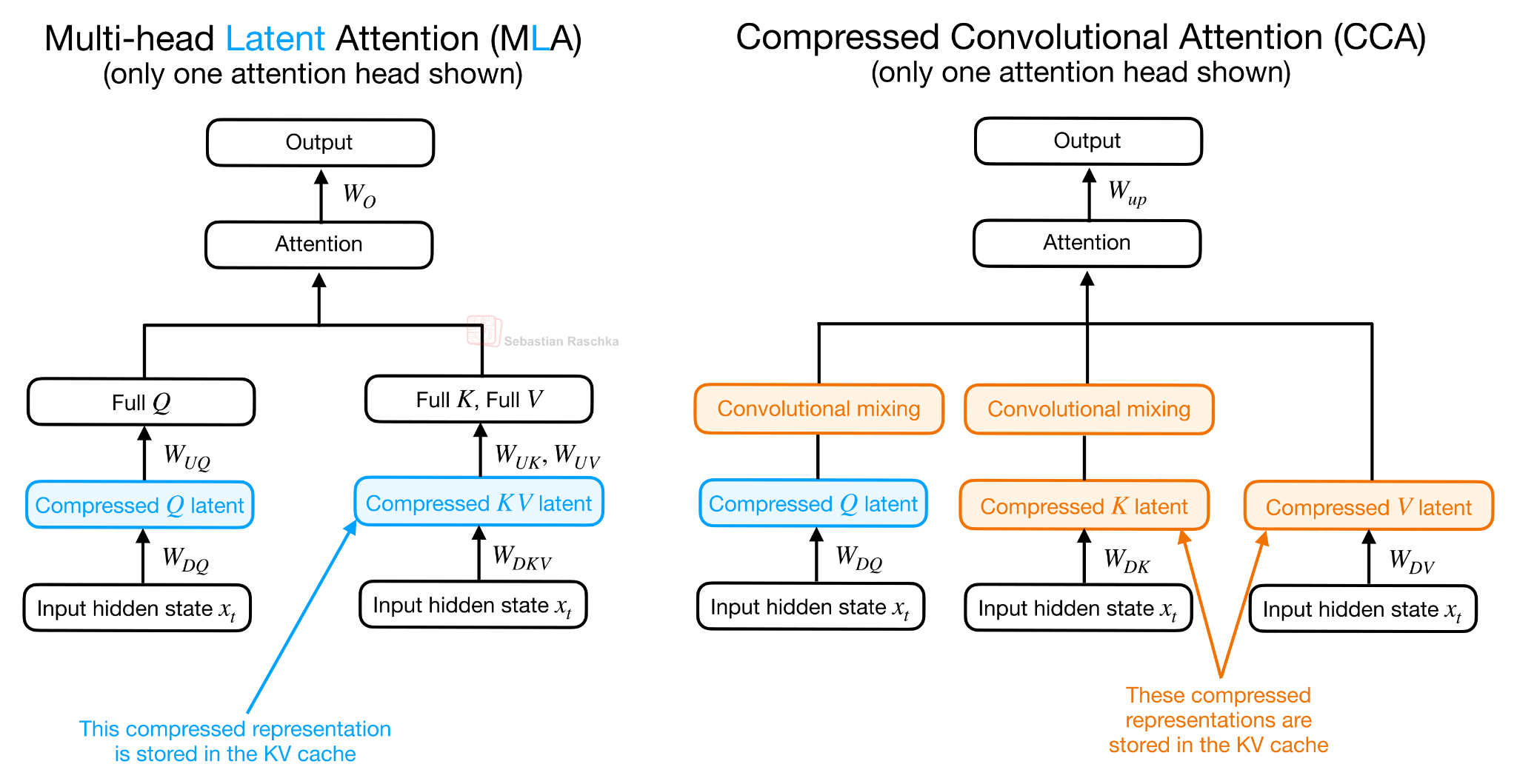
Figure: Cross-layer KV sharing (Gemma 4 E2B/E4B). Source: Recent Developments….
Takeaway for solution engineers: when choosing models for long-context agents, compare not only quality benchmarks but KV bytes per token and attention pattern (GQA vs MLA vs hybrid window). That number drives GPU concurrency and cost more than raw parameter count.
Part IV — Layer 2: PagedAttention and automatic prefix caching
Layer 1 caches within one request. Production engines must also:
- avoid GPU fragmentation from per-request contiguous KV allocations;
- share identical prefixes across concurrent users;
- schedule prefill vs decode under load.
That is the story of PagedAttention (vLLM) and automatic prefix caching (Sankalp, vLLM paper).
8. Why naive KV allocation fails at scale
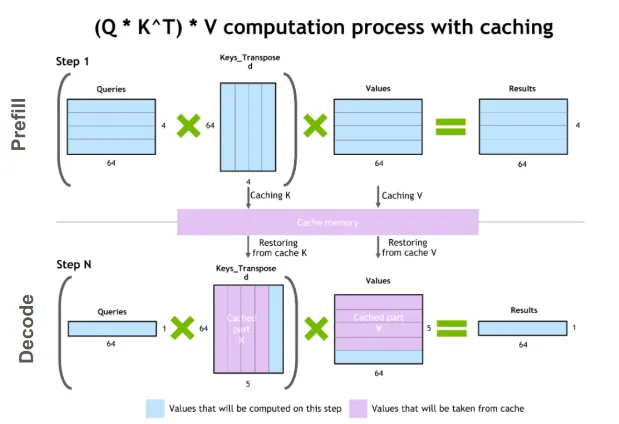
Figure: One big contiguous KV slab per request. Source: Sankalp.
Classic OS problems appear on the GPU:
- Internal fragmentation — allocate for max length; actual length much shorter.
- External fragmentation — finished requests leave holes; a new long request cannot find a contiguous slab even if free bytes exist.
- Redundancy — 100 users with the same system prompt → 100 copies of the same KV.
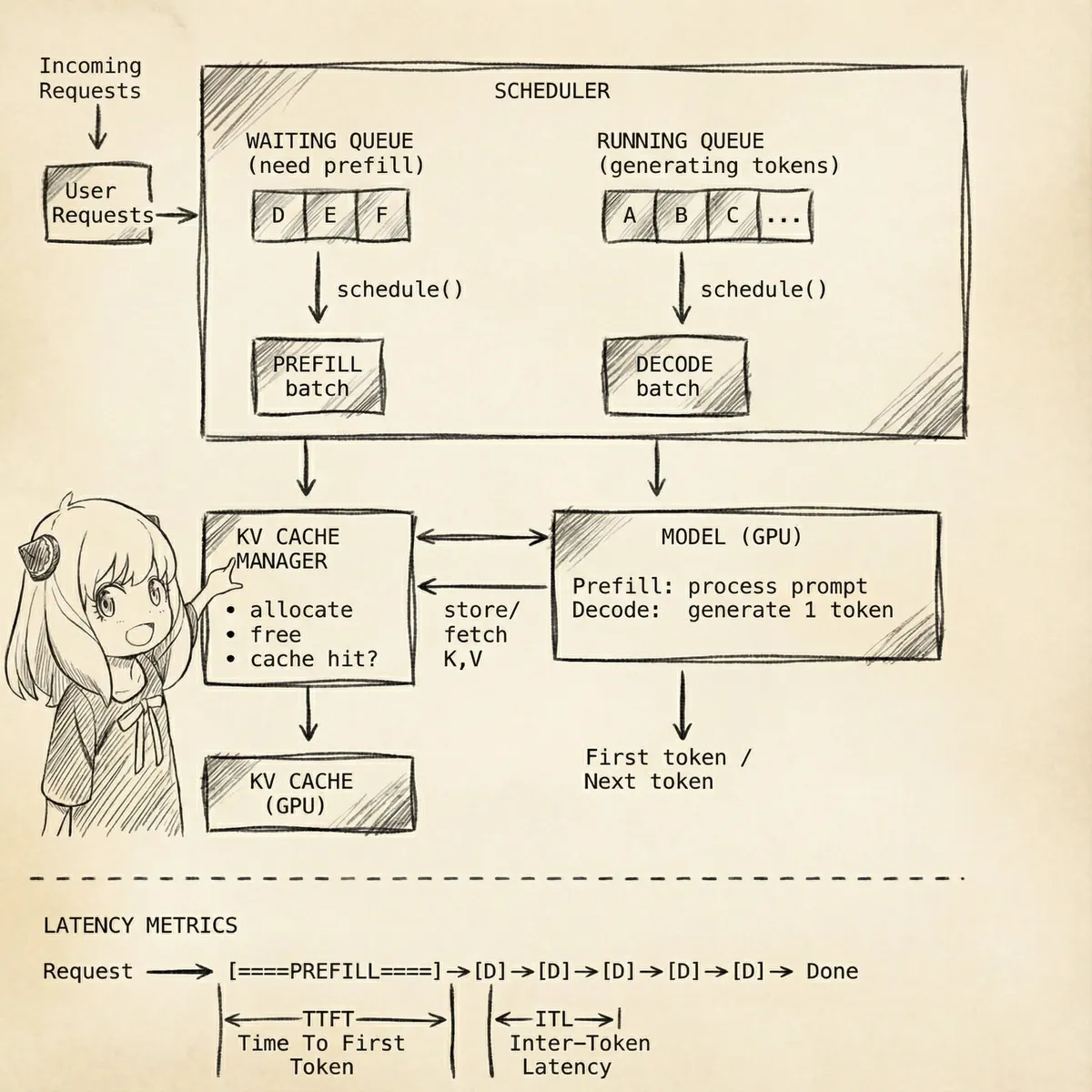
Figure: Fragmentation in KV cache memory. Source: Sankalp / vLLM paper diagrams.
9. PagedAttention: OS paging for KV tensors
vLLM pre-allocates a pool of fixed-size blocks (often 16 tokens each). Logical token positions map to blocks; a block table maps logical → physical GPU blocks—like a page table.

Figure: Paging inspiration. Source: Sankalp.
Each KVCacheBlock tracks roughly: block_id, ref_cnt (how many live requests share it), and a content block_hash for prefix lookup.
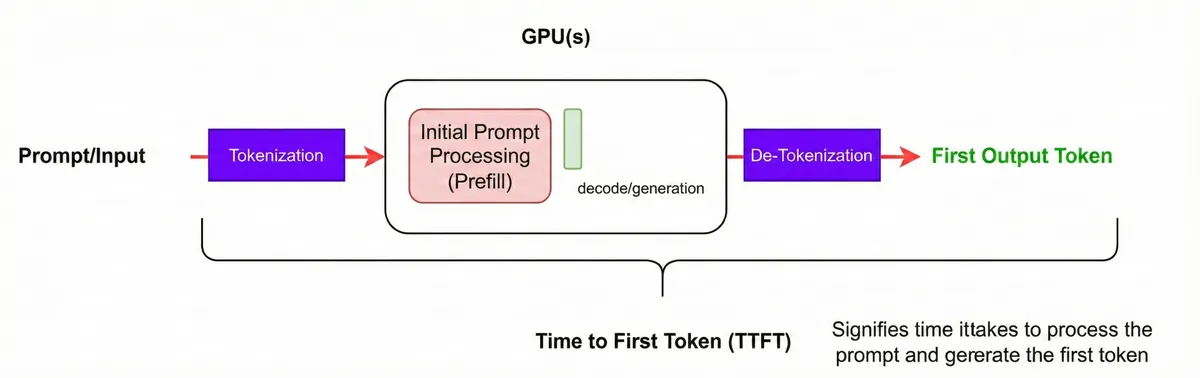
Figure: Block reuse across requests. Source: Sankalp.
10. Block hashing and longest prefix hit
Hashes are parent-chained:
hash(block 0) = H(NONE, tokens[0:16], extras)
hash(block 1) = H(hash(block 0), tokens[16:32], extras)
...
Why chain? Causal attention: token 32’s K/V depend on tokens 0–31. Matching block 2’s hash implies blocks 0–1 match. Independent per-block hashes would be unsafe.
Scheduler flow:
- Hash full blocks of the new request.
find_longest_cache_hit()walks block 0 → N until first miss.- Prefill only the miss suffix; attach hit blocks via the block table (
ref_cnt++).
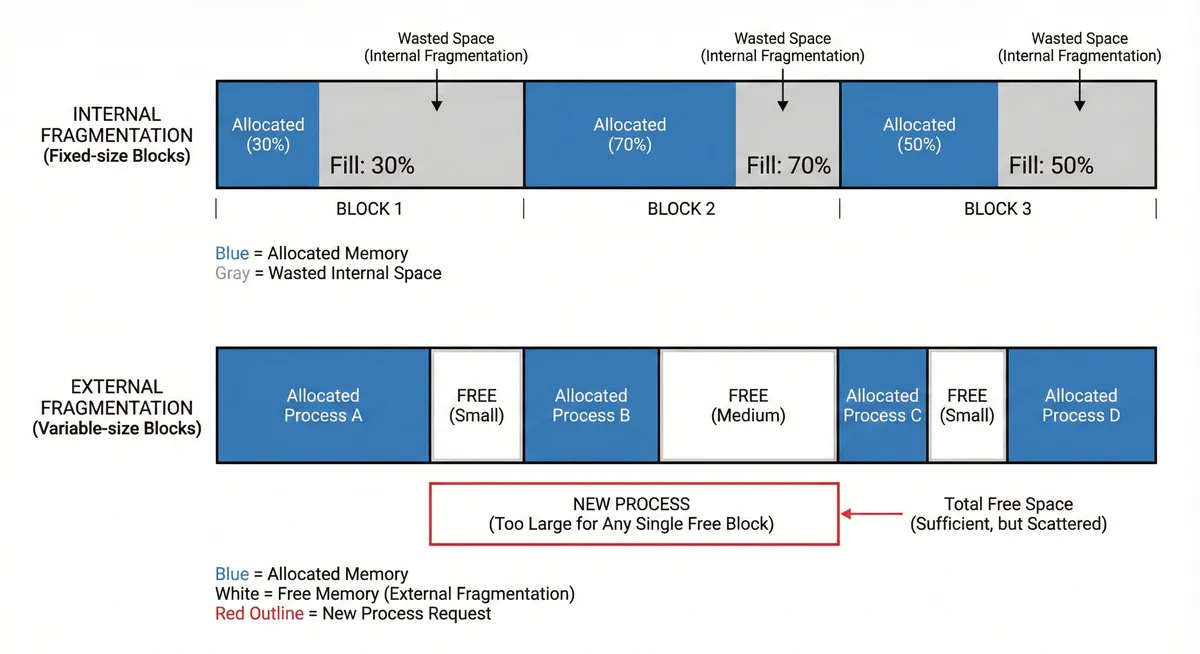
Figure: Cross-request prefix reuse while request 1 is still decoding. Source: Sankalp.
Mental model correction: prompt caching is content-addressed, not “per conversation.” User B can hit blocks written by User A if the token prefix is identical. Any change early in the prefix breaks the entire hash chain from that point onward.
SGLang’s RadixAttention solves the same problem with a radix tree over prefixes instead of vLLM’s block hash map—same product outcome, different data structure.
11. Provider “prompt caching” = selling Layer 2
When OpenAI / Anthropic / Bedrock advertise prompt or context caching, they are productizing cross-request KV reuse for matching prefixes—not caching the final chat reply (ngrok, IBM, MLM).
Evidence: identical prompts with caching still return different samples (temperature), while usage shows cached input tokens.
Typical economics (order-of-magnitude; verify current rate cards):
| Provider pattern | Cache write | Cache hit (input) | Notes |
|---|---|---|---|
| Anthropic-style | Often premium (e.g. ~1.25×) | Often ~0.1× base | Explicit cache_control breakpoints |
| OpenAI-style | Often automatic / no write surcharge (model-dependent) | Often ~0.5×–0.1× | Stable prefix; optional prompt_cache_key routing |
| Bedrock prompt cache | Model-dependent | Up to ~90% input savings, ~85% latency claims | Long reused prefixes |
Default retention is often minutes in VRAM; some models offer hours-long retention by spilling KV to GPU-local SSD (Sankalp).
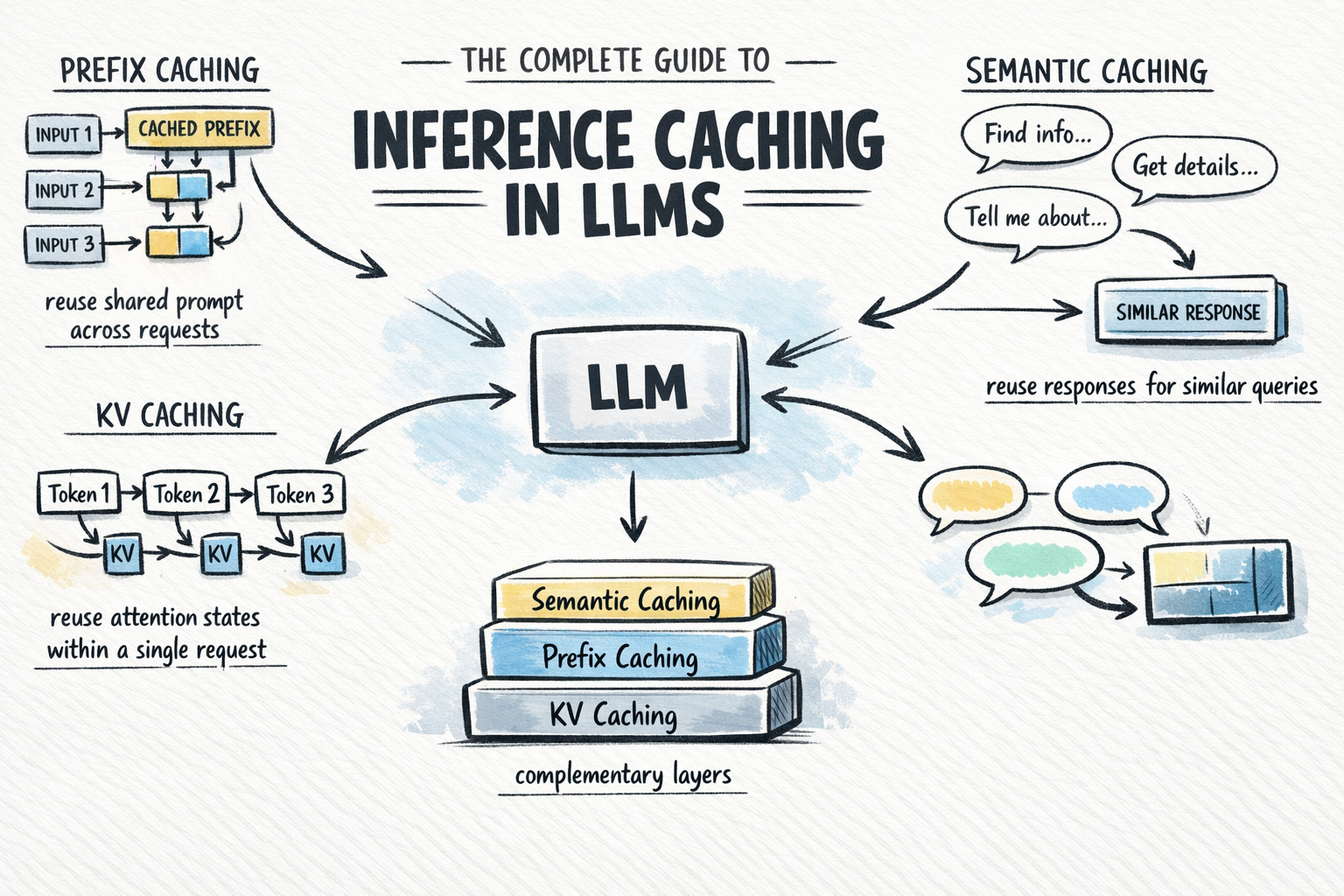
Figure: Three complementary inference caching types. Source: Machine Learning Mastery.
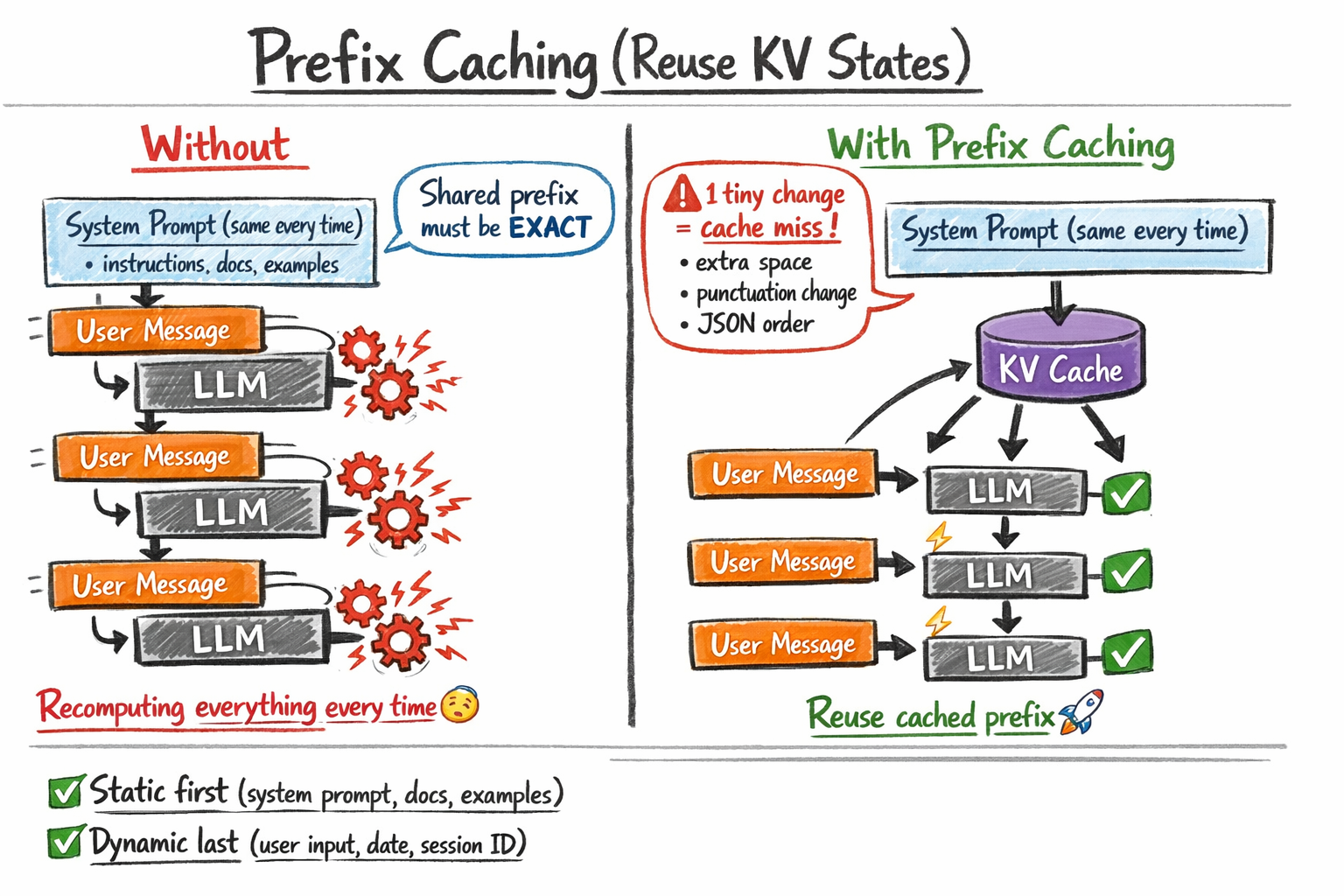
Figure: Prefix / prompt caching across requests. Source: MLM.
Part V — How to hit the prefix cache (application design)
12. Golden rule: longest stable prefix, byte-identical
Prefix caching requires exact token identity from position 0 until the first difference. One trailing space, reordered JSON key, or moved timestamp kills everything after the divergence (OpenAI / Anthropic / Manus guidance summarized by Sankalp, IBM).
Recommended message order:
1. System instructions (stable)
2. Tool / function definitions (stable; avoid mid-session mutation)
3. Few-shot examples / policy docs (stable)
4. Large reference documents (stable when possible)
5. Conversation history (append-only)
6. Latest user turn / dynamic fields LAST
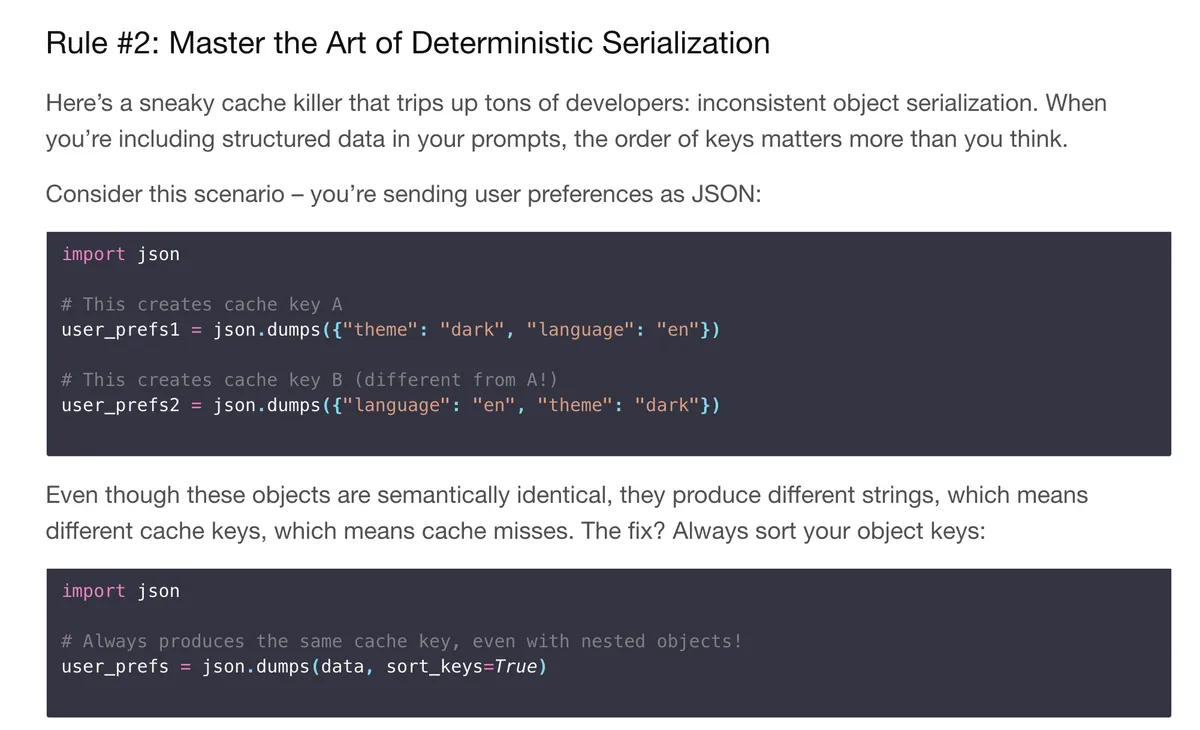
Figure: OpenAI-style prompt structuring for cache hits. Source: Sankalp (via OpenAI docs imagery).
13. Practical checklist (agents & tools)
| Practice | Why |
|---|---|
| Remove user-specific data from the system prompt | System prompt becomes a shared cross-user prefix |
| Keep context append-only; avoid truncating middle tool results | Truncation rewrites earlier tokens → chain break |
json.dumps(..., sort_keys=True) (or equivalent) | Non-deterministic key order → different tokens |
| Do not hot-swap tool schemas mid-session | Tools usually sit near the prompt start |
| Prefer “tool search / deferred tools” that append definitions | Preserves earlier cached blocks |
Anthropic: place cache_control on last stable block; consider intermediate breakpoints every ~15 blocks in huge tool turns | Lookback windows can miss anchors |
OpenAI: optional prompt_cache_key to colocate identical prefixes on the same machine | Cache is machine-local |
| Prefer multi-hour retention only when traffic gaps exceed default TTL | Idle spill to SSD trades VRAM for retention |
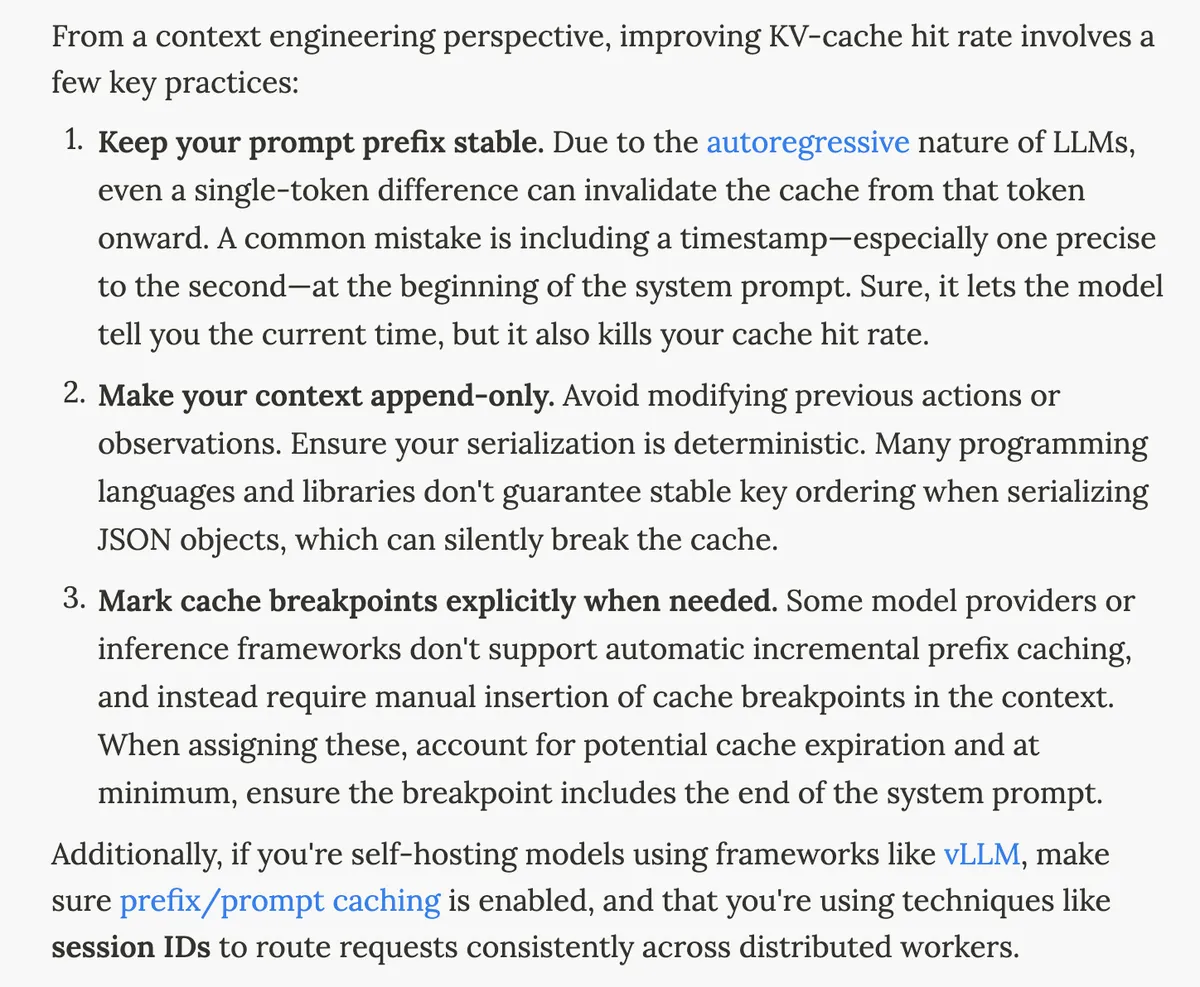
Figure: Context-engineering tips that improve cache hit rate. Source: Sankalp / Manus blog.
14. What prompt caching is not
| Confusion | Reality |
|---|---|
| “It caches the answer” | It caches K/V tensors, then still samples a new answer |
| “Similar prompts hit” | Only exact prefix tokens (semantic similarity is Layer 4) |
| “Per-user session cache” | Content-addressed; shareable across users with same prefix |
| “Same as Redis response cache” | Different layer; providers still run decode |
Part VI — Layers 3–4: request/response caching
When the business answer can be reused, skip the model.
15. Exact vs semantic response caching
| Exact | Semantic | |
|---|---|---|
| Key | Hash of prompt (+ model + temperature + …) | Embedding of query |
| Match | Byte / string equality | Cosine / ANN above threshold |
| Speed | Extremely fast | Fast + embedding latency |
| Flexibility | Brittle to paraphrases | Handles rephrasing |
| Risk | Low freshness risk if keyed well | Wrong-but-similar answers |
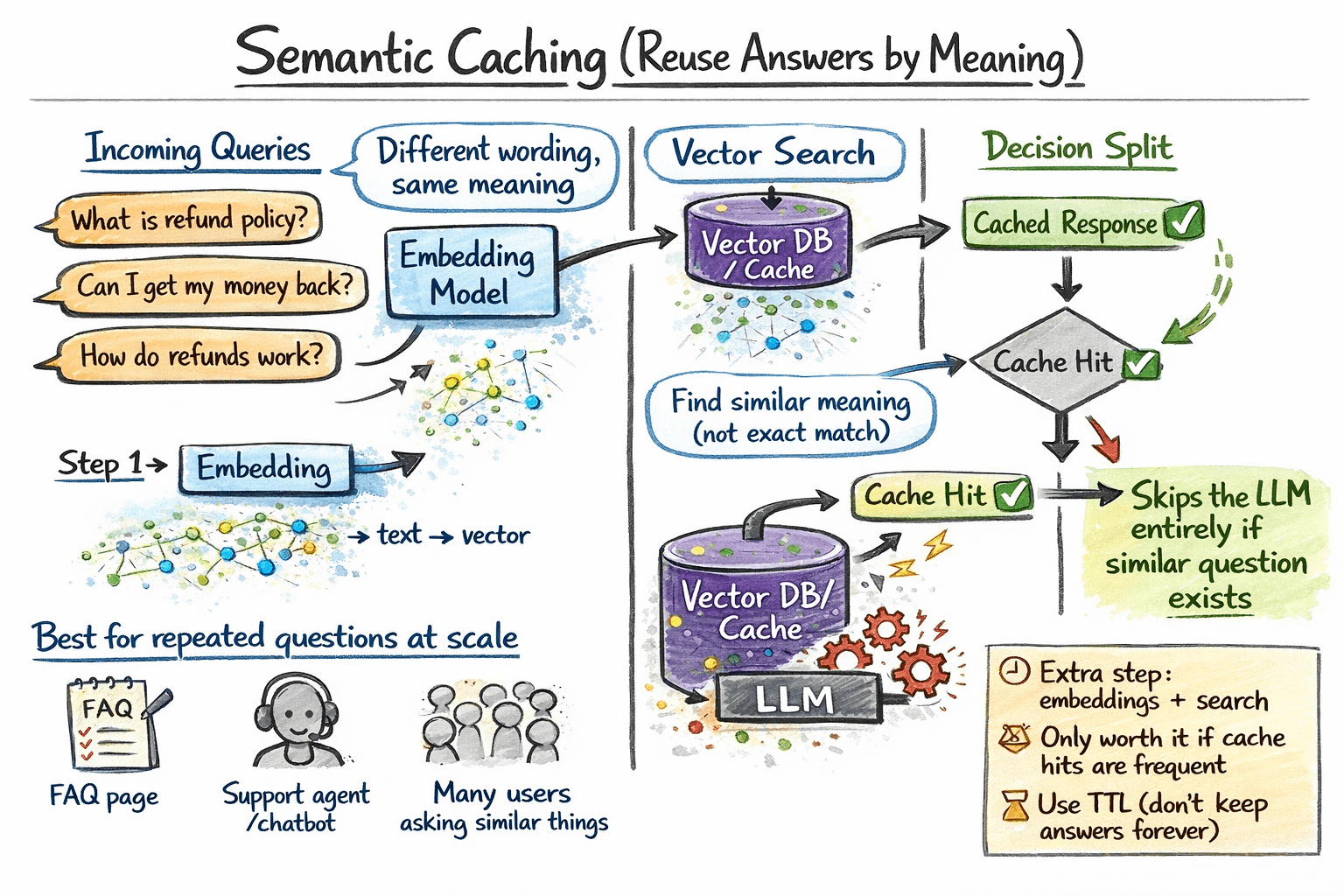
Figure: Embed → vector search → return or call LLM. Source: MLM.
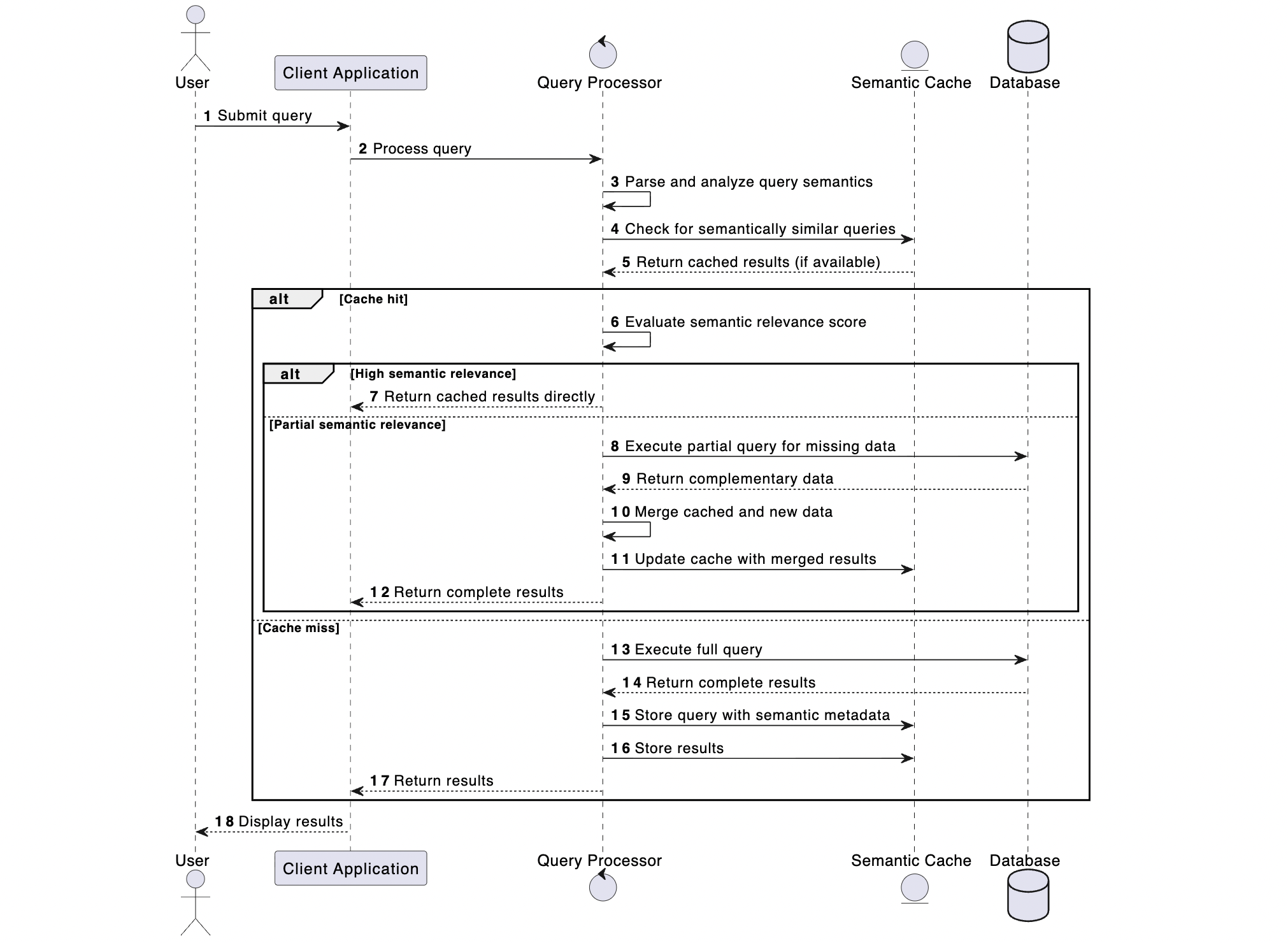
Figure: Semantic cache-augmented query workflow. Source: AWS Database Blog.
Storage options (AWS, Latitude)
- In-memory / MemoryDB / Redis / Valkey — sub-ms; exact or vector features.
- SQLite / local disk — simple single-node apps.
- DynamoDB / OpenSearch / pgvector / Pinecone — distributed exact or semantic stores.
- LangChain / GPTCache-style adapters — wire exact + semantic backends quickly for prototypes.
Multilayer example
- Exact Redis for identical FAQ within minutes.
- Regional Valkey for common policy answers.
- OpenSearch / MemoryDB semantic layer for paraphrases.
- Bedrock / OpenAI / Anthropic prompt cache for the long system+RAG prefix underneath.
16. Invalidation and safety
Caching without invalidation creates confident wrong answers.
| Strategy | Use when |
|---|---|
| TTL + jitter | Mostly static FAQs; jitter avoids stampedes |
| Proactive delete | KB article corrected; bad answer fixed |
| Proactive preload / batch refresh | New documents ingested |
| Namespace by tenant / domain / language | Same question, different correct answers |
| Guardrails on write and read | Prevent caching PII or policy-violating text (AWS / Bedrock Guardrails) |
Heuristic from AWS: if you cannot apply caching to a meaningful share of calls (they cite ~60% as a rule of thumb), prefer prompt design / streaming / smaller models over complex cache ops.
Version the cache key with: model_id, prompt_template_version, tool_schema_version, kb_version, and sampling params that affect the stored answer (for response caches).
Part VII — Decision framework and metrics
17. Choose the right lever
| Situation | Primary strategy |
|---|---|
| Any decode | KV cache (automatic) |
| Long shared system / tools / docs | Prefix / prompt caching |
| RAG with a large repeated corpus chunk | Put corpus in cached prefix when stable |
| Multi-tenant same product prompt | Shared system prefix + tenant data last |
| High-volume FAQ / support paraphrases | Semantic response cache |
| Strictly identical API requests | Exact response cache |
| Self-hosted high concurrency | vLLM/SGLang + automatic prefix caching |
| Long-context agents on device | Models with GQA/MLA/window/KV-sharing |
18. Metrics that matter
| Metric | Why |
|---|---|
| Prefix cache hit rate (% input tokens cached) | Direct cost / TTFT driver |
| TTFT p50/p95 | Prefill savings show up here |
| Response cache hit rate (exact vs semantic) | Full LLM bypass rate |
| Cost per successful task | FinOps north star |
| Semantic drift / wrong-hit rate | Quality of Layer 4 |
| GPU KV memory / concurrency | Capacity planning |
| Cache write vs read spend | Anthropic-style write premiums |
Instrument provider usage.cache_read_input_tokens / cache_creation_* fields (names vary) and your own Redis hit counters.
19. Negative cases (do not ignore)
- Dynamic dates / user IDs near the start of the prompt → permanent misses.
- Truncating or rewriting history mid-conversation → breaks prefix chain.
- Semantic cache threshold too loose → confident wrong answers.
- Caching personalized or regulated content without tenancy → data leakage across users (also a multi-tenant KV-sharing research concern).
- Caching before guardrails → poison the cache with toxic or PII-laden outputs.
- Expecting prompt cache to make outputs identical → it does not.
- Paying Anthropic-style write premiums for prefixes that never get re-read.
Part VIII — End-to-end reference architecture
Implementation order for most enterprise apps:
- Restructure prompts for prefix stability; enable provider prompt caching / Bedrock prompt cache / vLLM automatic prefix caching.
- Add exact response cache for truly identical calls.
- Add semantic cache only if paraphrases dominate and you can measure wrong-hit rate.
- Pick models with efficient KV designs for long-context workloads.
- Wire FinOps dashboards to hit rates and cost per task.
Key takeaways
Sources and further reading
- Understanding and Coding the KV Cache in LLMs from Scratch — Sebastian Raschka
- What is a KV cache? — Raschka FAQ
- The Big LLM Architecture Comparison — GQA, MLA, MoE
- Recent Developments in LLM Architectures — KV sharing, CCA, compressed attention
- How prompt caching works — PagedAttention and Automatic Prefix Caching — Sankalp
- Prompt caching: 10x cheaper LLM tokens, but how? — ngrok / Sam Rose
- The Complete Guide to Inference Caching in LLMs — MLM
- Optimize LLM response costs and latency with effective caching — AWS
- What is Prompt Caching? — IBM
- Ultimate Guide to LLM Caching for Low-Latency AI — Latitude
- Efficient Memory Management for LLM Serving with PagedAttention — vLLM paper
- Related playbook: Build a Large Language Model from Scratch, LLM Response Caching for RAG and Agents, Performance Engineering and AI FinOps
What to do next
- Audit one production prompt: move all dynamic fields to the end; enable provider prefix caching; measure
cache_readtokens for a week. - Add an exact-match FAQ cache with TTL + tenant namespace before investing in semantic caching.
- For self-hosted serving, verify automatic prefix caching is on in vLLM/SGLang and watch block hit metrics under concurrent load.
Discussion
Comments
Share feedback or questions about this page. No account required.
Loading comments…