Good Strategy Bad Strategy — Rumelt’s Kernel, Power Sources, and Strategist Thinking
Most “strategies” are not strategies. They are budgets with adjectives, vision posters, goal lists, or motivational fluff that never names the hard challenge—or the coordinated actions that would overcome it. Rumelt’s lasting gift is a ruthless filter: good strategy is a coherent response to a diagnosed difficulty, not ambition dressed as planning.
Source note: This article is an original practitioner synthesis of themes from Richard P. Rumelt’s Good Strategy Bad Strategy: The Difference and Why It Matters. It is not a reprint of the book. Support the original work if strategy design, corporate renewal, competitive positioning, or consulting diagnosis matters in your role.
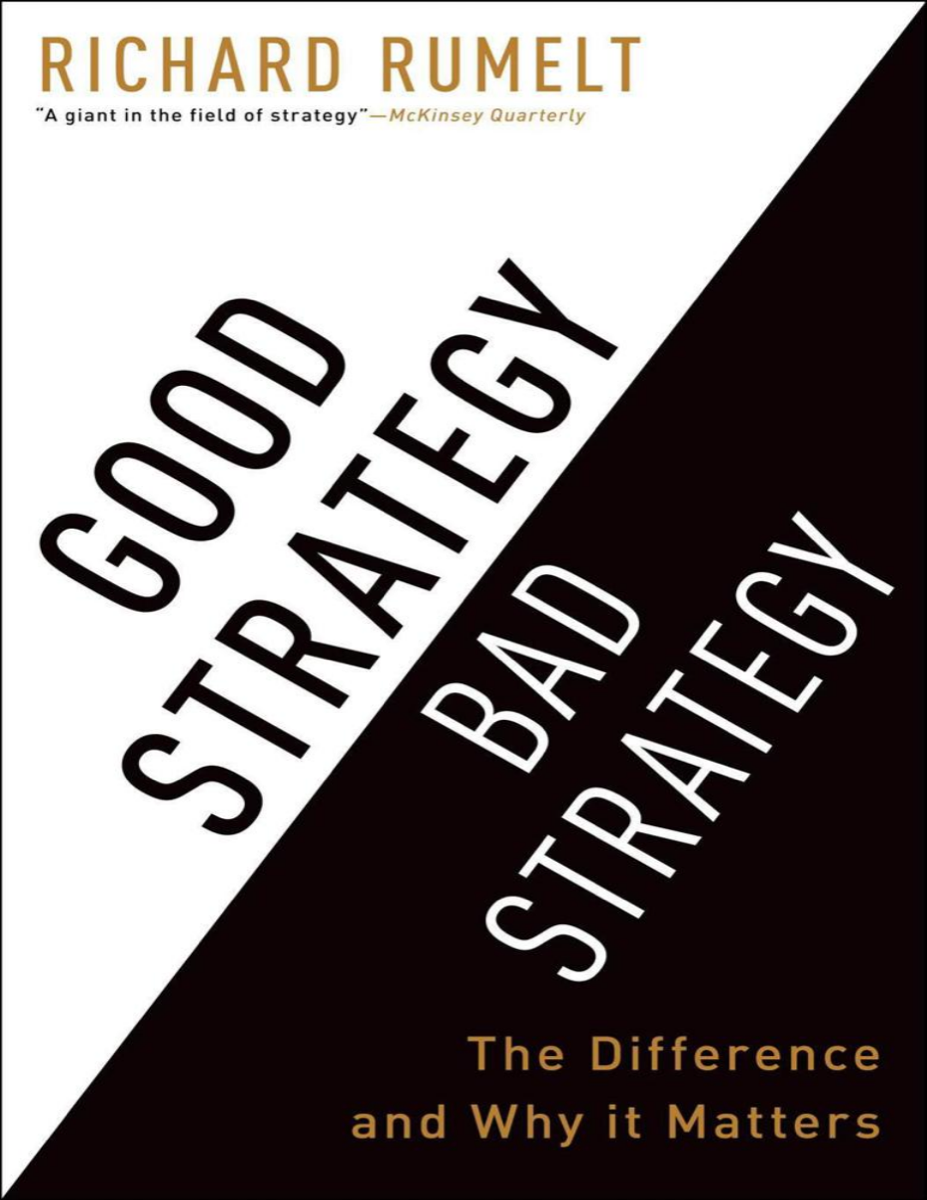
Figure: cover of Richard Rumelt’s Good Strategy Bad Strategy (educational illustration).
0. Why this book still matters
Strategy literature is crowded with frameworks, 2×2 matrices, and slogans. Rumelt cuts through that noise with a simple, uncomfortable question:
Does this document actually face the challenge—and does it commit scarce resources to a coherent set of actions that can change the situation?
If the answer is no, you do not have a strategy. You have theatre.
Rumelt writes as both theorist and practitioner: UCLA strategy professor, long-time adviser to corporations and governments, observer of successes that look obvious only in hindsight (Apple’s return; Walmart’s logistics machine; Cisco’s acquisition discipline in its growth years) and of failures that looked like “strategy” on slides.
His project is not to invent a new buzzword. It is to restore the word strategy to its original meaning: the intelligent application of strength against weakness, opportunity against obstacle, or design against complexity—always under scarcity of attention, capital, and organisational energy.
That framing travels cleanly into consulting, product leadership, public-sector reform, and AI transformation. The tools change; the kernel logic does not.
1. Part I — What strategy is (and is not)
1.1 Strategy is not goal-setting
A goal says where you hope to arrive. A strategy says how you will overcome the obstacle that stands in the way.
| Artefact | Typical content | Strategic value |
|---|---|---|
| Vision statement | Inspiring future state | Motivational; not strategy |
| Mission statement | Purpose / identity | Orientation; not strategy |
| OKRs / KPI packs | Metrics and targets | Control system; not strategy |
| Budget | Resource allocation by line | Finance; may implement strategy |
| Strategy | Diagnosis + policy + coherent actions | Choice under constraint |
Confusing goals with strategy is the most common executive error Rumelt attacks. “Grow 20%,” “become number one,” or “delight customers” are ambitions. Without a diagnosis of why growth is blocked and a policy for which obstacles you will attack first, they are wishes.
1.2 The kernel of good strategy
Every good strategy—military, corporate, political, or personal—has a kernel with three elements:
- Diagnosis — What is going on here? What is the critical challenge?
- Guiding policy — What overall approach will we take to deal with the challenge?
- Coherent actions — What coordinated steps implement the policy?
Remove any element and the “strategy” collapses into slogans, laundry lists, or disconnected projects.
Diagnosis is not a data dump. It is a simplification that names the pivotal factors—the few things that really matter. Good diagnosis is often uncomfortable because it identifies a problem the organisation would rather not admit (eroding advantage, channel conflict, capability gap, regulatory cliff, cultural inertia).
Guiding policy is not a goal. It is an approach—a channel for action that rules some paths out. “Compete on cost through logistics density” is a policy. “Be the best” is not.
Coherent actions are not a brainstorm wall. They are mutually reinforcing steps. If action A undermines action B, you do not yet have coherence—you have a dog’s dinner with project codes.
1.3 Discovery vs design
Some strategies are discovered through experimentation and selective amplification of what works. Others are designed as integrated systems before full evidence exists. Rumelt respects both—but insists that even discovery eventually requires a kernel: you must diagnose what you learned, choose a policy about what to scale, and align actions so the organisation does not chase every experiment forever.
1.4 Strategy and the hard work of choice
Strategy is choice. Choice means saying no. Organisations hate saying no because every “no” creates a constituency of losers. Bad strategy flourishes when leaders refuse to create losers—so they endorse every initiative and call the resulting pile a “strategic portfolio.”
Practitioner test:
- Can you name the one or two challenges that, if resolved, would unlock disproportionate progress?
- Can you state a policy that would be wrong for a competitor in a different situation?
- Can you list actions that reinforce each other—and name what you will stop?
If any answer is vague, you are not done.
2. Hallmarks of bad strategy
Rumelt’s taxonomy of bad strategy is diagnostic gold for consultants and boards. Learn to spot these patterns early.
2.1 Fluff
Fluff is restatement of the obvious dressed in buzzwords, designed to create the illusion of high-level thinking.
Classic pattern: “Our strategy is customer-centric digital transformation leveraging synergies across the ecosystem to deliver world-class experiences.”
Strip the adjectives: “We will try to please customers using computers and cooperation.” That is not a strategy. It is a weather report.
| Fluff signal | What it usually hides |
|---|---|
| Nested abstractions (“leverage platforms to unlock value”) | No diagnosis |
| Synonym chains (“innovative / leading / world-class”) | No choice |
| Passive voice about hard trade-offs | Political avoidance |
| Diagrams with no verbs | Decoration without decisions |
Defence: Force rewrite in plain nouns and verbs. If the rewrite becomes banal, the original was fluff.
2.2 Failure to face the challenge
Bad strategy skips or soft-pedals the hard part. It jumps to aspirations because facing the challenge would require admitting weakness, conflict, or a need for painful change.
Examples of challenges people avoid:
- The product is no longer differentiated and price is collapsing.
- The sales model cannot cover the cost of complex enterprise deals.
- The organisation’s incentives reward local optimisation and punish cooperation.
- A platform shift (cloud, mobile, AI) is making the current advantage obsolete.
A strategy that does not name the challenge cannot organise energy against it. It becomes a pep talk.
2.3 Mistaking goals for strategy
“We will grow revenue 15% and improve NPS” is a performance contract, not a strategy. Goals without a kernel leave the organisation with metrics and no method.
Worse: organisations pile goal upon goal—international expansion and margin expansion and new platforms and M&A and culture change—without sequencing or resource logic. Rumelt’s phrase for this is memorable: a dog’s dinner of objectives.
2.4 Bad strategic objectives (“blue-sky”)
Blue-sky objectives are aspirations disconnected from any plausible path. “Become the industry leader in AI within 18 months” with no diagnosis of data assets, talent, distribution, or competitive response is fantasy.
Good strategic objectives are proximate—close enough to be achievable with current resources and learning—and they create stepping stones toward larger aims. More on proximate objectives in Part II.
2.5 Template: bad vs good in one glance
| Dimension | Bad strategy | Good strategy |
|---|---|---|
| Challenge | Avoided or generic | Named and prioritised |
| Diagnosis | Data lake / SWOT laundry list | Simplified critical factors |
| Policy | “Be the best / grow / innovate” | Approach that channels choice |
| Actions | Initiative catalogue | Mutually reinforcing set |
| Language | Fluff and buzz | Plain and falsifiable |
| Trade-offs | Implicit or denied | Explicit and owned |
2.6 Checklist: audit a strategy deck in 20 minutes
- Highlight every sentence that is ambition or metric rather than diagnosis/policy/action.
- Circle the challenge. If you cannot find one sentence that would hurt if true, suspect avoidance.
- Underline the guiding policy. If several conflicting policies appear, you have a dog’s dinner.
- Map actions to policy. Orphans (actions with no policy parent) are politics or habit.
- Ask: what did we stop? Silence is a red flag.
- Rewrite the kernel on one page. If you cannot, the deck is not strategy yet.
3. Digging deeper into the kernel
3.1 Diagnosis as insight, not inventory
A useful diagnosis compresses complexity into a story about the situation that makes action obvious.
Military analogy: a commander does not list every enemy unit and terrain feature as equals. The diagnosis might be: “They are strong frontally but their supply line through the gorge is thin—and weather will close the pass in ten days.” That diagnosis implies policy (strike the supply line soon) and actions (recon, interdiction, timing).
Business analogy: “Our growth stalled because mid-market buyers cannot absorb our implementation complexity, while enterprise buyers demand deeper industry content we do not have.” That diagnosis implies policies you would never invent from a generic “grow faster” goal.
Tools that help diagnosis (without becoming ritual):
- Problem / opportunity trees with one critical path marked.
- Where-to-play / how-to-win only after the challenge is named.
- Customer jobs and failure modes, not vanity personas.
- Competitive response scenarios (what happens if we succeed?).
3.2 Guiding policy as a constraint system
A guiding policy creates leverage by concentrating resources and forbidding distractions. It should answer:
- What kinds of opportunities will we pursue?
- What kinds will we ignore—even if attractive?
- Which capabilities will we build as the spine of advantage?
- Which risks will we deliberately accept?
Policy is often expressed as a short set of principles with teeth. Soft principles (“we value excellence”) are culture wallpaper. Hard principles (“we will not custom-build one-off integrations for deals under £X”) change behaviour.
3.3 Coherent actions as system design
Coherence means actions fit. Fit can be:
- Simple consistency — not working at cross purposes.
- Reinforcement — each action makes others more effective.
- Optimization of effort — scarce skills applied where they create compounding returns.
Example of incoherence: a firm announces a “premium brand” policy while flooding discount channels, cutting service headcount, and paying sales only on volume. The actions fight the policy—and each other.
Example of coherence: a low-cost retailer invests in logistics density, private-label scale, ruthless SKU discipline, and store formats that reduce cost-to-serve—all reinforcing cost leadership.
3.4 Practitioner worksheet: build a kernel
| Kernel element | Prompt | Draft (fill in) |
|---|---|---|
| Challenge | What difficulty, if unresolved, makes success unlikely? | |
| Diagnosis | What are the 2–4 pivotal factors? | |
| Guiding policy | What approach channels effort and excludes alternatives? | |
| Coherent actions | What 5–9 mutually reinforcing moves implement the policy? | |
| Stops | What initiatives, segments, or habits will we end? | |
| Proximate objective | What near win makes the next win possible? |
Use this worksheet in consulting kickoffs. Force the client leadership team to fill it before PowerPoint art.
4. Part II — Sources of power
Good strategy draws power from identifiable sources. Rumelt’s catalogue is not a menu to tick; it is a set of lenses for finding advantage.
4.1 Leverage
Leverage means a concentrated application of force or insight that produces a disproportionately large effect. In strategy, leverage often comes from:
- Identifying a pivot point where a small shift changes the whole system.
- Using asymmetry (your strength vs their weakness).
- Timing (acting when thresholds, standards, or customer habits are in flux).
Consultant application: do not propose “ten equally important workstreams.” Find the pivot—data quality that unlocks automation; a channel partner that unlocks distribution; a regulatory approval that unlocks a market.
4.2 Proximate objectives
A proximate objective is close enough that the organisation can reasonably expect to hit it—and hitting it creates energy, learning, and position for the next objective.
Distant “moonshots” without proximate stepping stones demoralise and invite fluff. Proximate objectives:
- Are concrete and time-bounded.
- Are within (or just beyond) current capability with stretch.
- Reveal information that improves the next diagnosis.
Historical pattern Rumelt emphasises: leaders who win big often win a sequence of nearby contests that compound.
| Distant ambition | Better proximate objective |
|---|---|
| “Dominate European market” | Win three named cities with a repeatable playbook |
| “Become AI-first enterprise” | Ship one production use case with measured ROI and reusable platform components |
| “Transform culture” | Change one incentive system that currently punishes collaboration |
4.3 Chain-link systems
In a chain-link system, performance is limited by the weakest link. Investing in already-strong links yields little until the weak link is fixed.
Implications:
- Quality programmes fail if one bottleneck process remains broken.
- Customer experience scores stall if a single handoff destroys trust.
- AI systems underperform if retrieval quality, evaluation, or escalation paths are the weak link—no matter how good the model is.
Strategy under chain-link logic is often unbalanced investment: pour resources into the limiting constraint, even if other areas look “underfunded” relative to peer benchmarks.
4.4 Using design
Strategy as design means crafting a configuration of activities that fit together—like an architect designs a building, not like a painter lists colours they like.
Design thinking in Rumelt’s sense is closer to systems engineering than sticky-note ideation:
- Specify the challenge and constraints.
- Generate alternative configurations.
- Select a configuration with internal logic.
- Build the organisation and processes that hold the design together.
Apple’s product, retail, and software ecosystem (in its strong periods) is often cited as design coherence: hardware, OS, services, and stores reinforcing a premium, controlled experience. The design is the strategy—not a separate “innovation theatre” layer.
4.5 Focus
Focus is the deliberate limitation of scope to increase power. Without focus, resources dilute; with focus, learning and brand meaning compound.
Focus is politically costly. Every abandoned segment has advocates. That is why organisations prefer unfocused “portfolios” that look balanced and feel fair—and why focused competitors often win.
Checklist for focus:
- What is the primary customer / use case / theatre we will win?
- What adjacent opportunities will we defer for 12–24 months?
- Which metrics will we stop reporting so they stop driving distraction?
- Who has authority to kill non-focus work?
4.6 Growth
Growth is not a strategy. Growth is often a result of advantage—or a destroyer of advantage when pursued blindly.
Rumelt’s warning: treating growth as an imperative leads to overexpansion, acquisition indigestion, and cultural dilution. Healthy growth follows a logic:
- Advantage creates opportunity.
- Opportunity is harvested in ways that preserve the advantage system.
- Scale is added only where the chain links can hold.
Cisco’s historic acquisition machine worked when acquisitions were proximate to a clear networking platform thesis and integration discipline existed. When growth became the goal itself, coherence frayed.
4.7 Advantage
Advantage is the ability to create more value (or capture more of it) than rivals in a relevant arena. Sources include proprietary technology, scale economies, brand, switching costs, network effects, privileged access, and organisational capability.
Critical Rumeltian nuance: advantage decays. Rivals imitate; technology shifts; customers learn. Strategy must include renewal—not only exploitation.
| Advantage type | Typical decay path | Renewal move |
|---|---|---|
| Cost / scale | Competitors match density | New process tech; format innovation |
| Product features | Fast follower copy | Ecosystem lock-in; speed of learning |
| Brand | Meaning dilutes with overstretch | Protect positioning; quality discipline |
| Relationships | Key people leave; channel conflict | Institutionalise account systems |
| Data / AI | Commoditising models | Proprietary workflows + evaluation + distribution |
4.8 Dynamics
Industries move. Standards flip. Complements shift value. A static SWOT snapshot is not enough; strategists need a sense of dynamics—how the game is changing and where to place bets on the transition.
Questions that surface dynamics:
- What is becoming cheaper / faster / more modular?
- Which bottlenecks are moving upstream or downstream?
- Where are customer habits unlocked by a new interface?
- Which incumbents are trapped by their own success metrics?
Nvidia’s long arc—from niche graphics to accelerated computing platform—illustrates dynamics: diagnosing that parallel compute would matter far beyond games, then aligning chips, software (CUDA), developer ecosystem, and go-to-market around that diagnosis over years—not quarters.
4.9 Inertia and entropy
Even good strategies die from inertia (organisations keep doing what made them successful) and entropy (systems drift into disorder without constant energy).
Inertia shows up as:
- Processes that once fit the market and now fight it.
- Metrics that optimise yesterday’s business.
- Talent systems that promote guardians of the old model.
Entropy shows up as:
- Proliferating exceptions and SKUs.
- Unclear ownership.
- Strategy documents that nobody updates or uses.
Leaders must budget energy for maintenance of coherence—simplification, pruning, re-diagnosis—not only for new initiatives.
4.10 Sources-of-power map for practitioners
| Source of power | Question to ask | Consulting artefact |
|---|---|---|
| Leverage | Where does a small shift change the system? | Pivot-point memo |
| Proximate objectives | What near win unlocks the next? | 90-day outcome charter |
| Chain-link | What is the weakest link today? | Constraint kanban |
| Design | Do activities reinforce a configuration? | Activity-system map |
| Focus | What will we refuse? | Stop-doing list |
| Growth | Does growth preserve advantage? | Expansion fitness test |
| Advantage | Why us, sustainably? | Advantage decay review |
| Dynamics | How is the game changing? | Transition scenarios |
| Inertia / entropy | What must we unlearn / prune? | Simplification backlog |
5. Company lenses — Nvidia, Cisco, Apple, Walmart
These examples are teaching lenses, not hagiography. Firms succeed and stumble across eras; the point is the kernel and power sources visible in their strong periods.
5.1 Nvidia — diagnosis of a platform shift
Challenge (simplified): Graphics acceleration was a niche; the broader opportunity was general-purpose parallel computing as workloads outgrew traditional CPU scaling.
Diagnosis elements often emphasised in Rumelt-style readings of Nvidia:
- Workloads (graphics, then scientific, then AI) map to massive parallelism.
- Software and developer tools are as strategic as silicon.
- Ecosystem lock-in (CUDA and partners) compounds advantage.
Guiding policy (illustrative): Invest persistently in accelerated computing as a platform—chips + software + developer gravity—rather than treat GPUs as commodity add-ons.
Coherent actions (illustrative): Long R&D cycles; CUDA investment; domain expansions; partnerships with cloud and research; willingness to endure periods when the market thesis looked early.
Practitioner takeaway: Dynamics + design + focus beat quarterly feature chasing. Proximate objectives (win developers in a domain) stacked toward a larger platform position.
5.2 Cisco — growth with (and without) a kernel
In its high-coherence growth years, Cisco’s approach to acquisitions looked like a policy: buy complementary networking technologies and integrate them into a broader architecture customers trusted for end-to-end solutions.
When acquisition volume and ambition outran integration capacity, chain-link limits appeared: culture, product overlap, and sales complexity became weak links. Growth as imperative collided with design as discipline.
Practitioner takeaway: M&A is not a strategy. M&A can be a coherent action inside a policy—or a dog’s dinner that destroys focus.
5.3 Apple — design and focus after crisis
Apple’s late-1990s / early-2000s renewal is a classic Rumelt teaching case: drastic simplification of product lines, focus on a few products done with extreme design coherence, control of the customer experience, and later an ecosystem that reinforced switching costs and brand meaning.
Diagnosis (simplified): Complexity and lack of focus were killing the company; the challenge was survival through clarity, not “more innovation theatre.”
Guiding policy: Fewer products, deeper integration, premium experience, tight control of hardware–software interface.
Coherent actions: Product line cuts; industrial design emphasis; retail as experience channel; later services layered onto the installed base.
Practitioner takeaway: Focus feels like loss until coherence restores power. Entropy reduction is strategy work.
5.4 Walmart — advantage through activity systems
Walmart’s historic advantage was not a slogan about “everyday low prices.” It was a designed system: store density, logistics, information systems, supplier power, and culture of cost discipline reinforcing each other.
Competitors who copied prices without copying the system failed the chain-link and design tests. Advantage lived in the configuration.
Practitioner takeaway: Benchmarking isolated practices (“we need their logistics tech”) without the full activity system yields cargo-cult strategy.
5.5 Cross-company comparison table
| Company lens | Dominant power sources | Bad-strategy risk if imitated shallowly |
|---|---|---|
| Nvidia | Dynamics, design, focus, advantage | “Invest in AI chips” fluff without ecosystem policy |
| Cisco | Growth-as-action, leverage via platform | Acquisition dog’s dinner without integration chain links |
| Apple | Focus, design, advantage renewal | Premium branding fluff without product coherence |
| Walmart | Chain-link ops, design, cost advantage | Price cuts without logistics/info system fit |
6. Part III — Thinking like a strategist
6.1 The strategist’s intellectual work
Rumelt insists strategy is hard mental labour:
- Holding conflicting facts without premature resolution.
- Generating alternatives, not falling in love with the first plan.
- Using analogies carefully (they illuminate and mislead).
- Seeking insight that reframes the challenge.
Tools help; they do not replace judgement. A filled template can still be bad strategy if the diagnosis is wrong.
6.2 Scientific mindset without scientism
Treat strategy hypotheses as testable. Proximate objectives create experiments. Metrics should detect whether the diagnosis was roughly right—not only whether activity occurred.
But do not wait for perfect data. Strategy under uncertainty requires judgement calls with incomplete information—then rapid update when reality answers.
6.3 Create-Destroy-Create
A practical thinking loop:
- Create a candidate diagnosis and policy.
- Destroy it with criticism, rival hypotheses, and pre-mortems.
- Create a stronger version (or a different one).
Organisations that skip the destroy step ship fluff. Organisations that only destroy never commit.
6.4 Independent thinking vs group fluff
Committees are good at compromise and bad at insight. Rumelt’s counsel: protect space for individual strategic thought, then use groups to pressure-test and commit—not to invent by averaging.
Consulting implication: do not facilitate a workshop into a dog’s dinner. Bring a sharp draft kernel and let the room improve or reject it.
6.5 Ask better questions
| Weak question | Stronger strategist question |
|---|---|
| What are our goals for next year? | What challenge makes goal attainment hard? |
| How do we grow? | Where is leverage given our real strengths? |
| What are best practices? | What configuration fits our constraints? |
| How do we catch up? | Is catching up the right game—or a new game? |
| What initiatives should we fund? | Which actions cohere with one policy? |
6.6 Ethics and honesty in diagnosis
Bad strategy often begins as political strategy: hide the problem, protect factions, avoid blame. Good strategy requires enough psychological safety (or CEO courage) to tell the truth about the challenge.
As a consultant or internal strategist, your comparative advantage is often permissioned honesty—saying what insiders cannot.
7. Applying Rumelt in consulting and transformation
7.1 Typical engagement anti-patterns
| Client request | Bad response | Rumelt-aligned response |
|---|---|---|
| “Build us a strategy” | 80-page framework collage | One-page kernel + evidence appendix |
| “Align leadership” | Workshop that averages wishes | Force trade-offs; name stops |
| “AI strategy” | Vendor feature map | Diagnosis of workflow constraints + policy for build/buy/partner + coherent platform actions |
| “Growth strategy” | TAM slides | Advantage test + proximate market wins |
| “Operating model” | Org chart churn | Actions that implement a guiding policy |
7.2 AI / digital programmes through the kernel
Challenge examples:
- Pilot sprawl with no production path.
- Data foundations too weak for reliable automation.
- Business units refuse shared platforms.
- Risk and compliance gatekeepers are late, not designed in.
Guiding policy examples:
- “Platform once, configure many—no duplicate model stacks per BU.”
- “Only fund use cases with measurable process owners and evaluation harnesses.”
- “Human-in-the-loop for high-stakes decisions until error budgets are proven.”
Coherent actions examples:
- Kill zombie pilots.
- Stand up shared evaluation and observability.
- Train a small cadre of solution engineers.
- Tie funding to proximate outcome reviews every 90 days.
7.3 Board one-pager template
Title: Strategy kernel — [Business / Programme]
Date / Owner:

1. Challenge (3–5 lines, uncomfortable if true)
2. Diagnosis (bullets: pivotal factors only)
3. Guiding policy (one paragraph + 3–5 principles with teeth)
4. Coherent actions (5–9 moves; owners; dates)
5. Explicit stops (bullet list)
6. Proximate objective (next 90 days)
7. Risks / rival responses
8. What would falsify this diagnosis?
7.4 Facilitation checklist
- Ban fluff words for the first hour; plain language only.
- Separate ambition sticky notes from diagnosis sticky notes physically.
- Require at least two rival diagnoses before choosing.
- Vote on stops as hard as on starts.
- Assign a “destroyer” role to attack coherence.
- End with owners on actions—or admit you do not yet have a strategy.
8. Tables for daily use
8.1 Strategy quality scorecard
Score each 0–2 (0 = absent, 1 = weak, 2 = strong). Total /16.
| Criterion | 0 | 1 | 2 |
|---|---|---|---|
| Challenge named | Missing | Vague | Specific and consequential |
| Diagnosis simplifies | Laundry list | Partial | Pivotal factors clear |
| Guiding policy channels | Goals only | Soft principles | Hard approach + exclusions |
| Actions coherent | Initiative pile | Partial fit | Reinforcing system |
| Proximate objective | Blue-sky only | Distant milestones | Near, winnable step |
| Stops explicit | None | Implied | Named and owned |
| Advantage logic | Unclear | Generic | Specific and decay-aware |
| Update mechanism | Static PDF | Annual ritual | Triggered re-diagnosis |
Interpret: under 8 = bad strategy theatre; 8–11 = partial; 12+ = usable kernel with work remaining on execution quality.
8.2 Bad-strategy pattern library
| Pattern | Symptoms | First remedy |
|---|---|---|
| Fluff | Buzzword density; no verbs | Plain-language rewrite |
| Avoidance | No painful truths | Pre-mortem: “We failed because…” |
| Dog’s dinner | 20+ priorities | Force rank to 3; kill the rest |
| Blue-sky | No path from here to there | Insert proximate objective |
| Metrics masquerading as strategy | KPI walls | Ask “how” until actions appear |
| Copycat | Competitor feature mirror | Rebuild activity-system design |
| Growth worship | Revenue before coherence | Advantage preservation test |
8.3 Personal strategy (career / practice) mini-kernel
Rumelt’s logic scales to individuals:
| Element | Example for an AI consultant |
|---|---|
| Challenge | Buyers cannot tell serious delivery from demo theatre |
| Diagnosis | Trust is gated by production proof + commercial clarity |
| Policy | Publish deep case methods; refuse pure slideware pursuits |
| Actions | Two public deep-dives/quarter; reference architecture; partner with delivery leads |
| Stop | Random thought-leadership scatter; unpaid endless pitches |
9. Common objections and replies
| Objection | Reply |
|---|---|
| “We need stretch goals to inspire.” | Inspiration is fine; call it inspiration. Do not call it strategy without a kernel. |
| “The world is too uncertain for strategy.” | Uncertainty raises the value of proximate objectives and rapid re-diagnosis—not of fluff. |
| “Focus means missing opportunities.” | Unfocus means missing execution. Opportunity cost is real either way; choose consciously. |
| “Our board wants a full plan.” | Give them a kernel plus appendices. Thickness is not quality. |
| “We already have OKRs.” | OKRs manage performance; they do not replace diagnosis and policy. |
10. Integration with adjacent playbook themes
| Theme | How Rumelt sharpens it |
|---|---|
| Vision / mission | Purpose orients; strategy chooses means against a challenge |
| OKRs / KPIs | Metrics track; kernel decides |
| Transformation | Without stops and coherence, transformation is initiative entropy |
| Competitive strategy | Advantage and dynamics beat static positioning slides |
| Leadership | Leaders create focus and tell hard truths; managers run actions |
11. Closing synthesis
Rumelt’s book endures because it restores seriousness. In a world of cascading frameworks and AI-generated strategy prose, the scarce skill is still insightful diagnosis joined to policy with teeth and actions that fit.
Good strategy is not a thicker deck. It is a clearer choice.
Bad strategy is not merely ineffective. It consumes the organisation’s ability to choose—by teaching people that documents need not face reality.
If you lead, advise, or build: practise the kernel until it becomes muscle memory. Name the challenge. Choose an approach. Align the moves. Stop the rest. Seek leverage. Prefer proximate wins. Design systems, do not collect initiatives. Watch advantage decay. Fight inertia and entropy with simplification as hard as you chase growth.
That is the work. Everything else is fluff.
12. Practitioner closing checklist
Before you call a document “the strategy,” confirm:
- A reader outside your team can state the challenge in one sentence.
- The diagnosis would change if key facts changed (it is falsifiable).
- The guiding policy excludes attractive alternatives.
- Actions reinforce rather than compete for the same scarce skill without priority.
- At least one proximate objective can be hit soon enough to teach you.
- Stops are written, owned, and visible.
- You can explain advantage without using the word “synergy.”
- You have a trigger for re-diagnosis (market shift, failed proximate objective, new constraint).
- Language is plain—a smart new hire gets it in ten minutes.
- You would still defend this kernel if bonuses were on the line and politics were against you.
Discussion
Comments
Share feedback or questions about this page. No account required.
Loading comments…