Getting to Yes: Principled Negotiation Without Giving In — A Complete Practitioner Guide
Like it or not, you are a negotiator. You discuss fees with procurement, align sponsors on AI programme scope, settle vendor SLAs, and navigate internal priority fights that look like zero-sum battles but rarely are. Most people default to positional bargaining: take a stance, defend it, concede in small steps, split the difference. Fisher, Ury and Patton’s Getting to Yes—developed at the Harvard Negotiation Project and refined across decades of diplomacy, law, labour and business—offers a third path: principled negotiation. Decide issues on their merits, not through a contest of wills. Be soft on people, hard on the problem. Focus on interests, invent options, insist on objective criteria, and protect yourself with a real BATNA.
Source note: This article is an original practitioner synthesis of themes from Roger Fisher, William Ury and Bruce Patton’s Getting to Yes: Negotiating Agreement Without Giving In (Harvard Negotiation Project). It is not a reprint. Figures are educational illustrations from the work’s diagram tradition; buy the original for full cases, dialogue transcripts and the Ten Questions appendix.
0. Why this book still matters
Negotiation writing splits into two camps: tactical (anchors, labels, calibrated questions) and structural (interests, options, standards). Getting to Yes is the structural foundation. It answers a question most deal decks skip: What game are we playing?
Three ideas organise the whole work:
- Any negotiation method should be judged by three criteria: Does it produce a wise agreement (meeting legitimate interests, durable, fair)? Is it efficient? Does it improve or at least not damage the relationship?
- Positional bargaining fails all three—especially when many parties, complex issues, or ongoing relationships are involved.
- Principled negotiation is an all-purpose strategy—and unlike most tactics, it gets easier when the other side knows it too.
The book’s structure mirrors practitioner needs:
| Part | Chapters | Question answered |
|---|---|---|
| I — The problem | Ch. 1 | Why positions fail |
| II — The method | Ch. 2–5 | The four pillars |
| III — Yes, but… | Ch. 6–8 | Power, non-cooperation, dirty tricks |
| IV — Conclusion | — | Process over “winning” |
| V — Ten Questions | Appendix | Fairness, tactics, power, culture |
If your last commercial call felt like tug-of-war over a number, you were playing positional bargaining. This guide walks chapter-by-chapter through the alternative—and translates each pillar into consulting and AI pursuit work.
1. Introduction: the third way (neither soft nor hard)
1.1 The dilemma everyone recognises
People see two styles:
| Style | Moves | Typical outcome |
|---|---|---|
| Soft | Avoid conflict; trust; yield to reach agreement | Fast deal—often unwise; feels exploited |
| Hard | Distrust; dig in; threats; hold out | May “win”—often at relationship cost |
Soft negotiators want amicable resolution; hard negotiators want victory. Both are positional games. Fisher, Ury and Patton propose a third way: principled negotiation—decide on merits using interests, options and objective criteria; be decent without being a pushover.
1.2 The meta-game
Every negotiation has two levels:
- Substance — price, scope, timeline, risk allocation.
- Procedure — how you will negotiate substance (soft positional, hard positional, or principled).
Each move at level 1 also signals rules at level 2. When procurement opens with “take it or leave it,” they are negotiating procedure as much as fee. Your response either accepts their game or changes it.
Practitioner rule: Before debating numbers, decide whether you will bargain over positions or problem-solve on merits. Name the meta-game internally—even if you do not say it aloud yet.
1.3 What “wise agreement” means
A wise agreement (Fisher/Ury/Patton):
- Meets legitimate interests of each side as far as possible.
- Resolves conflicting interests fairly.
- Is durable—parties implement without sabotage.
- Takes community / precedent interests into account where relevant.
“Winning” the substantive point while destroying implementation is not winning. In consulting, a signed SOW that the delivery team cannot honour is a failed negotiation regardless of margin.
2. Chapter 1 — Don’t bargain over positions
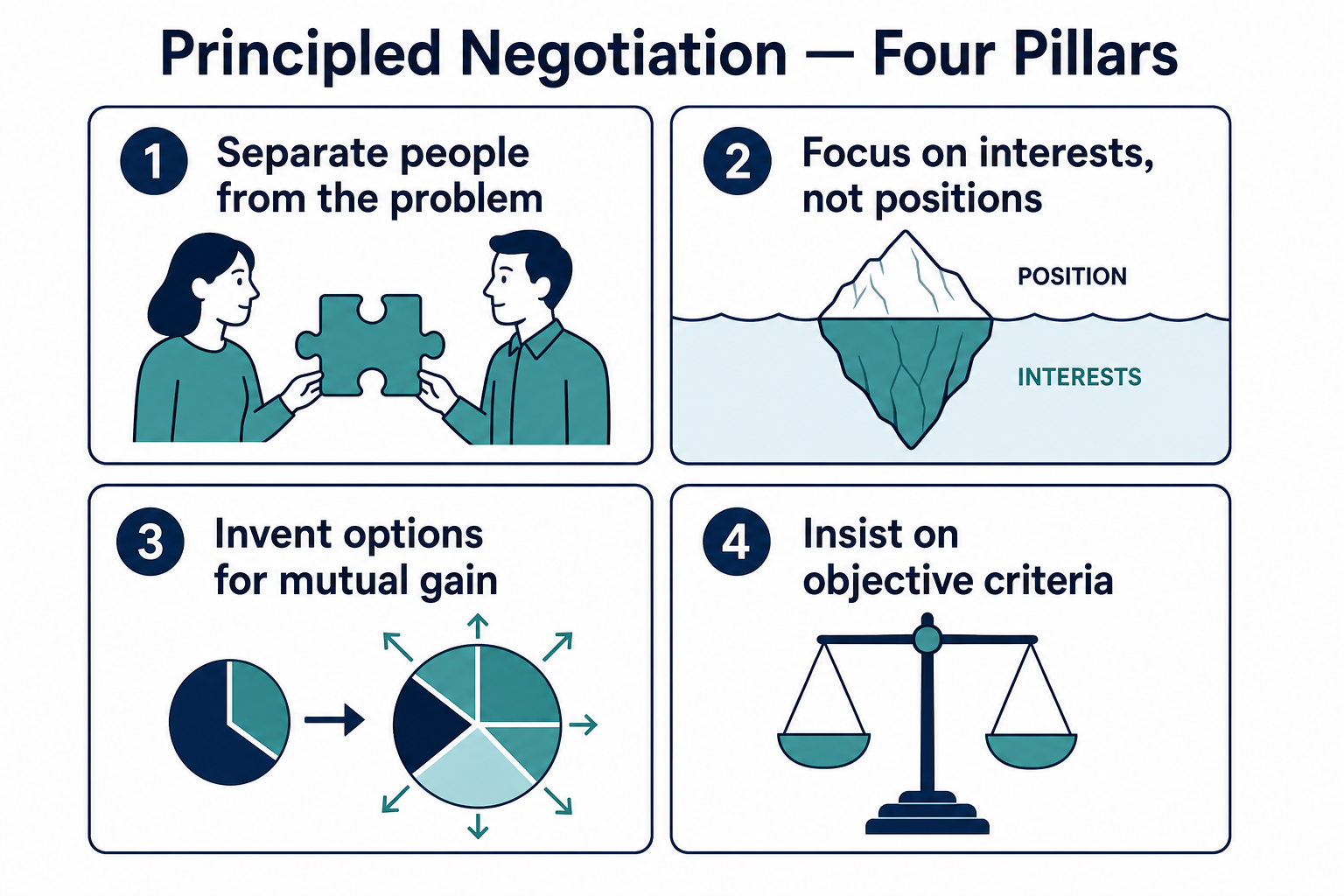
Figure: the four pillars—people, interests, options, criteria—replace positional tug-of-war.
2.1 How positional bargaining works (and why it persists)
Positional bargaining is familiar: each side states a demand, argues, makes concessions toward a compromise. It requires little preparation, works across language barriers (even finger-counting haggling), and is expected in some markets.
It also:
- Locks ego to positions — the more you defend a number, the harder it is to move without “losing face.”
- Hides interests — attention goes to stated demands, not underlying needs.
- Produces arbitrary splits — “meet in the middle” may satisfy neither side’s real concerns.
- Incentivises delay and deception — extreme openings, small concessions, stonewalling.
Classic failure: nuclear test-ban talks stalled over how many on-site inspections (positions) while neither side had defined what an “inspection” actually entailed (interests + standards).
2.2 Three tests positional bargaining fails
| Test | Positional failure mode |
|---|---|
| Wise agreement | Split-the-difference ignores merits; egos drive outcomes |
| Efficiency | Many rounds of offer/counter-offer; each concession feels costly |
| Relationship | Contest of will breeds anger, resentment, broken partnerships |
2.3 Soft vs hard — the trap
| Soft positional | Hard positional | |
|---|---|---|
| Goal | Agreement | Victory |
| Relationship | High priority | Subordinate to outcome |
| Typical moves | Concede readily; trust | Demand concessions; threaten |
| Risk | Exploitation | Escalation; damaged trust |
| Head-to-head | — | Hard beats soft |
Being “nice” is not principled negotiation. Soft positional bargainers get crushed by hard ones. Principled negotiation is both hard and soft: hard on the problem, soft on the people.
2.4 Multi-party collapse
With many parties (150 countries, enterprise buying committees, programme boards):
- Positions become coalitions (“North vs South,” “business vs IT”).
- Changing a group position is harder than changing one person’s.
- Absent approvers (legal, finance, board) freeze positions further.
Principled negotiation scales better because interests can be unpacked without forcing a public coalition line to move.
2.5 When positional bargaining might suffice
The Ten Questions appendix admits positional haggling can work when:
- Stakes are low and arbitrary outcomes acceptable.
- Issues are simple, single-issue, strangers, competitive alternatives exist.
- Transaction cost of interest exploration exceeds benefit.
But: if talks bog down, change gears—clarify interests before more haggling. In consulting pursuits, complexity and relationship duration almost always favour principled negotiation.
2.6 The four pillars (preview)
| Pillar | One-line job |
|---|---|
| People | Disentangle relationship from substance |
| Interests | Reconcile needs, not slogans |
| Options | Invent before you decide |
| Criteria | Insist on fair standards, not willpower |
The next four chapters unpack each pillar. Chapters 6–8 address power and bad behaviour.
Negative case — consulting: Account team treats procurement’s opening discount demand as “the deal” and trades scope quietly. Delivery inherits an unwise SOW; client relationship erodes at first missed milestone. Positions were negotiated; interests (risk, capability proof, time-to-value) were not.
3. Chapter 2 — Separate the people from the problem
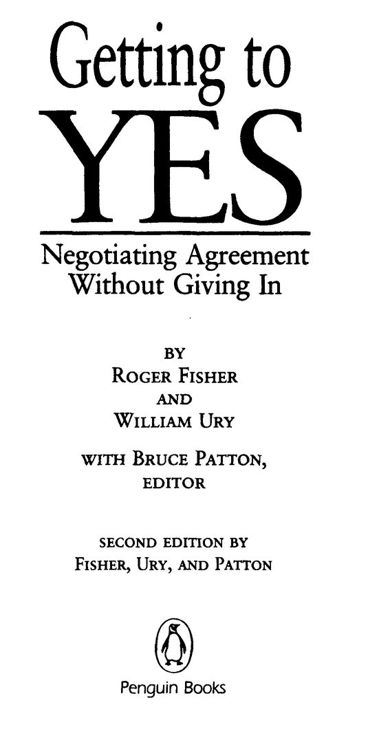
Figure: negotiators are people first—perception, emotion and communication sit beside substance.
3.1 Negotiators are people first
Corporate and diplomatic settings encourage us to forget it: counterparts have emotions, values, blind spots and bad days—so do you. The human layer can build commitment to a good outcome—or trigger vicious cycles where the “game” becomes scoring points and assigning blame.
Union foreman vs worker (book case): Jones thought Campbell “had it in for him” on replacement assignments. Campbell thought he was complimenting Jones by trusting him with hard jobs. Same facts, opposite stories—relationship nearly destroyed over a perception gap.
Insurance lawyer vs regulator (book case): A technical regulatory concern was heard as a personal attack on the commissioner’s competence. Relationship risk blocked a wise substantive fix.
3.2 Two interests in every negotiation
Every negotiator cares about:
- Substance — the terms of agreement.
- Relationship — future dealings, reputation, self-image.
Positional bargaining forces a trade-off: yield on substance to save relationship, or damage relationship to “win.” Principled negotiation treats people concerns alongside substance, not instead of it.
3.3 Three people problems
| Domain | What goes wrong | Method response |
|---|---|---|
| Perception | Each side sees a different “movie”; confirms bias | Discuss perceptions explicitly; don’t assume yours is reality |
| Emotion | Fear, anger, frustration drive tactics | Acknowledge feelings; allow venting without conceding substance |
| Communication | You talk past each other; listen to reply, not understand | Listen actively; speak to be understood; use “I” not “you” attacks |
3.4 Perception tactics
| Tactic | Application |
|---|---|
| Don’t blame them for your problem | “You’re unreasonable on price” → “We’re under board pressure on margin; help me understand your constraints.” |
| Discuss each other’s perceptions | “Here’s how this landed on our side—what did you intend?” |
| Give them a stake in the outcome | Co-design evaluation criteria, pilot success metrics |
| Involve them in the process | Joint working sessions beat emailed ultimatums |
| Face-saving | Offer a principled reason they can cite upward for movement |
| Put yourself in their shoes | Role-map their internal approvers before the call |
3.5 Emotion tactics
| Tactic | Application |
|---|---|
| Make emotions explicit | “It sounds like the last RFP left scar tissue on security review.” |
| Allow let-off-steam | Hear the rant; don’t respond point-for-point; return to interests |
| Symbolic gestures | Small acknowledgments (timeline apology, credit for their framework) unlock substance |
| Listen before inoculating | Premature “we hear you” without listening inflames |
Emotion is not weakness to exploit—it is data about interests and identity at stake.
3.6 Communication tactics
| Tactic | Application |
|---|---|
| Speak to be understood | One idea at a time; check comprehension |
| Listen actively | Paraphrase; ask follow-ups |
| Speak about yourself, not them | “We’re worried about model drift in production” beats “You don’t understand ML ops.” |
| Prevention works best | Build relationship before the hard issue; don’t cold-open with price |
3.7 Sit side by side, attack the problem
Figuratively (often literally in mediation): move from face-to-face opposition to side-by-side problem-solving. Whiteboard the problem—cost of delay, risk of failed AI pilot, audit findings—not the people.
Consulting translation: Security is not “blocking the deal”; they are protecting an interest (data residency, model governance). Procurement is not “attacking the team”; they are protecting budget credibility. Separate the person from the problem label.
3.8 Negative cases
| Failure | Symptom | Fix |
|---|---|---|
| Personalisation | “Legal always kills deals” | Map legal’s interests; pre-wire with standards |
| Emotional concession | Yield on fee to stop hostility | Acknowledge emotion; hold criteria on merits |
| Premature substance | Open on price before rapport | Sequence: people → interests → options |
| Face neglect | “That’s irrational” | Offer face-saving path tied to objective criteria |
Pair people skills with Difficult Conversations when identity, blame and feelings dominate—the three-conversation model (what happened, feelings, identity) deepens this chapter’s people work.
4. Chapter 3 — Focus on interests, not positions
4.1 Positions vs interests — the library window
Two people quarrel in a library: one wants the window open, one closed. They compromise—half open. Still wrong.
The librarian asks why. Fresh air vs avoid draft. She opens a window in the next room—air without draft.
| Concept | Definition | Example |
|---|---|---|
| Position | Stated demand | “$2M fixed fee” / “20% discount” |
| Interest | Underlying need, hope, fear, desire | Predictable cost; proof of value; career risk if pilot fails |
Interests define the problem. Positions are chosen strategies to satisfy interests—often not the only possible strategies.
4.2 Camp David — interests behind incompatible positions
Egypt: every inch of Sinai returned (sovereignty). Israel: keep part of Sinai (security). Map-splitting failed repeatedly.
Interests: Egypt—sovereignty after centuries of foreign rule. Israel—security against tank invasion. Solution: full Egyptian sovereignty + demilitarized zones—flag everywhere, tanks nowhere near Israel.
Lesson: For every interest, multiple positions may work. Compromising between positions (50% of Sinai) may be worse than inventing a new option.
4.3 Shared, differing, and conflicting interests
Behind opposed positions lie more compatible interests than you assume.
Tenant–landlord shared interests: stability, well-maintained property, good working relationship.
Differing (not conflicting) interests: tenant allergic to paint vs landlord repainting whole building; timing of deposit vs indifference on date.
Conflicting interests: minimize rent vs maximize return—often smaller once shared/differing interests are traded.
Shoe seller logic: You value shoes more than money; seller values money more than shoes—trade becomes possible because interests differ.
4.4 How to identify interests
| Technique | Question / move |
|---|---|
| Ask “Why?” | Why that position? Why that term? |
| Ask “Why not?” | What’s wrong with our proposal? What concern does it miss? |
| Recognise multiple interests | Each person and organisation has a bundle—economic, security, recognition, control |
| Basic human needs | Security, economic wellbeing, belonging, recognition, autonomy—often drive “irrational” positions |
| Make interests come alive | Specific scenarios beat abstract claims (“If audit fails, my job is…”) |
| Acknowledge theirs first | “You seem to need X—is that right?” before asserting yours |
| Be specific on yours | Vague grievances invite positional bargaining |
4.5 Talking about interests
| Do | Don’t |
|---|---|
| Ask for their interests behind positions | Debate positions head-on first |
| Be specific about consequences | Attack their interests as illegitimate |
| State your interests clearly | Conceal interests hoping to “win” |
| Put it in writing pre-meeting | Assume they share your priority order |
Problem before answer: Explore the problem jointly before committing to solutions. In AI pursuits: agree what “success” must prove (latency, accuracy band, human-in-loop) before debating licence model.
Use SPIN Selling discovery questions in early phases to surface interests before positions harden in a formal RFP.
4.6 Negative cases
| Failure | What happened | Principled move |
|---|---|---|
| Position lock-in | Public commitment to “cloud-only” | Reframe to interests: agility vs control; hybrid options |
| Assumed opposition | “They want to kill AI” | Test—often fear of reputational risk, not technology |
| Single-issue trap | Fee-only debate | Expand issues: timeline, risk share, references, training |
| Interest leak as weakness | Revealing desperation | Share interests, not BATNA/reservation |
5. Chapter 4 — Invent options for mutual gain
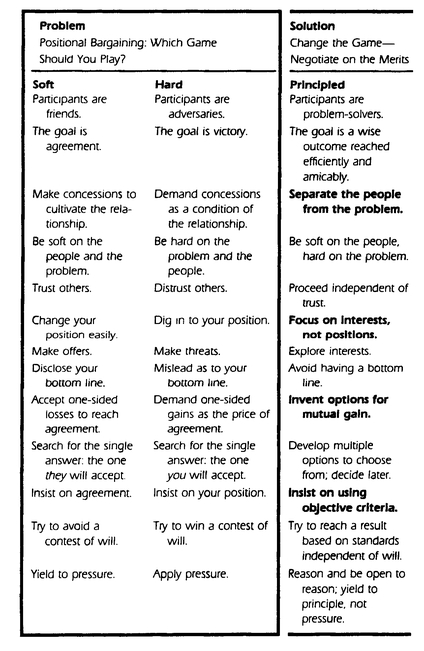
Figure: expand the pie before dividing it—brainstorm before evaluate.
5.1 The orange peel parable
Two children fight over one orange—split it 50/50. One eats fruit, throws peel away. Other bakes with peel, throws fruit away. Half an orange each; whole fruit + whole peel was available if they had asked why.
Consulting analogue: fighting over headcount days vs discovering client wanted knowledge transfer (training + docs) while you wanted reference rights—different slices of the same budget.
5.2 Diagnosis — four obstacles to inventing
| Obstacle | Mechanism | Symptom |
|---|---|---|
| Premature judgment | Critical mind kills ideas at birth | “That’ll never pass legal” in brainstorm |
| Searching for the single answer | Narrow to one line too early | One fee number before packages |
| Fixed-pie assumption | Every gain for them = loss for you | No creative trades |
| “Their problem is their problem” | Refuse to design for their interests | One-sided packages |
Nothing harms inventing like a critical sense waiting to pounce. Under negotiation pressure, creativity drops further—you fear ideas will be treated as commitments or expose weakness.
5.3 Prescription — four enabling moves
- Separate inventing from deciding — brainstorm first, evaluate later.
- Broaden options — multiply possibilities before selecting.
- Search for mutual gain — especially in differences.
- Make their decision easy — yesable proposals they can adopt without losing face.
5.4 Brainstorm rules (Harvard tradition)
When brainstorming (alone or jointly):
| Rule | Rationale |
|---|---|
| No criticism during inventing | Judgment inhibits imagination |
| Wild ideas welcome | Often seed practical hybrids |
| Go for quantity | More options → better final package |
| Mutate and combine ideas | Build on partial fits |
| Separate session if needed | Different room, time, facilitator |
Do not treat brainstorm outputs as offers. Label the phase explicitly: “Nothing we say in the next 30 minutes is binding.”
5.5 Circle Chart — four steps to invent options
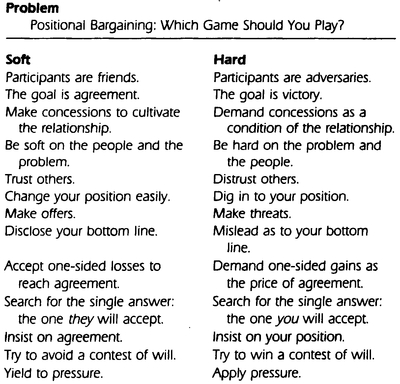
Figure: shared interests, differing interests and conflicting interests—all can be designed around.
Use the Circle Chart to structure invention:
| Step | Action |
|---|---|
| 1. State the problem | In joint problem-solving terms—not “their fault” |
| 2. Analyse interests | Yours, theirs, third parties’ |
| 3. Brainstorm options | Quantity; no evaluation |
| 4. Refine for mutual gain | Improve options against interests; prepare criteria for choice |
Shared interests → emphasise in proposal framing. Differing interests → logroll (give them what they value cheaply; get what you value cheaply). Conflicting interests → objective criteria + fair process.
5.6 Dovetail differences
Look for differences in:
| Difference type | Trade example |
|---|---|
| Preferences | They want brandable case study; you want faster payment |
| Forecasts | Contingency fee if ROI band hit |
| Risk tolerance | You cap liability; they accept higher fee |
| Time preference | They defer cost; you phase delivery |
| Cost structure | Training online (cheap to you, high value to them) |
Negotiation Genius adds contingency contracts and post-settlement settlements as advanced dovetail tools.
5.7 Make their decision easy
| Technique | Detail |
|---|---|
| Draft a yesable proposal | Complete package they can accept with minimal edit |
| Consistent with their interests | Frame in their language upward |
| Face-saving wrapper | Tie to industry standard, audit requirement, pilot precedent |
| Avoid brinkmanship | Ultimatums force positional response |
Negative case: Sending three incompatible “options” without recommendation forces client to do your work—they pick cheapest by default.
5.8 AI pursuit option menu (examples)
| Option axis | A | B | C |
|---|---|---|---|
| Scope | Discovery + roadmap | Pilot in one domain | Enterprise rollout |
| Risk | Time & materials cap | Fixed pilot; variable scale | Gain-share band |
| Data | Synthetic + sample | Prod subset in VPC | Full prod with DP |
| IP | Client owns prompts/workflows | Joint reference architecture | Licence + support |
Invent before procurement collapses everything to “lowest fixed fee.”
6. Chapter 5 — Insist on objective criteria
6.1 Will-based vs principle-based decisions
Some conflicts remain after interests are explored and options invented. Rent up vs down. Delivery tomorrow vs next week. You both want the corner office.
Deciding by will (who concedes, who threatens, who flatters) is costly— inefficient, relationship-damaging, and often arbitrary.
Objective criteria decide on merits independent of either side’s will: market value, safety codes, industry benchmarks, precedent, expert models, efficiency standards.
6.2 Foundations case — don’t horse-trade safety
Contractor wants 2-foot foundations; you want five feet. Contractor says: “You got steel girders; your turn to yield on foundations.”
You would not horse-trade. You would ask: soil specs, seismic risk, building codes, neighbouring foundations—standards, not turn-taking.
Same logic applies to fee benchmarks, SLA percentiles, model accuracy bands, and regulatory minimums in AI deals.
6.3 Fair standards and fair procedures
| Type | Examples |
|---|---|
| Substantive standards | Market comps; replacement cost; depreciated value; competitive bid results; MIT-style economic models |
| Procedural standards | Who decides; what evidence counts; escalation path; independent expert; arbitration |
Joint search for standards beats invoking “company policy” as a brick wall. Policy is a starting point—ask what principle it reflects and whether it fits this case.
6.4 Using criteria in negotiation
| Move | Script direction |
|---|---|
| Frame as search | “What standard should we both use?” |
| Be open to reason | “If industry benchmark is X, we should discuss it.” |
| Never yield to pressure alone | Distinguish threat from principle |
| Agree criteria before numbers | Prevents positional anchoring war |
Law of the Sea case (book): India proposed $60M/site seabed fee; US wanted zero. Stalemate. MIT economic model became accepted objective tool—showed India’s fee killed mining economics; showed some fee was feasible. Both moved without “losing”—reasonable, not weak.
6.5 “It’s company policy”
When they hide behind policy:
- Ask what interest the policy serves.
- Ask whether exceptions exist on principle.
- Propose alternative standards (market, precedent, risk-adjusted model).
- Negotiate procedure if substance blocked (pilot, phased approval).
6.6 Criteria catalogue for consulting / AI
| Issue | Possible objective criteria |
|---|---|
| Price / rate | Published rate cards; Big Four / SI benchmarks; cost-plus with open book |
| SLA | Industry uptime percentiles; incident severity matrix |
| Model quality | Held-out test metrics; fairness/disparate impact thresholds |
| Security | ISO 27001 / SOC2 mappings; regulatory minimums (GDPR, sector rules) |
| Scope | Reference architecture; defined artefact list; out-of-scope log |
| IP | Who owns what class of work product—market norm by deal type |
6.7 Negative cases
| Failure | Result |
|---|---|
| Criteria-free split | 50/50 on fee and scope—both sides unhappy |
| Fake objectivity | “Industry standard” with no source |
| Yielding to pressure | Accept bad SLA because counterpart yelled |
| Criteria after anchor | Number fight first—standards feel like concessions |
7. Chapter 6 — What if they are more powerful? (Develop your BATNA)
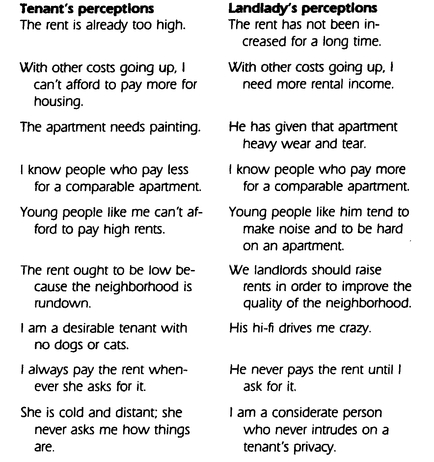
Figure: your walk-away alternative sets the floor for what any deal must beat.
7.1 Realities power creates
No method grows lilies in a desert. If you have $100 and the tea set costs thousands, skill cannot close the gap. Power realities exist: budget caps, monopoly suppliers, regulatory mandate, timeline.
Negotiation under asymmetry can still:
- Protect you from accepting a bad agreement.
- Help you make the most of the assets you have.
7.2 Bottom line vs BATNA
| Concept | Definition | Problem |
|---|---|---|
| Bottom line | Worst acceptable deal (max pay / min accept) | Rigid; set too high/low; blocks learning and invention |
| BATNA | Best Alternative To a Negotiated Agreement—what you actually do if no deal | Dynamic; interest-based; compares whole packages |
Bottom line helps resist momentary pressure—but shuts ears, kills creative packages, and is often chosen arbitrarily (family roundtable picks inflated house minimum).
BATNA asks: If we don’t sell by March, do we rent, delay, renovate, accept best offer? Compare real alternatives, not slogans.
7.3 Trip wire
A trip wire is an early warning signal—not your final walk-away. Example: if offer falls below X and lacks Y safeguards, escalate internally. Gives flexibility between aspiration and BATNA.
| Term | Role |
|---|---|
| Aspiration | Target outcome (ambitious, justifiable) |
| Reservation value | Walk-away point tied to BATNA |
| Trip wire | Review trigger before reservation breached |
| BATNA | Best non-agreement course |
Never confuse aspiration with reservation. Never reveal reservation/BATNA as a threat—it becomes a position to attack.
7.4 Develop BATNA in three steps
| Step | Action |
|---|---|
| 1. Invent alternatives | List all credible non-agreement paths (other vendors, in-house build, delay, partial scope, partner sub-contract) |
| 2. Improve best alternatives | Make them real—get quotes, start parallel POC, formalise internal build approval |
| 3. Select carefully | Choose the best among alternatives—that is BATNA |
Weak BATNA symptoms: desperate timeline; sole-source acceptance; accepting unfavourable terms “to preserve relationship.”
Strong BATNA symptoms: calm willingness to walk; packages offered on merits; counterpart engages on criteria.
7.5 Consider their BATNA
Estimate theirs without assuming everything is bluff. Ask:
- What happens for them if no deal?
- How good are their alternatives (incumbent, competitor, status quo)?
- What would improve their BATNA during talks (your exclusivity, delay)?
Shape offers so agreement beats their BATNA—not just yours.
7.6 Making the most of your assets
Power is not only alternatives. Also: information, expertise, relationships, legitimacy, coalition, process design, persistence, communication skill. Principled negotiation converts some “power deficits” into process advantage (you look reasonable; they look arbitrary).
7.7 Negative cases
| Failure | Consequence |
|---|---|
| BATNA as bluff | Called; credibility destroyed |
| Aggregate fantasy | “We could go to California, Texas, Florida…”—no real option |
| Ignoring their BATNA | Surprised when they walk |
| Bottom line in email | Becomes their target |
8. Chapter 7 — What if they won’t play? (Negotiation jujitsu)
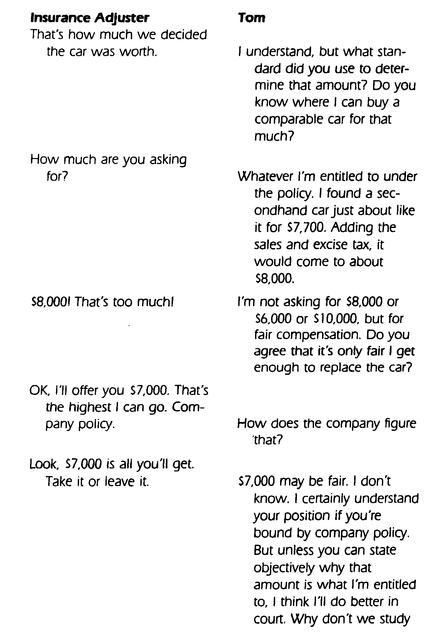
Figure: do not push back against a push—deflect force into problem-solving.
8.1 Three approaches when they stay positional
| # | Approach | Mechanism |
|---|---|---|
| 1 | Principled negotiation (contagion) | You model interests/options/criteria—they may join |
| 2 | Negotiation jujitsu | Deflect positional moves without pushing back |
| 3 | Third party / one-text | Mediator holds single draft; parties critique |
8.2 The vicious cycle
They assert position → you reject → they dig in. They attack your idea → you defend → you’re locked in. They attack you → you counterattack → personality war.
Do not push back. Channel force into the problem.
8.3 Jujitsu against three attacks
| Their move | Jujitsu response |
|---|---|
| Assert position forcefully | Don’t reject/accept; treat as one option; ask interests and principles behind it; hypothetically explore consequences (“What if they accepted your position verbatim—what breaks?”) |
| Attack your ideas | Don’t defend; invite criticism and advice — “What’s wrong with this?” “How would you improve it?” |
| Attack you personally | Don’t counterattack; recast as attack on shared problem; pause; sit side-by-side |
Nasser / Meir hypothetical (book): Asking what would happen if Israel unilaterally withdrew exposed unrealistic position—opened space for cease-fire discussion.
Teacher strike example (book): Mine board’s $2k offer for budget theory, competitiveness standard, layoff fairness principles—turn positions into criteria discussion.
Never Split the Difference adds calibrated questions and labels when jujitsu needs more emotional granularity—use both layers.
8.4 One-text procedure
Developed for Middle East peace talks (Camp David lineage):
- Third party drafts single text—proposal addressing issues.
- Parties critique; no side owns the draft.
- Mediator revises; repeat.
- When ready, parties seek approval from constituents—no one “gave in” to the other; both responded to fair text.
Consulting use: Independent architect or PMO drafts integration blueprint; vendor and client comment; reduces “your paper vs my paper” positional warfare.
Book closes with a landlord–tenant dialogue showing persistent principled moves—interest discovery, options, standards, jujitsu. Pattern: patience + method beats escalation; matching hardball locks both sides.
9. Chapter 8 — What if they use dirty tricks?
9.1 Two wrong responses
| Response | Result |
|---|---|
| Put up with it | Encourages escalation (Munich pattern—concessions invite new demands) |
| Respond in kind | Trick arms race; agreement or breakoff—both costly |
Tricky tactics are one-sided procedural proposals. Counter with principled negotiation about the negotiation process.
9.2 Three steps — negotiate the rules
- Recognise the tactic (name the pattern).
- Raise explicitly — without personal attack (“I may be wrong, but this feels like good-cop/bad-cop…”).
- Question legitimacy and desirability — propose fair rules; use objective criteria and BATNA if needed.
Apply the four pillars to procedure:
| Pillar | Procedural use |
|---|---|
| People | Question tactic, not integrity |
| Interests | “Why commit in press before we agree?” |
| Options | “No press statements until deal or break” |
| Criteria | Reciprocity—low chair, sun in eyes, arbitrary deadlines |
Last resort: Walk to BATNA on legitimate grounds (deception, false authority)—leave door open if they return to merits.
9.3 Common tricky tactics (three categories)
| Category | Examples | Counter principle |
|---|---|---|
| Deliberate deception | Phony facts; ambiguous authority; dubious intentions | Verify without calling liar; confirm decision-makers upfront; tie commitments to milestones |
| Psychological warfare | Stressful setting; personal attacks; good-cop/bad-cop; threats | Name setting; recast to problem; label routine; closed to threats, open to reason |
| Positional pressure | Refusal to meet; take-it-or-leave-it; escalating demands; lock-in | Improve BATNA visibility; ignore ultimatum format; trip wire; one-text or third party |
Never fight trick with trick if implementation quality matters—you will inherit the relationship you trained.
10. Preparation — Analysis, Planning, Discussion
Getting Ready to Negotiate (Fisher & Ertel workbook) operationalises preparation:
| Phase | Core tasks | Key outputs |
|---|---|---|
| Analysis | Map parties/interests; list issues; invent options; develop BATNA + reservation; estimate their BATNA; select criteria; anticipate tricks | Interest table; BATNA memo; standards catalogue |
| Planning | Sequence issues; choose forum/attendees; plan face-saving; draft yesable proposal; define trip wires; align internal coalition | Meeting plan; package A draft |
| Discussion | Open on people/process → explore interests → brainstorm → decide on criteria vs BATNA → close with authority check | Signed commitments; debrief notes |
After every negotiation: debrief against the four pillars—what interests were missed? Was BATNA real? Relationship state?
11. Ten Questions — selected practitioner answers
The second-edition appendix addresses common objections—condensed here.
| Question | Short answer |
|---|---|
| Does positional bargaining ever make sense? | Sometimes on low-stakes, single-issue, stranger deals—with competitive alternatives. Change gears if stuck. |
| Different fairness standards? | Use external standards to narrow gap; agreement on “best” standard not required; fair procedures (split, arbitrator) remain |
| Should I be fair if I don’t have to? | Book is practical, not sermon; standards protect you from being taken and help justify claims |
| People are the problem? | Negotiate relationship explicitly; Difficult Conversations |
| Negotiate with terrorists / Hitler? | Some parties reject merit-based process; sometimes no negotiation is wise |
| Personality, gender, culture? | Adjust style, not principles; respect; learn their norms |
| Where meet? Who offers first? How high? | Process affects power—negotiate fairly; first offers anchor—prepare reasoned anchor tied to criteria |
| Inventing → commitments? | Separate phases; draft; trial balloons labelled non-binding |
| Try ideas without too much risk? | Pilot principled approach on lower-stakes issue; build skill |
| Can method beat power? | Improves outcomes within constraints; BATNA + preparation = power |
12. In conclusion — winning the right game
Hyde Park Frisbee story: a passerby asks, “Who’s winning?” In marriage—and many negotiations—that question misses the point. The first game is what kind of negotiation you will play.
Principled negotiation aims to win a better process—one where you need not choose between getting what you deserve and being decent. You can have both—if you invest preparation, emotional discipline, and skill practice.
Reading alone does not make you fit; learn from doing. Debrief every significant negotiation against the four pillars.
13. Consulting and AI pursuit playbook
13.1 Phase map
| Phase | Getting to Yes moves | Deliverables |
|---|---|---|
| Discovery | Interest map (business, IT, security, procurement); SPIN-style why/why not | Stakeholder table, success criteria draft |
| Design | Invent options; circle chart; no premature fee anchor | Options A/B/C with trade-offs |
| Commercial | Objective criteria (benchmarks, SLA norms); package not line-item haggle | Priced packages tied to standards |
| Governance | Separate people from problem in steering spats | Joint problem statements |
| Contract / legal | Criteria: regulatory, precedent, audit | Clause map to standards |
| Impasse | BATNA check; jujitsu; one-text via third party | Escalation with trip wire |
13.2 AI-specific translation
| Topic | Positional trap | Principled move |
|---|---|---|
| Model hosting | “Must be public cloud” | Interests: speed vs control → hybrid, data residency schedule |
| Accuracy | “95% or no pay” | Criteria: held-out set, baseline comparison, human review loop |
| Liability | “Unlimited indemnity” | Standards: sector norms, cap linked to fee, mutual responsibility |
| IP | “We own everything” | Package: client owns prompts/data; vendor retains platform IP |
| Exit | “Free transition” | Criteria: documented artefacts, training hours, escrow |
13.3 Negative cases — field guide
| Anti-pattern | Why it fails | Fix |
|---|---|---|
| “Win-win” wallpaper | No interest analysis | Circle chart; verify mutual gain |
| Early reservation leak | Becomes target | Share interests; protect BATNA |
| Brainstorm in RFP response | Evaluation kills invention | Internal invent; external package |
| BATNA bluff | Destroyed trust | Build real alternatives |
| Soft people + soft problem | Value destruction | Hard on criteria, soft on ego |
| Criteria after anchor war | Numbers entrenched | Criteria first on structural issues |
| Ignore procedural tricks | Normalise abuse | Negotiate rules |
13.4 Integration with the negotiation stack
| Book | Layer | Use when |
|---|---|---|
| Getting to Yes | Method — interests, options, criteria, BATNA | Default framework for any negotiation |
| Negotiation Genius | Analytics — claim/create, biases, investigation | Complex multi-issue commercials |
| Never Split the Difference | Tactical empathy — labels, mirrors, calibrated questions | Hostile, emotional, high-stakes calls |
| Difficult Conversations | Interpersonal — identity, feelings, stories | Internal conflict, feedback, partnership strain |
| SPIN Selling | Discovery — Situation, Problem, Implication, Need-payoff | Early pursuit before positions form |
| MBA reading map | Curriculum order | Stack sequencing for self-study |
Patton co-authored Getting to Yes and later Difficult Conversations—the people pillar connects directly.
14. Capstone — principled negotiation one-sheet
Copy before your next commercial session:
- Situation — deal name; relationship horizon; parties + authority; absent constituents (legal, finance, board).
- Positions vs interests — their stated positions; hypothesised interests (ranked); our interests (ranked).
- Interest geometry — shared interests to emphasise; differing interests to logroll; conflicting interests needing criteria.
- Options — packages A/B/C (invented before evaluation); yesable draft recommendation.
- Criteria — substantive standards (with sources); fair process (who decides, what evidence).
- Power — our BATNA (invent / improve / select); reservation value; trip wire; their likely BATNA.
- Process — dirty-trick watchlist; rules to propose; Analysis / Planning / Discussion checklist complete.
15. Practitioner checklist — before you close
- Can you state their interests better than they can?
- Did you invent before deciding—at least three packages?
- Are hard numbers tied to objective criteria, not will?
- Is your BATNA real—not aspirational aggregate fantasy?
- Did you separate people from problem when it got hot?
- If they used tricks, did you negotiate rules—not mirror tricks?
- Will this agreement survive implementation—who sabotages if not?
- Did you debrief against the four pillars for next time?
Discussion
Comments
Share feedback or questions about this page. No account required.
Loading comments…