Disciplined Entrepreneurship: Bill Aulet’s 24-Step Startup Operating System
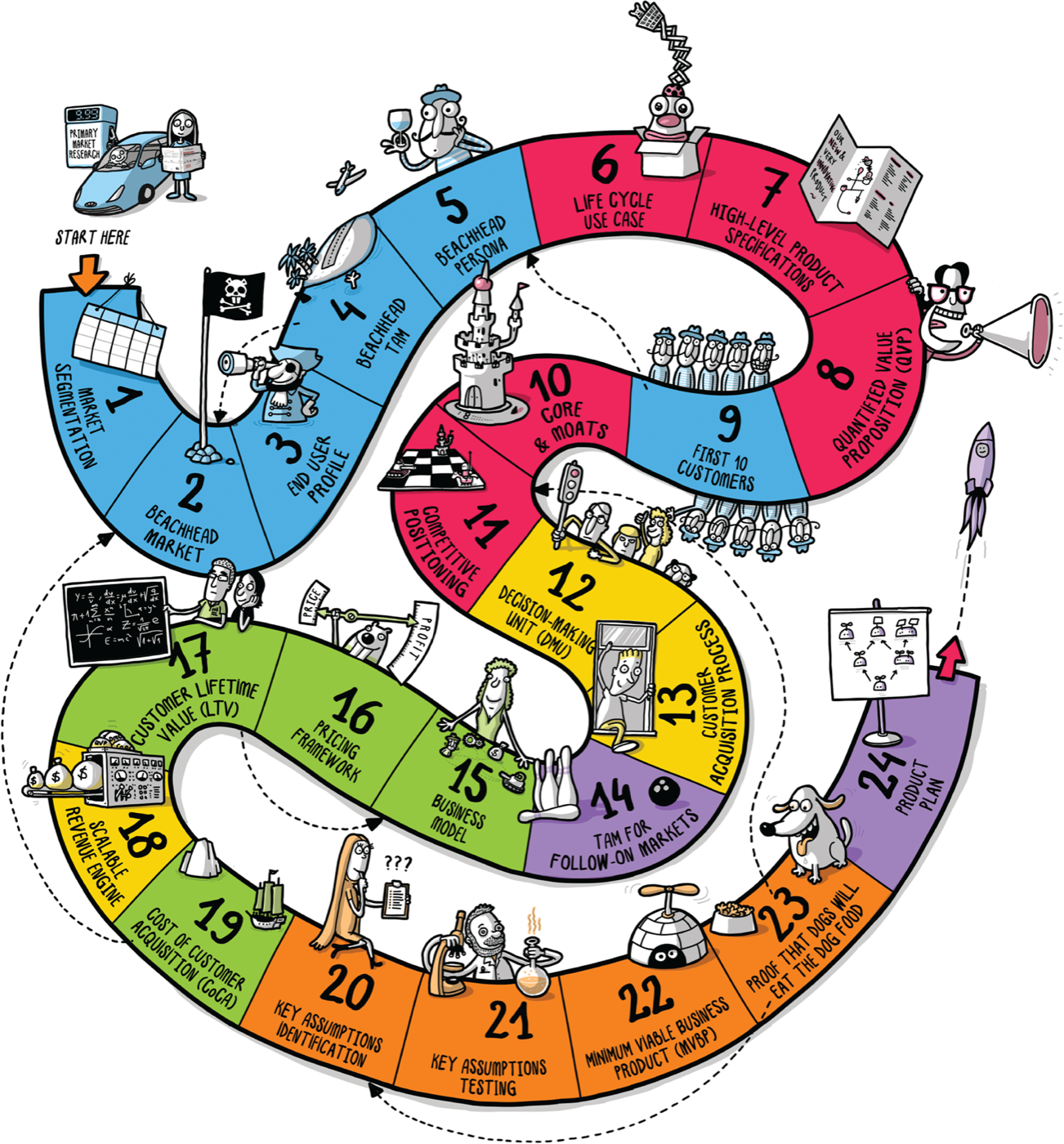
Most startups fail from undisciplined guessing—shipping a product nobody needs, chasing every market, or scaling before the economics work. Bill Aulet’s Disciplined Entrepreneurship (Expanded / Updated) replaces folklore with a 24-step operating system: narrow the customer, prove value, design acquisition, lock unit economics, then build and scale with intent.
Source note: This article is an original practitioner synthesis of themes from Bill Aulet’s Disciplined Entrepreneurship Expanded & Updated: 24 Steps to a Successful Startup. It is not a reprint. Figures below are educational illustrations from the work; support the original book and MIT/Delta V teaching materials for full worksheets and detail.
0. Why “disciplined” matters
0.1 Three false starts
Aulet reframes common founder identities:
| Starting myth | Better obsession |
|---|---|
| “I have an idea” | Create real value |
| “I have a technology” | Create impact |
| “I have passion” | Be obsessed with the mission |
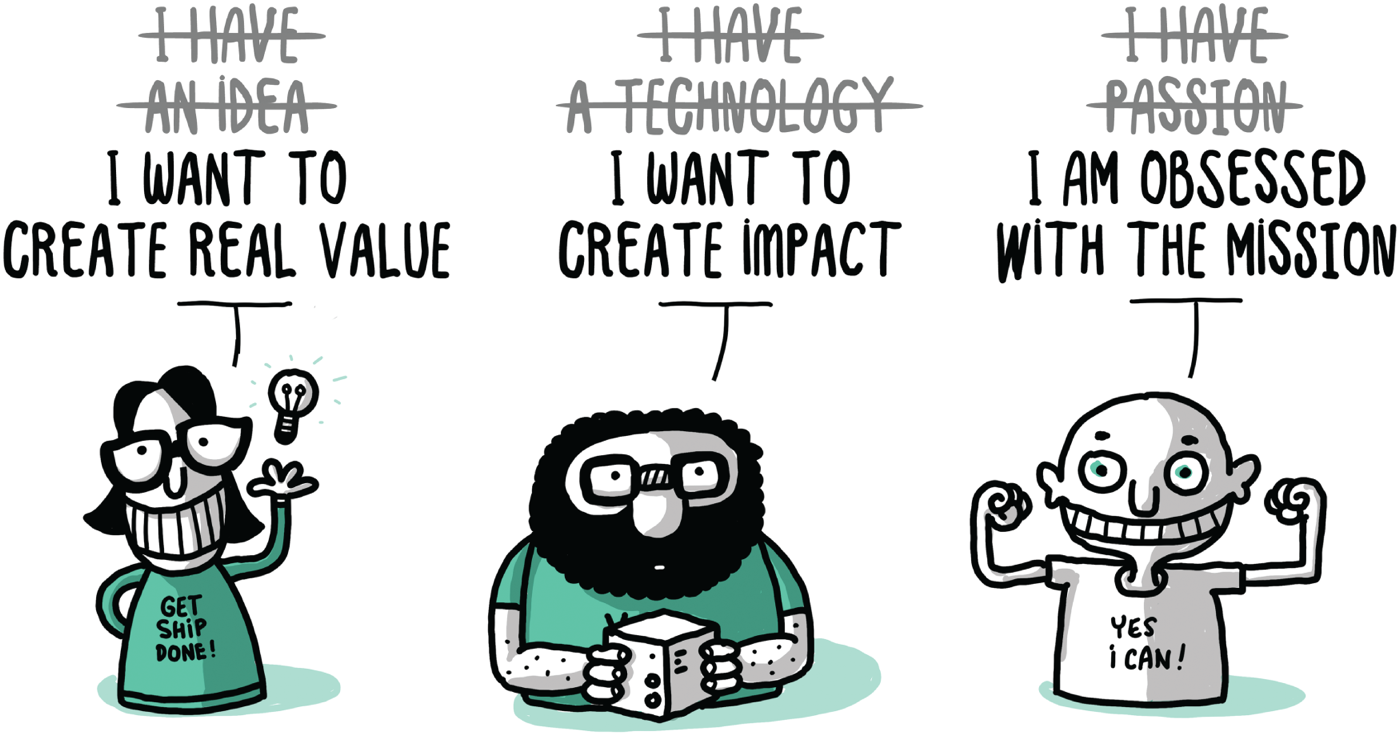
Figure: three common starting points reframed toward value, impact and mission (Aulet).
0.2 Process over heroics
Entrepreneurship is a craft with stages. Skipping steps (especially customer specificity and unit economics) creates false confidence. Completing steps poorly is still better than skipping them—because the artefacts expose assumptions.
0.3 Six themes, 24 steps — master map
| Theme | Steps | Gate question |
|---|---|---|
| I — Who is your customer? | 1–5 | Can we name one beachhead and one persona? |
| II — What can you do for them? | 6–9 | Is value quantified in customer currency? |
| III — How do they acquire it? | 10–13 | Do we know core, competition, DMU, process? |
| IV — How do you make money? | 14–18 | Does LTV:CAC work at steady state? |
| V — Design and build | 19–22 | Did dogs eat the dog food? |
| VI — Scale | 23–24 | Can we scale without breaking economics? |
0.4 Complete 24-step reference table
| Step | Name | Primary output |
|---|---|---|
| 1 | Market segmentation | Scored segment long list |
| 2 | Select beachhead market | One focused beachhead + rationale |
| 3 | Build end-user profile | Persona draft |
| 4 | Calculate beachhead TAM | Bottom-up revenue opportunity |
| 5 | Profile persona for beachhead | Deep persona + reference customer |
| 6 | Full life cycle use case | End-to-end journey map |
| 7 | High-level product specification | Conceptual product boundaries |
| 8 | Quantify value proposition | £/€/$ impact metrics |
| 9 | Identify next 10 customers | Named accounts + access path |
| 10 | Define your core | Unique capability statement |
| 11 | Chart competitive position | vs real alternatives |
| 12 | Determine DMU | Role map + politics |
| 13 | Map process to acquire paying customer | Stage diagram + durations |
| 14 | Design business model | Revenue architecture |
| 15 | Set pricing framework | Price logic + tests |
| 16 | Calculate LTV | Margin over lifetime |
| 17 | Map sales process | Repeatable motion + conversion |
| 18 | Calculate COCA/CAC | Steady-state acquisition cost |
| 19 | Identify key assumptions | Ranked assumption register |
| 20 | Test key assumptions | Experiment results |
| 21 | Define MVBP | Minimum viable business product |
| 22 | Show dogs eat dog food | Payment / commitment evidence |
| 23 | Develop product plan | Release sequence |
| 24 | Develop business plan to scale | People, capital, expansion |
1. Theme I — Who is your customer? (Steps 1–5)
Step 1 — Market segmentation
Brainstorm many end-user markets. Score for personal passion/fit, technical capability, market accessibility, and competitive intensity. Narrow to a short list—not “everyone with a smartphone.”
| Scoring dimension | Question |
|---|---|
| Passion/fit | Will we persist through setbacks? |
| Capability | Can we deliver 10× better for this segment? |
| Access | Can we reach buyers affordably? |
| Competition | Is the segment winnable? |
Step 2 — Select a beachhead market
A beachhead is a focused market where you dominate a narrow segment first, then expand adjacent.
| Beachhead criterion | Rationale |
|---|---|
| Similar buying process | Repeatable sales motion |
| Strong word-of-mouth | Lower CAC over time |
| Compelling reason to buy now | Urgency exists |
| Finite reachable set | You can list targets |
Christensen link: Beachhead often aligns with disruptive foothold (Disruptive Innovation).
Step 3 — Build an end-user profile / persona
Go beyond demographics. Capture goals, fears, day-in-the-life, buying triggers, and success definition.
Step 4 — Calculate the TAM for the beachhead
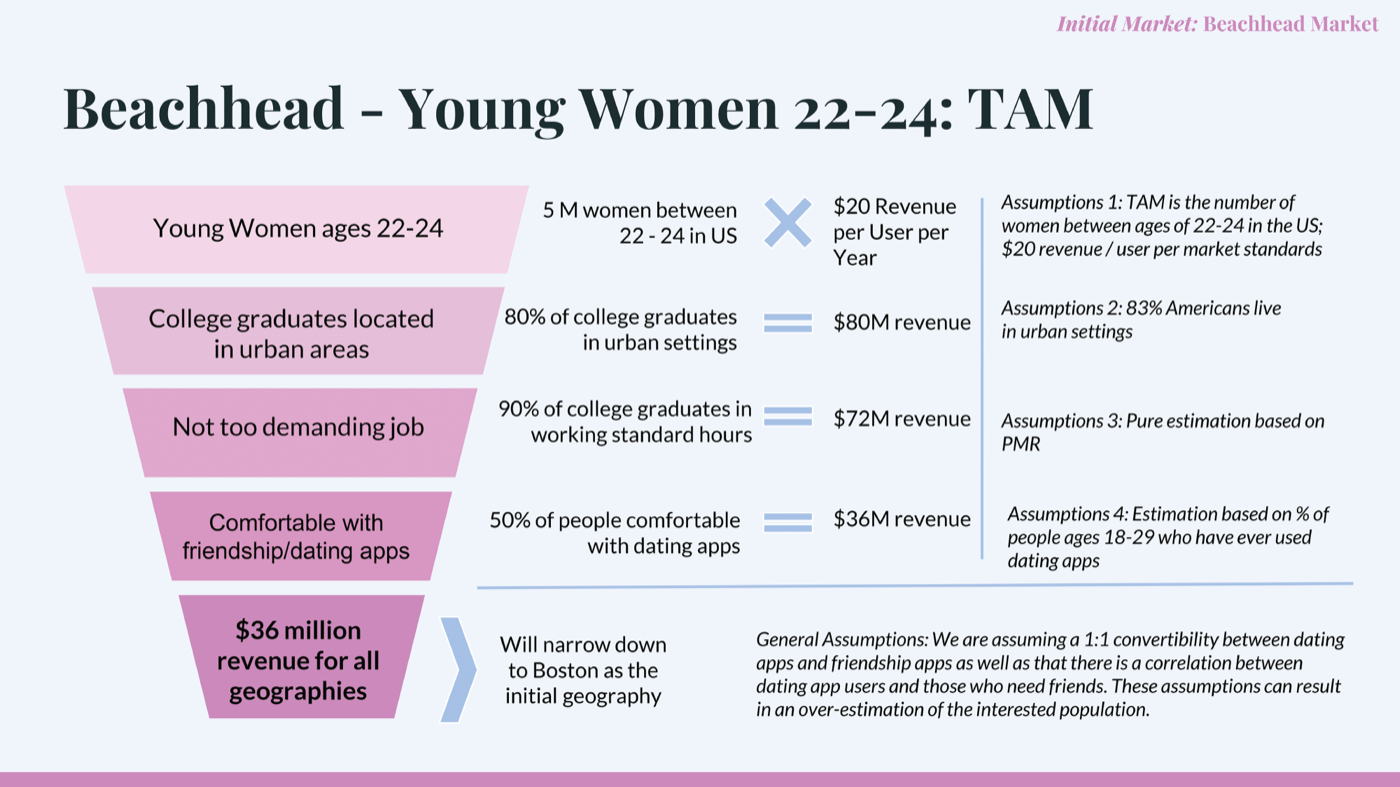
TAM = beachhead annual revenue if you owned 100%—bottom-up, not global fantasy.
| Bad TAM | Good beachhead TAM |
|---|---|
| “AI market is $500B” | “4,200 EU mid-market insurers × £80k ASP = £336m” |
| Top-down slides only | Counts you can defend in diligence |
Step 5 — Profile the persona for the beachhead
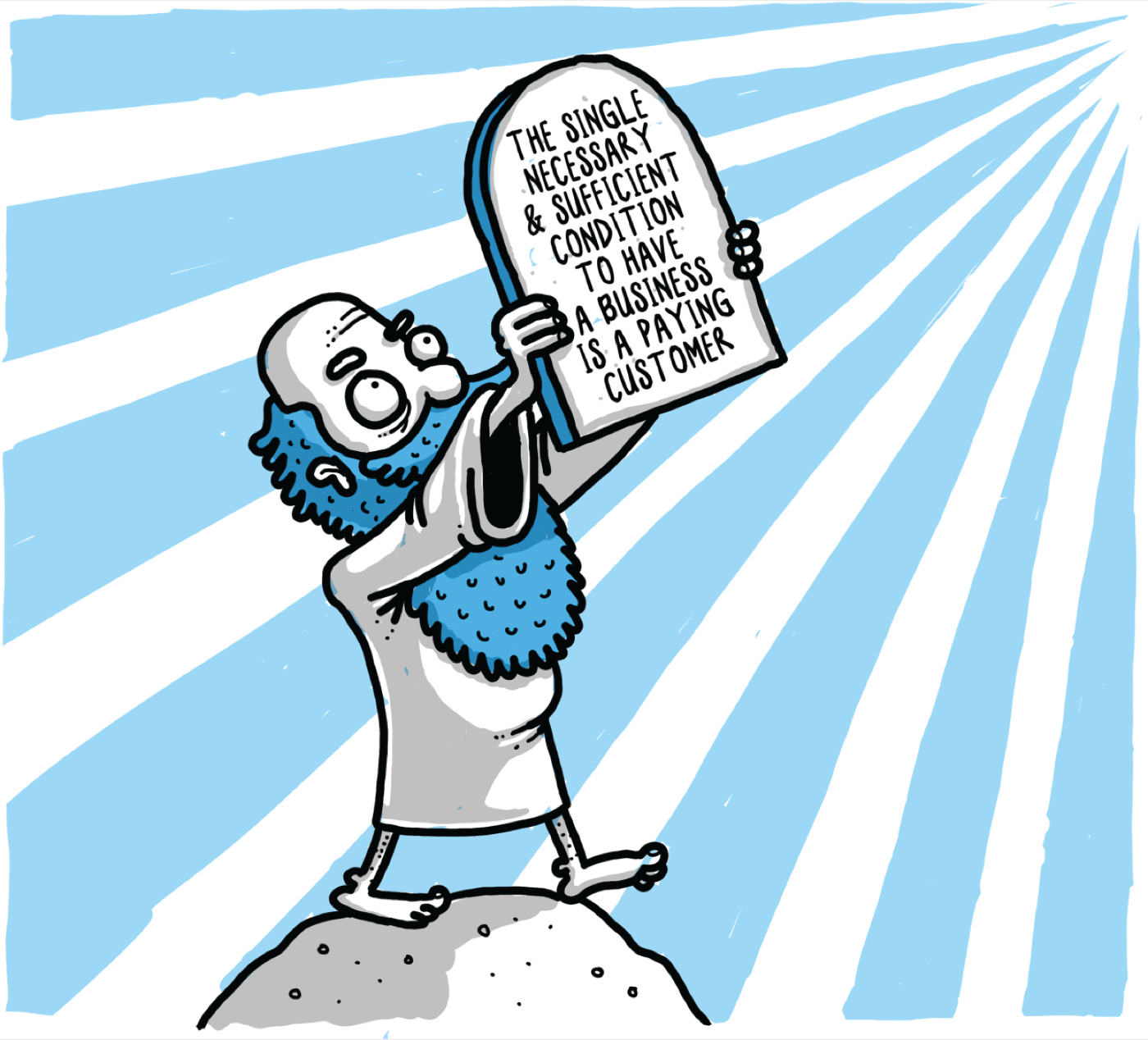
Deepen until product, messaging and sales become concrete. Holy grail: one real reference customer (Aulet’s “Philippa” archetype).
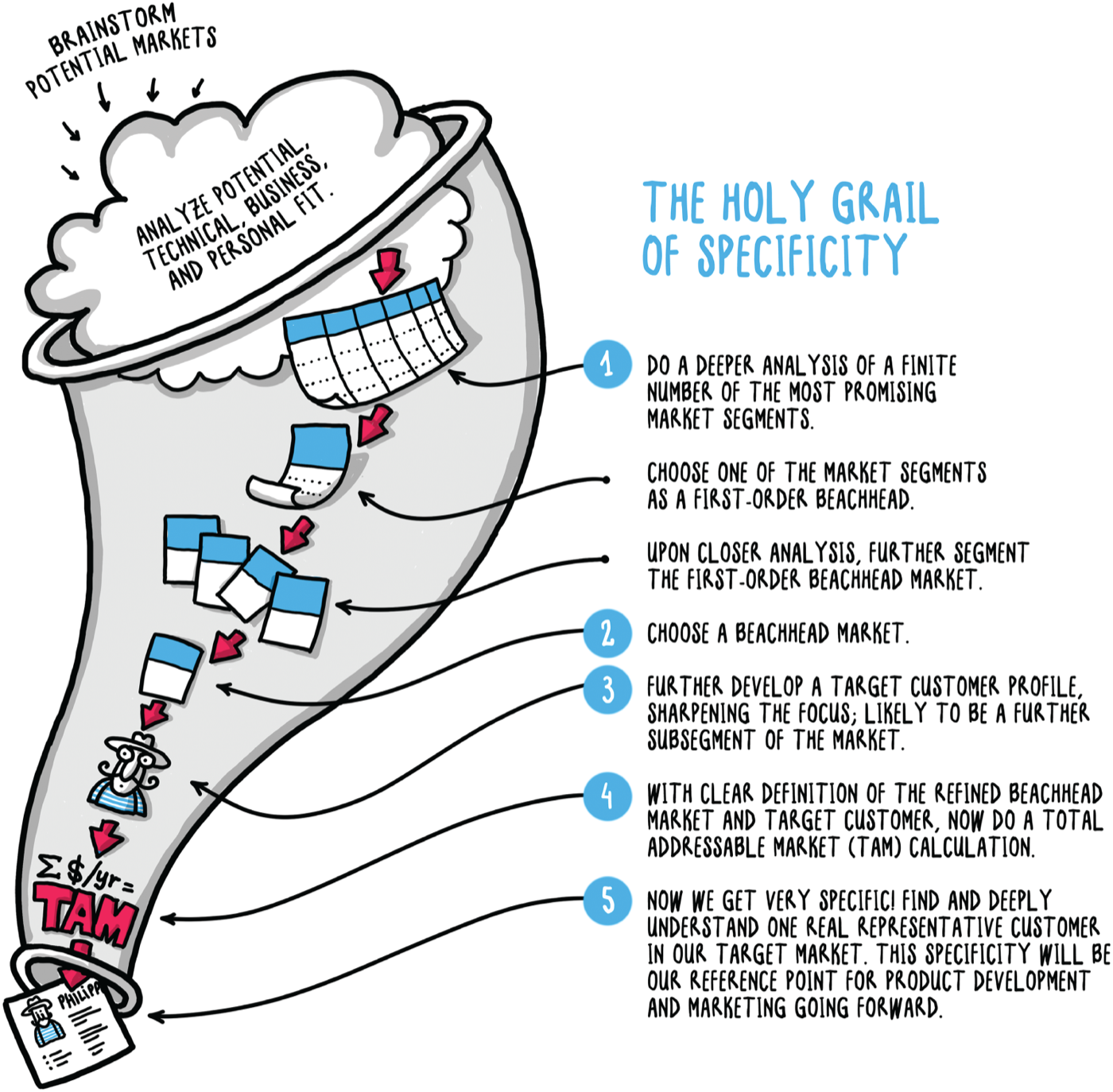
Figure: brainstorm → segments → beachhead → persona → TAM → one real customer.
Theme I checklist
- Short list of markets scored with explicit criteria
- One beachhead chosen with written rationale
- Persona documented and stress-tested with real interviews
- Beachhead TAM calculated bottom-up
- Team can name the same primary end user in one sentence
2. Theme II — What can you do for them? (Steps 6–9)
Step 6 — Full life cycle use case
Map discover → acquire → use → pay → support → renew. Include failures and workarounds.
Step 7 — High-level product specification
Capabilities and boundaries—not UI chrome. Answers: what job, for whom, under what constraints.
Step 8 — Quantify the value proposition
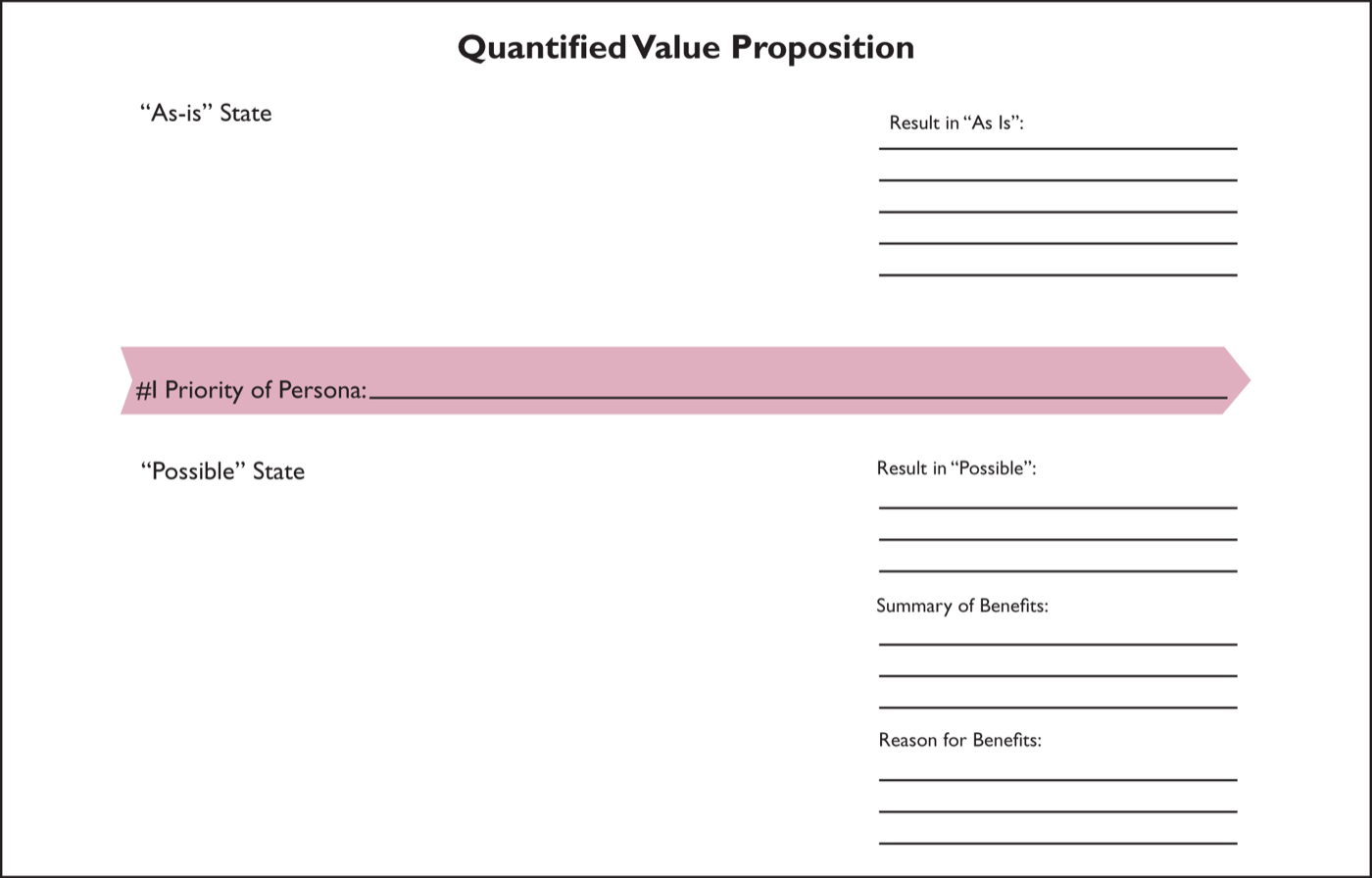
Figure: educational illustration from the Disciplined Entrepreneurship EPUB on quantifying customer value.
Replace “better” with measurable impact: time saved, risk reduced, revenue gained, cost avoided.
SPIN link: Quantified value feeds Implication and Need-payoff (SPIN Selling).
Step 9 — Identify your next 10 customers
Name real organisations or people you can reach. If you cannot list ten, the market may be fictional.
Theme II checklist
- Life-cycle use case mapped end-to-end
- High-level product boundaries written
- Value quantified in customer currency
- Ten named next customers with access path
3. Theme III — How do they acquire your product? (Steps 10–13)
Step 10 — Define your core
Core = capability creating unique, defensible value—protect and deepen; outsource non-core.
Step 11 — Chart your competitive position
Position vs real alternatives (status quo, spreadsheets, agencies, internal build). Pair with Obviously Awesome.
Step 12 — Determine the DMU
Map champion, end user, economic buyer, influencers, saboteurs. Enterprise deals die at the wrong role.
Step 13 — Map the process to acquire a paying customer
Stages from first contact to paid adoption: who, proof required, objections, duration.
Theme III checklist
- Core capability stated in one paragraph
- Competitive map vs real alternatives
- DMU diagram for beachhead deals
- Written acquisition process with stage durations
4. Theme IV — How do you make money? (Steps 14–18)
Step 14 — Design a business model
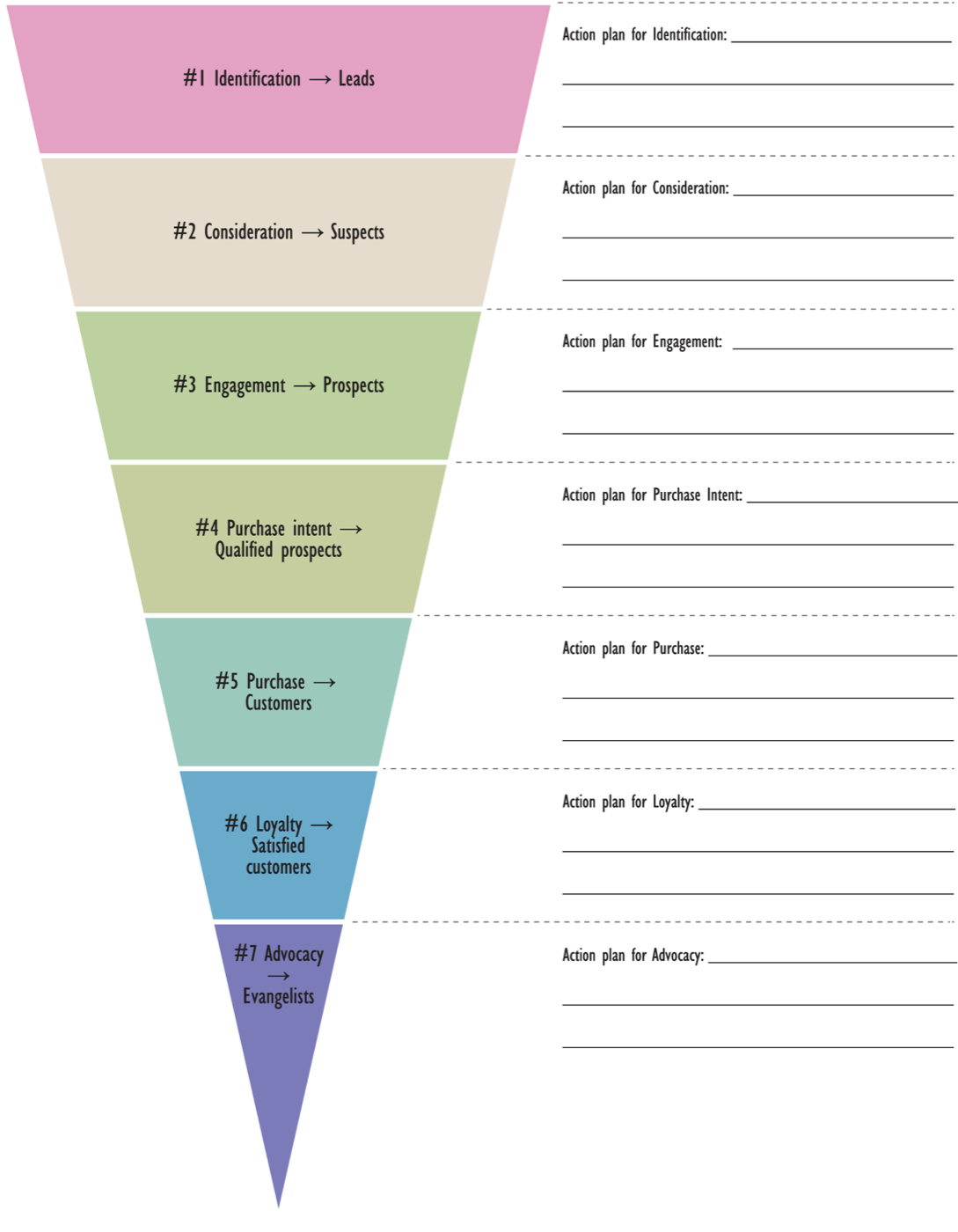
Figure: educational illustration from the Disciplined Entrepreneurship EPUB on business-model design.
Subscription, usage, license, take-rate, hybrid—must fit buying process and DMU incentives.
Step 15 — Set your pricing framework
Price from value and willingness to pay, not cost-plus alone. Document discount rules.
Step 16 — Calculate LTV
Gross margin contribution over expected lifetime (discount if needed). Include churn, expansion, support.
Step 17 — Map the sales process to acquire a customer
Step 13 → repeatable motion with owners, artefacts, conversion rates.
Step 18 — Calculate COCA / CAC
Steady-state acquisition cost—not founder heroics only. Compare to LTV.
| Health signal | Typical interpretation |
|---|---|
| LTV ≫ CAC, short payback | Scale candidate |
| LTV ≈ CAC | Fix value, price or funnel before scale |
| CAC only works with founder selling | Not yet a process |
Theme IV checklist
- Business model chosen and stress-tested
- Pricing framework written
- LTV model with explicit assumptions
- Sales process with conversion metrics
- CAC estimated for steady state; LTV:CAC reviewed
5. Theme V — How do you design and build? (Steps 19–22)
Step 19 — Identify key assumptions
What would kill the venture if false: need intensity, WTP, technical feasibility, regulatory access, channel access.
Step 20 — Test key assumptions
Cheap tests: interviews, concierge, prototypes, LOIs, spikes. Rank by risk × cost to falsify.
Step 21 — Define the MVBP
Minimum Viable Business Product: smallest offer delivering quantified value and a real purchase path—not a feature demo.
Step 22 — Show dogs eat the dog food
Evidence of use and payment or irrevocable commitment. Interest ≠ product–market fit.
Theme V checklist
- Assumption register ranked
- Tests executed with written outcomes
- MVBP scope locked to beachhead value
- Paying or committed users observed
6. Theme VI — How do you scale? (Steps 23–24)
Step 23 — Develop a product plan
Sequence releases for beachhead dominance, then adjacent expansion. Avoid “platform for everyone” before one segment loves you.
Step 24 — Develop a business plan to scale
People, capital, partnerships, geography—tied to unit economics and operational capacity.
Scaling a broken process multiplies waste (The Goal).
Theme VI checklist
- Product roadmap sequenced beachhead → adjacent
- Scale plan gated on LTV:CAC and capacity
- Constraint identified before hiring spree
7. Stage gates for consultants running venture programmes
| Gate | Required artefacts | No-go signals |
|---|---|---|
| Gate A (after Theme I) | Beachhead, persona, TAM | Cannot name 10 targets |
| Gate B (after Theme II) | Quantified value, use case | Value is adjective-only |
| Gate C (after Theme III) | DMU, acquisition map | Single-thread champion |
| Gate D (after Theme IV) | LTV:CAC model | Founder-only sales works |
| Gate E (after Theme V) | MVBP proof | Pilots without payment |
| Gate F (Theme VI) | Scale plan | Scale before Gate D pass |
8. Consulting and AI product application
| Engagement need | Aulet steps |
|---|---|
| GenAI use-case selection | 1–5, 8 |
| Pursuit narrative | 6–9, 11–13 |
| Commercial case | 14–18 |
| Pilot design | 19–22 |
| Scale decision | 23–24 |
8.1 AI venture example (synthetic pattern)
| Step | Example artefact |
|---|---|
| Beachhead | UK mid-market insurers, claims Tier-1 |
| Persona | Claims ops director, 120 FTE team |
| Quantified value | 30% handle-time reduction = £2.4m/year |
| Core | Citation-locked agent assist + eval harness |
| MVBP | One workflow, one LOB, paid pilot |
8.2 Negative cases (expanded)
| Failure | Step broken | Fix |
|---|---|---|
| Beachhead too broad | 2 | Re-segment |
| TAM top-down only | 4 | Bottom-up rebuild |
| Persona is committee | 5 | Primary end user |
| CAC on founder magic | 18 | Steady-state model |
| MVP without purchase | 21–22 | MVBP path |
| Scale before economics | 24 | Gate D |
9. Capstone one-pager (use on every venture)
- Beachhead (one sentence)
- Persona (name + job-to-be-done)
- Quantified value (metric + £/€/$ impact)
- Core (unique capability)
- DMU map (roles)
- Business model + price
- LTV : CAC and payback
- Top three killer assumptions + tests
- MVBP scope
- Next ten customers
If any row is blank, that is your next work block.
10. Integration map
| Book | Aulet connection |
|---|---|
| Obviously Awesome | Step 11 positioning + messaging |
| SPIN Selling | Step 8 value in discovery |
| Disruptive Innovation | Beachhead as disruptive wedge |
| The Goal | Step 24 scale at constraint pace |
| 7 Powers | Core → Power path over time |
11. All 24 steps — detailed artefact table
Use this as the master worksheet. Each row must be completable before advancing themes.
| Step | Name | Key questions | Required artefact | Failure signal |
|---|---|---|---|---|
| 1 | Market segmentation | Which end-user markets exist? | Scored segment list | One generic segment |
| 2 | Beachhead | Where can we dominate first? | Beachhead + rationale | “Global enterprises” |
| 3 | End-user profile | Who uses it day-to-day? | Persona v0 | Demographics only |
| 4 | Beachhead TAM | How big is the beachhead? | Bottom-up TAM sheet | Top-down $B slide |
| 5 | Persona depth | Who is the reference customer? | Named persona + quotes | Team disagrees on user |
| 6 | Life cycle use case | How do they discover→pay→use? | Journey map | Happy path only |
| 7 | Product spec | What are we building conceptually? | Capability doc | UI mockups only |
| 8 | Quantified value | What £/€/$ impact? | Value model | “Efficiency gains” |
| 9 | Next 10 customers | Who can we reach next? | Named list + path | Empty rows |
| 10 | Core | What is uniquely defensible? | Core paragraph | Feature list |
| 11 | Competitive position | vs real alternatives? | Position map | Logo slide only |
| 12 | DMU | Who decides/pays/blocks? | DMU diagram | Single-thread champion |
| 13 | Acquire process | Steps to first payment? | Stage map + days | Unknown duration |
| 14 | Business model | How do we capture value? | Model canvas | Copied SaaS default |
| 15 | Pricing framework | WTP-based price logic? | Price doc + tests | Cost-plus only |
| 16 | LTV | Margin over lifetime? | LTV spreadsheet | Missing churn |
| 17 | Sales process | Repeatable motion? | Funnel + conversion | Founder-only sales |
| 18 | CAC/COCA | Steady-state acquisition cost? | CAC model | Ignores marketing/sales load |
| 19 | Key assumptions | What kills us if false? | Assumption register | Unwritten beliefs |
| 20 | Test assumptions | How do we falsify cheaply? | Experiment log | Build full product first |
| 21 | MVBP | Smallest paid viable product? | MVBP scope doc | Demo ≠ purchase path |
| 22 | Dogs eat dog food | Payment/commitment proof? | LOI/revenue evidence | “Great workshop” |
| 23 | Product plan | Release sequence? | Roadmap by beachhead | Platform for all |
| 24 | Scale plan | People/capital/geo? | Scale plan gated on LTV:CAC | Hire before economics |
12. Theme I — steps 1–5 expanded worksheet
| Step | Workshop prompt (60 min each) | Done when |
|---|---|---|
| 1 | Brainstorm 20 segments; score 4 dimensions | Top 3 segments ranked |
| 2 | Debate beachhead; write one-page rationale | Single beachhead chosen |
| 3 | Draft persona on template | Day-in-the-life complete |
| 4 | Build TAM bottom-up in spreadsheet | Formula auditable |
| 5 | Interview 3 users matching persona | Reference customer quoted |
13. Theme II–III — steps 6–13 expanded worksheet
| Step | Deliverable template | Reviewer |
|---|---|---|
| 6 | Swimlane: discover→renew | Product + sales |
| 7 | Capability/boundary list | Engineering |
| 8 | Value metric tied to customer P&L | Finance sponsor |
| 9 | CRM list of 10 names | Sales lead |
| 10 | “We alone can…” statement | Founder |
| 11 | Alternatives + positioning canvas | Marketing |
| 12 | DMU RACI + politics notes | Pursuit lead |
| 13 | Stage gates with median days | Delivery |
14. Theme IV–VI — steps 14–24 expanded worksheet
| Step | Model inputs | Red flag |
|---|---|---|
| 14 | Revenue streams, packaging | One-size pricing |
| 15 | Value-based price anchors | Race to bottom |
| 16 | ARPA, gross margin, churn, years | LTV < 3× CAC |
| 17 | Stage conversion % | Unknown funnel |
| 18 | Fully loaded CAC | Founder time = £0 fantasy |
| 19 | Top 10 assumptions ranked | Blank register |
| 20 | Test cards with pass/fail | No kill criteria |
| 21 | MVBP feature ≤ beachhead job | Platform scope creep |
| 22 | ≥1 paying beachhead customer | PILOT with no path to PO |
| 23 | Adjacency sequence documented | Random feature roadmap |
| 24 | Scale only after Gate D pass | Headcount before PMF |
15. AI venture walkthrough (synthetic)
| Step | Example completion |
|---|---|
| 2 Beachhead | UK mid-market insurers — claims Tier-1 |
| 5 Persona | Ops director, 120 FTE, SLA pressure |
| 8 Value | £2.4m/year handle-time savings |
| 12 DMU | Champion: ops; EB: CFO; Blocker: CISO |
| 18 CAC | £45k steady-state vs £180k LTV |
| 21 MVBP | One workflow, one LOB, eval gates |
| 22 Proof | 2 paid pilots, 1 LOI for expand |
16. Consulting programme — map steps to SOW phases
| SOW phase | Aulet steps | Client deliverable |
|---|---|---|
| Discovery | 1–5, 12 | Beachhead + persona memo |
| Design | 6–9, 11 | Value case + journey |
| Commercial | 14–18 | Pricing + business case |
| Build | 19–22 | MVBP pilot |
| Scale decision | 23–24 | Roadmap + operating plan |
17. LTV/CAC worksheet (field definitions)
| Field | Definition | Typical source |
|---|---|---|
| ARPA | Average revenue per account/year | Pricing × usage |
| Gross margin % | After COGS to serve | Finance model |
| Churn % | Logo or revenue churn | Cohort data |
| Lifetime years | 1/churn or contract length | Assumption |
| LTV | ARPA × margin × years | Calculated |
| Sales + marketing $ | Fully loaded per won deal | Steady-state ops |
| CAC | S+M / new customers | Calculated |
| LTV:CAC | Ratio | Target >3× often cited; validate for your model |
| Payback months | CAC / monthly gross profit | Cash planning |
Negative case: LTV using fantasy zero churn—model honestly or flag uncertainty.
18. Assumption test menu (Step 20)
| Assumption type | Cheap test |
|---|---|
| Need intensity | Problem interviews + LOI ask |
| Willingness to pay | Pricing conversation with anchor |
| Technical feasibility | Spike / prototype in 2 weeks |
| Channel access | 10 outbound attempts |
| Regulatory | Counsel memo + pre-read with regulator style |
Kill or pivot when kill criterion met—document decision.
19. Step completion certificate (gate sign-off)
Before Theme VI scale, leadership signs:
- Steps 1–18 complete with artefacts on file
- Steps 19–20: top assumptions tested
- Steps 21–22: MVBP + payment proof
- LTV:CAC and payback acceptable at steady-state CAC
- Constraint check (The Goal) for delivery scale
Discussion
Comments
Share feedback or questions about this page. No account required.
Loading comments…