Difficult Conversations: The Three Conversations Framework — A Complete Practitioner Guide
Most “hard talks” fail because people argue inside the wrong conversation. Stone, Patton and Heen’s Difficult Conversations (third edition) shows that every tough exchange is actually three conversations at once: What Happened?, Feelings, and Identity. Shift from a battle stance to a learning stance, begin from the third story, and jointly map contribution—not blame. This guide walks the full book structure for practitioners in consulting, leadership and complex delivery.
Source note: This article is an original practitioner synthesis of themes from Douglas Stone, Bruce Patton and Sheila Heen’s Difficult Conversations (third edition, Penguin Books). It is not a reprint. Buy the original for full case stories, workplace adaptations, the “Ten Questions People Ask” appendix and the Harvard Negotiation Project lineage. Patton co-authored both this work and Getting to Yes—the books are designed to stack.
0. Introduction — what counts as difficult, and why we avoid them
0.1 A difficult conversation is anything you find hard to talk about
The book’s definition is deliberately personal: difficult means you find it hard—not a universal catalogue of “serious topics.” Asking for a raise. Ending a relationship. Giving critical performance feedback. Saying no to someone in need. Confronting disrespect. Disagreeing with the majority. Apologising. At work, at home and across organisational boundaries, these talks are attempted or avoided every day.
For consultants and leaders, the list expands:
| Situation | Why it feels difficult |
|---|---|
| Telling a sponsor the programme is off track | Threatens competence and commercial relationship |
| Challenging a senior SME in front of the team | Threatens authority and identity |
| Naming passive-aggressive behaviour on a blended team | Threatens harmony and future collaboration |
| Admitting you contributed to a failed go-live | Threatens goodness and professional self-image |
| Pushing back on scope creep from a powerful client | Threatens worthiness and career safety |
The common thread is not the topic—it is the emotional load and the risk that the conversation will go badly.
0.2 Why we avoid them (and what avoidance costs)
We avoid difficult conversations because we predict pain:
- They might get angry — and we will not know what to do.
- We might make it worse — so silence feels safer.
- It might damage the relationship — and we need that relationship tomorrow.
- We might discover we are wrong — and identity cannot tolerate that yet.
- We might not get what we want — so why open the door?
Avoidance has a short-term reward and a long-term tax. Unsaid issues compound: resentment leaks into tone, decisions get made in hallway conversations, and the eventual explosion is harder than the conversation you skipped three weeks ago. In delivery programmes, avoidance shows up as “green status / red reality,” surprise escalations and partners who stop returning calls.
0.3 Battle stance vs learning stance
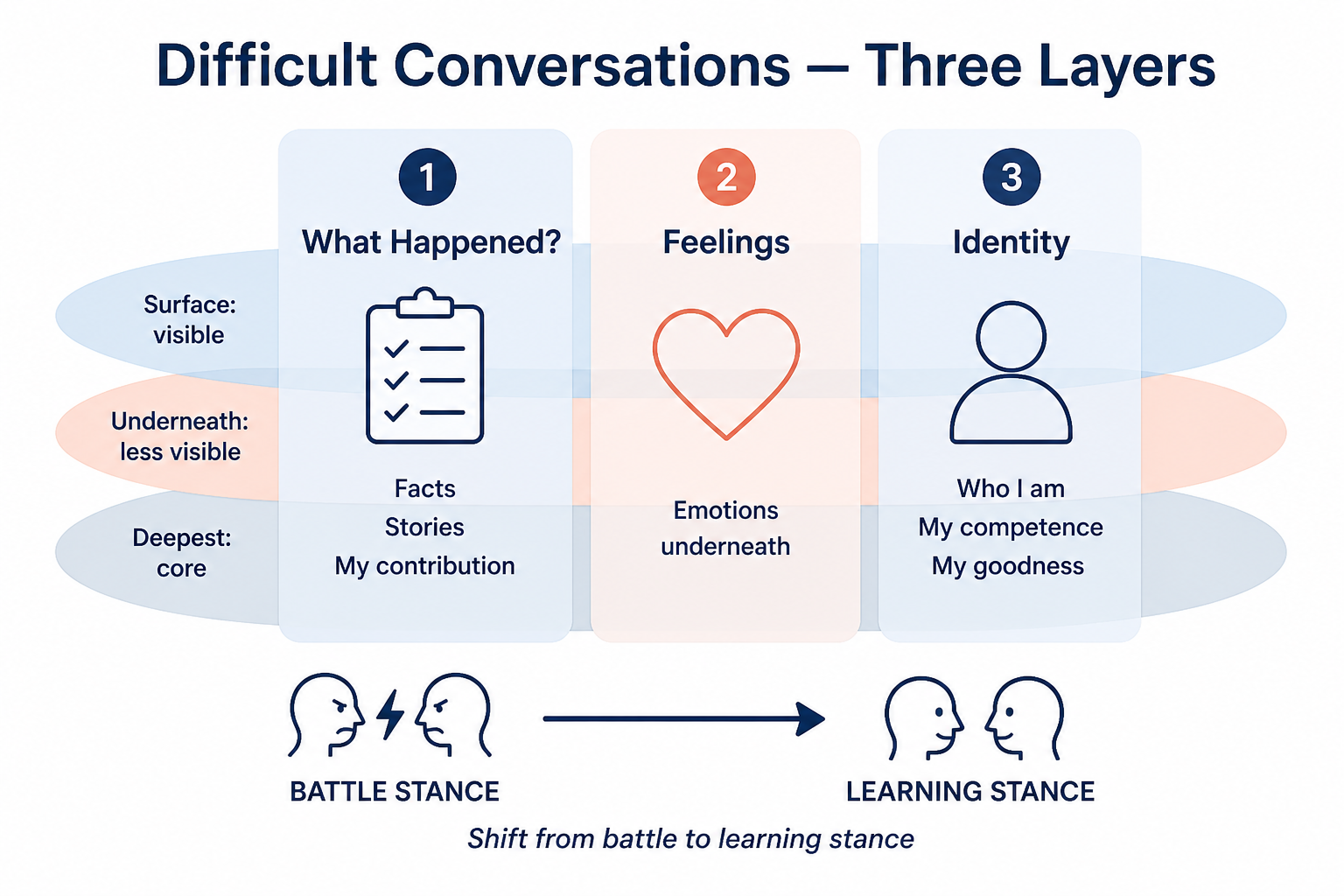
Figure: What Happened / Feelings / Identity—shift from battle to learning.
| Battle stance | Learning stance |
|---|---|
| Deliver a message | Explore each other’s stories |
| Prove I am right | Understand how we each make sense |
| Assign blame | Map joint contribution |
| Control or suppress emotions | Acknowledge and work with feelings |
| Protect a fragile identity | Accept that I am complex (and so are they) |
| Win the argument | Learn enough to decide well together |
The battle stance feels powerful in the first five minutes. The learning stance produces better decisions, fewer repeats and relationships that survive the talk.
0.4 This book’s promise (third edition)
The third edition retains the core Harvard Negotiation Project method and adds workplace adaptations, remote-media guidance and refreshed examples. The authors—Stone, Patton and Heen—have taught this material to executives, mediators, diplomats and couples for decades. Their claim is modest and testable: structure beats charisma. If you can sort the three conversations, you can prepare for talks that currently feel impossible.
0.5 Where this guide sits in your stack
| Book | Layer |
|---|---|
| Getting to Yes | Interests, options, criteria, BATNA |
| Difficult Conversations | Stories, feelings, identity, contribution |
| Negotiation Genius | Biases, claiming/creating value, investigative negotiation |
| Never Split the Difference | Tactical empathy, labels, calibrated questions under stress |
| The Culture Map | How directness, emotion and hierarchy vary by culture |
Use Difficult Conversations when the relationship and meaning layer is as important as the substance—often before or alongside formal negotiation.
1. Sort out the three conversations
Every difficult conversation contains three strands. Most people argue in one while the other two run silently—and derail the talk.
1.1 The “What Happened?” conversation
This is the story each person tells about events: who said what, who did what, who is to blame, who should apologise, who had the right facts. It feels like a debate about truth. It is usually a debate about different stories built from different data.
Questions in this layer:
- What happened? (events)
- Who is right?
- Who is to blame?
- Who should change?
1.2 The Feelings conversation
Every difficult conversation also has an emotional footprint—often unspoken. Anger, hurt, embarrassment, fear, betrayal, disappointment. When feelings are ignored, they do not disappear; they drive the What Happened conversation (sarcasm, rigidity, sudden escalation).
Questions in this layer:
- What am I feeling? What are they feeling?
- Are these feelings valid? Should I express them?
- What if they dismiss my feelings?
1.3 The Identity conversation
Underneath both strands, something is at stake about who we are:
| Identity axis | Internal question |
|---|---|
| Competence | “Am I capable? Did I fail?” |
| Goodness | “Am I a good person? Am I unfair or cruel?” |
| Worthiness | “Am I deserving of respect, love, belonging?” |
When identity feels all-or-nothing, feedback becomes unbearable and we either attack or collapse.
1.4 Jack and Michael — a brief illustration (prospectus pattern)
The book opens with Jack and Michael—a designer and a client/friend—trapped in a recurring fight about a rushed prospectus job. Jack’s story: Michael called late, demanded impossible turnaround, then criticised the work. Michael’s story: he has helped Jack repeatedly; Jack argues instead of assuming the client is right; trust is eroding.
Decode the three layers:
| Layer | Jack | Michael |
|---|---|---|
| What Happened | “Unreasonable deadline; unfair criticism” | “I help him; he doesn’t deliver; he argues with me” |
| Feelings | Resentment, unappreciated | Frustration, let down |
| Identity | “Am I a competent professional?” | “Am I a good friend / reasonable client?” |
Neither needs a long quote to recognise the pattern: same history, different stories, unspoken feelings, threatened identity. Months later they are still awkward because they never repaired the conversation—only the document.
1.5 Moving toward a learning conversation
Sorting is not a paperwork exercise. It tells you what to stop doing:
- Stop trying to win the What Happened debate while feelings are flooding.
- Stop treating emotions as irrational noise.
- Stop pretending identity is not in the room.
Once sorted, you can choose a learning purpose (Section 7) and a structured arc (Sections 8–12).
2. Stop arguing about who’s right — explore each other’s stories
2.1 Why we argue, and why it doesn’t help
Arguing about who is right feels necessary because each of us experiences our story as reality. We have the facts. We were there. We know what we intended.
The problem: the other person also has facts, was also there, and knows what they intended. Arguing “truth” as if only one story fits the data escalates conflict and closes learning.
| Arguing move | Hidden effect |
|---|---|
| “That’s not what happened” | They hear: my experience is invalid |
| “You always / you never” | Global labels trigger identity threat |
| “Let me prove it” | Debate replaces understanding |
| “The data is clear” | You collapse observations with conclusions |
2.2 Where our stories come from — the ladder
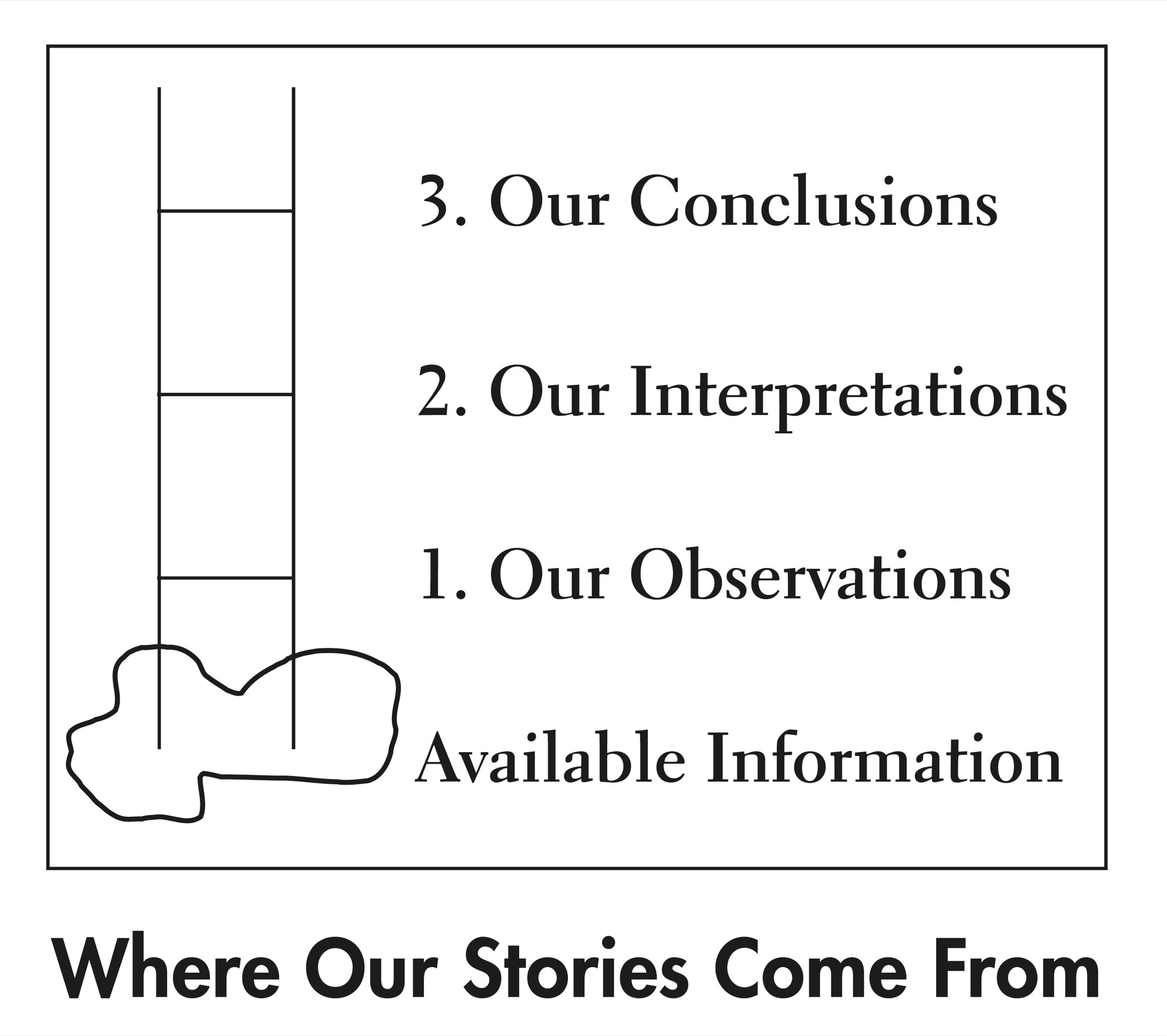
Figure: Where Our Stories Come From ladder — available information → observations → interpretations → conclusions. Different people climb different ladders from the same pool of data.
We climb a mental ladder:
- Available information — what we noticed, what we were told, what we did not see.
- Observations — selected facts from that pool.
- Interpretations — meaning we assign (“they don’t respect me”).
- Conclusions — judgments and decisions (“I can’t trust them”).
Two people on the same project can share a pool of information and climb different ladders because they noticed different details, hold different past experiences and protect different identity stakes.
Consulting example: A client says the SI “doesn’t care about quality.” The SI says the client “changes requirements daily.” Shared pool: missed dates, defect counts, tense stand-ups. Different observations (who missed which gate). Different interpretations (malice vs chaos). Different conclusions (replace the partner vs escalate to exec).
2.3 Move from certainty to curiosity
Certainty closes learning; curiosity opens it.
| Certainty stance | Curiosity stance |
|---|---|
| “I know why they did that” | “I wonder what led them to that choice” |
| “They’re wrong” | “Help me see what I’m missing” |
| “Case closed” | “What else could be true?” |
Curiosity is not weakness. It is epistemic discipline—especially for leaders who must decide under incomplete information.
2.4 Embrace both stories — adopt the “And Stance”
The And Stance holds two truths at once:
- “I felt blindsided by the change request and I can see you were reacting to regulator pressure.”
- “I believe we missed the gate and I accept that ownership was unclear on both sides.”
- “I’m angry about the tone in that meeting and I know you were exhausted from the go-live.”
“But” erases the first clause. “And” keeps both stories in play long enough to learn.
2.5 Two exceptions that aren’t
Practitioners sometimes ask: “Surely sometimes one person is just wrong?” Stone, Patton and Heen acknowledge:
- Facts exist — but our access to facts differs, and we still attach different meanings to shared facts.
- Some behaviour is unacceptable — exploring story does not mean tolerating abuse; it means understanding and setting boundaries (Sections 3, 11, 13).
Exploring stories is not moral relativism. It is how adults update maps before changing territory.
2.6 To move forward, first understand where you are
Before problem-solving, locate yourself:
| Question | Purpose |
|---|---|
| What is my story (data → interpretations → conclusions)? | Own your ladder |
| What is their likely story? | Hypothesis, not verdict |
| Where do stories overlap? Where do they diverge? | Find shared ground |
| What do I genuinely not know? | Design inquiry |
Pair this with Negotiation Genius investigative negotiation: treat their story as data worth fetching before you claim value or assign fault.
3. Don’t assume they meant it — disentangle intent from impact
3.1 The battle over intentions
Intentions dominate our moral judgments. If they meant to hurt us, we judge harshly. If harm was accidental, we soften—sometimes too much.
In difficult conversations, intent becomes a battlefield:
- “You undermined me in the steering committee.” (impact + assumed intent)
- “I was trying to help.” (good intent, impact ignored)
Both sides feel righteous. Both feel unheard.
3.2 Two key mistakes
Mistake 1 — We assume intent from impact
We experience something painful → we infer they intended that pain. Mind-reading replaces inquiry.
| Impact observed | Intent assumed (often wrongly) |
|---|---|
| Not copied on an email | “They wanted to exclude me” |
| Short reply in chat | “They disrespect me” |
| Changed decision without consultation | “They’re power-playing” |
Mistake 2 — We ignore the impact of good intent
We judge ourselves by intent (“I meant well”) and dismiss legitimate impact on others (“They’re too sensitive”). Good intentions do not erase harm—and repeating harm with good intentions erodes trust.
3.3 Avoiding the two mistakes — disentanglement moves
Step 1 — Separate impact from intent in your own head
- Impact: what happened to me (observable).
- Assumed intent: what I think they meant (hypothesis).
Step 2 — Describe impact without mind-reading
Weak: “You tried to humiliate me in front of the client.”
Stronger: “When my estimate was challenged in front of the client, I felt publicly undermined.”
Step 3 — Ask about intent; share assumptions as hypotheses
“I’ve been telling myself you wanted to make me look unprepared. Is that what was going on for you?”
Step 4 — Hold accountability for impact and patterns
Even with good intent, repeated negative impact requires change. “I believe you meant to help and we need a different approach in exec forums.”
3.4 Consulting field patterns
| Scenario | Intent/impact trap | Disentangled move |
|---|---|---|
| Partner reassigns your lead without notice | “They’re sidelining me” | “Impact: I lost visibility; Intent: ask; Problem-solve: succession protocol” |
| Client exec skips your section in the deck review | “They don’t value our work” | “Impact: team demoralised; Intent: ask; Data: time pressure vs preference” |
| Offshore lead pushes back on stories | “They’re not committed” | “Impact: delay; Intent: ask; System: timezone + definition of done” |
When emotions run hot in live calls, pair disentanglement with Voss-style labels (Never Split the Difference): “It sounds like this landed as a trust issue, not just a schedule issue.”
4. Abandon blame — map the contribution system
4.1 In our story, blame seems clear
Blame is seductive because it is simple: identify the villain, assign fault, punish or extract apology. Our brains prefer single-cause explanations for painful events.
The book’s ad-agency pitch story illustrates the trap: wrong slide version, shaky presentation, potentially lost client. The assistant “obviously” failed. Dig deeper and the system appears: versioning chaos, no dry-run rule, unclear handoffs, leader who never wanted rehearsal feedback.
4.2 We’re caught in blame’s web
Blame conversations loop:
- Person A accuses Person B.
- Person B defends or counter-accuses.
- Identity threat spikes.
- Everyone spends energy protecting self-image instead of fixing the system.
In programmes, blame web language is familiar: “Vendor dropped the ball.” “Business never decided.” “Architecture was ivory tower.” Each statement may contain truth and still be useless for prevention.
4.3 Distinguish blame from contribution
| Blame frame | Contribution frame |
|---|---|
| Backward-looking | Forward-looking |
| “Whose fault?” | “How did we get here?” |
| Seeks punishment | Seeks change |
| Single villain | Multiple actors + system |
| Closes learning | Opens learning |
Contribution asks: what did each person and the system do that helped create this outcome? Contribution is not equal guilt—it is joint causality.
4.4 The costs of the blame frame
- Defensiveness — people hide information you need for root cause.
- Repeat incidents — system flaws stay untouched.
- Relationship damage — winners and losers in a team that must collaborate tomorrow.
- Slow decisions — energy spent on adjudication instead of design.
4.5 The benefits of understanding contribution
- Shared picture of how we got here.
- Actionable levers for each party.
- Identity relief: “I contributed and I can help fix it.”
- Better steering narratives: honest without scapegoating.
4.6 Three misconceptions about contribution
Misconception 1 — “Contribution means no accountability”
False. You can map contribution and decide someone must change role, process or behaviour.
Misconception 2 — “If I admit contribution, I lose in politics”
Strategic silence sometimes wins battles and loses wars. Selective contribution (“Here’s what I could have done differently”) often increases credibility.
Misconception 3 — “They must admit first”
Waiting for the other side to go first freezes progress. Lead with your slice of contribution when you want learning.
4.7 Two tools for spotting contribution
Tool 1 — The “how did we get here?” timeline
Plot decisions, handoffs, incentives, assumptions, near-misses ignored. Include:
- What each person did / did not do
- What the system rewarded or punished
- What information was missing or siloed
Tool 2 — Role reversal
Ask: “If I were in their role with their constraints, what might I have done similarly?” Not to excise accountability—to see the full graph.
4.8 Moving from blame to contribution — language shifts
| Blame language | Contribution language |
|---|---|
| “You screwed up the cutover” | “Our cutover checklist didn’t catch X; I didn’t escalate Y early enough” |
| “They never engage” | “We haven’t created a forum where engagement is safe and rewarded” |
| “Architecture blocked us” | “We didn’t align decision rights before build started” |
Invisible contributors to include: incentives, unclear ownership, tooling debt, workload, prior silence, ambiguous RACI, mixed messages from leadership.
5. Have your feelings (or they will have you)
5.1 We try to frame feelings out of the problem
Professional culture often treats feelings as noise: “Let’s be rational.” “Emotions aren’t productive.” The book’s image: a child with a baseball bat and a shattered vase answering “Nothing” when asked what happened. Denial does not restore the vase.
Unexpressed feelings leak as:
- Sarcastic compliance
- Withdrawal and slow responses
- Stubborn re-litigation of old facts
- Sudden explosions in unrelated meetings
5.2 Sometimes feelings are best left out
Not every feeling belongs in every conversation. The method is not “total emotional disclosure.” It is conscious choice:
| Include now | Defer or process elsewhere |
|---|---|
| Feelings blocking listening | Raw rage you cannot yet describe cleanly |
| Feelings central to the issue | Feelings better handled with a coach or friend |
| Feelings they need to understand impact | Feelings that would purely punish |
5.3 A way out of the feelings bind
Negotiate with yourself first:
- What am I feeling? (Name more than anger.)
- Why now?
- What happens if I don’t express this?
- What happens if I express this poorly?
- What would skillful expression look like?
5.4 Learn where feelings hide
Feelings often masquerade as:
| Mask | Possible feeling underneath |
|---|---|
| “I’m fine” | Hurt, fear |
| “It’s just business” | Betrayal, disappointment |
| “They’re incompetent” | Fear of failure, shame |
| “Whatever, do what you want” | Powerlessness, resentment |
Anger is frequently a secondary emotion—easier to show than hurt or fear.
5.5 Don’t vent — describe feelings clearly
Venting dumps emotion without structure and triggers defensiveness. Description connects feeling to meaning:
Weak vent: “You always make me furious!”
Clear description: “When the decision changed without telling me, I felt angry and embarrassed—like my role didn’t matter.”
Guidelines:
- Use “I feel …” not “You make me …”
- Be specific about the trigger behaviour
- One feeling at a time when possible
- Avoid global character labels
5.6 The importance of acknowledgment
On the listening side, acknowledgment is not agreement. It is proof you heard:
- “I can see why you’d feel blindsided.”
- “It makes sense that you’re frustrated given the deadline shift.”
- “I hear that you felt alone carrying that risk.”
Skipping acknowledgment sends people back to amplification loops. Pair with Business Communication active-listening drills.
5.7 Sometimes feelings are all that matter
Some conversations are not about facts—they are about relationship repair. A sponsor who feels disrespected may not care about your Gantt chart until the feeling is named and acknowledged. Decide whether this is a facts conversation, a feelings conversation, or both (Section 7).
6. Ground your identity — ask yourself what’s at stake
6.1 Difficult conversations threaten our identity
Intellectually, Ben knows he can leave his job without needing references. Emotionally, telling his boss terrifies him. Identity—not economics—drives the fear.
Difficult conversations implicate:
- Am I competent?
- Am I a good person?
- Am I worthy of respect and belonging?
When these feel on the line, we attack, avoid, cry, or over-apologise—anything to restore identity equilibrium.
6.2 Vulnerable identities — the all-or-nothing syndrome
All-or-nothing identity turns feedback into catastrophe:
| All-or-nothing thought | Grounded alternative |
|---|---|
| “One mistake = I’m a fraud” | “I’m skilled in X and still learning Y” |
| “If they’re upset, I’m cruel” | “I can act with good intent and still cause impact” |
| “If I lose this deal, I’m worthless” | “My worth is not identical to this outcome” |
Consulting amplifies competence identity threat because expertise is the product.
6.3 Ground your identity — practices
- Accept complexity — you are not only your last mistake or triumph.
- Prepare identity triggers — before the meeting, write: “What might I hear that will sting? What will I tell myself instead?”
- Separate behaviour from global self — “That decision was weak” ≠ “I am weak.”
- Remember past resilience — you have recovered before.
- Let go of controlling their view — you cannot fully manage their story of you.
6.4 Their identity is also implicated
When you deliver hard feedback, their competence/goodness/worthiness may feel attacked. Expect defensiveness—not as proof they are hopeless, but as identity protection.
Moves:
- Describe behaviour and impact, not character.
- Acknowledge their strengths where genuine.
- Invite their story before concluding.
- Offer a path to restore identity (“Here’s how we recover together”).
6.5 Raising identity issues explicitly
When identity is the elephant:
- “I want to be direct and I also want you to know I respect what you’ve built here.”
- “I’m worried this will land as a judgment on your leadership—it’s about the process, not your worth.”
Explicit naming reduces guessing games.
6.6 Find the courage to ask for help
Identity-threatened leaders often isolate. Asking a peer, coach or mentor to rehearse the third-story opening is not weakness—it is preparation (Section 14 capstone).
7. What’s your purpose? When to raise it and when to let go
7.1 You can’t have every difficult conversation
Life and programme bandwidth are finite. Not every irritation deserves a summit. The art is selection.
7.2 To raise or not to raise — how to decide?
Ask:
| Filter question | If “no” repeatedly … |
|---|---|
| Does this pattern affect work or relationship materially? | Consider letting go |
| Am I willing to work toward learning, not just venting? | Delay until you are |
| Is there a realistic path to change? | Adjust purpose or audience |
| Is timing survivable for both sides? | Schedule, don’t ambush |
| Am I the right person to raise it? | Involve sponsor, HR, or peer |
7.3 Three kinds of conversations that don’t make sense
- Pure venting without change goal — call a friend instead.
- Repeated conversation with no new information or leverage — changes strategy, not volume.
- Conversation whose only purpose is to prove superiority — battle stance; expect damage.
7.4 Letting go
Letting go is not “I was wrong to care.” It is “I choose not to invest more here.” Practices:
- Write the unsent email; extract lessons; delete.
- Shift from changing them to changing your boundaries or role.
- Use Getting to Yes BATNA thinking: if the relationship cannot improve, what is your best alternative?
7.5 If you raise it — three purposes that work
- Learning — understand stories, feelings, contribution.
- Relationship — repair trust, reset expectations.
- Problem-solving — agree on actions, standards, follow-up.
State purpose internally before opening. If you cannot name one of these, pause.
8. Getting started — begin from the third story
8.1 Why our typical openings don’t help
Typical openings launch your first story as if it were obvious truth:
- “We need to talk about your attitude.”
- “You screwed up the release.”
- “I’m tired of carrying this programme alone.”
They trigger defensiveness in seconds because identity and blame alarms fire immediately.
8.2 Step one — begin from the third story
The third story is how a neutral, fair observer would describe the difference between your stories—without picking a winner.
| First story (you) | Second story (them) | Third story |
|---|---|---|
| “They are careless about quality.” | “You are micromanaging.” | “We seem to have different standards and unclear ownership on quality gates.” |
| “They politicised the decision.” | “You didn’t consult stakeholders.” | “We have different views on who needed to be in the decision and when.” |
| “They’re not committed.” | “You keep moving the goalposts.” | “We’re misaligned on priorities and what ‘done’ means this sprint.” |
Third-story openings describe patterns and differences, not verdicts.
Templates:
- “I think we see X differently, and I’d like to understand your view.”
- “Something feels off in how we’re working together on Y—can we talk it through?”
- “I have an impact I want to share, and I’m also curious about your experience.”
8.3 Step two — extend an invitation
Invite joint exploration:
- “Would you be open to a conversation about this?”
- “I’d like about twenty minutes—does now work or should we schedule?”
Invitation signals learning stance and reduces ambush trauma.
8.4 Some specific kinds of conversations
| Type | Third-story angle |
|---|---|
| Feedback | Difference between your experience of their behaviour and their likely intent |
| Disappointment | Gap between expectations and what happened—both sides’ |
| Request | Shared problem you want to solve together |
| Apology | Impact acknowledged without drowning in self-flagellation |
| Boundary | Pattern that isn’t working for you—not their character |
9. Learning — listen from the inside out

Figure: putting the pieces together into a learning conversation.
9.1 Listening transforms the conversation
Most people listen to reload—planning rebuttal while the other speaks. Inside-out listening listens to learn their story, feelings and identity stakes.
The uncle-and-child phone call vignette in the book is trivial and familiar: Andrew wants to go outside; Doug is on the phone; both repeat louder. Neither inquires. Neither paraphrases. Neither acknowledges. Replace either skill and the loop breaks.
9.2 Inquire to learn
Inquiry is genuine curiosity, not cross-examination.
| Cross-exam | Inquiry |
|---|---|
| “Why did you do that?” (accusatory tone) | “What was going on for you when that decision got made?” |
| “Isn’t it true that…?” | “How did you see it at the time?” |
| Leading questions | Open questions that expand the story |
Stop when you can paraphrase their view accurately and they say “yes, that’s it.”
9.3 Paraphrase for clarity
Paraphrase content and emotion:
- “So from your side, the deadline felt non-negotiable because investors were waiting, and you felt you had no backup—did I get that?”
- “It sounds like my pushback in the meeting felt like disloyalty, not technical concern.”
Paraphrase until they feel understood—not until you feel vindicated.
9.4 Acknowledge their feelings
Acknowledgment phrases:
- “That must have been frustrating.”
- “I can see why you’d feel unappreciated.”
- “Given what you knew then, your reaction makes sense.”
If you skip feelings, they will return to facts louder.
9.5 Deciding to listen — or not
Listening is not infinite patience for abuse. You may decide:
- “I’m willing to listen after we agree on basic respect.”
- “I need a break; let’s continue tomorrow.”
- “This needs a facilitator or manager present.”
Listening is a choice, not a surrender.
10. Expression — speak for yourself with clarity and power
10.1 Orators need not apply
Expression is not performance. You do not need eloquence—you need clarity and ownership.
10.2 You’re entitled (yes, you)
Your story matters too. Learning stance is not self-erasure. After inquiry, share:
- Your observations (not absolutes)
- Your interpretations (labelled as yours)
- Your feelings
- Your identity stakes (when helpful)
- Your requests
10.3 Speak the heart of the matter
Do not bury the lead in context dumps. Say what is most important:
- “The heart of it for me is trust on escalation—I don’t feel safe raising risks early.”
10.4 Telling your story with clarity — three guidelines
-
Don’t present your conclusions as the only possible reading of facts.
Weak: “You clearly don’t care about quality.”
Strong: “When defects returned twice, I concluded quality wasn’t a shared priority—I want to test that.” -
Share the impact on you.
“I felt exposed in front of the client when the slide didn’t match the narrative.” -
Avoid character attacks.
Behaviour + impact, not global labels.
10.5 Help them understand you
Invite correction:
- “What part of that doesn’t fit your experience?”
- “Is there something I’m not seeing?”
Expression completes the loop opened by listening.
11. Problem-solving — take the lead
11.1 Don’t count on them having read the book
You may listen beautifully while they blame. Take the lead in reframing—without condescension.
11.2 Skills for leading the conversation
| They do | You lead with |
|---|---|
| Argue who’s right | “Can we share how each of us saw it?” |
| Blame | “How did we each contribute to this?” |
| Deny feelings | “Feelings seem strong here—can we name them?” |
| Jump to solutions | “Before we fix, are we aligned on what happened and why it matters?” |
11.3 Reframe, reframe, reframe
Reframing translates battle language into learning language in real time. It is exhausting—and high leverage.
11.4 It’s always the right time to listen
Even while leading problem-solving, return to inquiry when temperature rises. Getting to Yes separates people from the problem; Difficult Conversations shows how on the ground.
11.5 Name the dynamic — make the trouble explicit
When stuck:
- “We’re both repeating our positions—can we step back?”
- “I notice we’re arguing intent; can we separate impact first?”
- “It feels like identity is getting hit—can we slow down?”
11.6 Now what? Begin to problem-solve
After sufficient understanding:
- Reframe to interests and contribution — what each person needs; what each will change.
- Invent options — brainstorm before evaluate (Getting to Yes).
- Agree standards — objective criteria where possible; tests for ambiguous areas.
- Document next steps — owners, dates, check-in.
- Schedule follow-up — difficult conversations rarely finish in one sitting.
11.7 It takes time
Problem-solving under identity threat is slow. A 15-minute “quick chat” fantasy often creates a second difficult conversation. Plan time and medium accordingly.
12. Putting it all together — full conversation arc
Jack returns to Michael months after the prospectus incident—friendship strained, business awkward. A full arc might look like:
Step 1 — Clarify purpose
Learning + relationship repair (not re-litigating every past job).
Step 2 — Third-story opening
“I think we’ve been stuck since the prospectus rush—we see what happened differently, and I’d like to understand your experience and share mine.”
Step 3 — Listen (inside out)
Inquire into Michael’s story; paraphrase; acknowledge frustration and disappointment.
Step 4 — Express with clarity
Jack shares impact (felt unappreciated, argued with in front of pressure), his interpretations, his regret where real.
Step 5 — Map contribution
Late call + unclear specs + no pushback protocol + friendship blur + stress on both sides.
Step 6 — Problem-solve
Agreements: lead times, when to say no, how to flag quality concerns early, separate “friend” vs “client” hats when needed.
Step 7 — Follow up
Check in after the next engagement—one conversation rarely resets years of pattern.
Arc template for practitioners
| Phase | Time share (guide) | Success signal |
|---|---|---|
| Opening + invitation | 5–10% | They stay in the room |
| Their story | 30–40% | They say “you understand” |
| Your story | 20–30% | They don’t feel ambushed |
| Contribution map | 10–20% | Forward-looking language |
| Problem-solving | 20–30% | Named actions + date |
Adjust for power dynamics and culture (The Culture Map).
13. Ten questions people ask — expanded practitioner answers
The book’s appendix addresses predictable objections. Below are expanded field answers for consulting and leadership.
13.1 Isn’t some stuff just true? Aren’t some things relative?
Short answer: Facts matter; stories about facts still differ—test both.
Expanded: Gravity doesn’t care about your story; most organisational conflicts are not gravity. Two people can agree on emails sent and still disagree on meaning, priority and blame. “Relative” does not mean “anything goes.” It means humility about your ladder before you impose conclusions. Where facts are disputed, agree on how to verify (logs, timelines, witnesses). Where facts are shared, shift to impact, contribution and next steps.
13.2 What if the other person really does have bad intentions?
Short answer: Still start with impact + evidence; protect yourself; escalate patterns.
Expanded: Some people bully, lie or manipulate. Exploring story is not handing them a weapon. Sequence matters: describe impact, request change, set boundaries, involve third parties, document. If bad intent is confirmed by pattern, shift from learning to protection and decision: HR, legal, exit, re-contracting. Negotiation Genius covers lies and ethics; Difficult Conversations keeps the human door open until evidence closes it.
13.3 What if they’re genuinely difficult — personality, trauma, volatility?
Short answer: Boundaries, process, witnesses; don’t convert method into revenge.
Expanded: Not everyone will co-create a learning conversation. Your job is to control your side: shorter meetings, written summaries, clear agendas, escalation paths, emotional regulation (see Voss). Avoid amateur diagnosis. Ask: “Is this a skill gap, a incentives gap, or a fit gap?” Fit gaps may not be fixable with dialogue alone.
13.4 What if there’s a power imbalance?
Short answer: Purpose clarity; allies; document; improve BATNA; choose timing.
Expanded: Junior to boss, vendor to client, offshore to onshore lead—power shapes who can speak safely. Tactics: rehearse third-story opening; bring data not drama; align with sponsors; use “we” problem-solving; know your walk-away (Getting to Yes BATNA). Sometimes the learning conversation must include a power-holder as facilitator.
13.5 I’m the boss / parent — can’t I just tell them?
Short answer: You can decide—and still learn faster with contribution mapping.
Expanded: Authority lets you end debate. It does not let you end consequences—quiet quitting, sabotage, compliance without commitment. Even directives land better when people feel heard first. “I’ve decided X; I want to explain why and hear what this means for you” preserves dignity.
13.6 Isn’t this too American / direct / soft for our culture?
Short answer: Adapt expression to culture; keep learning purpose.
Expanded: The Culture Map scales—direct vs indirect feedback, emotional expressiveness, hierarchical deference—change how you speak, not whether understanding matters. High-context cultures may require more private settings, more relational preamble, more third-party facilitation. The three conversations still run underneath; they are just voiced differently.
13.7 What about email, chat and remote media?
Short answer: Higher misunderstanding risk; move identity-heavy topics to richer media.
Expanded: Text strips tone and multiplies intent/impact errors. Use async for scheduling and factual summaries; use voice/video for identity-heavy or feelings-heavy talks. After live conversation, confirm agreements in writing. Remote work increased “difficult conversations by Slack”—budget the upgrade to phone or camera.
13.8 Should feelings be part of work conversations?
Short answer: Feelings already are at work—unacknowledged ones manage you.
Expanded: Professionalism is not emotional nullity. The standard is appropriate expression: describe feelings tied to work impact; avoid venting at scale; choose forum. Teams that never acknowledge feelings get unpredictable escalation—especially before go-lives and exec readouts.
13.9 Who has time for this?
Short answer: Unfinished difficult conversations consume more time later.
Expanded: A 40-minute learning conversation prevents weeks of rework, politics and re-meetings. If you truly have no time, you are choosing delayed pain. Minimum viable version: third-story opening + one paraphrase + one agreed next step.
13.10 What if identity feels either-or — I can’t shake “I’m perfect or horrible”?
Short answer: Practise complex identity statements before the talk.
Expanded: Write grounding sentences: “I am a strong architect and I missed a dependency.” “I am a caring manager and I need to give hard feedback.” Rehearse with a trusted peer. Identity work is pre-work, not in-meeting improvisation. Therapy and coaching belong here when stakes are chronic.
14. Consulting and leadership playbook
14.1 Situation → move matrix
| Situation | Difficult Conversations move |
|---|---|
| Missed milestone blame storm | Contribution map across client, SI, vendor, tooling; third-story steering opening |
| Feedback to senior SME | Identity grounding for both; behaviour + impact; private forum |
| Scope fight with sponsor | Interests under positions (Getting to Yes); feelings about risk named |
| Offshore / onshore friction | Stories + culture scales; avoid intent accusations; clarify “definition of done” |
| Partnership distrust after incident | Impact without assumed malice; joint prevention design; dated follow-up |
| Client exec bypassing your PM | Third story on decision rights; inquire their constraints; agree protocol |
| Internal resource conflict | Separate identity (“not a verdict on talent”) from allocation decision |
| Post-mortem after failed pursuit | Contribution before blame; feelings about loss acknowledged |
| Toxic high performer | Boundaries + documented impact; don’t confuse genius with licence |
| Apology to client after outage | Impact first; contribution; standards; not grovelling that invites pile-on |
14.2 Sequencing with negotiation and sales methods
| Phase | Tool |
|---|---|
| Relationship repair after bad news | Difficult Conversations |
| Commercial re-trade | Getting to Yes + Negotiation Genius |
| Live high-stress call | Never Split the Difference labels and calibrated questions |
| Discovery before proposal | SPIN / investigative questions |
| Cross-border team setup | The Culture Map |
14.3 Negative cases — method misuse
| Misuse | Why it fails |
|---|---|
| “Learning conversation” to avoid accountability | Becomes manipulation; trust dies |
| Endless empathy, no problem-solving close | People leave without clarity |
| Public identity shaming | Triggers all-or-nothing defence |
| Starting with first story disguised as third story | “I’m not blaming you but you always …” |
| Skipping feelings until steering committee explosion | Maximum audience, minimum repair |
| Contribution as forced confession in power imbalance | Feels like trap; use facilitation |
| Over-indexing on intent (“they meant well”) | Ignores repeated harm |
| Single marathon meeting | Fatigue breaks learning stance |
14.4 Positive cases — what good looks like
- Programme director names contribution including self before asking client for behaviour change—credibility rises.
- Sponsor conversation ends with one agreed experiment and a 2-week check-in—not a manifesto.
- Offshore lead paraphrases onshore frustration before proposing process fix—velocity improves.
- Leader separates “you are valued” from “this behaviour must change”—report stays engaged.
14.5 Capstone — difficult conversation prep sheet
Copy before your next hard talk:
1. Purpose
Learning / relationship / problem-solving—and whether to raise now.
2. My first story
Data → interpretations → conclusions (ladder explicit).
3. Their likely story
Hypothesis only; what identity is threatened for them?
4. Third-story opening sentence
Neutral difference frame + invitation.
5. Intent / impact separations
Where am I mind-reading? What impact must I name?
6. Contribution map
Me / them / system—forward-looking.
7. Feelings
What I will name; what I will hold for later; what I need acknowledged.
8. Identity prep
Grounding sentences for my triggers; anticipate theirs.
9. Understanding goals
What I want to learn; what I need them to understand about me.
10. Problem-solving
Options (brainstorm first); standards; owners; follow-up date and medium.
11. Safety and power
Witness needed? BATNA? Escalation path if talk fails?
12. Culture and medium
Direct vs indirect norms; live vs async; language choices.
15. Closing — a final thought from the practitioner stack
Difficult conversations are not a detour from “real work.” They are the work of leadership, delivery and partnership. The third edition’s enduring insight is structural: when you feel stuck, ask which of the three conversations you are accidentally fighting in—and switch stance before you switch volume.
You will not execute this perfectly. You will revert to battle stance under stress. The practice is to notice faster, repair sooner, and build teams where third-story openings are normal—not rare heroic events.
Discussion
Comments
Share feedback or questions about this page. No account required.
Loading comments…