The Diary of a CEO: Steven Bartlett’s 33 Laws as a Personal Operating System
Careers and companies are not destroyed only by bad strategy—they are destroyed by fragile personal operating systems. Steven Bartlett’s The Diary of a CEO: The 33 Laws of Business & Life packages hard-won founder lessons into laws for self-mastery, storytelling, philosophy and teams. Treat them as a checkable OS, not as posters.
Source note: This article is an original practitioner synthesis of themes from Steven Bartlett’s The Diary of a CEO. It is not a reprint. Figures are educational illustrations; support the original book for the full 33 laws, stories and exercises.
0. Why this book still matters
Leadership content oscillates between hustle porn and abstract mindset. Bartlett sits closer to memoir-plus-operating-system: laws distilled from building companies, advising global brands, and 700+ hours of podcast interviews with operators, scientists and athletes. The book is visually driven—diagrams are part of the argument, not decoration.
For consultants and founders, the durable contribution is sequencing: what to build before you broadcast, how to influence without ego battles, and how to design teams that survive your inconsistency as a human leader.
Three commitments organise the 33 laws:
- Master the self first—the only domain of direct control.
- Story is leverage—frames beat facts in human systems.
- Teams compound standards—culture is what you tolerate.
1. Introduction — professional earthquakes and credibility
Bartlett opens with autobiography: young founder, marketing agencies, podcast scale, boardrooms with global brands. The intro establishes earned pattern recognition, not guru abstraction.
1.1 Professional earthquakes
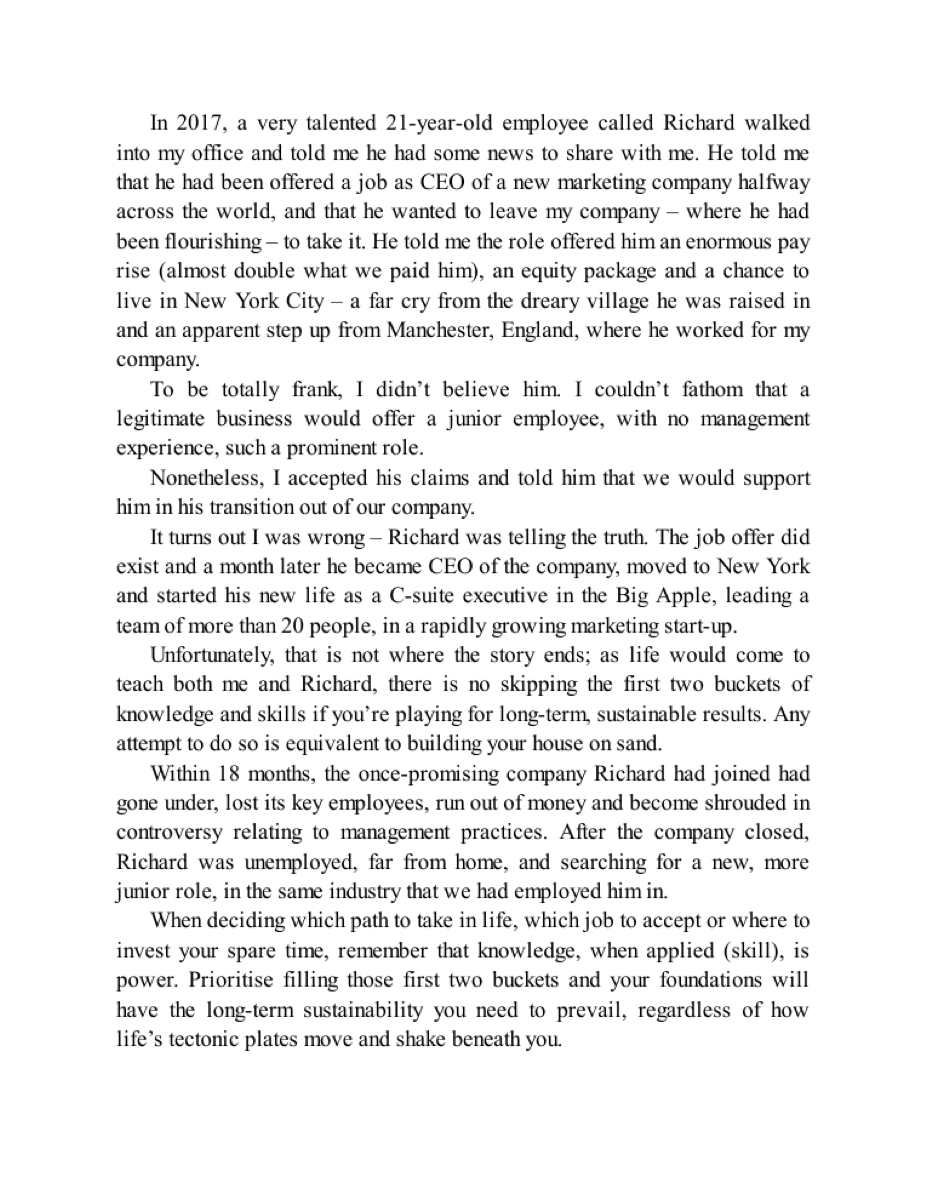
A professional earthquake is an unpredictable adverse shock: firing, failed startup, industry disruption, reputational hit, market collapse.
| Earthquake type | What survives if buckets ordered |
|---|---|
| Company failure | Knowledge + skills → next role |
| Industry shift | Skills + network partial |
| Reputation scandal | Knowledge + skills; reputation rebuild slow |
| Pure network loss | Skills + knowledge still billable |
Consulting translation: When utilisation drops firm-wide, consultants with deep craft and portable skills recover faster than those with LinkedIn theatre only.
2. Pillar I — The Self (Laws 1–9)
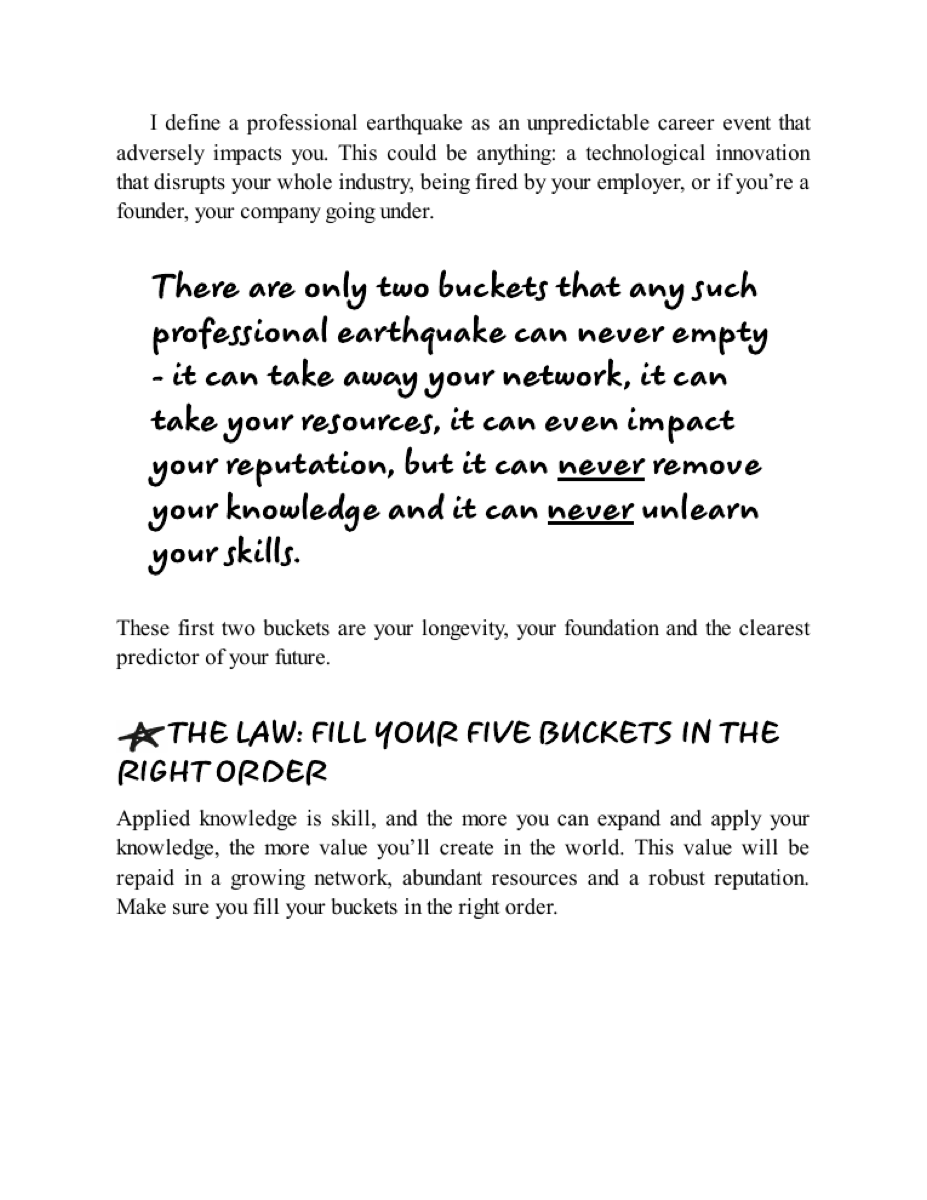
Figure: knowledge, skills, network, resources, reputation—and the law to fill them in the right order.
| Bucket | What it is | Earthquake-proof? |
|---|---|---|
| Knowledge | What you understand | Yes |
| Skills | What you can do repeatedly | Yes |
| Network | Who trusts you | Partially |
| Resources | Capital, assets, access | No |
| Reputation | How you are perceived | Fragile |
Law 1 — Fill your five buckets in the right order
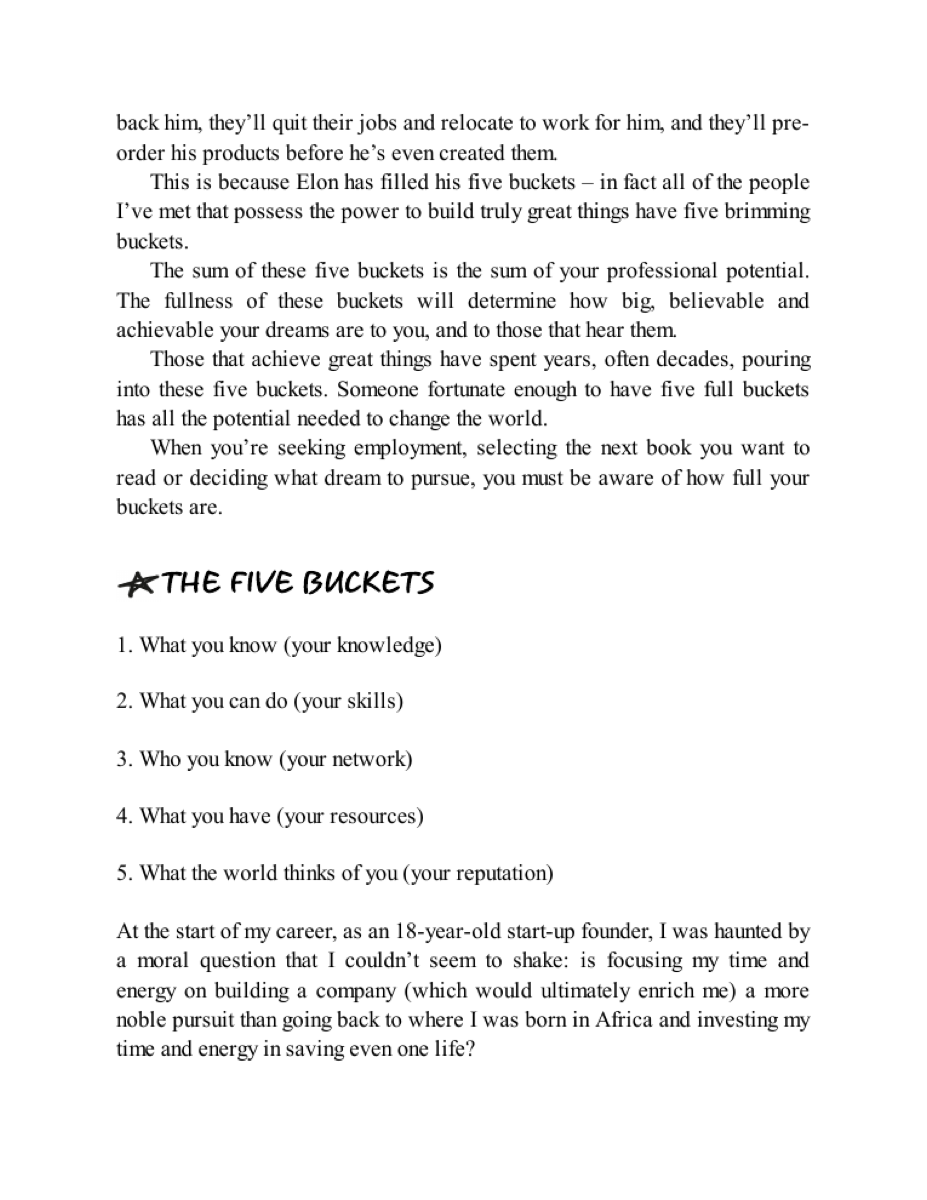
Figure: educational illustration expanding the five-bucket model from The Diary of a CEO.
Applied knowledge becomes skill; skill creates value; value grows network, resources and reputation. Skipping to reputation (personal-brand-first) builds a hollow tower.
Practice: Weekly calendar audit—hours into learning and deliberate practice before networking events or vanity metrics.
Law 2 — To master it, you must create an obligation to teach it
Teaching forces clarity and accountability. Write, present, mentor—obligation beats passive consumption.
Consulting move: Internal brown-bag on a method you are learning; client-safe case write-ups.
Law 3 — You must never disagree (influence, not surrender)
Figure: educational illustration of the “never disagree / inspire new beliefs” law.
Direct disagreement hardens identity. Inspire new beliefs with questions and stories. Pairs with Never Split the Difference tactical empathy and SPIN Need-payoff.
Law 4 — You do not get to choose what you believe
Beliefs form from repeated exposure and environment. Design inputs: who you follow, what you read, who you hire.
Law 5 — You must lean in to bizarre behaviour
Break routines to discover non-obvious insights—aligned with Innovator’s DNA observing and experimenting.
Law 6 — Ask, don’t tell — the question/behaviour effect
Questions change behaviour more than lectures. Use in coaching and client discovery.
Law 7 — Never compromise your self-story
Identity narrative shapes resilience. Do not adopt a self-story that breaks under pressure (e.g. “I am only valid when utilisation is 100%”).
Law 8 — Never fight a bad habit
Replace habits; do not white-knuckle willpower wars. Design environment and triggers (Grove systems thinking).
Law 9 — Always prioritise your first foundation
Return to knowledge and skills when stressed—do not panic-optimize reputation.
Pillar I checklist
- Learning block scheduled weekly
- Skill practice with feedback loop
- Teaching obligation on calendar
- Network nurtured after value creation
- Reputation claims backed by artefacts
3. Pillar II — The Story (Laws 10–18)
Story is not fluff—it is how humans allocate attention and trust.
Law 10 — Useless absurdity will define you more than useful practicalities
Memorable differentiation often comes from unexpected creative choices—not only functional specs.
Law 11 — Avoid wallpaper at all costs
Wallpaper: generic content that blends into the feed. If your story could belong to any competitor, it is wallpaper.
Law 12 — You must piss people off
Polarisation filters for the right audience. Trying to please everyone produces wallpaper (Law 11).
Caution: Polarise on values and stance, not on disrespecting clients or colleagues.
Law 13 — Shoot your psychological moonshots first
Attempt the scary creative or commercial move early while you have less to lose—or while the window is open.
Law 14 — Friction can create value
Not all friction is bad—some signals quality, commitment, or exclusivity. Remove stupid friction; keep meaningful friction.
Law 15 — The frame matters more than the picture
Same facts, different frame → different decision. Pairs with Obviously Awesome positioning and Minto SCQA.
Law 16 — Use Goldilocks to your advantage
Present options so your preferred path feels “just right”—not extreme. Useful in packaging and proposals.
Law 17 — Let them try and they will buy
Experience beats description—pilots, demos, trials. Aligns with MVBP thinking in Disciplined Entrepreneurship.
Law 18 — Fight for the first five seconds
Attention window is tiny—in pitches, content hooks, meeting openings. Front-load tension and relevance.
Story structure for operators
Context → conflict → turning point → lesson → ask.
4. Pillar III — The Philosophy (Laws 19–27)
Law 19 — You must sweat the small stuff
Details signal standards—especially early in brand and product.
Law 20 — A small miss now creates a big miss later
Compound errors in quality, ethics, or delivery. Related to The Goal: small defects at a constraint become catastrophes.
Law 21 — You must out-fail the competition
Run more experiments; fail smaller and faster—within disciplined tests (Aulet Step 20).
Law 22 — You must become a Plan-A thinker
Commit to a primary path with full energy; Plan B obsession dilutes Plan A.
Law 23 — Don’t be an ostrich
Face uncomfortable metrics and conversations early.
Law 24 — You must make pressure your privilege
Choose voluntary hardship that builds skill; distinguish training stress from destructive overload.
Law 25 — The power of negative manifestation
Visualise failure modes to prevent them—premortems for projects and pursuits.
Law 26 — Your skills are worthless, but your context is valuable
Skills transfer when paired with where you apply them. Consulting “context” = industry + problem + trust.
Law 27 — The discipline equation: death, time and discipline!
Mortality awareness + finite time → discipline beats motivation theatre.
Philosophy pillar prompts
| Prompt | Evidence |
|---|---|
| Where did curiosity beat ego? | Experiments run |
| What small miss did we fix? | Incident log |
| Did we premortem the pursuit? | Risk doc |
5. Pillar IV — The Team (Laws 28–33)
Law 28 — Ask who not how
Find the right person before optimising the wrong task yourself—leverage (Grove).
Law 29 — Create a cult mentality
Strong shared mission and standards—not cult as abuse, but intense alignment on what matters.
Law 30 — The three bars for building great teams
Bartlett describes bars teams must clear (hiring, performance, culture)—use as explicit scorecard in hiring panels.
Law 31 — Leverage the power of progress
Visible progress motivates more than vague vision. Track wins weekly.
Law 32 — You must be an inconsistent leader (humanity)
Consistency in standards, not in mood or perfection. Admit mistakes; keep expectations steady.
Law 33 — Learning never ends
Institutionalise learning loops—post-mortems, libraries, training budget protected in downturns.
Team OS checklist
- Written standards for quality and behaviour
- Hiring scorecard tied to bucket skills
- Cadence for hard conversations
- Recognition systems that reward desired behaviours
- Progress visible to the team
6. Mapping 33 laws into an operating cadence
You do not need to memorise every law title. Run a monthly four-pillar review:
| Pillar | Prompt | Evidence |
|---|---|---|
| Self | Did I invest in knowledge/skills first? | Hours, artefacts shipped |
| Story | Did I persuade without belief-attacks? | Wins/losses in influence |
| Philosophy | Where did curiosity beat ego? | Questions asked / experiments |
| Team | What did we tolerate that we shouldn’t? | Incidents + fixes |
7. Consulting career application
| Situation | Bartlett-oriented move |
|---|---|
| Utilisation panic | Protect skill-building hours anyway (Law 9) |
| Personal brand push | Publish proof from client-safe artefacts (Law 11 anti-wallpaper) |
| Pursuit conflict | Inspire beliefs; don’t fight egos (Law 3) |
| Team underperformance | Name tolerated standard breach (Law 30–31) |
| After a setback | Inventory buckets; rebuild from knowledge/skills (Law 1) |
| Steer committee pitch | First five seconds + try/experience (Laws 17–18) |
7.1 Integration with negotiation and sales
| Book | Bartlett bridge |
|---|---|
| Voss | Law 3 — never disagree; label and inspire |
| SPIN | Law 6 — ask, don’t tell |
| Dunford | Law 15 — frame over picture |
8. Negative cases (expanded)
| Failure | Law violated | Fix |
|---|---|---|
| Reputation-first LinkedIn theatre | Law 1 order | Skills artefacts first |
| “Hustle” without recovery | Law 9, 24 | Discipline systems |
| Weaponising candour | Law 3, 32 | Care + standards |
| Collecting laws as quotes | All | Monthly pillar audit |
| Wallpaper content | Law 11 | Polarise on real stance (Law 12) |
| Avoiding failure entirely | Law 21 | Small disciplined experiments |
9. Capstone — 30-day OS sprint
- Week 1: Bucket audit + learning plan (Law 1, 9)
- Week 2: One public artefact—post, talk, tool (Law 2, 11)
- Week 3: One hard team/standard conversation (Law 30, 32)
- Week 4: Influence experiment—inspire a belief without attacking (Law 3)
- Retrospective: What survives if an earthquake hit tomorrow?
10. Quick reference — all 33 laws
| # | Law | Pillar |
|---|---|---|
| 1 | Fill five buckets in order | Self |
| 2 | Obligation to teach | Self |
| 3 | Never disagree (inspire beliefs) | Self |
| 4 | You don’t choose beliefs | Self |
| 5 | Lean in to bizarre behaviour | Self |
| 6 | Ask, don’t tell | Self |
| 7 | Never compromise self-story | Self |
| 8 | Never fight a bad habit | Self |
| 9 | Prioritise first foundation | Self |
| 10 | Useless absurdity defines you | Story |
| 11 | Avoid wallpaper | Story |
| 12 | Piss people off (filter audience) | Story |
| 13 | Psychological moonshots first | Story |
| 14 | Friction can create value | Story |
| 15 | Frame > picture | Story |
| 16 | Goldilocks advantage | Story |
| 17 | Let them try → buy | Story |
| 18 | First five seconds | Story |
| 19 | Sweat small stuff | Philosophy |
| 20 | Small miss → big miss | Philosophy |
| 21 | Out-fail competition | Philosophy |
| 22 | Plan-A thinker | Philosophy |
| 23 | Don’t be ostrich | Philosophy |
| 24 | Pressure as privilege | Philosophy |
| 25 | Negative manifestation | Philosophy |
| 26 | Context > raw skills | Philosophy |
| 27 | Discipline equation | Philosophy |
| 28 | Who not how | Team |
| 29 | Cult mentality (alignment) | Team |
| 30 | Three bars for teams | Team |
| 31 | Power of progress | Team |
| 32 | Inconsistent leader (human) | Team |
| 33 | Learning never ends | Team |
11. Law-by-law practitioner notes (Pillar I — Self)
| Law | Practice this week | Metric |
|---|---|---|
| 1 Five buckets | Block 3h learning before networking event | Learning hours |
| 2 Teach it | Publish one internal note | Artefact shipped |
| 3 Never disagree | Rewrite one hard email as questions | Sent message |
| 4 Beliefs | Audit feed/subscriptions | Inputs changed |
| 5 Bizarre behaviour | One non-routine experiment | Experiment log |
| 6 Ask don’t tell | Discovery call: 70% their talk | Talk ratio |
| 7 Self-story | Write one-sentence identity | Clarity test |
| 8 Bad habits | Replace one trigger/environment | Habit track |
| 9 First foundation | Protect skill time in utilisation crunch | Calendar |
12. Law-by-law practitioner notes (Pillar II — Story)
| Law | Consulting / founder application |
|---|---|
| 10 Absurdity | Memorable pursuit hook—not gimmick for C-suite |
| 11 Wallpaper | Cut generic “digital transformation” slides |
| 12 Piss people off | Clear stance on build vs buy in AI |
| 13 Moonshots | Pitch bold pilot before incremental year |
| 14 Friction | Premium tier with white-glove onboarding |
| 15 Frame | Open with client problem frame (Minto SCQA) |
| 16 Goldilocks | Three-option proposal with middle recommended |
| 17 Let them try | Paid pilot / sandbox before enterprise SOW |
| 18 First five seconds | Steering meeting opens with stakes not bios |
13. Law-by-law practitioner notes (Pillar III — Philosophy)
| Law | Operator habit |
|---|---|
| 19 Sweat small stuff | Proposal typos, chart titles, naming consistency |
| 20 Small miss → big miss | Fix eval gap in pilot before scale |
| 21 Out-fail | More small tests than competitors (Aulet Step 20) |
| 22 Plan-A | One primary growth path per quarter |
| 23 Ostrich | Read churn/loss reasons weekly |
| 24 Pressure privilege | Choose hard certifications that build skill |
| 25 Negative manifestation | Premortem every major pursuit |
| 26 Context | Industry + problem > generic AI skills |
| 27 Discipline equation | Systems > motivation posts |
14. Law-by-law practitioner notes (Pillar IV — Team)
| Law | Team ritual |
|---|---|
| 28 Who not how | Staff pursuits with SME owners early |
| 29 Cult mentality | Written mission + non-negotiables |
| 30 Three bars | Hiring scorecard enforced |
| 31 Progress | Weekly shipped artefact visible |
| 32 Inconsistent leader | Admit errors; hold standards |
| 33 Learning never ends | Monthly post-mortem library |
15. Professional earthquake playbook
When shock hits (layoff, lost mega-deal, startup failure):
| Day | Action |
|---|---|
| 1–3 | Inventory buckets: knowledge/skills intact? |
| 4–7 | List 10 people for honest conversations |
| 8–14 | Ship one public proof of craft |
| 15–30 | One experiment (Law 21) with bounded downside |
Do not panic-optimize reputation (LinkedIn blitz) before skill and value clarity.
16. Consulting career OS — quarterly review
| Quarter | Self | Story | Philosophy | Team |
|---|---|---|---|---|
| Q1 | Certification / deep skill | One case study | Premortem pursuits | Hiring bar |
| Q2 | Teach internally | Conference talk | Experiment log | Standards audit |
| Q3 | Cross-industry learning | Polarise POV content | Fail small publicly | Progress board |
| Q4 | Bucket rebalance | Influence without fight | Plan-A reset | Learning budget |
17. Integration with negotiation and sales canon
| Situation | Bartlett | Partner book |
|---|---|---|
| Hard commercial | Law 3 inspire | Voss labels |
| Discovery | Law 6 ask | SPIN |
| Proposal frame | Law 15 | Dunford |
| Team deal loss | Law 23 ostrich | Honest loss review |
18. Weekly bucket tracker (template)
| Week | Knowledge (hrs) | Skill practice | Network (value-first) | Resources | Reputation artefact |
|---|---|---|---|---|---|
| 1 | |||||
| 2 | |||||
| 3 | |||||
| 4 |
Rule: No reputation column entry without a skill or knowledge entry the same week.
19. Capstone — 90-day CEO OS
| Phase | Outcome |
|---|---|
| Days 1–30 | Bucket rebalance; one skill certification path |
| Days 31–60 | One non-wallpaper story asset; one influence win without fight |
| Days 61–90 | Team standard enforced; premortem on top pursuit |
Retrospective: which buckets survive a simulated earthquake?
Discussion
Comments
Share feedback or questions about this page. No account required.
Loading comments…