The Culture Map: Eight Scales for Leading, Meeting, and Deciding Across Borders
A meeting that feels efficient in Amsterdam can feel rude in Tokyo. Feedback that feels honest in New York can feel destructive in Jakarta. A decision process that feels inclusive in Stockholm can feel endless in New York—and a decision that feels decisive in Shanghai can feel illegitimate in Amsterdam. Global business does not fail because people lack intelligence. It fails because leaders assume their cultural operating system is universal. Erin Meyer’s Culture Map gives you eight dials—and a way to stop blaming personalities for what is often culture.
Source note: This article is an original practitioner synthesis of themes from Erin Meyer’s The Culture Map: Breaking Through the Invisible Boundaries of Global Business. It is not a reprint of the book. Country positions are relative and illustrative—cultures are spectra within nations, and individuals vary. Support the original work if you lead multicultural teams, negotiate internationally, or advise global clients.
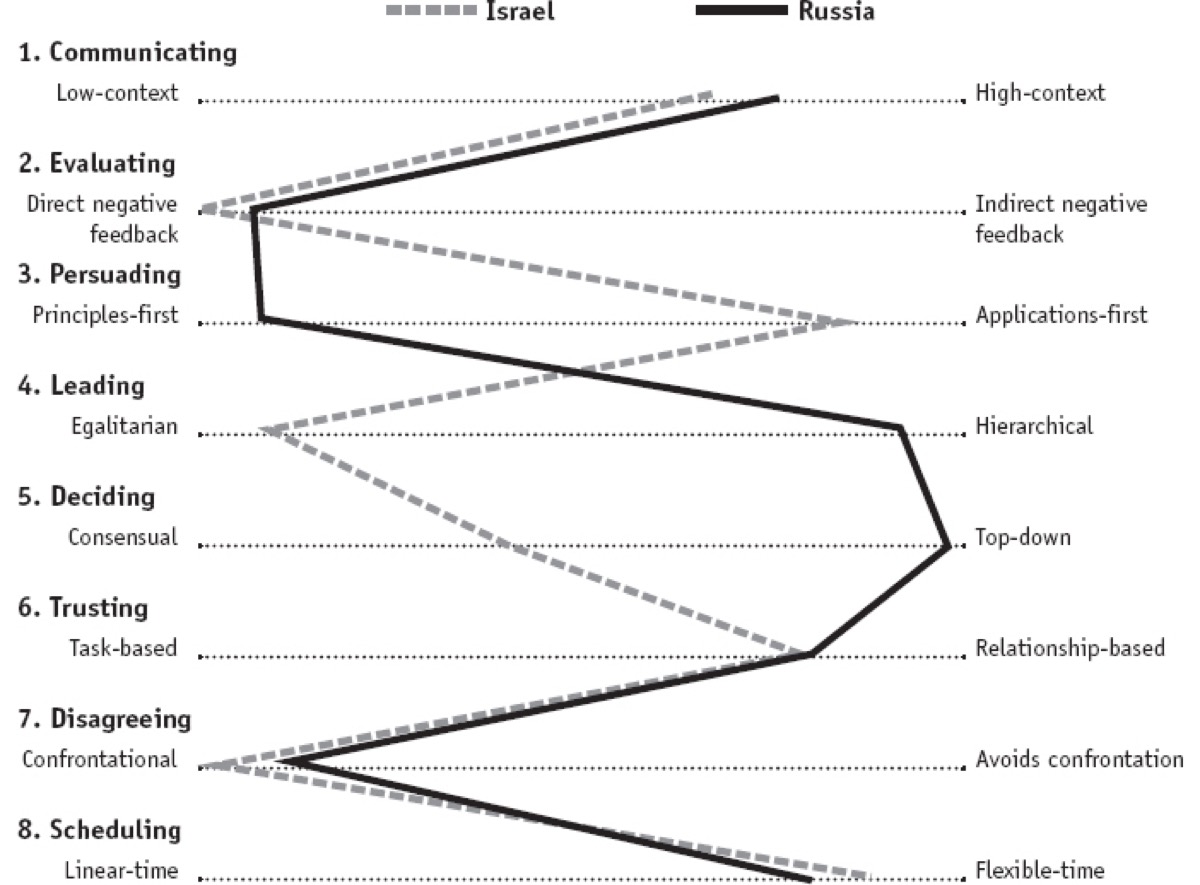
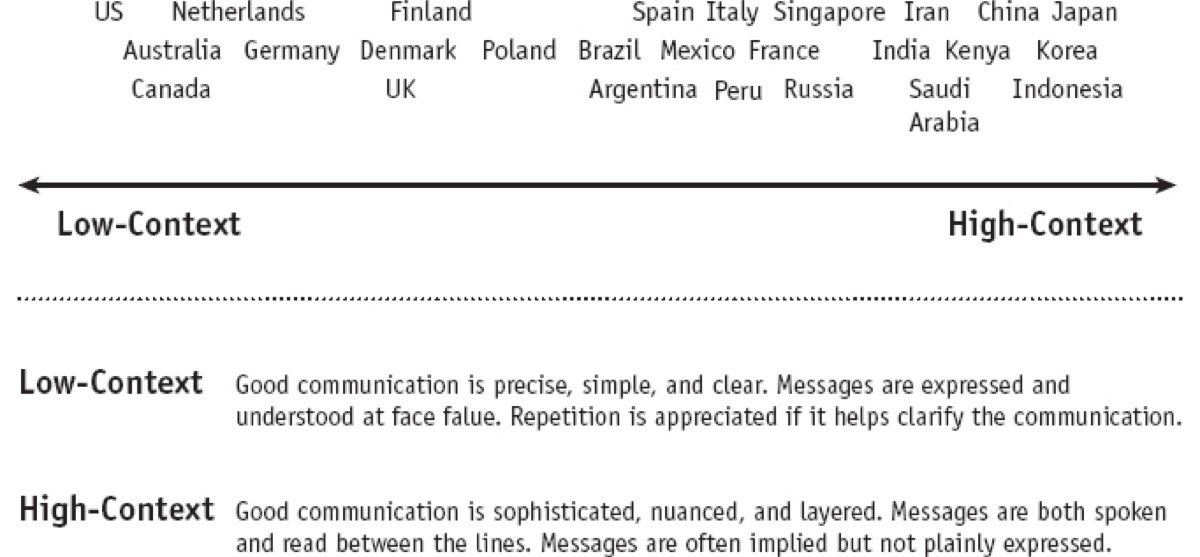
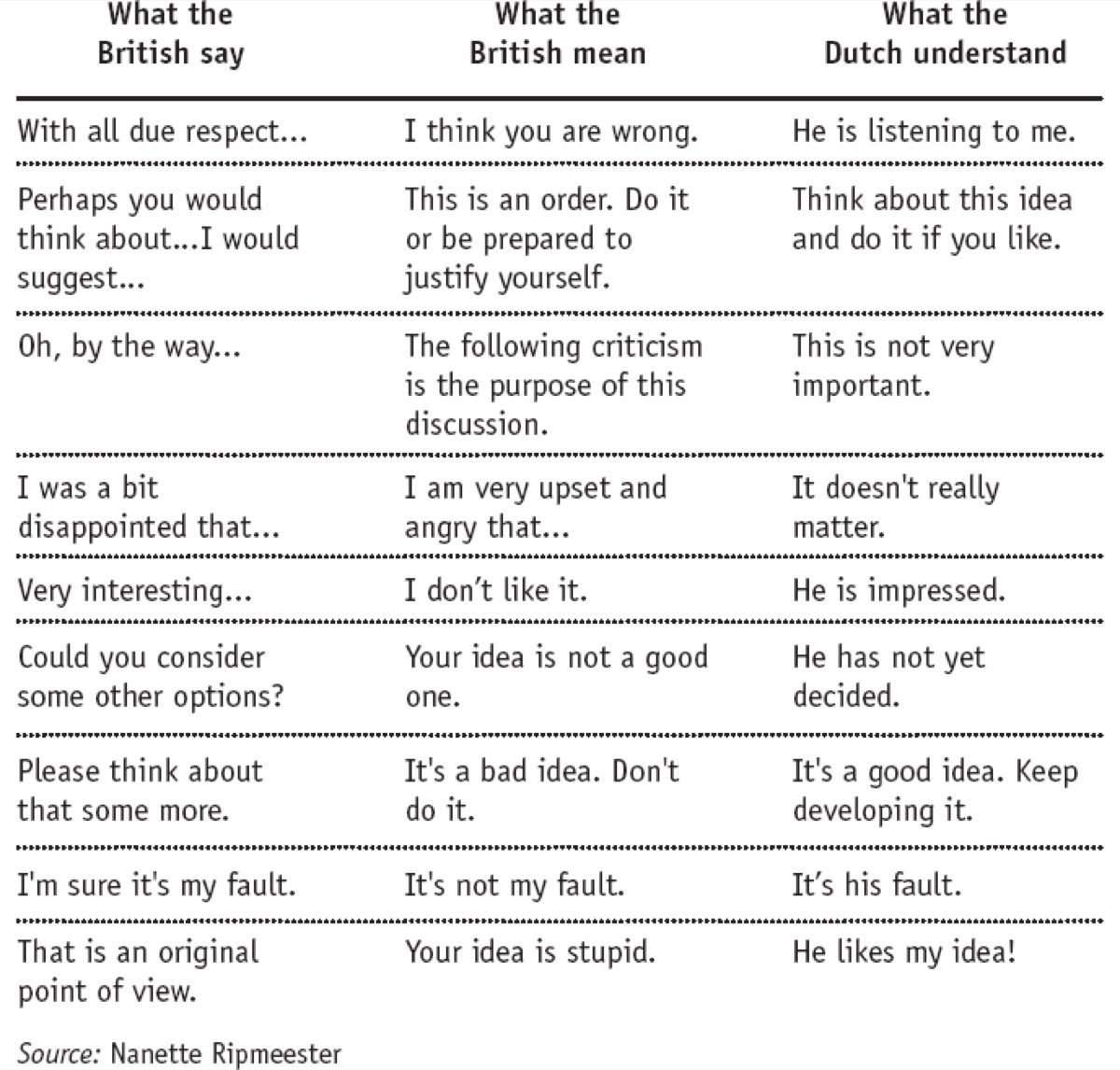
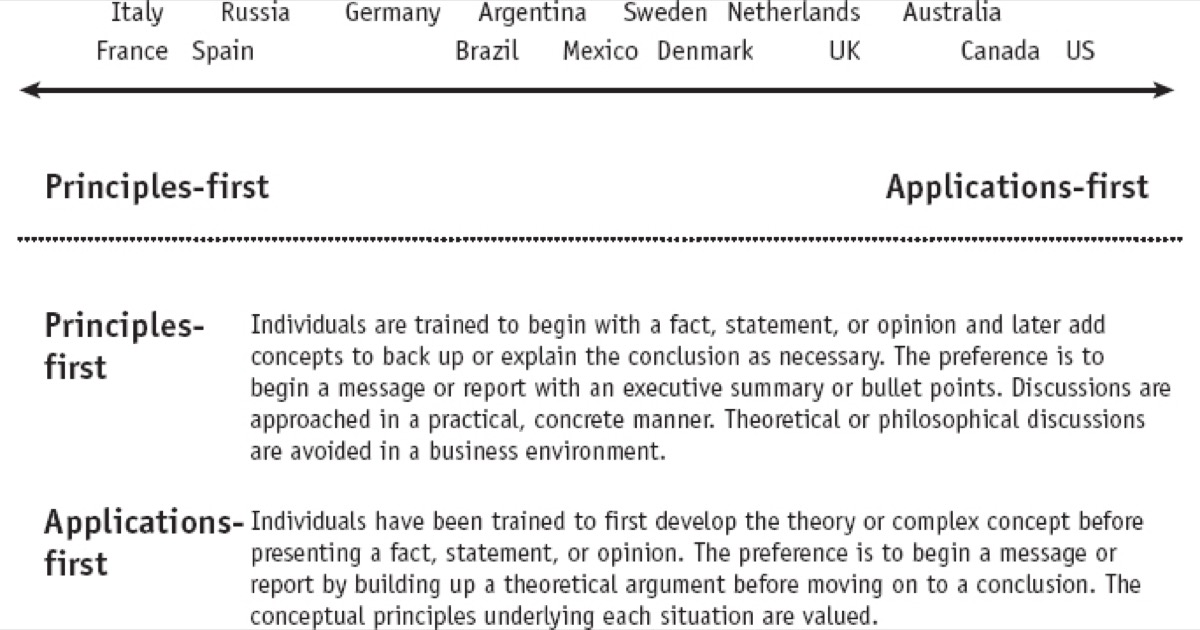
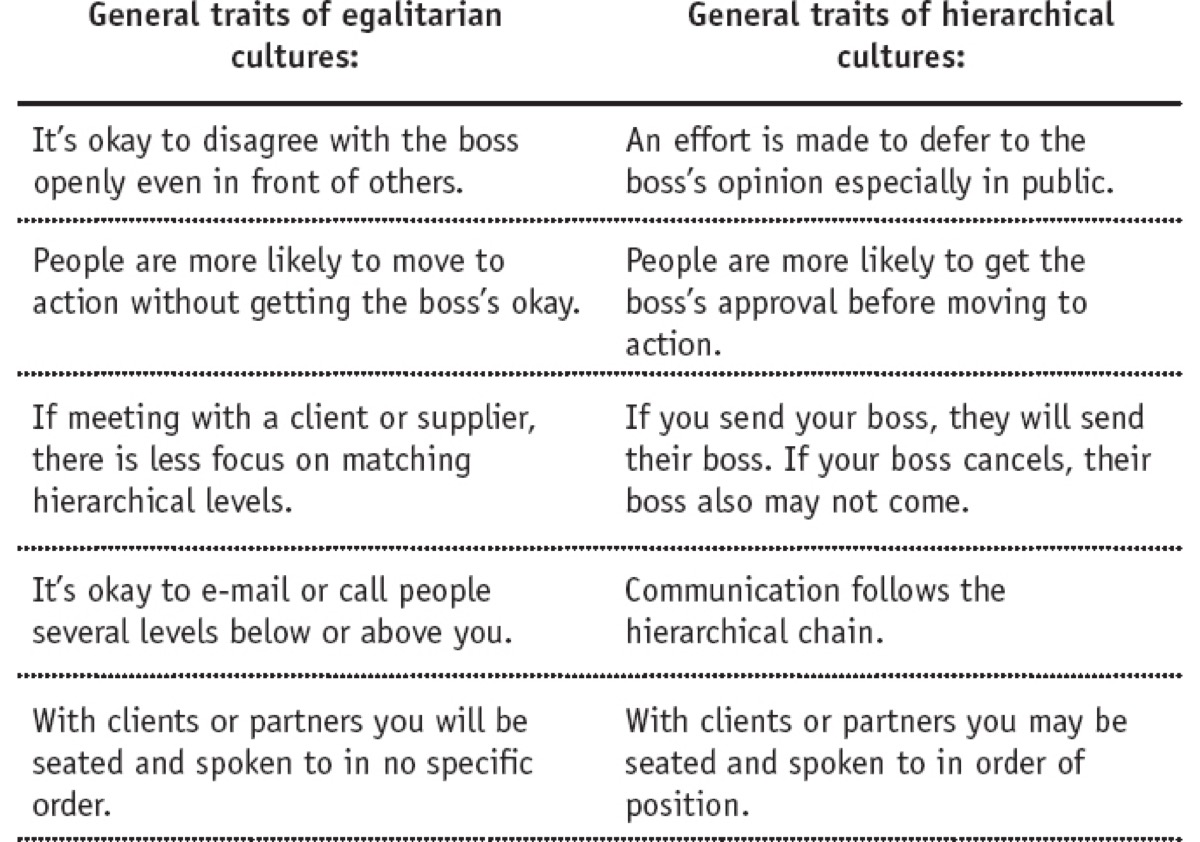
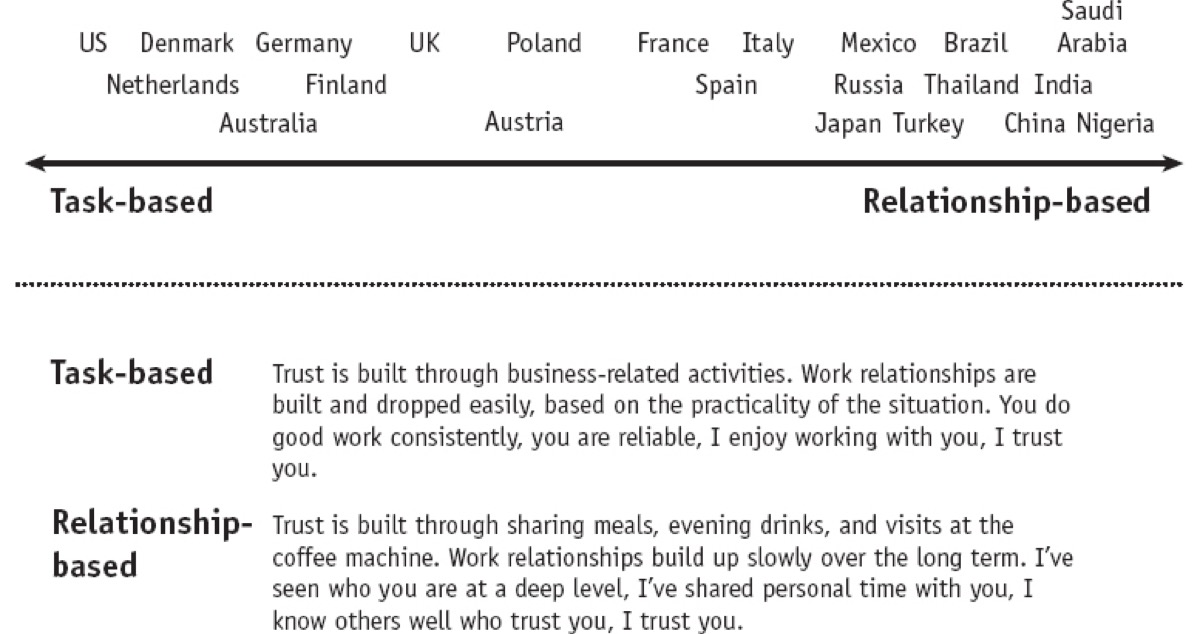
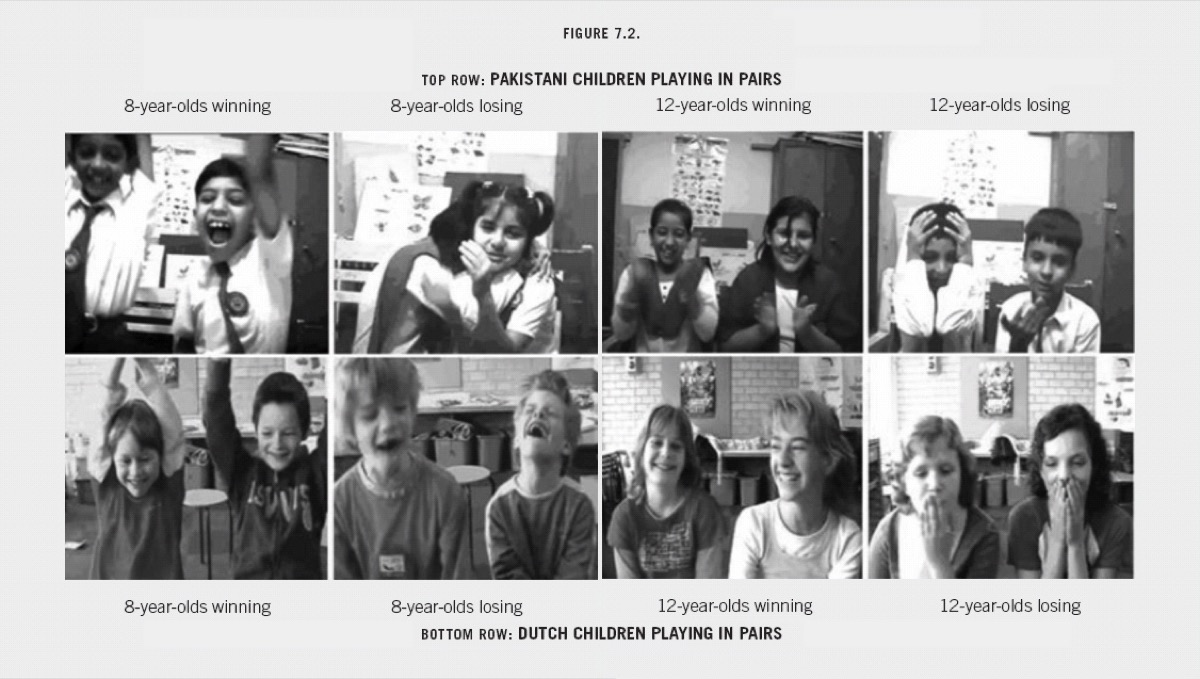
Figure: educational illustrations from Erin Meyer’s The Culture Map EPUB — relative cultural scales.
0. Why culture maps beat gut instinct
0.1 The invisible operating system
Every professional carries an invisible OS for:
- How explicitly to speak
- How bluntly to criticise
- How to build a persuasive argument
- How much hierarchy to show
- How decisions should be made
- How trust is earned
- How openly to disagree
- How strictly time should be scheduled
When two OS versions collide, people invent personal explanations: “She’s passive-aggressive.” “He’s arrogant.” “They’re disorganised.” “They’re rigid.” Often the real story is cultural distance on one or more scales.
0.2 Relative, not absolute
Meyer’s crucial methodological point: cultures should be understood in relation to each other, not as fixed national essences.
Example: A French manager may seem hierarchical to a Dane and egalitarian to a Chinese counterpart—same person, different relative position.
| Mistake | Better practice |
|---|---|
| “Germans are always direct” | “Relative to us, they tend to be more direct on evaluating” |
| “Asians avoid conflict” | “On disagreeing, many East Asian contexts prefer harmony-preserving paths—verify locally” |
| One country = one point | Nation as a range; industry, company, and individual matter |
| Culture explains everything | Culture is one lens; incentives, power, and personality still matter |
0.3 How to use the eight scales
- Plot yourself (or your home office).
- Plot the counterpart culture(s)—relatively.
- Identify the largest gaps.
- Design bridging behaviours for those gaps.
- Explicitly agree team norms when multiple cultures share a platform.
1. Scale 1 — Communicating: low-context vs high-context
1.1 The scale
| Low-context | High-context |
|---|---|
| Meaning is in the words | Meaning is in context, relationship, and implication |
| Good communication = clear, explicit, repeated | Good communication = nuanced, layered, read between lines |
| Messages stand alone | Messages assume shared background |
| “Say what you mean” | “If I must spell it out, something is wrong” |
Illustrative relative tendencies (not stereotypes): many Anglo and Nordic business cultures lean lower-context; many East Asian, Arab, Latin European, and African contexts lean higher-context—always verify with local practice.
1.2 Failure modes
| Low-context speaker → high-context listener | High-context speaker → low-context listener |
|---|---|
| Feels patronising, repetitive, simplistic | Feels vague, evasive, incomplete |
| Over-explains and insults intelligence | Under-specifies and creates risk |
| Mistakes silence for agreement | Mistakes questions for hostility |
1.3 Bridging playbook — communication
If you are lower-context working with higher-context colleagues:
- Invest in relationship and shared context before task detail.
- Listen for what is not said; ask gentle clarifying questions.
- Reduce blunt repetition; use summaries as collaborative check-backs.
- Put important commitments in writing after verbal alignment—not as a surprise.
If you are higher-context working with lower-context colleagues:
- Err on the side of explicitness; they are not being rude—they need the words.
- State recommendations and owners clearly.
- Do not assume “they should know.”
- Confirm understanding out loud without shame.
Meeting checklist — communicating
- Did we define key terms explicitly?
- Did we leave space for indirect signals to surface?
- Are action items written with owners and dates?
- Did quieter voices get invited without being put on the spot culturally?
2. Scale 2 — Evaluating: direct vs indirect negative feedback
2.1 The scale
Evaluating is not the same as communicating. A culture can be low-context in information exchange and still soft in negative feedback—or the reverse.
| Direct negative feedback | Indirect negative feedback |
|---|---|
| Criticism is frank, often in public or with little padding | Criticism is soft, private, and wrapped in positives |
| Honesty = respect | Harmony and face = respect |
| Upgraders: “absolutely inappropriate,” “totally unprofessional” | Downgraders: “a bit,” “maybe,” “we might consider” |
2.2 Classic misfires
| Direct evaluator → indirect receiver | Indirect evaluator → direct receiver |
|---|---|
| Feels attacked, shamed, demotivated | Misses the message entirely |
| Relationship damage | Performance drift (“I thought things were fine”) |
| Defensive shutdown | Frustration: “Why won’t they just say it?” |
2.3 Feedback playbook for multicultural teams
Rule 1: Separate clarity of message from harshness of delivery.
Rule 2: Agree a team feedback contract:
| Element | Example norm |
|---|---|
| Setting | Private first for developmental feedback |
| Structure | Situation–Behaviour–Impact + request |
| Language | Avoid absolute upgraders unless safety-critical |
| Frequency | Continuous small feedback > rare bombs |
| Written vs spoken | Match preference; confirm understanding |
Direct giver → indirect receiver:
- Soften with care and relationship.
- Be specific about behaviour, not character.
- Offer a path forward.
- Check emotional impact; do not equate silence with fine.
Indirect giver → direct receiver:
- Signal explicitly: “I need to give you clear developmental feedback.”
- State the gap without burying it in praise sandwiches that confuse.
- Ask them to reflect back the takeaway.
- Document agreements.
Feedback checklist
- Is the feedback about observable behaviour?
- Is the cultural delivery calibrated to the receiver?
- Did the receiver accurately restate the message?
- Is there a follow-up date?
- Would a third culture on the team find the process fair?
3. Scale 3 — Persuading: principles-first vs applications-first
3.1 The scale
| Principles-first (deductive) | Applications-first (inductive) |
|---|---|
| Theory → conclusion | Example/practical case → conclusion |
| Build the conceptual frame first | Show what works first |
| “Why this is true” before “what to do” | “What to do” before deep theory |
| Common in many Romance/Germanic intellectual traditions | Common in many Anglo business contexts |
3.2 Why pitches fail across this scale
An applications-first presenter jumps to recommendations; a principles-first audience feels the argument is shallow or manipulative.
A principles-first presenter builds theory for twenty minutes; an applications-first audience feels bored and asks: “So what do we do on Monday?”
3.3 Persuasion playbook
For mixed audiences:
- Open with a practical hook (applications).
- Provide a tight conceptual frame (principles).
- Return to recommendations and pilots (applications).
- Offer an appendix for deep theory lovers.
| Audience lean | Structure |
|---|---|
| Applications-first | Case → insight → recommendation → optional theory |
| Principles-first | Framework → logic → case proof → recommendation |
| Mixed global room | Hook → framework (short) → cases → decision ask |
Persuasion checklist
- Did I identify the audience’s persuasion style?
- Is there enough “why” for principles-first listeners?
- Is there enough “so what / now what” for applications-first listeners?
- Can I switch modes mid-meeting without ego?
4. Scale 4 — Leading: egalitarian vs hierarchical
4.1 The scale
| Egalitarian | Hierarchical |
|---|---|
| Flat distance between boss and team | Clear status distance |
| Skip-level interaction normal | Chain of command matters |
| Ideal boss = facilitator among equals | Ideal boss = clear directive authority |
| Titles less central | Titles and deference more central |
4.2 Leadership collision patterns
| Egalitarian leader in hierarchical culture | Hierarchical leader in egalitarian culture |
|---|---|
| Seen as weak or confusing | Seen as arrogant or autocratic |
| Team waits for direction that never comes | Team feels micromanaged |
| Informal style read as disrespect | Formal style read as coldness |
4.3 Leading playbook
If you lean egalitarian in a hierarchical context:
- Provide clearer direction than feels natural.
- Respect formal channels when giving feedback upward/downward.
- Use titles appropriately in early relationship stages.
- Still invite input—but structure it so it does not look like indecision.
If you lean hierarchical in an egalitarian context:
- Explain the “why” and invite challenge.
- Reduce status theatre; increase coaching behaviours.
- Encourage skip-level communication with norms.
- Judge people on contribution, not proximity to power.
Leadership meeting norms
| Topic | Bridging norm |
|---|---|
| Who speaks first | Rotate; boss speaks last on ideation topics |
| Disagreement with boss | Explicit permission + private channels if needed |
| Decision announcement | Leader states decision and rationale |
| Email to seniors | Match formality to local expectation |
Leading checklist
- Do people know when I want input vs when I have decided?
- Am I matching status cues to local expectations without abandoning my values?
- Is psychological safety real for juniors from hierarchical backgrounds?
- Are titles used as respect tools, not as barriers to truth?
5. Scale 5 — Deciding: consensual vs top-down
5.1 The scale
Important: hierarchical ≠ always top-down deciding, and egalitarian ≠ always consensual. Meyer separates leading from deciding for this reason.
| Consensual | Top-down |
|---|---|
| Decisions take longer; build broad buy-in | Decisions faster; driven by authority |
| Implementation often smoother | Implementation may need heavier push |
| Sounding out stakeholders is the process | Sounding out may be courtesy, not power-sharing |
| Hard to reverse once agreed | Easier to reverse, but can create whiplash |
5.2 Decision speed myths
Consensual cultures are not “slow because inefficient.” They often front-load alignment so execution is fast.
Top-down cultures are not “decisive because superior.” They often decide quickly and then spend time driving adoption—or revisiting decisions.
5.3 Decision playbook for multicultural teams
Agree explicitly:
- Decision type: informative, consultative, consensual, or authoritative.
- Who decides (single owner).
- Who must be consulted.
- Deadline for input.
- Communication plan after decision.
| Situation | Suggested mode |
|---|---|
| Existential crisis / safety | Top-down with rapid consultation |
| Cross-functional operating model | Consensual or consultative with clear owner |
| Local market tactic | Local owner with centre consultation |
| Global standard (security, brand) | Centre-led with local input windows |
Deciding checklist
- Have we named the decision mode out loud?
- Do consensual members have enough time to align their constituencies?
- Do top-down members know when a decision is truly closed?
- Is implementation ownership clear after the decision?
- Are we confusing politeness with agreement?
6. Scale 6 — Trusting: task-based vs relationship-based
6.1 The scale
| Task-based trust | Relationship-based trust |
|---|---|
| Trust from reliable delivery | Trust from personal bonds |
| “You do good work → I trust you” | “I know you → I trust you” |
| Business can start quickly | Business deepens after meals, time, favours |
| Relationships can be friendly but transactional | Relationships are the platform for transactions |
6.2 Business development and partnership implications
Task-based cultures may see relationship investment as inefficient.
Relationship-based cultures may see pure transactional pitching as untrustworthy.
6.3 Trust playbook
If you are task-based entering a relationship-based context:
- Budget time for meals, introductions, and personal curiosity.
- Use trusted intermediaries where appropriate.
- Demonstrate reliability and personal respect.
- Do not rush the contract before the relationship can carry it.
If you are relationship-based entering a task-based context:
- Lead with competence evidence and clarity of offer.
- Keep personal sharing appropriate; do not over-invest early.
- Deliver quickly on small promises to build task trust.
- Still humanise—but put performance proofs first.
Trust-building checklist
- What trust currency does this culture primarily use?
- Have we scheduled non-transactional time where needed?
- Are we proving reliability in the first 14 days?
- Who is the relationship owner on our side?
- Are legal/compliance constraints explained without killing rapport?
7. Scale 7 — Disagreeing: confrontational vs avoids confrontation
7.1 The scale
| Confrontational | Avoids confrontation |
|---|---|
| Open debate is positive | Open conflict threatens group harmony |
| Disagreement ≠ personal attack | Disagreement can feel like disrespect |
| Cognitive conflict welcomed in meetings | Prefer private, mediated, or indirect paths |
| Silence may mean lack of ideas | Silence may mean disagreement or discomfort |
7.2 The dangerous misread
Confrontational cultures often believe debate improves ideas.
Harmony-preserving cultures often believe public debate damages relationships and face—so they channel dissent differently.
If you force one style globally, you either suppress truth or destroy trust.
7.3 Disagreement playbook
Design dual channels:
| Channel | Use |
|---|---|
| Public debate | For cultures/people who thrive on open challenge |
| Private pre-wires | For those who need face-safe dissent |
| Anonymous inputs | For early ideation in mixed groups |
| Devil’s advocate role | Rotating, assigned, depersonalised critique |
| Written comments | Asynchronous disagreement without theatre |
If you are confrontational with harmony-oriented colleagues:
- Soften personal force; attack the problem, not the person.
- Invite dissent privately before the meeting.
- Watch for polite “yes” that means “I heard you.”
- Thank people for disagreement to rewire safety.
If you avoid confrontation with confrontational colleagues:
- Practise stating a clear contrary view with evidence.
- Separate relationship affirmation from issue disagreement.
- Do not assume they are angry when they are debating.
- Prepare one crisp challenge per key meeting.
Disagreeing checklist
- Did we create safe paths for dissent across styles?
- Are we mistaking harmony for alignment?
- Are we mistaking debate for disrespect?
- Is conflict about ideas—or about status?
- After debate, did we reaffirm relationships?
8. Scale 8 — Scheduling: linear-time vs flexible-time
8.1 The scale
| Linear-time | Flexible-time |
|---|---|
| Time is a line to be planned | Time is a river; relationships and context interrupt plans |
| Punctuality = respect | Adaptability = respect |
| Agenda fidelity matters | People and unfolding events matter more |
| One meeting, one purpose | Meetings may sprawl as relationships require |
8.2 Collaboration friction
Linear-time partners feel flexible-time partners are late and undisciplined.
Flexible-time partners feel linear-time partners are rigid and relationship-blind.
8.3 Scheduling playbook
Team operating agreement:
- Define punctuality norms for internal vs customer meetings.
- Distinguish hard-time events (launches, regulators, board) from flexible collaboration.
- Build buffers into cross-culture schedules.
- When delayed, communicate early—silence is the insult in linear cultures.
- When agenda changes, explain the relationship or context reason to linear partners.
| Event type | Suggested norm |
|---|---|
| Board / regulator / go-live | Linear-time strict |
| Creative workshops | Flexible within a container |
| Customer visits in relationship cultures | Flexible with relationship priority |
| Global all-hands | Start on time; publish recording |
Scheduling checklist
- Have we published time norms for this team?
- Are time zones and prayer/family constraints respected?
- Do we communicate delays proactively?
- Is agenda fidelity matched to the cultural mix and meeting purpose?
- Are we using “flexible” as an excuse for poor preparation?
9. Country relative positioning guidance
9.1 How to read positions
The following tables are relative orientation aids for business practice—not league tables of virtue, and not fixed coordinates. Always triangulate with:
- Local colleagues
- Industry norms
- Company culture (often stronger than national culture inside global firms)
- Individual personality
9.2 Communicating & Evaluating (relative tendencies)
| More low-context / more direct evaluating (relative) | More high-context / more indirect evaluating (relative) |
|---|---|
| Netherlands, Germany, Australia, USA (task settings), Denmark | Japan, Korea, Indonesia, Saudi Arabia, many high-context Asian/Arab contexts |
| UK often clearer than many high-context cultures but softer than Dutch/German evaluating | France/Italy may combine eloquence with more indirect negative feedback than Dutch norms |
Bridge rule: If Evaluating gap is large, never give developmental feedback only in public—and never assume soft hints were understood.
9.3 Persuading & Leading (relative tendencies)
| More applications-first / more egalitarian (relative) | More principles-first / more hierarchical (relative) |
|---|---|
| USA, Canada, Australia (applications); Netherlands, Denmark, Sweden (egalitarian) | France, Italy, Spain, Germany (often stronger principles/theory traditions); Japan, Korea, China, India, Russia, Nigeria (often more hierarchical relative to Nordics) |
Bridge rule: Combine a short framework with concrete cases; clarify when the boss is facilitating vs deciding.
9.4 Deciding & Trusting (relative tendencies)
| More consensual / more task-based (relative) | More top-down / more relationship-based (relative) |
|---|---|
| Sweden, Netherlands, Japan (consensual patterns differ—Japan often ringi-style alignment); USA/Germany/Netherlands more task-based trust | China, India, Russia, Nigeria, Brazil often more relationship-weighted; many hierarchical systems more top-down in final call |
Nuance: Japan can be hierarchical in Leading yet highly consensual in Deciding. Do not collapse scales.
9.5 Disagreeing & Scheduling (relative tendencies)
| More confrontational / more linear-time (relative) | More confrontation-avoiding / more flexible-time (relative) |
|---|---|
| Israel, France, Germany, Netherlands (debate cultures vary); Germany/Switzerland/USA/UK more linear in business scheduling | Japan, Thailand, Indonesia (harmony-preserving disagreement patterns); many Middle Eastern, African, Latin American contexts more flexible-time relative to Germany |
Bridge rule: Create private dissent channels; define which meetings are sacred-linear.
9.6 Mapping exercise template
For any partnership, fill this:
| Scale | Us | Them | Gap size (1–5) | Bridge behaviour |
|---|---|---|---|---|
| Communicating | ||||
| Evaluating | ||||
| Persuading | ||||
| Leading | ||||
| Deciding | ||||
| Trusting | ||||
| Disagreeing | ||||
| Scheduling |
Focus energy on gaps ≥4.
10. Practical playbooks for multicultural teams
10.1 Meeting playbook
Before
- Send agenda with purpose and decision mode.
- Pre-wire relationship-based and harmony-oriented stakeholders.
- Share pre-reads early for high-context + consensual participants.
- Clarify time-zone fairness (rotate pain).
During
- Restate purpose and decision rights.
- Use round-robins or written inputs to include quieter voices.
- Separate ideation from critique.
- Capture decisions and dissent respectfully.
After
- Circulate written summary (helps low-context and hierarchical documentation needs).
- Confirm understanding with key stakeholders privately.
- Track commitments visibly.
Meeting quality checklist
- Purpose clear
- Decision mode named
- Cultural airtime balanced
- Actions owned
- Relationship temperature checked
10.2 Feedback playbook (manager → report)
| Step | Action |
|---|---|
| 1 | Diagnose Evaluating gap |
| 2 | Choose setting (usually private) |
| 3 | Signal intent (“I want to help you succeed”) |
| 4 | Specific behaviour + impact |
| 5 | Ask for their view |
| 6 | Agree next experiment |
| 7 | Confirm takeaway in their words |
| 8 | Follow up |
10.3 Decision playbook (global programme)
- Publish RACI and decision types.
- Set input windows long enough for consensual alignment.
- Freeze decision at deadline; communicate rationale.
- Allow local adaptation only where standards permit.
- Review decision quality after 30/90 days—not only speed.
10.4 Trust playbook (new market entry)
| Week | Task-based proof | Relationship-based investment |
|---|---|---|
| 1–2 | Deliver a small visible win | Senior-to-senior introductions |
| 3–4 | Transparent plan and risks | Hosted meal / cultural respect gestures |
| 5–8 | On-time milestones | Local partner advocacy |
| 9–12 | Contract clarity + flexibility clauses | Shared narrative of partnership |
10.5 Conflict playbook
- Name the issue as a shared problem.
- Choose channel (public vs private) based on Disagreeing scale.
- Use factual timeline.
- Separate intent from impact.
- Agree behavioural norms going forward.
- Restore face for all parties.
11. Company culture vs national culture
Global companies often create a third culture—the company way. That can help, but it can also:
- Privilege HQ culture as “professionalism”
- Punish difference as “low performance”
- Create dual lives: people code-switch endlessly
Healthy global company norms:
- Explicit cultural OS for the company (meeting, feedback, decision norms).
- Local flexibility within non-negotiables (safety, ethics, brand, security).
- Cultural intelligence as a leadership competency.
- Staffing that avoids monoculture echo chambers on global programmes.
| Unhealthy | Healthy |
|---|---|
| “Our way is the global way” | “Our non-negotiables + local methods” |
| Accents and indirectness penalised | Multiple communication styles valued |
| Only HQ can lead | Local leaders sponsored into global roles |
12. Assessment — personal cultural agility
Score 1–3 (rare → habitual):
- I can plot myself on all eight scales.
- I diagnose gaps before important cross-culture meetings.
- I adapt feedback style without losing clarity.
- I name decision modes explicitly.
- I invest in the correct trust currency.
- I create safe dissent channels for harmony-oriented colleagues.
- I set scheduling norms rather than assuming mine.
- I avoid essentialising individuals as their nationality.
- I can explain relative positioning to my team.
- I repair quickly after cultural misfires.
28–30: strong agility
20–27: competent with blind spots
≤19: high risk in global roles—deliberate practice needed
13. Negative cases (handle explicitly)
- Weaponised culture: Using “that’s my culture” to avoid accountability.
- Stereotype laziness: Skipping individual observation.
- Ethics collapse: Relativising bribery or harassment as “culture.”
- Adaptation burnout: Asking only one side to stretch forever.
- Fake consensus: Harmony that hides no-decision.
- Speed arrogance: Top-down global mandates that cannot be implemented locally.
- Feedback cowardice: Hiding behind “indirect” and never being clear.
- Trust corruption: Relationship-based trust becoming favouritism.
Non-negotiable rule: Culture explains style; it does not excuse ethics breaches or missed commitments once norms are explicit.
14. Practitioner map: scale → bridge move
| Scale | Fast bridge move |
|---|---|
| Communicating | Write it down after talking |
| Evaluating | Private + explicit takeaway check |
| Persuading | Hook + framework + case |
| Leading | Say when you are asking vs deciding |
| Deciding | Name mode and owner |
| Trusting | Pair delivery proof with relationship time |
| Disagreeing | Dual channels for dissent |
| Scheduling | Define hard-time vs flexible-time events |
15. Closing: map the gap, then lead the bridge
The Culture Map does not ask you to abandon who you are. It asks you to stop treating your defaults as human nature. The leaders who win globally are not the most “international” by passport stamps. They are the ones who can see the dials, measure the gaps, and design bridges that preserve clarity, dignity, and speed.
Plot the eight scales. Agree team norms. Practise the playbooks until they are muscle memory. Then culture stops being a mysterious source of friction—and becomes a manageable dimension of performance.
Discussion
Comments
Share feedback or questions about this page. No account required.
Loading comments…