CEO Excellence: The Six Mindsets That Distinguish Extraordinary Chief Executives
The CEO job looks like a longer version of every prior leadership role. It is not. The altitude changes: you set direction for an entire enterprise, align thousands of people you will never meet, mobilise a team that must outgrow individual egos, help a board help you, connect stakeholders who do not share your incentives, and still protect the few hours only you can spend well. Extraordinary CEOs do not win by working harder at middle-management tasks. They win by adopting six mindsets—and practising them until the organisation feels the difference.
Source note: This article is an original practitioner synthesis of themes from Carolyn Dewar, Scott Keller, and Vikram Malhotra’s CEO Excellence: The Six Mindsets That Distinguish the Best Leaders from the Rest (drawing on McKinsey research and interviews with world-class CEOs). It is not a reprint of the book. Support the original work if you lead an enterprise, advise CEOs, sit on a board, or are preparing for the role.
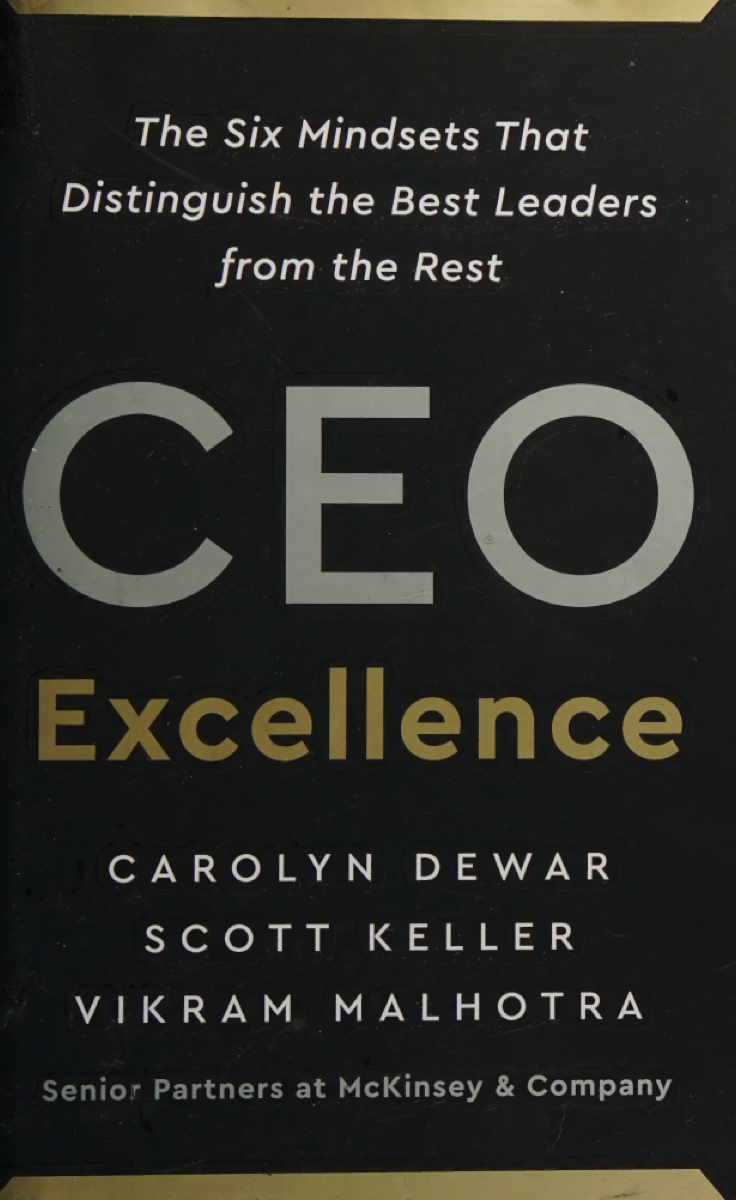
Figure: cover of Carolyn Dewar et al., CEO Excellence (educational illustration).
0. Why the CEO role breaks ordinary leadership habits
0.1 The role is a different sport
Promotion into the CEO seat often rewards excellence at the previous game: functional depth, P&L ownership, turnaround heroics, boardroom polish. Those skills still matter. They are not sufficient.
The CEO alone sits at the intersection of:
| Domain | What only the CEO fully owns |
|---|---|
| Direction | Where the enterprise is going and which big bets define the next decade |
| Organisation | How culture, structure, and talent convert strategy into behaviour |
| Mobilisation | Whether the top team acts as a true enterprise leadership system |
| Governance | How the board becomes an asset rather than a compliance theatre |
| Stakeholders | How customers, employees, investors, regulators, communities, and partners experience purpose |
| Self | How scarce CEO attention is allocated to unique work |
Miss any one of these and the others degrade. Brilliant strategy with a dysfunctional top team stalls. A great culture with timid capital allocation loses to competitors. A beloved public voice with a weak board relationship eventually loses the room that can remove you.
0.2 Research posture of the book
Dewar, Keller, and Malhotra interviewed and studied a large set of high-performing CEOs—leaders who created exceptional value across industries and geographies—and distilled patterns that separate “excellent” from merely competent. The output is not a personality cult. It is a mindset → practice architecture: six mindsets, eighteen practices (three per mindset), grounded in stories and operating habits.
The practical implication for readers: do not treat the six mindsets as branding. Treat them as a diagnostic grid. Where is your enterprise weak? Which mindset is underdeveloped in you? Which practice would unlock the most value in the next 90 days?
0.3 How to use this guide
- Read for the mindset first (the stance), then the practices (the behaviours).
- Use the assessment checklists honestly—score “habitually true,” “sometimes,” or “rarely.”
- Convert gaps into a 90-day CEO operating agenda (see Section 8).
- Revisit quarterly with your chair, coach, or trusted peer.
1. Mindset 1 — Direction-setting: Be Bold
Mindset: The best CEOs do not inch the organisation forward. They reframe the possible, make big strategic moves early and often, and allocate resources as if they were outsiders with no loyalty to yesterday’s portfolio.
1.1 Practice: Vision — play the reframe game
Vision is not a poster. It is a cognitive reframing of what the company is for and what winning means.
Excellent CEOs repeatedly ask questions that break inherited frames:
- What business are we really in?
- If we were founding this company tomorrow, what would we build—and what would we refuse?
- What customer outcome, if delivered ten times better, would make competitors irrelevant?
- What industry “truth” is actually a habit?
Reframe examples (archetypes, not prescriptions):
| Inherited frame | Bold reframe |
|---|---|
| “We sell products” | “We own a recurring customer outcome” |
| “We are a regional bank” | “We are a trust platform for financial decisions” |
| “We are a consulting firm” | “We are an industrialised capability engine for transformation” |
| “We grow by adding headcount” | “We grow by multiplying leverage per person” |
Practitioner checklist — Vision reframe
- Can every senior leader state the vision in one sentence without jargon?
- Does the vision create tension with the current portfolio (if not, it is probably incremental)?
- Have you named what you will stop being known for?
- Is the vision time-bound enough to force choices in this planning cycle?
- Do capital and talent decisions visibly bend toward the vision within two quarters?
1.2 Practice: Strategy — make big moves early and often
Bold vision without bold moves is theatre. Excellent CEOs treat strategy as a sequence of decisive commitments: acquisitions, divestitures, geographic bets, platform shifts, pricing resets, capability builds, partnership ecosystems.
Key patterns:
- Early: Do not wait for perfect information. Waiting is also a bet—usually on the status quo.
- Often: One big move is rarely enough; portfolios of moves compound.
- Coherent: Moves must reinforce the reframe, not decorate it.
Big-move taxonomy for CEOs:
| Move type | Questions to force clarity |
|---|---|
| Portfolio | What must we own? What must we exit? What must we partner? |
| Capability | Which capabilities create asymmetric advantage if we build them now? |
| Capital | Where does incremental capital earn the highest risk-adjusted return? |
| Business model | What would customers pay for if we changed how value is packaged? |
| Competitive | Which competitor move would hurt most if we do nothing for 24 months? |
Practitioner checklist — Strategy big moves
- Do you have a living list of 3–7 enterprise-level moves (not 40 initiatives)?
- Is at least one move uncomfortable for the current organisation?
- Have you assigned a single accountable owner and a kill/scale criterion for each move?
- Do board and investors understand the logic of the moves, not only the PR narrative?
- Are you reviewing move progress monthly at the enterprise level?
1.3 Practice: Resource allocation — act like an outsider
Incumbent CEOs inherit sacred cows: legacy products, pet projects, historical market shares, political budgets. Outsiders—and the best insiders who think like outsiders—reallocate capital and talent ruthlessly toward future value.
Outsider allocation habits:
- Zero-base the largest cost and investment pools periodically.
- Fund strategy with people, not only money (star talent on the highest-value problems).
- Treat “fair share” budgets as a warning sign.
- Prefer a few overfunded bets over many underfunded hopes.
- Measure managers on returns and opportunity cost, not on defending their empire.
| Insider habit | Outsider habit |
|---|---|
| Protect last year’s budget | Re-justify every major pool |
| Spread investment for peace | Concentrate for advantage |
| Promote for loyalty and tenure | Deploy talent for mission |
| Defend historical markets | Exit or harvest declining returns |
| Announce strategy, fund everything a little | Fund strategy, starve non-strategy |
Practitioner checklist — Outsider resource allocation
- What percentage of capital and top talent moved toward new priorities in the last 12 months?
- Which businesses would an activist force you to exit—and why haven’t you?
- Do you know the true fully-loaded cost of each major initiative?
- Is there a formal mechanism to stop work and reclaim resources mid-year?
- Would a private-equity owner recognise your capital discipline?
1.4 Assessment — Direction-setting (Be Bold)
Score each item: 3 = habitual, 2 = inconsistent, 1 = rare.
- Vision creates a meaningful reframe, not a slogan.
- Strategy is expressed as big moves with owners and criteria.
- Resource allocation follows strategy, not politics.
- The organisation feels constructive urgency, not bureaucratic drift.
- You personally sponsor at least one move that could fail publicly.
Interpretation: 12–15 strong; 8–11 uneven; ≤7 direction-setting is the bottleneck.
2. Mindset 2 — Organisation alignment: Treat soft as hard
Mindset: Culture, organisation design, and talent are not “HR soft stuff.” Excellent CEOs treat them as hard operating systems—measurable, designable, and non-negotiable.
2.1 Practice: Culture — find the one thing
Many companies publish long value lists. Excellent CEOs often converge on one cultural differentiator that, if lived, would change performance—and then amplify it relentlessly.
“One thing” does not mean one poster. It means a behavioural centre of gravity:
- Radical customer obsession
- Extreme ownership
- Scientific debate and candour
- Speed with discipline
- Stewardship and integrity under pressure
How to find the one thing:
- Diagnose the performance gap that culture is causing (not the gap you wish you had).
- Study moments when the company already wins—what behaviour is present?
- Choose a behaviour that is specific, observable, and scarce in your industry.
- Embed it in hiring, promotion, recognition, and consequence systems.
- Tell stories that make the behaviour legendary.
| Weak culture work | Strong culture work |
|---|---|
| 12 values, none distinctive | One signature behaviour, over-indexed |
| Cascaded posters | Rituals, stories, consequences |
| Annual engagement survey only | Weekly behavioural evidence in operating reviews |
| “Culture is everyone’s job” | CEO models and measures the one thing |
Practitioner checklist — Culture one thing
- Can you name the one cultural behaviour that would most improve results?
- Do promotions visibly reward that behaviour over pure short-term numbers?
- Are there recent examples of consequences when the behaviour was violated by high performers?
- Do new hires encounter the behaviour in their first 30 days?
- Does the CEO’s calendar visibly model the behaviour?
2.2 Practice: Organisation design — stagility
Excellent CEOs seek stagility: enough stability for people to execute, enough agility to reconfigure around opportunity and threat.
Design principles:
- Stable platforms (shared services, data, talent systems, brand) + flexible front-end teams.
- Clear decision rights (who decides, who inputs, who executes).
- Reconfigurable squads without constant wholesale reorg trauma.
- Fewer matrix knots; more mission-aligned interfaces.
Stagility diagnostic questions:
| Symptom | Likely design failure |
|---|---|
| Endless reorgs | Instability masquerading as agility |
| Silo wars | Unclear interfaces and incentives |
| Slow decisions | Too many approvers; unclear rights |
| Innovation theatre | Agility without resource reallocation |
| Execution fatigue | Stability without renewal mechanisms |
Practitioner checklist — Stagility
- What is intentionally stable for the next 24 months?
- What is intentionally reconfigurable within a quarter?
- Are decision rights written and used—or folklore?
- Do reorgs solve a strategy problem, or a politics problem?
- Can mid-level leaders explain how work flows across units without a 40-slide chart?
2.3 Practice: Talent — (don’t) put people first
The provocative practice: excellent CEOs care deeply about people and refuse sentimental talent management. “People first” becomes dangerous when it means protecting underperformance, avoiding hard conversations, or confusing kindness with clarity.
The better frame: put the right people in the right roles on the right missions—fast.
Talent disciplines of excellent CEOs:
- Obsess over the top 100–200 roles, not only the top team.
- Differentiate ruthlessly between A roles / A players and everything else.
- Move talent to the strategy’s bottlenecks.
- Develop successors early; refuse to be held hostage by irreplaceable heroes.
- Combine empathy with standards: support people; do not lower the bar.
| Sentimentality | Excellence |
|---|---|
| Keep loyal underperformers indefinitely | Coach briefly, then decide |
| Promote for time served | Promote for future role capability |
| Hide poor fits | Make role fit transparent |
| Equal investment in all | Disproportionate investment in critical roles |
| “Family” metaphor without accountability | High-trust, high-standards team |
Practitioner checklist — Talent discipline
- Do you have a living map of critical roles and succession depth?
- In the last year, did you make at least one difficult talent move that improved enterprise performance?
- Are star performers concentrated on the highest-value problems?
- Is feedback candid at the top, or politeness-first?
- Would a top candidate join because of your talent standards—or despite them?
2.4 Assessment — Organisation alignment (Treat soft as hard)
- Culture is focused on a distinctive behavioural “one thing.”
- Org design balances stability and agility with clear decision rights.
- Talent moves are timely, role-based, and strategy-aligned.
- Soft topics appear in hard forums (capital reviews, board packs, operating rhythm).
- You personally spend meaningful time on culture and talent, not only finance and markets.
3. Mindset 3 — Mobilising leaders: Solve for team psychology
Mindset: The CEO’s leverage is multiplied—or destroyed—by the top team’s psychology. Excellent CEOs design the team as a system, make collective success the star, and install an operating rhythm that creates groove.
3.1 Practice: Team composition — build an ecosystem team
An ecosystem team is not a collection of the best individual P&L owners. It is a set of leaders who:
- Cover the enterprise’s critical capabilities and horizons.
- Challenge each other without destroying trust.
- Optimise for company outcomes over unit outcomes.
- Include diverse cognitive styles and experiences.
Composition questions:
| Question | Why it matters |
|---|---|
| Who is missing for the next strategy? | Yesterday’s team rarely fits tomorrow’s bets |
| Who cannot play enterprise ball? | Brilliant silo leaders can sink the team |
| Who creates psychological safety vs fear? | Fear kills information flow to the CEO |
| Who is future-ready vs past-proven? | Tenure is not destiny |
| Who should leave so the team can rise? | Subtraction is a leadership act |
Practitioner checklist — Ecosystem team
- Does the team roster match the strategy’s capability needs?
- Are there at least two members who will disagree with you constructively in the room?
- Is enterprise incentive design stronger than unit incentive design for the top team?
- Do you have a planned renewal path for the team over 24–36 months?
- Would the team still function if you were offline for six weeks?
3.2 Practice: Teamwork — make the team the star
Celebrity-CEO cultures often create weak teams. Excellent CEOs redirect glory: celebrate collective wins, insist on mutual accountability, and refuse to let one hero narrative dominate.
Behaviours that make the team the star:
- Public credit to peers in board and all-hands settings.
- Joint ownership of enterprise KPIs, not only unit KPIs.
- Peer feedback as a normal operating habit.
- No tolerance for end-runs that undermine the team.
- After-action reviews that focus on system learning.
| Ego-centric pattern | Team-star pattern |
|---|---|
| CEO as sole narrator of success | Shared narrative ownership |
| Side deals with favourites | Transparent commitments in the room |
| Silence after mistakes | Collective learning rituals |
| Competing for CEO airtime | Competing for enterprise impact |
Practitioner checklist — Team as star
- In the last major win, did the public story feature the team—or only you?
- Do peers hold peers accountable without waiting for you?
- Are cross-team dependencies managed as first-class work?
- Is politics visible and named—or denied while it festers?
- Do promotions to the top team select for collaborative excellence?
3.3 Practice: Operating rhythm — find the groove
Rhythm converts intention into muscle memory. Excellent CEOs design a cadence of meetings, metrics, and decisions that creates groove: predictable enough to reduce noise, intense enough to drive progress.
Typical enterprise groove elements:
- Annual: strategy, capital plan, talent plan, board calendar alignment.
- Quarterly: performance deep-dives, portfolio resets, big-move reviews.
- Monthly: operating reviews, risk and customer signals, cross-enterprise issues.
- Weekly: top-team huddle on bottlenecks and decisions.
- Daily/personal: CEO focus blocks (see Mindset 6).
Rhythm design principles:
- Every forum has a unique purpose; kill duplicate meetings.
- Pre-reads are short; discussion is decision-oriented.
- Metrics fit the altitude (enterprise, not departmental noise).
- Timeboxes are sacred; overtime is a design failure.
- Follow-through is tracked visibly.
Practitioner checklist — Operating rhythm
- Can you draw your annual→weekly cadence on one page?
- Do forums produce decisions and owners, or only updates?
- Have you killed at least one recurring meeting in the last quarter?
- Does the rhythm surface bad news early?
- Does the team feel the groove as energy—or as bureaucracy?
3.4 Assessment — Mobilising leaders (Solve for team psychology)
- Team composition matches future strategy.
- Incentives and culture make the team the star.
- Operating rhythm creates predictable, high-quality decisions.
- Psychological safety and high standards coexist.
- You invest in team dynamics as deliberately as in strategy slides.
4. Mindset 4 — Board engagement: Help directors help the business
Mindset: The board is not an audience for performance theatre. Excellent CEOs help directors become a competitive advantage—through trust, elder wisdom, and future-focused meetings.
4.1 Practice: Relationships — build trust
Trust with the board is built by:
- No surprises on bad news.
- Radical transparency on risks and uncertainties.
- Consistency between private conversations and public boardrooms.
- Respect for directors’ time and fiduciary duty.
- Personal relationships with the chair and key committee leads.
Trust destroyers:
| Pattern | Effect |
|---|---|
| Sugarcoating | Directors stop believing the narrative |
| Last-minute packs | Oversight becomes shallow |
| Splitting the board | Politics replace governance |
| Defensiveness to questions | Inquiry dies; risk rises |
| Over-managing the story | Directors feel used, not used well |
Practitioner checklist — Board trust
- Would your chair say you bring bad news early?
- Do directors hear consistent facts from management and from you?
- Is the board pack decision-useful, or marketing-heavy?
- Do you invest relationship time outside formal meetings?
- Are conflicts of narrative resolved before they become public?
4.2 Practice: Capabilities — tap the wisdom of elders
Excellent CEOs treat directors as a wisdom network: industry veterans, crisis survivors, functional deep experts, customer-proximate leaders, and governance professionals.
How to use elder wisdom well:
- Map director strengths to strategic dilemmas.
- Create structured 1:1 or small-group deep dives (not only formal meetings).
- Ask for judgment on choices, not rubber stamps on finished decks.
- Invite challenge early enough to change the path.
- Close the loop: show how advice changed decisions.
| Underuse of board | Excellent use of board |
|---|---|
| Report-out theatre | Decision dialogue |
| Generic “any questions?” | Targeted asks to relevant directors |
| Avoiding expertise that threatens ego | Seeking expertise that improves odds |
| Annual strategy offsite only | Continuous counsel on live issues |
Practitioner checklist — Wisdom of elders
- Have you mapped each director’s distinctive value?
- In the last quarter, did director input materially improve a decision?
- Do committee structures match the company’s real risk profile?
- Are you using directors as coaches—not only as judges?
- Is board composition evolving with strategy?
4.3 Practice: Meetings — focus on the future
Too many boards spend majority time on rear-view compliance and historical variance. Excellent CEOs redesign agendas toward forward choices: strategy options, capital allocation, talent risk, technology shifts, geopolitical exposure, culture health, and stakeholder trust.
Future-focused agenda design:
| Agenda block | Typical trap | Better use |
|---|---|---|
| Financials | Line-by-line archaeology | Exceptions, outlook, capital implications |
| Risk | Checklist theatre | Scenario choices and resilience bets |
| Strategy | Update monologue | Options, trade-offs, kill/scale decisions |
| Talent | Succession as footnote | Critical-role risk and development |
| Stakeholders | PR summary | Trust, regulation, and social licence choices |
Practitioner checklist — Future-focused board meetings
- What percentage of the last board meeting was about the future vs the past?
- Did the meeting produce explicit decisions or only “noted”?
- Are pre-reads designed for judgment, not volume?
- Do you leave enough white space for real debate?
- Would a high-performing director say the meeting used their best thinking?
4.4 Assessment — Board engagement (Help directors help the business)
- Trust is high enough for hard truths.
- Director expertise is actively used.
- Meetings are future- and decision-centric.
- Chair–CEO partnership is strong and clear.
- Governance feels like an asset to value creation.
5. Mindset 5 — Stakeholder connection: Start with Why
Mindset: Excellent CEOs begin stakeholder engagement from purpose and essence, then show up elevated in moments of truth—especially when pressure invites defensiveness.
5.1 Practice: Purpose — connect social purpose to value
“Start with Why” is not soft branding. Stakeholders—employees, customers, communities, regulators, investors—increasingly demand a coherent answer to: Why does this company deserve to exist beyond making money?
Excellent CEOs:
- Articulate a social purpose that is real in operations, not only in CSR reports.
- Link purpose to strategy and capital (what you fund and refuse).
- Avoid purpose-washing; hypocrisy destroys trust faster than silence.
- Use purpose as a decision filter in dilemmas.
| Purpose theatre | Purpose as operating system |
|---|---|
| Annual glossy report | Hiring, product, and capital filters |
| Slogan without trade-offs | Explicit refusals (“we will not…”) |
| Separate from investor story | Integrated with long-term value creation |
| Owned by communications | Owned by CEO and line leaders |
Practitioner checklist — Social purpose
- Can you state purpose in plain language without buzzwords?
- Does purpose change at least one hard capital or product decision?
- Do employees believe the purpose, or joke about it?
- Are ESG and social claims auditable?
- Would customers recognise the purpose in their experience?
5.2 Practice: Interactions — get to the essence
Stakeholder communication fails when CEOs drown audiences in complexity. Excellent CEOs strip issues to essence: what matters, what is true, what will change, what is asked of the other party.
Essence skills:
- Translate strategy into stakeholder-specific meaning.
- Lead with the headline truth, then evidence.
- Separate facts, judgments, and commitments.
- Repeat the essence until the organisation can carry it without you.
- Listen for the stakeholder’s real constraint—not only their stated ask.
Essence test: If a journalist, frontline employee, or major investor had 30 seconds, would they leave with the same core message?
Practitioner checklist — Get to essence
- Can you explain the current strategy in under two minutes to a frontline employee?
- Do your external messages match internal reality?
- Are you over-indexing on slides and under-indexing on clarity?
- Do you prepare essence statements before high-stakes interactions?
- After meetings, do stakeholders repeat your intended message?
5.3 Practice: Moments of truth — stay elevated
Crises, earnings misses, safety incidents, cultural failures, activist attacks, regulatory shocks—these are moments of truth. Excellent CEOs stay elevated: grounded in purpose, factual, accountable, and oriented to repair and learning—not ego defence.
Elevated behaviours:
- Empathy without abandoning standards.
- Ownership without self-immolation theatre.
- Transparency within legal and ethical bounds.
- Visible presence where harm was felt.
- Follow-through that matches the apology.
| Low elevation | High elevation |
|---|---|
| Blame deflection | Clear ownership |
| Legalistic coldness | Human + accountable |
| Overpromise to calm markets | Credible commitments with dates |
| Disappear from the front line | Show up where trust was broken |
| Message discipline as spin | Message discipline as clarity |
Practitioner checklist — Moments of truth
- Do you have a crisis communication and decision protocol rehearsed with the team?
- In the last hard moment, did you lead with stakeholders’ reality or your defensiveness?
- Are commitments from crises tracked to completion?
- Does the board trust your elevation under fire?
- Would employees say you showed up when it counted?
5.4 Assessment — Stakeholder connection (Start with Why)
- Purpose is operational, not decorative.
- Communications reach essence quickly.
- Moments of truth are handled with elevation.
- Stakeholder map is explicit and prioritised.
- Trust metrics (employee, customer, regulator, investor) are watched as leading indicators.
6. Mindset 6 — Personal effectiveness: Do what only you can do
Mindset: The scarcest CEO resource is not intelligence—it is attention. Excellent CEOs ruthlessly focus on work only they can do, run personal energy in sprints, maintain a to-be list (not only a to-do list), and stay humble enough to keep learning.
6.1 Practice: Time and energy — manage in sprints
CEOs who treat every day as an undifferentiated grind burn out and become reactive. Excellent CEOs design sprints: intense focus periods on a few enterprise priorities, interleaved with recovery and reflection.
Sprint design ideas:
- Theme weeks/months (e.g., “customers,” “talent,” “capital”).
- Deep-work blocks protected from calendar predation.
- Travel and external engagement batched.
- Recovery as a planned input, not a leftover.
- After-action reflection at sprint boundaries.
| Reactive CEO calendar | Sprint-aware CEO calendar |
|---|---|
| Back-to-back forever | Focus blocks + recovery |
| Everything is urgent | Few priorities per sprint |
| Travel fragments attention | Batched external work |
| No reflection | Scheduled learning loops |
Practitioner checklist — Sprints
- What are the 1–3 themes of your current personal sprint?
- Where are protected deep-work blocks on your calendar?
- What will you stop doing this quarter to create capacity?
- Do you have a recovery practice that actually restores cognition?
- Does your EA/chief of staff protect the sprint design?
6.2 Practice: Leadership model — keep a to-be list
Most leaders run on to-do lists. Excellent CEOs also keep a to-be list: the leader they are becoming—qualities, behaviours, and inner disciplines required by the role’s next chapter.
Examples of to-be items:
- Be more curious before conclusive.
- Be calmer under ambiguity.
- Be bolder in capital reallocation.
- Be more present with family without guilt theatre.
- Be a better listener in board settings.
- Be less identified with being the smartest person in the room.
Why it matters: The CEO role amplifies character. Unexamined traits become enterprise risks.
Practitioner checklist — To-be list
- Do you have a written to-be list reviewed monthly?
- Have you asked a trusted advisor what you need to become, not only do?
- Are to-be items tied to observable behaviours?
- Do you solicit feedback against the to-be list?
- Has at least one to-be item changed your meeting behaviour?
6.3 Practice: Perspective — stay humble
Humility is not self-effacement. It is accurate self-appraisal plus openness to reality. Excellent CEOs stay humble because the role is bigger than any individual narrative.
Humility practices:
- Seek dissenting data and people.
- Credit others publicly; examine failures privately and systemically.
- Maintain proximity to customers and frontline truth.
- Avoid the bubble of flattery.
- Remember stewardship: you hold the role temporarily.
| False humility | Real humility |
|---|---|
| Performative self-deprecation | Accurate ownership of strengths and gaps |
| Avoiding hard calls | Making hard calls while staying teachable |
| Fishing for reassurance | Asking for disconfirming evidence |
| “I’m just lucky” as deflection | “I’m responsible—and still learning” |
Practitioner checklist — Humility
- Who has permission to tell you hard truths—and do they use it?
- When did you last change your mind publicly because of better evidence?
- Do you still spend time in unfiltered customer/frontline contexts?
- Is your personal brand serving the company—or the reverse?
- Would your team say power has made you more curious or more certain?
6.4 Assessment — Personal effectiveness (Do what only you can)
- Calendar reflects unique CEO work.
- Energy is managed in sprints with recovery.
- To-be list guides personal growth.
- Humility keeps information flowing upward.
- You protect thinking time as fiercely as external commitments.
7. Integrating the six mindsets: one operating system
7.1 How the mindsets reinforce each other
| If this is weak… | It undermines… |
|---|---|
| Be Bold (direction) | Soft-as-hard alignment becomes rearranging deck chairs |
| Treat soft as hard | Bold strategy cannot execute |
| Solve for team psychology | Organisation systems lack a coherent leadership engine |
| Help directors help the business | Bold moves lack governance sponsorship |
| Start with Why | Internal mobilisation and external trust erode |
| Do what only you can | Everything else becomes noisy and shallow |
7.2 Ninety-day integration plan
Days 1–30 — Diagnose
- Score all six mindset assessments.
- Interview chair, top team, and 10–15 critical stakeholders.
- Identify the single highest-leverage mindset gap.
- Publish a short personal leadership agenda to the top team.
Days 31–60 — Install one practice deeply
- Choose one practice per priority mindset (max three total).
- Redesign one forum (board, top team, or capital allocation) to embody the practice.
- Make one visible talent or resource allocation move that proves seriousness.
Days 61–90 — Institutionalise
- Embed metrics and cadence so the practice survives without heroics.
- Ask the board for feedback on observed change.
- Set the next quarter’s mindset focus.
7.3 For consultants advising CEOs
Use the six mindsets as a shared diagnostic language:
- Do not start with slides; start with mindset gaps evidenced by decisions and calendars.
- Tie recommendations to practices, not abstract “leadership excellence.”
- Pressure-test whether the client wants transformation or theatre.
- Align board and CEO on the same grid to avoid mixed signals.
8. Master assessment scorecard
Copy this scorecard into your notes. Score each practice 1–3, then total by mindset (max 9) and overall (max 54).
8.1 Direction-setting — Be Bold
| Practice | Score (1–3) | Evidence / gap |
|---|---|---|
| Vision reframe game | ||
| Strategy big moves early/often | ||
| Resource allocation like an outsider | ||
| Mindset total | /9 |
8.2 Organisation alignment — Treat soft as hard
| Practice | Score (1–3) | Evidence / gap |
|---|---|---|
| Culture: find the one thing | ||
| Org design: stagility | ||
| Talent: (don’t) put people first | ||
| Mindset total | /9 |
8.3 Mobilising leaders — Solve for team psychology
| Practice | Score (1–3) | Evidence / gap |
|---|---|---|
| Ecosystem team | ||
| Make the team the star | ||
| Operating rhythm groove | ||
| Mindset total | /9 |
8.4 Board engagement — Help directors help the business
| Practice | Score (1–3) | Evidence / gap |
|---|---|---|
| Build trust | ||
| Wisdom of elders | ||
| Focus meetings on the future | ||
| Mindset total | /9 |
8.5 Stakeholder connection — Start with Why
| Practice | Score (1–3) | Evidence / gap |
|---|---|---|
| Social purpose | ||
| Get to essence | ||
| Moments of truth: stay elevated | ||
| Mindset total | /9 |
8.6 Personal effectiveness — Do what only you can
| Practice | Score (1–3) | Evidence / gap |
|---|---|---|
| Manage time/energy in sprints | ||
| Keep a to-be list | ||
| Stay humble | ||
| Mindset total | /9 |
8.7 Overall interpretation
| Total | Meaning | Suggested action |
|---|---|---|
| 45–54 | Strong CEO operating system | Maintain; deepen weakest practice |
| 32–44 | Solid with material gaps | 90-day focus on lowest mindset |
| 20–31 | Structural role risk | Board-aligned remediation plan |
| ≤19 | Role mismatch or severe overload | Coaching + role redesign urgently |
9. Negative cases and failure modes
Excellent frameworks fail in predictable ways. Anticipate these:
- Mindset theatre: Posters and speeches without capital and talent moves.
- One-mindset obsession: Bold strategy with a toxic team; humble CEO with timid allocation.
- Checklist complacency: High self-scores without external challenge.
- Board capture or board avoidance: Either letting directors run the company or freezing them out.
- Purpose-washing: Social claims that operations contradict.
- Calendar hypocrisy: Claiming “do only what you can do” while living in email and ceremonies.
- Talent cruelty misread as discipline: Standards without dignity destroy culture.
- Rhythm as bureaucracy: Meetings multiply; decisions do not.
Defence: Every practice needs a behavioural proof in the next 30 days—something observable in capital, talent, calendar, or board outcomes.
10. Practitioner map: mindset → weekly behaviours
| Mindset | Weekly CEO behaviours |
|---|---|
| Be Bold | Revisit one strategic move; kill or accelerate something |
| Treat soft as hard | Spot one culture moment; make one talent decision |
| Solve for team psychology | Run one high-quality team forum; unblock a peer conflict |
| Help directors help | One proactive board touchpoint with substance |
| Start with Why | One essence message repeated in a stakeholder setting |
| Do what only you can | Protect sprint blocks; review to-be list; seek one hard truth |
11. Closing: excellence is a stance, then a system
CEO Excellence is ultimately a claim about altitude and intentionality. The best CEOs are not mystical. They are unusually clear about the job’s unique demands and unusually disciplined about the mindsets that meet those demands.
Be bold about direction. Treat culture, design, and talent as hard. Solve for the psychology of the team. Help directors help the business. Start stakeholder work from why. Do only what only you can do—and become the person the enterprise needs next.
If you lead, advise, or govern at the top, the six mindsets are not optional inspiration. They are an operating system. Install them deliberately—or watch the enterprise install mediocrity by default.
Discussion
Comments
Share feedback or questions about this page. No account required.
Loading comments…