$100M Offers: Alex Hormozi’s Grand Slam Offer Operating System
Most acquisition problems are misdiagnosed as “marketing” or “sales” problems. Hormozi’s blunt thesis in $100M Offers: if strangers do not feel stupid saying no, your offer is weak—and no amount of clever ads, CRM sequences or closing scripts will save a commodity package. The book is Volume I of an acquisition stack: before leads and money models, engineer an offer so differentiated that price comparison becomes irrational.
Source note: This article is an original practitioner synthesis of themes from Alex Hormozi’s $100M Offers (Acquisition.com). It is not a reprint. Figures are educational illustrations from the work; buy the original for full stories, worksheets and bonus tutorials.
0. Why this book still matters
Offer design is usually treated as a pricing slide and a feature list. Hormozi treats it as the unit of commerce: the literal exchange proposition that ads, sales and fulfilment all orbit.
Three commitments organise the work:
- Acquisition starts at the offer—not at the ad account.
- Value is a equation you can design, not a vibe.
- Enhancers multiply a strong core; they cannot rescue a weak one.
If your pursuit process cannot state the dream outcome, proof of likelihood, time-to-first-win and effort removed—on one page—you do not yet have a Grand Slam Offer.
1. Grand Slam Offers — definition and economics
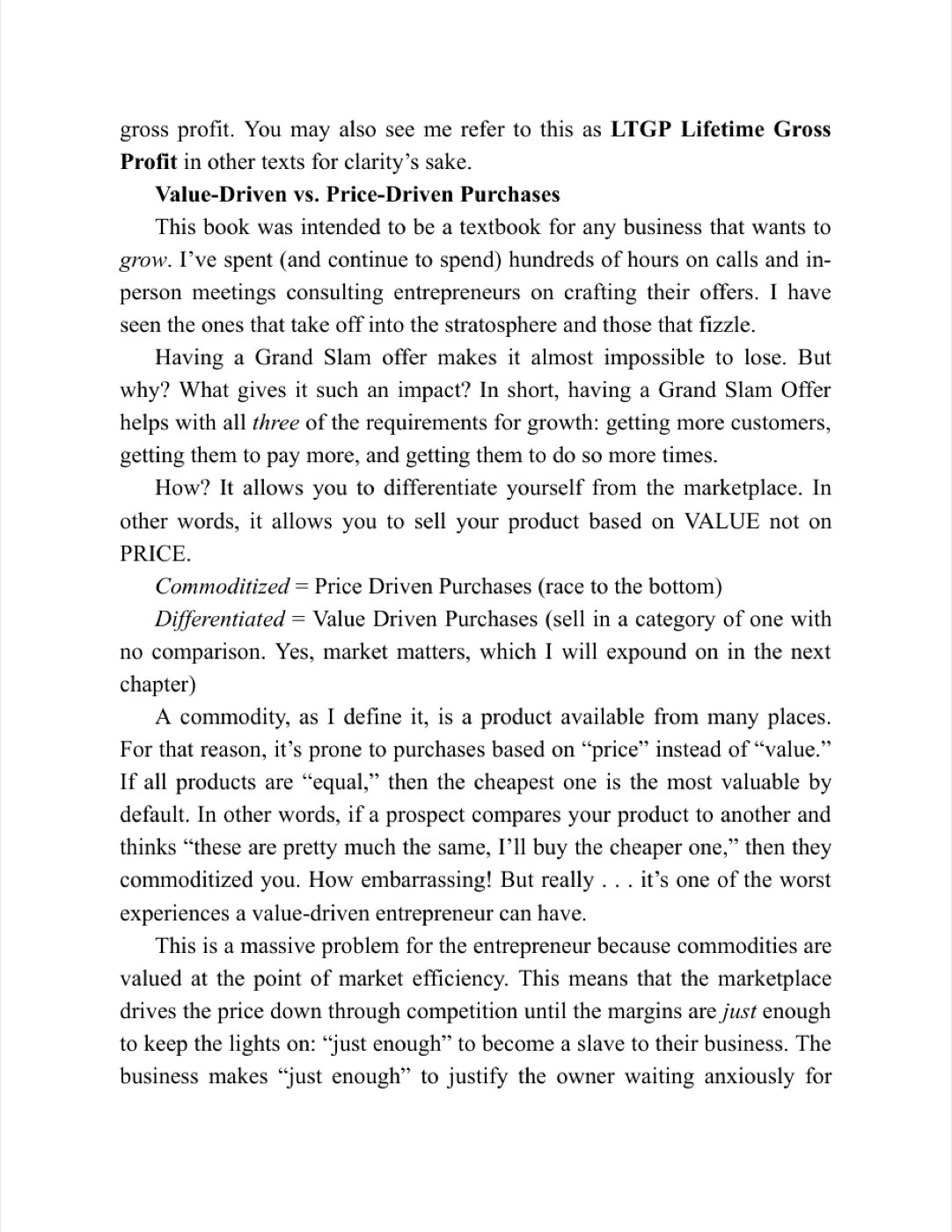
Figure: educational illustration introducing Grand Slam Offers from $100M Offers.
1.1 Commodity vs Grand Slam
| Dimension | Commodity offer | Grand Slam Offer |
|---|---|---|
| Comparison | Easy to price-shop | Hard to compare apples-to-apples |
| Purchase driver | Price | Value / risk-adjusted outcome |
| Response to ads | Low CTR / low close | Higher response at higher price |
| Fulfilment identity | “Hours / features” | “Outcome + stack + guarantee” |
A Grand Slam Offer is not “charge more.” It is charge more while increasing the buyer’s reason to say yes—through differentiation, packaging, guarantee and payment terms.
1.2 The before/after money math
Hormozi’s gym software example (illustrative): move from undifferentiated SaaS fees to a pay-for-performance style Grand Slam framing—pay once, no retainer, pay if people show up, guarantee first-cohort attendance. Same underlying capability; radically different commercial story and margin structure.
Negative case: Raising price 3× on the same undifferentiated “AI advisory days” without changing value drivers. Close rate collapses; team concludes “market won’t pay,” when the market correctly refused a commodity.
1.3 Why Grand Slam Offers win acquisition
- Higher response rates to the same media spend
- Higher prices and margins (room to acquire)
- Less price negotiation theatre
- Clearer sales narrative (outcome + proof + risk reversal)
2. The starving crowd — market before offer
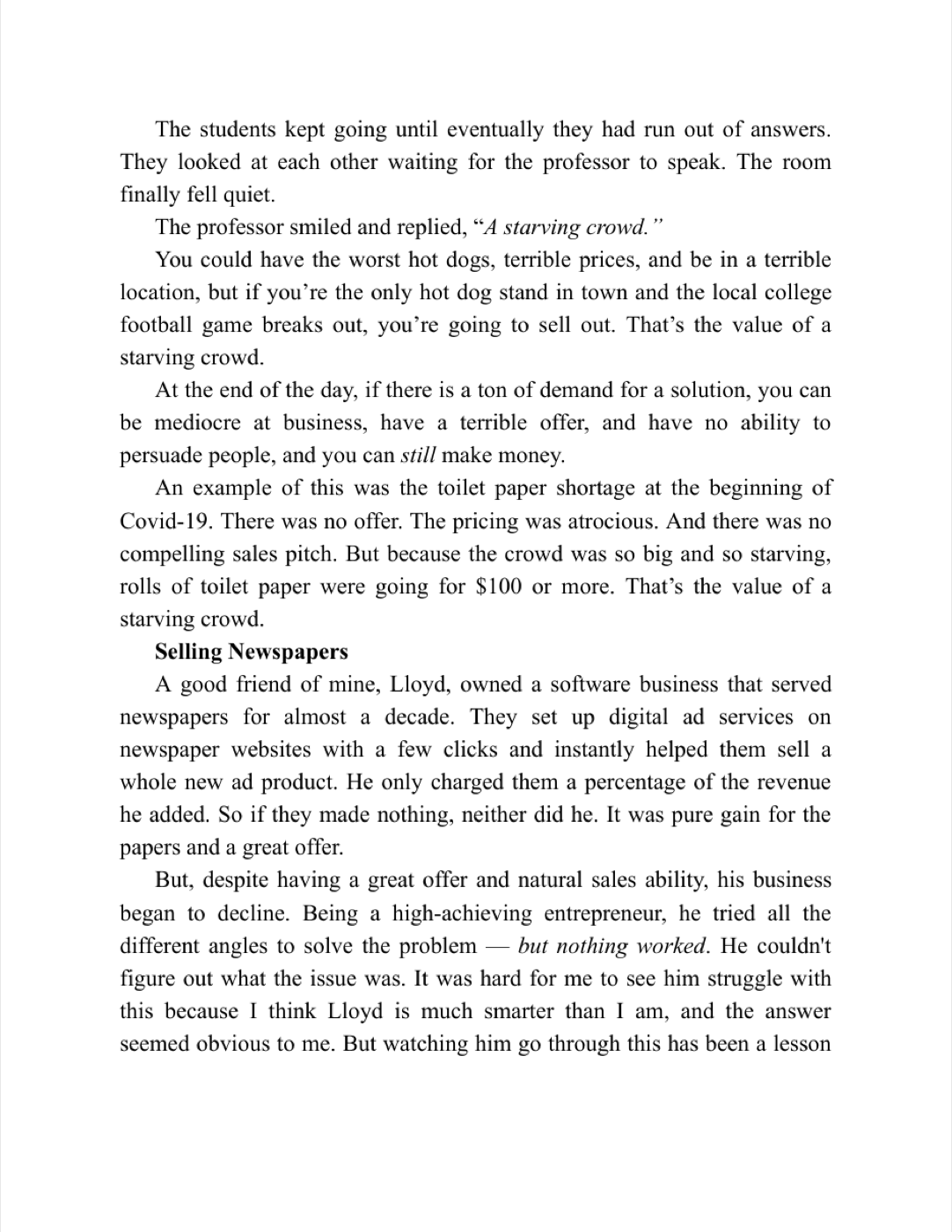
Figure: educational page on market selection and the starving crowd.
2.1 The hierarchy that breaks egos
Hormozi’s ordering:
Starving Crowd (market) > Offer Strength > Persuasion Skills
A mediocre offer in a desperate market beats a clever offer in a satiated one. Persuasion skills matter least when the first two are strong—and matter most when you wrongly try to compensate for a dead market.
2.2 What makes a market “starving”
| Signal | Strong market | Weak market |
|---|---|---|
| Pain urgency | Acute, time-bound | Vague aspiration |
| Purchasing power | Can pay premium | Wants discounts by default |
| Ease of targeting | Clear channels / avatars | “Everyone” |
| Growth / need | Expanding need | Shrinking or trendy noise |
Consulting translation: “All banks need GenAI” is not a starving crowd. “Claims ops leaders missing statutory SLAs with rising adjuster attrition” is closer.
2.3 Avatar ruthlessness
If you cannot describe who is not for the offer, you will attract tyre-kickers and train your sales team to discount.
3. Pricing — charge what it is worth
3.1 Abandon “fair”
Hormozi’s provocation: successful products create a large gap between fulfilment cost and price while remaining a steal relative to value received. “Fair cost-plus” thinking caps upside and invites commoditisation.
3.2 Price as a value signal
Underpricing can reduce perceived likelihood of achievement (“if it is cheap, it probably does not work”). Premium pricing, paired with proof and guarantees, can increase conversion for outcome-seeking buyers.
3.3 Practical pricing tests
| Test | Question |
|---|---|
| Outcome multiple | Is price a small fraction of quantified dream outcome? |
| Alternative cost | Cheaper than DIY time, agency, or failure cost? |
| Sales friction | Are you discounting to close, or clarifying value? |
| Fulfilment margin | Can you still deliver delight at this price? |
Negative case: Winning a pursuit by undercutting day rates, then discovering delivery cannot fund senior review—quality collapses and referrals die.
4. The Value Equation
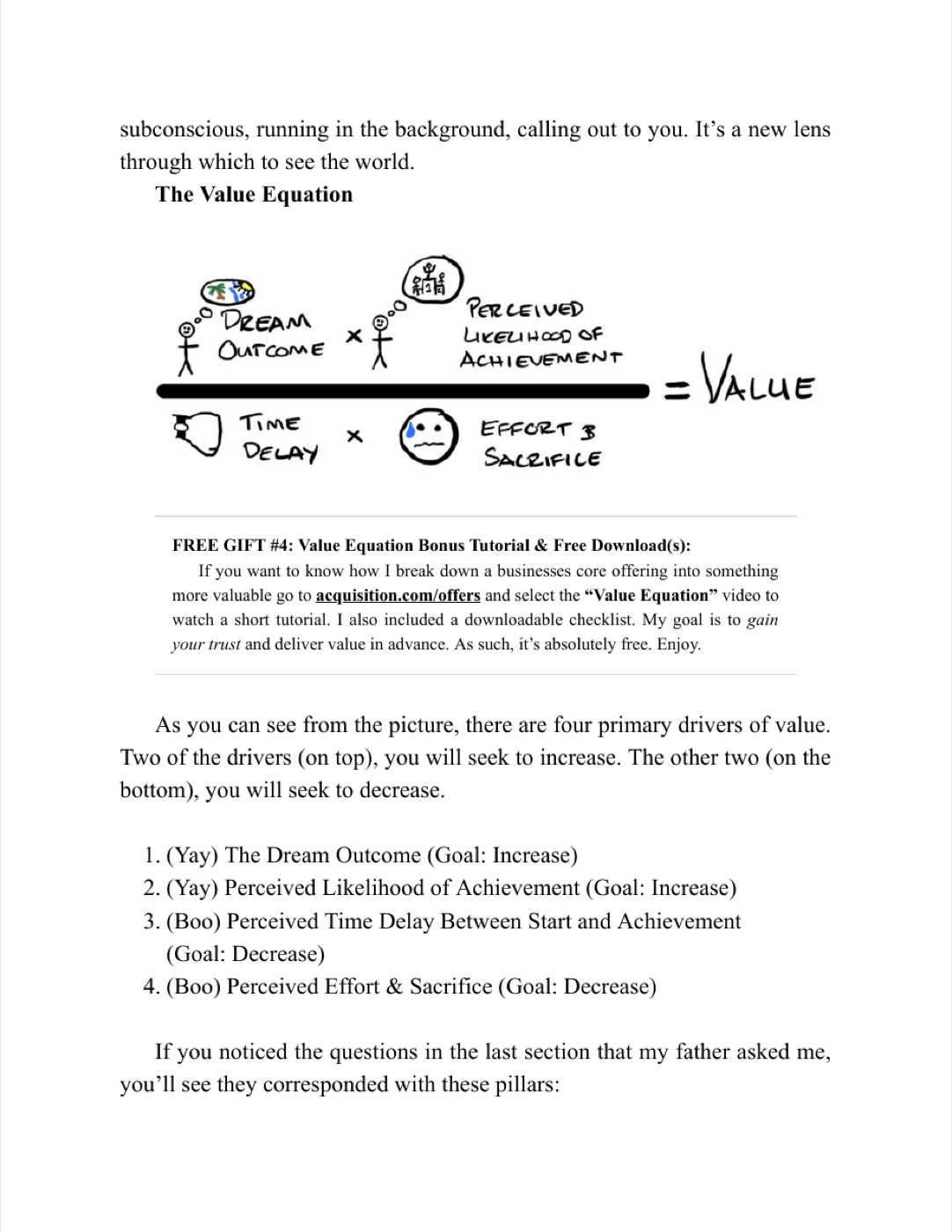
Figure: Hormozi’s Value Equation—increase the top, decrease the bottom.
4.1 The formula
Value ≈ (Dream Outcome × Perceived Likelihood of Achievement) ÷ (Time Delay × Effort & Sacrifice)
| Driver | Goal | Levers |
|---|---|---|
| Dream Outcome | ↑ | Status-linked outcomes; specific tangible results |
| Perceived Likelihood | ↑ | Proof, track record, demos, guarantees, case studies |
| Time Delay | ↓ | Fast wins; shorter path to first value |
| Effort & Sacrifice | ↓ | Done-for-you, templates, concierge, remove homework |
Division matters rhetorically: if the denominator approaches zero (immediate, effortless realisation), value becomes “infinite” in the buyer’s felt experience.
4.2 Perception is the product
The London Underground example: rider satisfaction jumped more from knowing when the next train arrives than from making trains faster. Psychological solutions often beat expensive logical ones.
4.3 Fast beats free
Speed can defeat free alternatives. If you compete with free internal tools or open-source, compete on time-to-value, not feature parity.
4.4 Fast wins keep people long enough to get the dream
Buyers purchase the long-term dream; they stay for short-term reinforcement. Design a visible win in days, not quarters.
AI consulting example:
| Driver | Weak packaging | Strong packaging |
|---|---|---|
| Dream | “GenAI transformation” | “Cut Tier-1 handle time 25% on top 3 intents” |
| Likelihood | Logo slide | Named insurer pilot + eval harness metrics |
| Delay | “Phase 1 in Q3” | Live shadow mode in 14 days |
| Effort | Client supplies all data engineering | Joint data sprint + playbooks + office hours |
5. Creating the Grand Slam Offer — problems, solutions, trim & stack
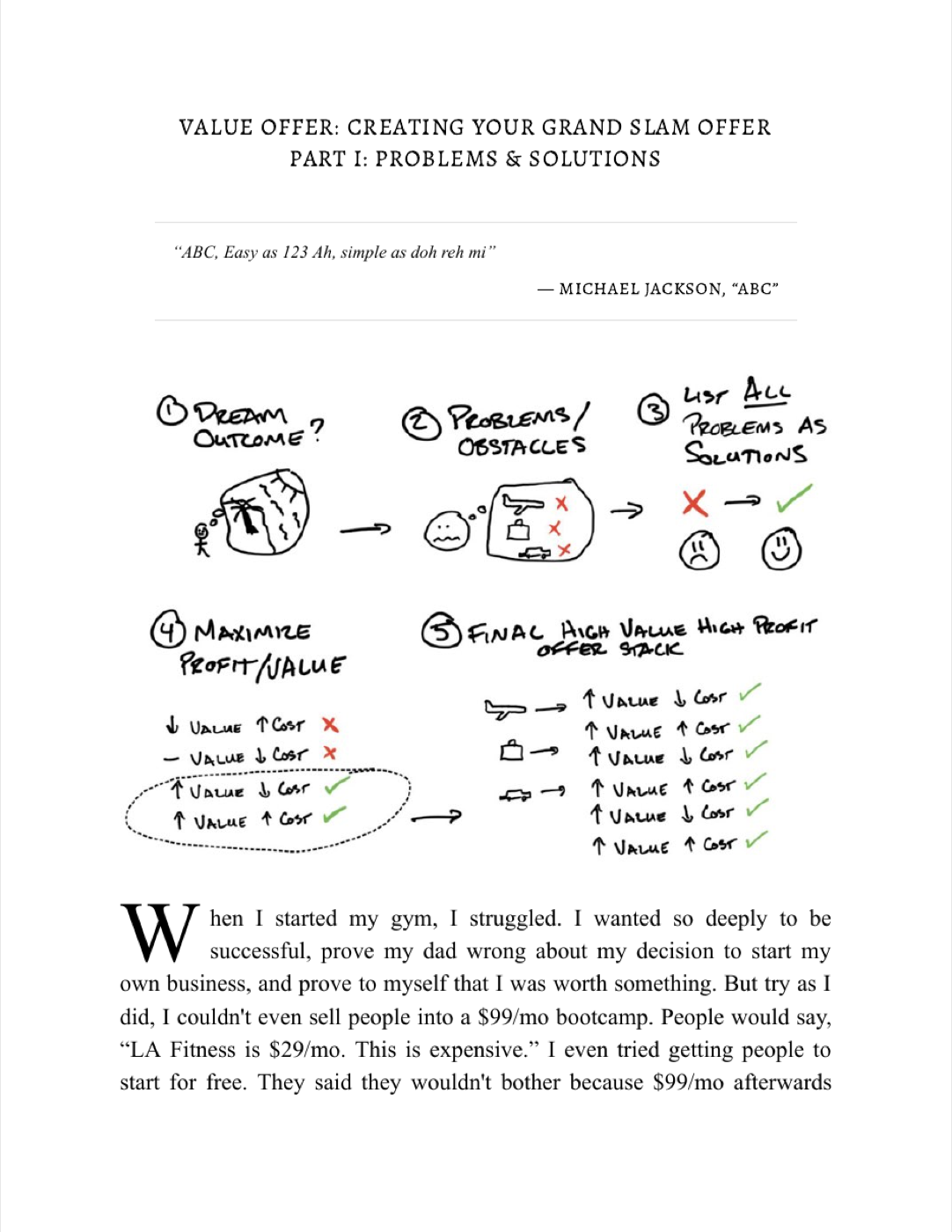
Figure: educational page on problem/solution offer construction.
5.1 Part I — Problems & solutions
Process (compressed):
- List every problem the avatar hits on the journey to the dream outcome.
- Translate each problem into a solution vehicle (product, service, asset, access).
- Do not start from your existing SKU list—start from their friction list.
5.2 Part II — Trim & stack
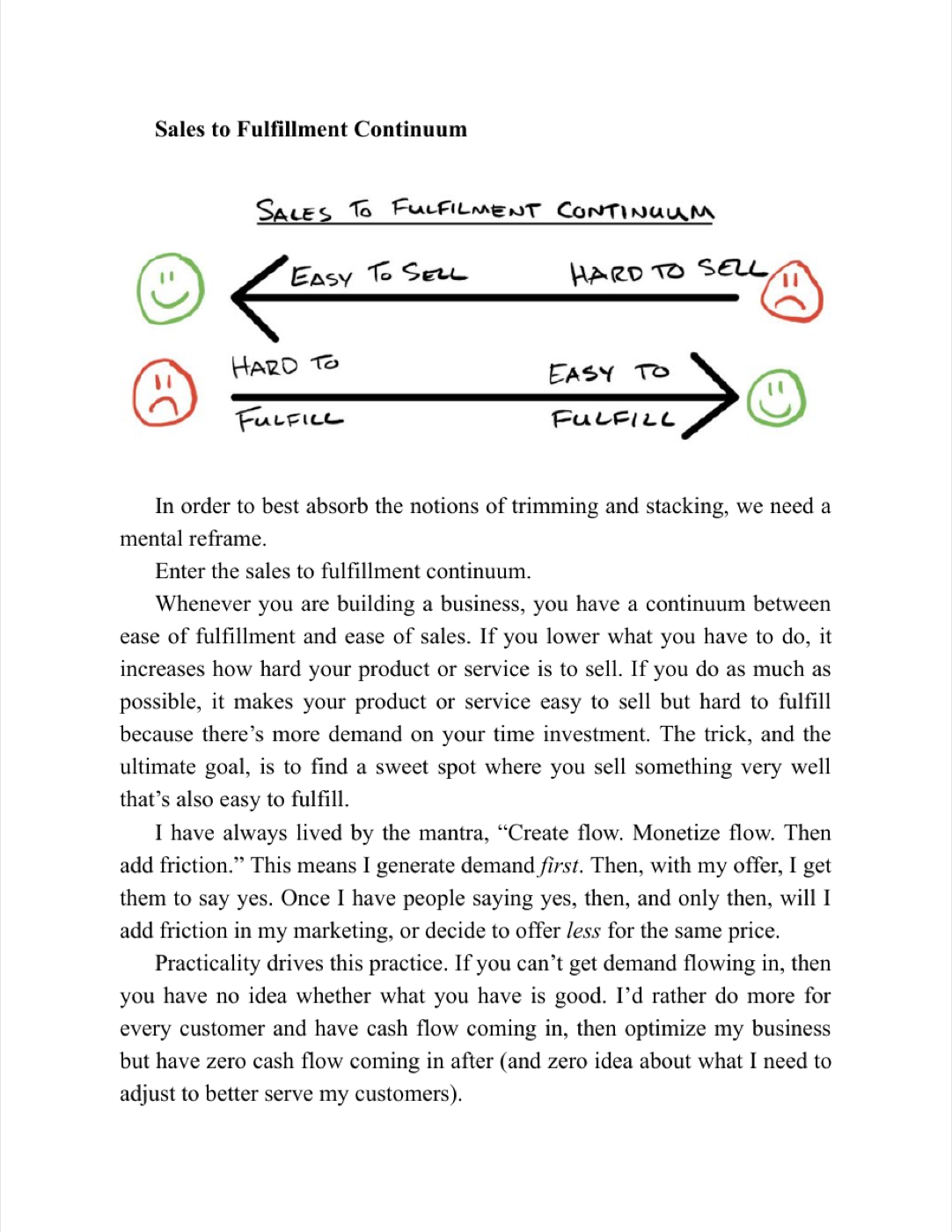
Figure: Sales-to-Fulfilment continuum—easy to sell vs easy to fulfil.
Continuum insight: Maximise ease of sale and you often maximise fulfilment burden. Maximise ease of fulfilment and you often make sales harder. The craft is finding a sweet spot you can deliver profitably.
Hormozi’s sequencing mantra:
Create flow. Monetise flow. Then add friction.
Prove people will buy a high-touch, high-value version before you strip delivery to scale.
| Stage | Action | Risk if skipped |
|---|---|---|
| Create flow | Over-deliver to get yeses | Optimising a product nobody buys |
| Monetise flow | Capture cash at premium | Building audience without revenue |
| Add friction | Remove costly extras later | Scaling unprofitable heroics forever |
5.3 Stack presentation
Present the core offer, then layer bonuses so the bonus stack appears to eclipse the core price—while the core remains the real engine of results.
6. Enhancing the offer
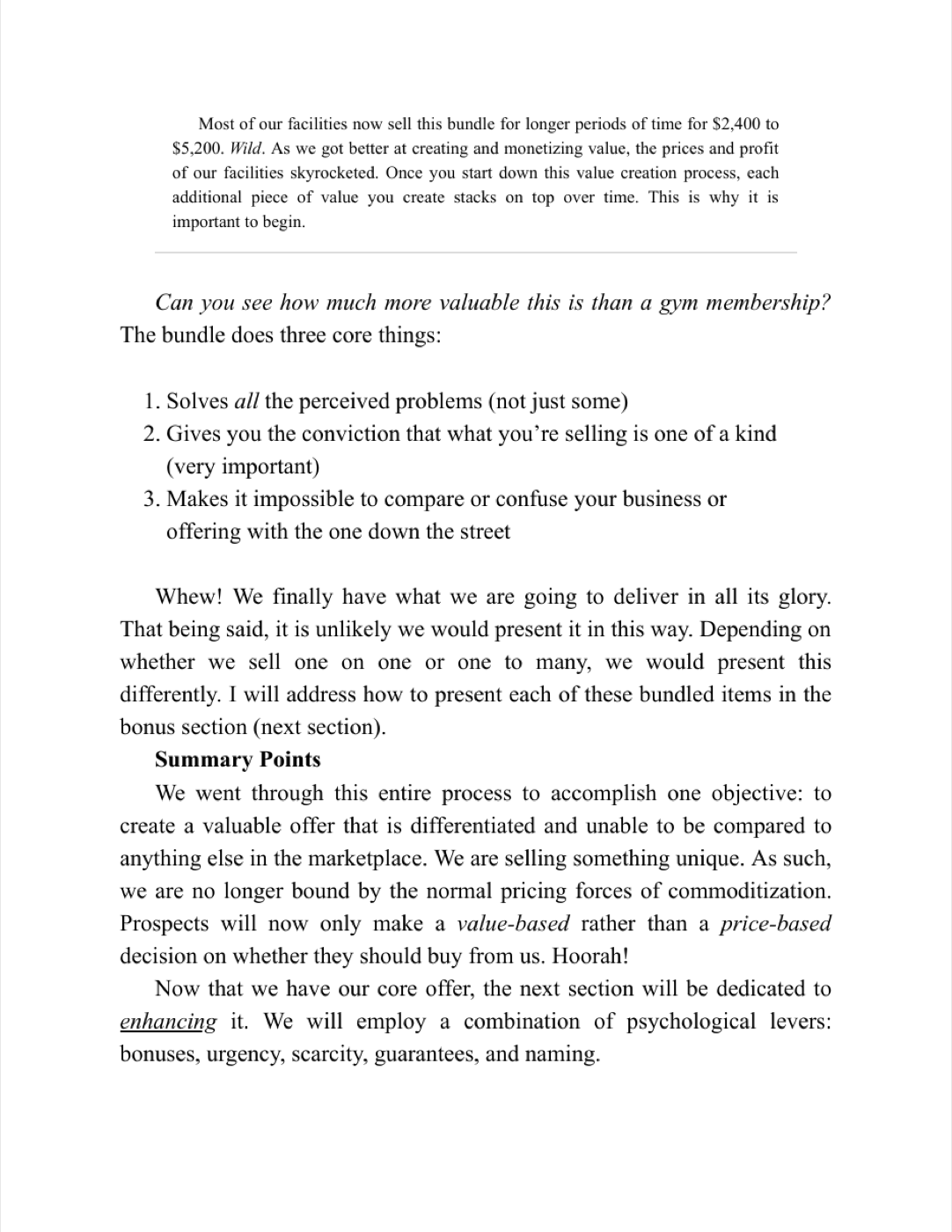
Figure: overview of scarcity, urgency, bonuses, guarantees and naming.
Enhancers multiply demand after the core value is real. Using them on a weak offer is decoration on a commodity.
6.1 Scarcity
Figure: educational page on scarcity mechanics.
| Type | Example | Honesty requirement |
|---|---|---|
| Limited supply | Cohort caps, seat limits | Real capacity constraints |
| Limited bonuses | Only N onboarding intensives | Truly limited |
| Implied demand | Waitlists, application filters | Not fake counters |
Negative case: Fake “only 2 seats left” timers. Destroys trust; kills referrals.
6.2 Urgency
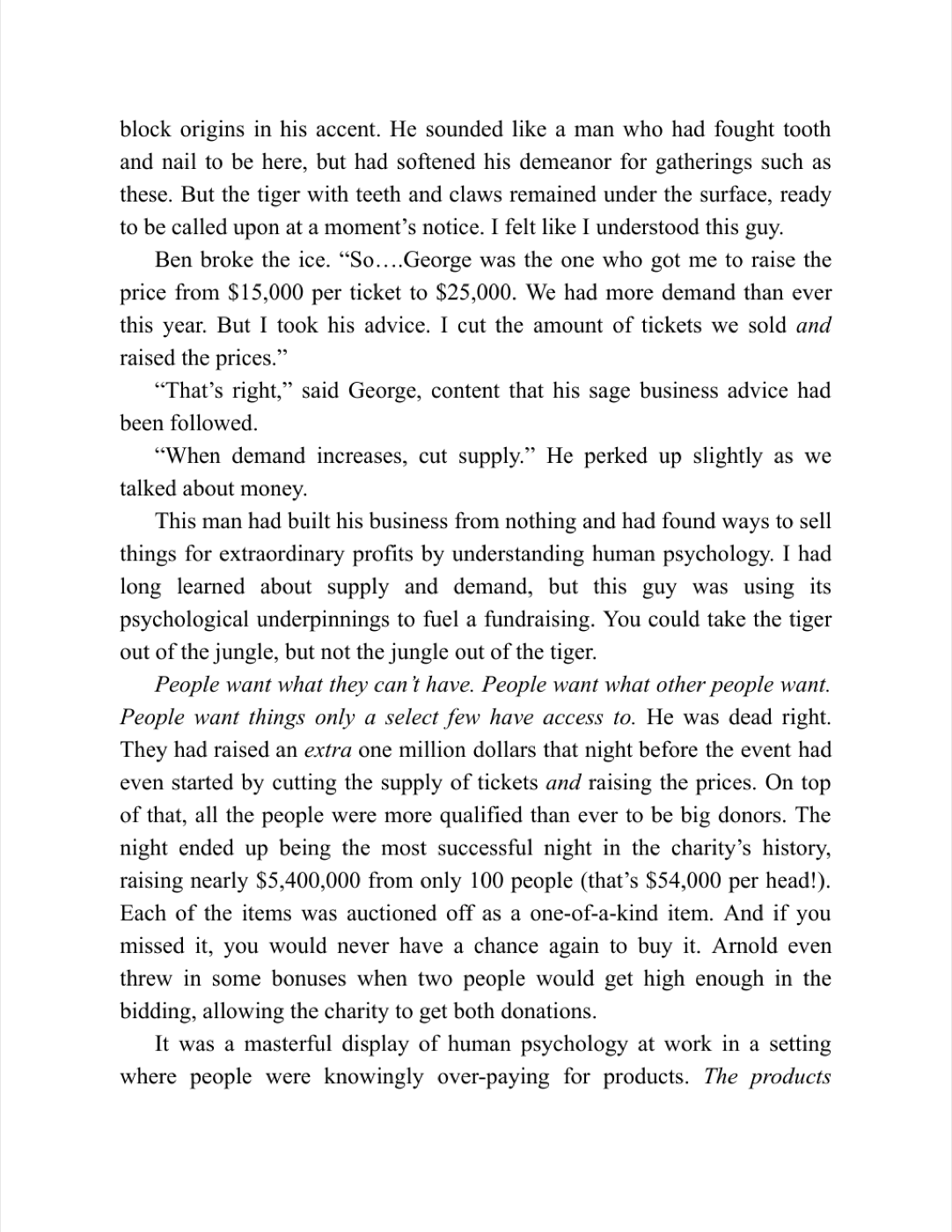
Figure: educational page on urgency mechanics.
Urgency is time-based action pressure: cohort start dates, seasonal deadlines, expiring bonuses. Honest urgency aligns with real calendars (regulatory deadlines, board dates, budget cycles).
6.3 Bonuses
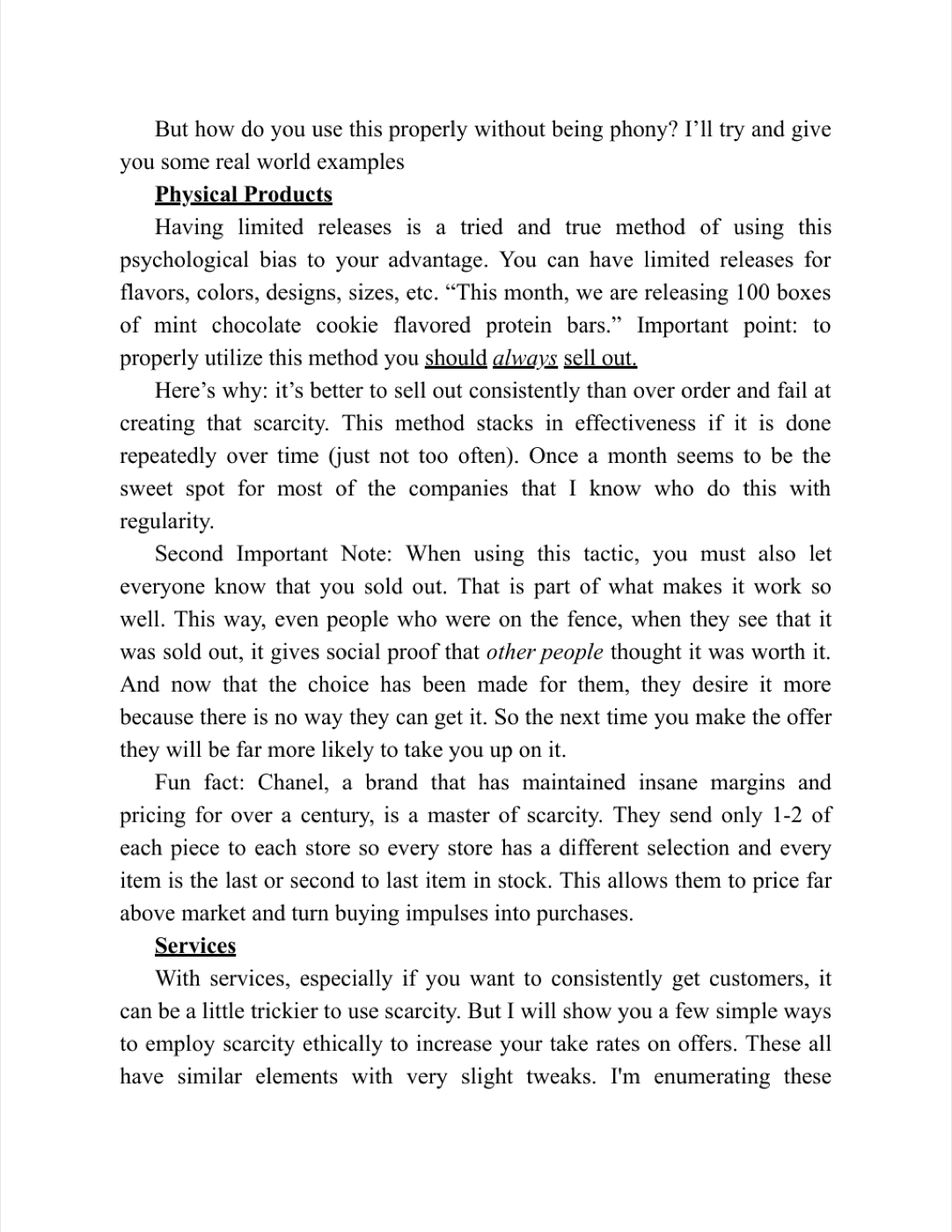
Figure: educational page on bonus design and stacking.
Bonus rules of thumb from the book’s practice:
- Match bonuses to specific objections (“I’m worried about implementation” → implementation bonus).
- Name and price bonuses distinctly.
- Bonus value should appear to eclipse the core price.
- Add scarcity/urgency to bonuses themselves when true.
- In 1:1 sales, reveal bonuses after commitment to create a wow—or use objection-matched bonuses before the ask.
6.4 Guarantees
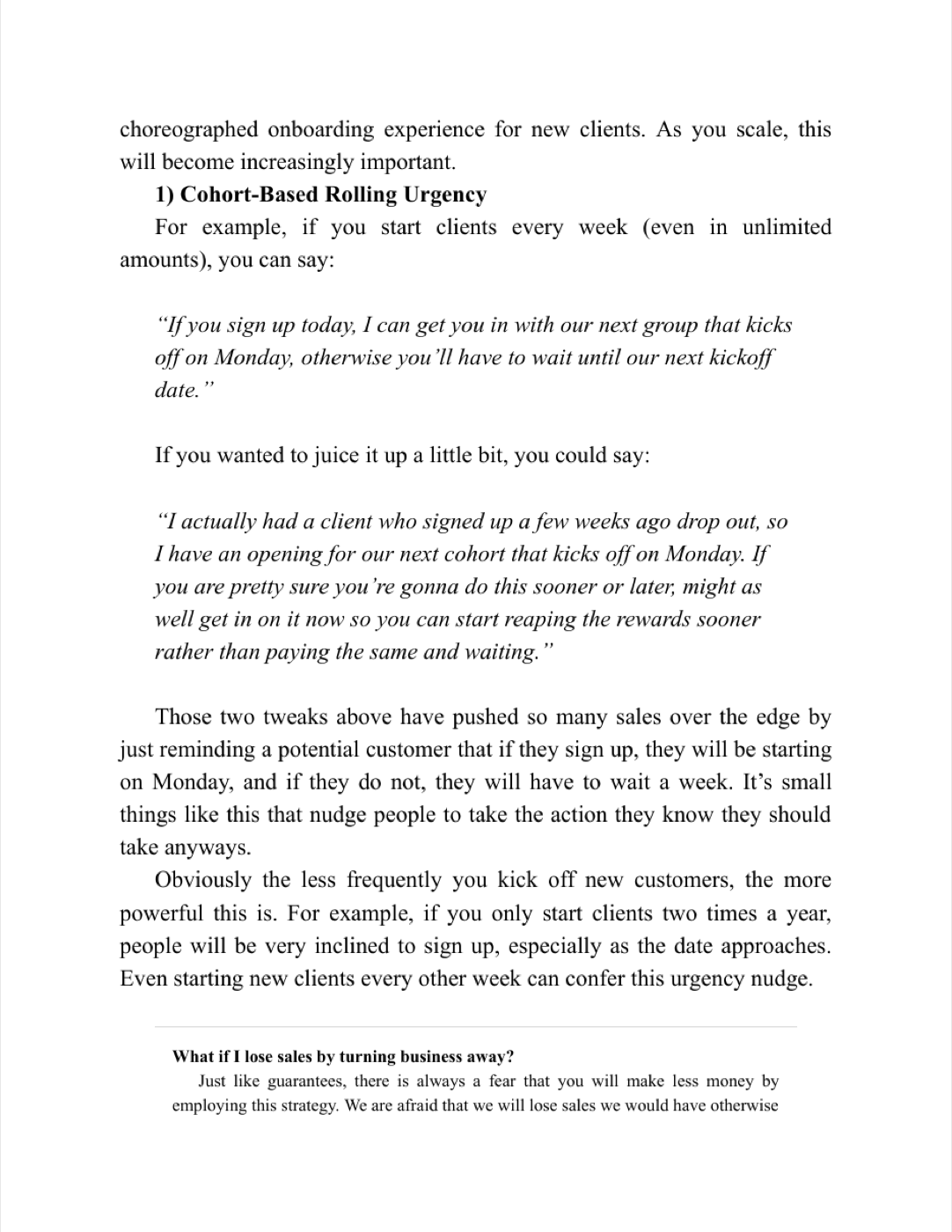
Figure: educational introduction to guarantee design.
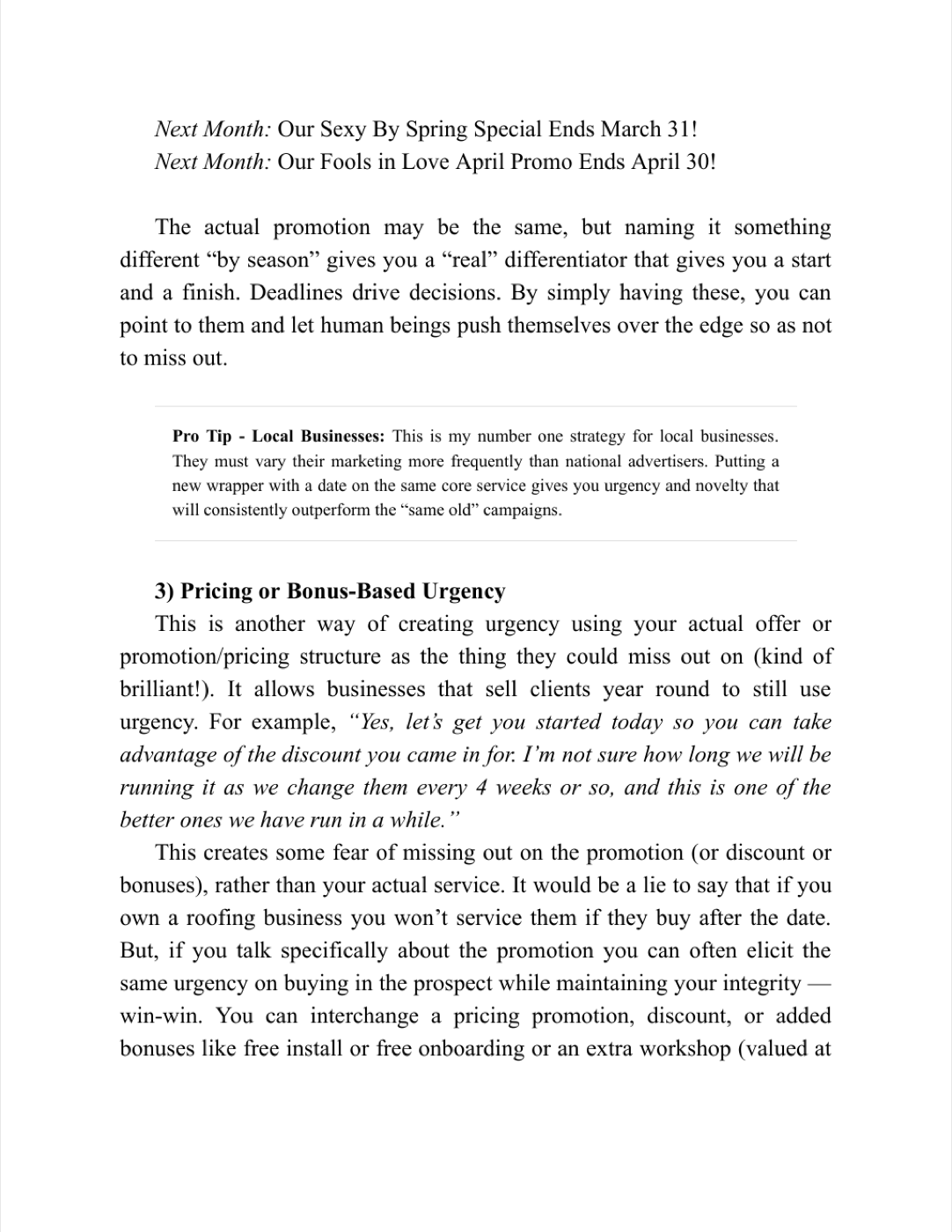
Figure: educational page expanding guarantee structures.
| Style | Idea | When it fits |
|---|---|---|
| Unconditional | Money-back for any reason in window | High trust products; low abuse risk |
| Conditional | “Do the work, get the result or…” | High-touch programmes with compliance |
| Anti-guarantee | All sales final (status / scarcity) | Ultra-premium, application-only |
| Implied | Reputation / brand as safety | Strong brand; still weaker than explicit |
Consulting caution: Outcome guarantees on AI programmes need precise definitions (metric, window, client obligations). Vague “ROI guaranteed” is a legal and delivery trap.
6.5 Naming — the MAGIC formula
Hormozi’s naming components (use 3–5, keep punchy):
| Letter | Component | Role |
|---|---|---|
| M | Magnetic reason why | Why this promotion exists now |
| A | Avatar | Who it is for (hyper-specific) |
| G | Goal | Dream outcome in plain language |
| I | Interval | Timeframe to result (compliance-aware) |
| C | Container | Challenge, Bootcamp, Intensive, System… |
Example shape: “Free 6-Week Claims Copilot Sprint for Mid-Market Insurers” beats “AI Advisory Retainer.”
Rename the wrapper when creative fatigues; keep the underlying stack stable.
7. Consulting and AI offer patterns
| Weak offer | Grand Slam direction |
|---|---|
| “20 days of GenAI consulting” | “90-day Production Copilot: 3 intents live, eval harness, runbook, 30-day hypercare” |
| “RAG workshop” | “From pilot purgatory to audit-ready answers in 6 weeks—or we extend hypercare free” |
| “Strategy deck” | “Board-ready VALUE case + bid/no-bid memo in 10 business days” |
Stack with Obviously Awesome so the category makes the value obvious, and SPIN Selling so discovery produces explicit needs the offer maps to.
8. Failure modes
| Failure | Symptom | Fix |
|---|---|---|
| Great ads, weak offer | Clicks, no closes | Rebuild Value Equation |
| Wrong market | Endless education | Find starving crowd |
| Enhancer theatre | Fake urgency | Honest constraints only |
| Over-trim too early | Easy to fulfil, impossible to sell | Create flow first |
| Guarantee vagueness | Disputes | Metric + obligations + window |
| Feature naming | Sounds like everyone | MAGIC rename |
9. Practitioner checklist — Grand Slam Offer one-pager
- Avatar named; exclusions clear
- Dream outcome in buyer language (status-aware)
- Proof assets for likelihood (cases, metrics, demos)
- Time-to-first-win < 14 days where possible
- Effort removed listed (what you do vs client)
- Problem→solution map complete; trimmed to profitable stack
- Bonuses mapped to top objections
- Guarantee terms precise
- MAGIC name tested in 5 variants
- Price set from value, not cost-plus alone
10. Capstone — rewrite one live offer
Take one live SKU and rewrite:
- Market one-liner (starving crowd)
- Value Equation scores (1–10) before/after redesign
- Stack (core + 3 bonuses)
- Guarantee paragraph
- MAGIC name A/B
- Sales script bridge from SPIN explicit needs → offer
11. Worked example — AI claims copilot package
| Element | Draft |
|---|---|
| Avatar | Mid-market P&C claims ops leaders (100–800 adjusters) |
| Starving problem | Cycle time + leakage while hiring freeze blocks headcount |
| Dream outcome | 20% faster straight-through on top 5 FNOL intents without increasing leakage |
| Likelihood proof | 6-week shadow-mode pilot metrics + named reference |
| Time delay | Shadow answers in week 2; production intents by week 6 |
| Effort removed | We bring prompts, eval harness, policy chunking playbook; client provides SME hours |
| Core stack | Discovery workshop · data readiness sprint · 5-intent build · eval gate · hypercare |
| Bonuses | CISO questionnaire pack · adjuster change kit · weekly office hours (30 days) |
| Guarantee | If eval gate metrics miss agreed thresholds after client obligations met, we extend hypercare 30 days at no fee |
| MAGIC name | “6-Week Claims Copilot Sprint for Mid-Market P&C Insurers” |
| Price logic | Fraction of leakage + overtime cost over 12 months |
SPIN bridge: Implication questions quantify leakage and overtime; Need-payoff gets the economic buyer to say the outcome in their words; the Grand Slam name and stack mirror those words in the proposal governing thought (Minto).
12. Offer fatigue and creative refresh
Local and niche markets fatigue faster because you can reach the addressable audience cheaply. Hormozi’s fix is usually wrapper refresh, not tearing down the stack:
| Keep | Change |
|---|---|
| Fulfilment stack | Hooks, stories, creative |
| Core promise | MAGIC name components |
| Proof assets | Angle (season, regulation, event) |
Negative case: Rebuilding the entire delivery model every quarter because ads stopped converting—when only the creative and call-outs were tired.
13. Virtual vs physical products — Value Equation emphasis
| Offer type | Often over-indexes on… | Often under-invests in… |
|---|---|---|
| Coaching / consulting | Dream outcome claims | Effort removal and fast wins |
| Software | Features (false likelihood) | Time-to-first-value |
| Done-for-you services | Speed | Proof and guarantee clarity |
| Info products | Dream outcome | Perceived likelihood (proof) |
Apple / Amazon / Netflix-style winners obsess over the denominator—make it immediate and effortless—after the dream is clear.
14. Pricing conversation scripts (ethical)
| Buyer line | Weak response | Stronger response |
|---|---|---|
| “Can you do it cheaper?” | Immediate discount | “Which outcome should we remove to hit that number?” |
| “Competitor is half” | Feature war | “Are you comparing the same stack, proof and risk reversal?” |
| “We need to think” | Fake urgency | Honest cohort date + offer to answer one unresolved risk |
Enhancers support truth; they do not replace discovery.
15. Ninety-day offer upgrade programme
| Month | Focus | Artefact |
|---|---|---|
| 1 | Avatar + Value Equation baseline | One-pager scores |
| 2 | Problem→solution→stack + guarantee | Sales deck v2 |
| 3 | MAGIC names + creative tests | 5 name variants live |
KPI: close rate × average price (revenue per qualified conversation), not vanity demo count.
16. Cross-stack map
| Job | Book |
|---|---|
| Category context | Obviously Awesome |
| Beachhead & persona | Disciplined Entrepreneurship |
| Discovery questions | SPIN Selling |
| Lead channels | $100M Leads |
| Sales org scale | Sales Acceleration Formula |
Discussion
Comments
Share feedback or questions about this page. No account required.
Loading comments…